
AdS5 × T¹,¹ and the Klebanov–Witten theory
The Klebanov–Witten duality relates type IIB string theory on to a four-dimensional superconformal gauge theory. Its most direct spectral test matches the meson operators to coupled metric and five-form modes with dimensions
Obtaining this result requires more than finding an internal Laplacian eigenvalue. One must identify which ten-dimensional fields fluctuate, diagonalize their coupled equations, and choose the AdS boundary condition. For , the required dimension comes from alternate quantization. We will derive this match, then compare the conformal anomalies and baryon dimensions. These are specific tests of the duality, rather than a calculation of its complete string spectrum.
The conifold and its Einstein link
Section titled “The conifold and its Einstein link”The conifold is a complex three-dimensional hypersurface. After a linear change of its four complex coordinates, its equation is
Equivalently, it can be written as . The origin is singular; away from it the conifold admits a Ricci-flat Kähler metric with cone form
Here is the metric radius. It is proportional to , not the ordinary Euclidean norm of the algebraic coordinates. Indeed, the conifold Kähler potential is proportional to . Under , lengths therefore scale by . Exercise 1 connects this homogeneity directly to scalar harmonics.
The link at fixed radius is
Its standard dimensionless metric is
with , , and . Coordinate patches are needed at the poles of the two spheres. The apparent singularities there are coordinate singularities of the bundle description.
The two pairs describe a base . The remaining coordinate parametrizes a circle fiber. To see its normalization, put , which has period . The circle connection is
where each sphere has orientation . Thus the circle is twisted over both factors. The total space is topologically , although the displayed Einstein metric is not a product metric.
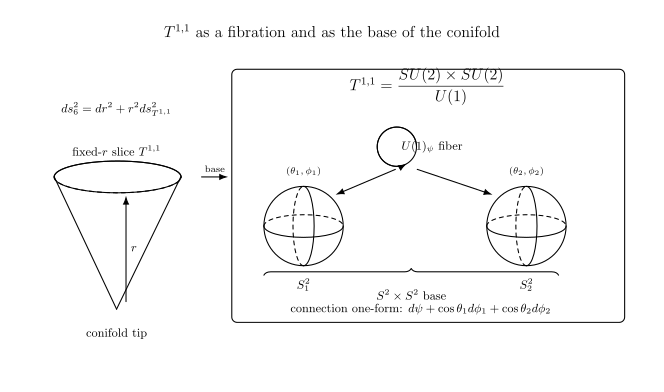
The cone radius and the circle-bundle projection describe different structures. Each fixed- slice is ; its circle projects to a point of . The fiber coordinate has period , or has period . This is a schematic diagram, not an isometric embedding.
Curvature and volume normalization
Section titled “Curvature and volume normalization”An orthonormal coframe is
The metric has . One way to check the factor four is to treat it as a circle bundle with fiber coefficient and two equal sphere coefficients . The curvature of is minus the sum of the two unit-sphere area forms. The horizontal and vertical Ricci eigenvalues are respectively
This positive Ricci tensor of the link is consistent with the Ricci-flat cone: for a five-dimensional link, the cone’s angular Ricci tensor is .
The coframe also fixes the volume element and total volume:
Both sphere integrals contribute , and the integral contributes . Replacing the fiber period by would halve the volume and change the space.
The conifold geometry and its quotient description were used by Klebanov and Witten, sections 2–3. A cone with full holonomy supplies the supersymmetry appropriate to this example. The D3-brane projection leaves four Poincaré supercharges; in the conformal near-horizon theory there are also four superconformal supercharges. This is less supersymmetry than the spherical example, whose spin cover is .
D3-branes at the conifold tip
Section titled “D3-branes at the conifold tip”Place coincident D3-branes at the tip. The harmonic function and metric take the form
Use the shared D-brane normalization and the oriented positive-D3 flux. With constant dilaton and vanishing two-forms, the internal five-form and its charge integral are
The two signs are linked by the shared orientation. Substitution gives
Dropping the constant term in in the decoupling limit produces
Thus the AdS factor and the Einstein-normalized internal factor have a common radius . The meaning and order of this limit are explained on the decoupling-limit page. Classical type IIB supergravity is controlled when and , hence with weak string coupling. The two-node field theory has two gauge couplings; the spherical single-coupling dictionary should not be copied onto it without further specification.
There is already a normalization test. The inverse-volume result gives, at leading classical order,
At fixed D3 charge, changing the internal volume changes the radius as well as the five-dimensional Newton constant. Accounting for both changes produces this inverse-volume dependence. Exercise 5 compares it with exact field-theory anomalies.
The two-node gauge theory
Section titled “The two-node gauge theory”The interacting conformal theory has gauge group and four chiral multiplets:
| Fields | Gauge representation | Flavor representation |
|---|---|---|
| doublet of | ||
| doublet of |
It is useful to regard as a map and as a map . Then
The continuous flavor and R-symmetry algebra contains . The baryonic symmetry assigns opposite charges to and . It is distinct from the geometric R-symmetry circle. Global quotients of these symmetry groups do not affect the local calculations below.
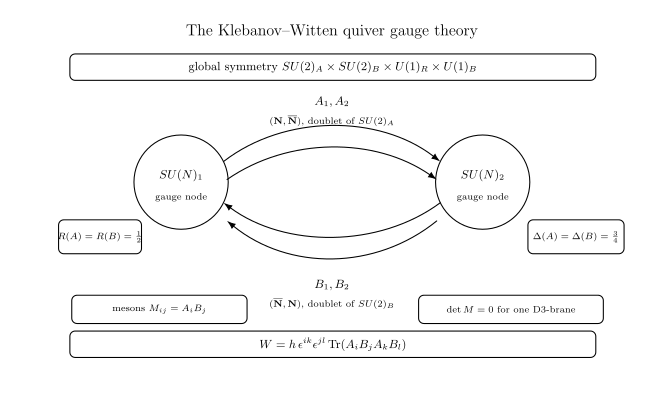
Each arrow is one chiral multiplet. Arrows follow the direction of linear maps: and , giving the matrix transformations above. The two fields and the two fields form separate flavor doublets. This is a representation diagram, not a diagram of particle motion.
The superpotential and its F terms
Section titled “The superpotential and its F terms”The flavor-invariant quartic interaction can be written as
Equivalently, with , it is . The factor compensates the two copies produced by cyclicity of the trace.
Varying a matrix inside a trace brings its variation to the front. For example,
The four variations therefore give
These are matrix equations; one must preserve the order of factors. They will allow adjacent flavor labels to be exchanged in chiral operators.
Why the quartic interaction belongs to an interacting fixed point
Section titled “Why the quartic interaction belongs to an interacting fixed point”At the Klebanov–Witten fixed point, the chiral multiplets have superconformal R charges
Their Weyl fermions have charge , while each gaugino has charge . For either gauge node, the mixed gauge–R anomaly vanishes:
The factor multiplying each fundamental index comes from the other gauge node. This is consistent with the superconformal relation between a chiral field’s scaling weight and its R charge, which gives for and . These gauge-covariant elementary fields are not gauge-invariant local operators; the scalar unitarity bound is applied to the latter.
The same fixed-point condition appears in the gauge beta functions. If is defined by the elementary scaling weight , the symmetric matter assignment gives the NSVZ numerator
Its vanishing requires . The quartic chiral operator then has dimension three and R charge two, so it can appear in a marginal superpotential. At the free fixed point its engineering dimension would instead be four. The existence and exactly marginal deformations of the interacting theory use the additional fixed-point argument of Klebanov and Witten, section 3; an R-charge assignment alone is not a proof of exact marginality.
One probe brane and the conifold quotient
Section titled “One probe brane and the conifold quotient”The one-brane geometric construction starts with . The diagonal combination acts trivially on the matter. The relative acts as
For commuting fields the two terms in cancel, so the F terms vanish automatically. At zero Fayet–Iliopoulos parameter, the remaining vacuum condition is
Impose this real equation and divide by the relative phase. Four complex variables lose two real dimensions, leaving a complex threefold. Its invariant coordinates are
Conversely, every nonzero rank-one matrix factors as . Two such factorizations differ by with . If and are nonzero, choosing gives a D-flat representative. The remaining phase is precisely the gauge equivalence. At zero invariants, the D-flat quotient identifies the result with the cone tip.
This proves the one-probe moduli-space statement. It is not a literal version of the interacting conformal theory. For separated branes, the simultaneous diagonal mesonic configurations describe an unordered set of points on the conifold; this does not classify every non-Abelian vacuum or every baryonic branch.
Chiral operators and flavor representations
Section titled “Chiral operators and flavor representations”Consider alternating single-trace operators
The F-term equation exchanges two adjacent A flavor labels across the B field between them. Repeating such exchanges symmetrizes all A labels. The other F-term equation does the same for the B labels, with cyclicity covering the end of the word. This is a relation in the chiral ring, where F-term descendants are set to zero.
The symmetric product of doublets has spin . Thus the surviving flavor representation and protected quantum numbers are
For there are four mesons , each with dimension . Their dimensions are below two but above the four-dimensional scalar unitarity bound of one. The representation at general has components; Exercise 3 recovers this number from the conifold coordinate ring.
A single trace of fixed degree is identified with a one-particle bulk excitation in the usual large- limit. At finite rank, trace relations can relate such operators, and multitraces represent additional states. The formula above specifies a protected family; it is not a claim that infinitely many single traces remain independent at every finite .
Scalar harmonics on T¹,¹
Section titled “Scalar harmonics on T¹,¹”Let a scalar harmonic satisfy
The metric determines the operator. Its horizontal derivatives subtract the connection along the fiber, giving
For fiber dependence , periodicity requires . Each sphere now carries a monopole Laplacian with charge magnitude . If its angular momentum is , its positive eigenvalue is . Combining the two spheres and the fiber gives
The spin representations must contain the relevant monopole weights. Therefore the full scalar selection rule is
Equivalently, , , and have the same parity. For example, obeys the inequalities but is not an allowed scalar harmonic. This selection rule and the spectrum are derived by harmonic analysis in Ceresole et al., sections 2.3–2.4.
For the smallest representation at fixed positive charge, , one obtains
As direct coordinate checks, has , while has . A lowest charged harmonic is proportional to
Its expression is understood in the corresponding sphere-bundle patches.
A harmonic is not yet a mass eigenstate
Section titled “A harmonic is not yet a mass eigenstate”For a minimally coupled massless ten-dimensional scalar, separation of variables gives
For example, the E=12 harmonic gives dimension six in this tower. But chiral mesons do not come from this minimally coupled field. They come from metric and five-form perturbations that source one another. The same internal harmonic can therefore produce different masses in different ten-dimensional field sectors.
The coupled metric and five-form scalars
Section titled “The coupled metric and five-form scalars”We now derive the two mixed masses. The calculation retains the scalar sector generated by a nonconstant harmonic and works to linear order around the product background. The field definitions and reduction equations can be compared with Lee et al., equations (3.4)–(3.14), with the general Einstein-link application explained by Klebanov and Witten, Appendix A.
Trace and five-form amplitudes
Section titled “Trace and five-form amplitudes”Use for the dimensionless internal metric trace. In a scalar gauge with the scalar-generated internal trace-free metric deformation and mixed metric components removed, write
If is the trace of in the unit AdS metric, the external trace amplitude is . Define the four-form amplitude by
Here is the star for the unit five-dimensional link metric. The minus sign matches the internal background flux already specified above; this is an amplitude definition within the calculation. Since , no WZ-to-bulk four-form shift is involved.
The trace-free internal Einstein equation is proportional to
For a nondegenerate harmonic it therefore fixes
Exercise 4 derives why every nonconstant scalar harmonic on is nondegenerate in this sense. The remaining constraint equations determine accompanying external metric components; they do not supply another independent scalar in this sector.
Two linearized equations
Section titled “Two linearized equations”Put temporarily. Since , the internal four-form ansatz gives
Thus the internal flux amplitude changes by the relative amount against its background value . Self-duality also changes the external volume factor by . Combining it with the five-form Bianchi identity yields
The factor restores the physical AdS radius in the dimensionless reduction equation.
The trace of the internal Einstein equation supplies the other equation. Its linearized Ricci trace is
The five-form stress has two field-strength factors and four raised internal indices. Its trace variation is consequently
The first term comes from varying the two flux amplitudes; the second comes from the four inverse metrics. Equating the two traces and using gives the coupled system
This establishes the scalar mass problem from the trace and self-duality equations. It does not require treating the unconstrained ten-dimensional metric and four-form components as independent physical scalars.
Diagonalization and the constant harmonic
Section titled “Diagonalization and the constant harmonic”A mass eigenmode obeys . Its amplitudes are eigenvectors of
The characteristic equation can be completed to a square:
Hence
For instance, eigenvectors may be chosen proportional to . The nonsymmetric appearance of the matrix reflects the amplitude normalization, not complex masses: for , replacing by makes the off-diagonal entries equal to .
One must not extend this two-field argument blindly to . The constant harmonic has , so the four-form amplitude in this ansatz vanishes identically. There is no lower mass-zero scalar from mixing two such fields. With the flux fixed, the displayed internal trace equation reduces directly to . This does not use the trace-free constraint, which is degenerate at . The uniform breathing mode therefore has
Constant dilaton and axion modes, with mass zero and ordinary dimension four, belong to different ten-dimensional fields. They are not the missing lower branch, and the identity operator is not a new propagating bulk scalar obtained from it.
The lowest meson requires alternate quantization
Section titled “The lowest meson requires alternate quantization”The lower mass can also be written as
It is never below the BF mass . The standard dimension is
The absolute value is essential. For a chiral harmonic, put . Then and
The first few cases display the boundary-condition issue:
| Chiral level | Dimension of the meson bottom component | ||
|---|---|---|---|
| alternate | |||
| standard | |||
| standard |
At , the ordinary root is , while the required chiral-primary dimension is . Both radial powers have finite boundary Klein–Gordon norm because . Supersymmetry identifies the bottom component with the alternate choice. Another scalar in the same full supermultiplet has dimension ; selecting the bottom component’s quantization does not forbid that dimension in a different component.
At , . The formal lower dimension one is the endpoint at which the ordinary slower-mode norm diverges logarithmically. It is outside the open alternate window derived on the BF-bound page. The desired meson uses the ordinary dimension three. This reproduces for the entire chiral family with the appropriate choice at its lowest level.
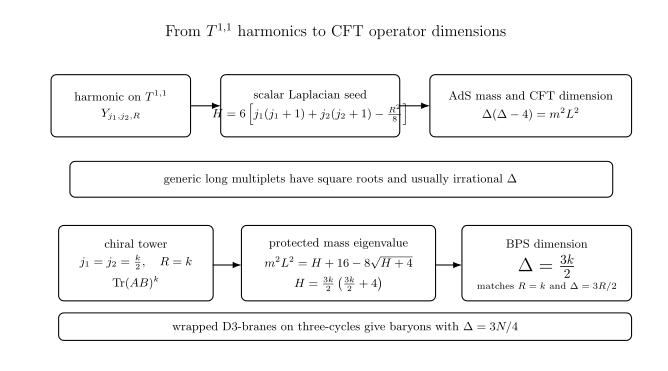
The curve is . It is a continuous guide through a discrete harmonic spectrum. The marked modes have for the first meson, for the second, and for flavor moment maps. The shaded strip is the strict mass window ; its boundaries require separate treatment. Only the lower mixed branch is plotted, not the complete KK spectrum.
Flavor-current multiplets and unprotected modes
Section titled “Flavor-current multiplets and unprotected modes”The allowed harmonics and have . Their lower mixed scalar saturates the BF bound:
On the field-theory side these are the scalar bottom components of flavor-current multiplets. One family is schematically
with its gauge-covariant superspace completion understood. It is a triplet of and a singlet of ; the B family exchanges the two factors. The conserved vector currents are descendants with dimension three. This explains why assigning dimension three to every component of a current multiplet would miss the scalar mass match.
The harmonic instead has . In the lower mixed sector its ordinary dimension is , while a minimally coupled scalar with the same harmonic has dimension . Neither is a chiral operator of positive R charge. More generally, the full KK spectrum contains short, semishort, and long multiplets. Long-multiplet dimensions can be irrational, but some rational values also occur without shortening. A rational square root alone is not a protection argument; see Ceresole et al., section 4.
Wrapped D3-branes and baryon dimensions
Section titled “Wrapped D3-branes and baryon dimensions”The quiver has gauge-invariant operators that use bifundamental fields and two color epsilon tensors. An A-type operator has the form
It has R charge , so its chiral dimension is . A second family uses B fields. These are often called dibaryons, since both gauge-node indices are antisymmetrized. Their dimensions grow with , unlike a fixed-level supergravity fluctuation.
The bulk counterpart is a D3-brane wrapped on a supersymmetric three-cycle of . Fix one point and retain . The induced dimensionless metric is
Its determinant and volume are
The physical volume is . Using the shared tension gives
For a heavy wrapped brane this is the leading semiclassical contribution to its AdS energy and boundary dimension. It agrees with the independent protected R-charge result. We have not used as an exact universal formula for an elementary massive scalar, nor computed quantum corrections to the wrapped-brane action.
The alternative family wraps the cycle with the two spheres exchanged. Its orientation in the remaining sphere is a collective coordinate; quantization reproduces the baryon’s flavor multiplicity, as derived in Exercise 6. This comparison was developed by Gubser and Klebanov, section 2.
Common pitfalls
Section titled “Common pitfalls”Identifying a harmonic with one operator. A harmonic fixes internal quantum numbers. The ten-dimensional field and its coupled equations still determine the AdS mass; the E=12 minimal scalar and flavor moment map illustrate the difference.
Dropping the absolute value in the dimension root. The ordinary root of the lower mixed mass is . The first meson uses a different, allowed boundary quantization to reach dimension .
Applying scalar unitarity to a colored field. The weights of and do not describe gauge-invariant local operators. Their mesons and baryons obey the appropriate bounds.
Equating a classical match with an exact bulk calculation. Protected field-theory dimensions and anomalies can be exact, while the Einstein and heavy-brane computations shown here retain only their controlled classical contributions.
Exercises
Section titled “Exercises”1. Holomorphic functions as cone harmonics
Section titled “1. Holomorphic functions as cone harmonics”Suppose the conifold Kähler potential is homogeneous as . Find the metric homogeneity of a holomorphic polynomial of degree in the . Derive its angular Laplacian eigenvalue without using the monopole spectrum. Explain the error caused by identifying the cone radius with .
Solution
Under , the line element scales by , so lengths and the metric radius scale by . A degree- holomorphic polynomial scales by . Its radial dependence is consequently
For a six-dimensional cone, . Applying the scalar Laplacian to gives
A holomorphic function on a Kähler manifold is harmonic: its mixed holomorphic–antiholomorphic second derivatives vanish. Therefore, away from the cone tip,
This agrees with the angular spectrum. The derivation applies to holomorphic functions on the conifold, so polynomials differing by a multiple of its defining relation represent the same function.
Using the algebraic Euclidean norm as a metric radius would assign and produce . That expression is familiar for degree- harmonic polynomials on a flat six-dimensional cone, but the conifold’s Ricci-flat metric has different coordinate homogeneity.
2. Resolve the one-probe quotient
Section titled “2. Resolve the one-probe quotient”In the auxiliary Abelian probe model, replace the D-flat equation by with . Show that the quotient is smooth near the former tip by constructing two coordinate patches. Identify the exceptional curve and the two line-bundle fibers. What changes at ?
Solution
Since , the two A components cannot vanish simultaneously. On the patch , use the complex gauge action to choose a representative with and introduce invariant coordinates
This holomorphic gauge choice describes the complex quotient. A unique positive real gauge rescaling can subsequently impose the D equation: for nonzero A, the function increases from its lower limit to , so it takes the value exactly once.
On , define
On the overlap,
The coordinates are the usual two patches of . The transition law for each fiber is that of the tautological line bundle : a vector represented as is represented in the other patch as , requiring . Thus the total space is
Setting gives its zero section. The D equation fixes , and quotienting the phase leaves the exceptional sphere. All of this sphere maps to under the map to the singular conifold. As , its size shrinks and the affine quotient recovers the cone tip. For , A and B exchange their roles, giving the other small resolution.
This is a geometric extension of the Abelian probe construction. It does not introduce an FI term for an gauge factor, and it does not by itself determine the full non-Abelian baryonic vacuum structure.
3. Count the one-probe mesonic ring
Section titled “3. Count the one-probe mesonic ring”Give each invariant degree one. Compute the Hilbert series of the coordinate ring with relation , and show that its degree- coefficient agrees with the flavor representation of the chiral mesons. State what this counting does not establish at finite rank.
Solution
Four unrestricted commuting generators have Hilbert series . The determinant is a nonzero quadratic polynomial. Multiplication by it injects the polynomial ring shifted up by two degrees into the original ring, so the quotient has
At degree , the quotient dimension is
where the second term vanishes for . For example, the ten unrestricted quadratic monomials lose one determinant relation, leaving nine.
The factorization gives another explanation. Degree contains commuting A doublets and commuting B doublets. Symmetrizing each set produces spins and dimension . The Hilbert series therefore reproduces the same flavor counting as the F-term construction.
Here counts meson degree, equivalently positive integer R charge, not energy in units of one: the protected dimension is . This is the coordinate ring of one probe. It is not the complete finite- chiral-ring generating function, a multitrace partition function, or proof that every large- single trace remains independent at finite rank.
4. Find the exceptional scalar harmonics
Section titled “4. Find the exceptional scalar harmonics”Let be a normalized scalar harmonic on a compact five-dimensional Einstein space with and . Derive the squared norm of its trace-free Hessian. Use the T¹,¹ selection rules to determine when the trace constraint used in the coupled reduction can fail. Explain why the constant harmonic must be treated separately.
Solution
The integrated Bochner identity gives
Integration by parts gives for . Therefore
Subtracting the trace removes , so
The generic trace constraint is nondegenerate unless or . This also shows that a nonconstant harmonic on such a compact Einstein space cannot have .
On , if , parity requires integer . The smallest nonconstant choice is or and gives . If , the smallest allowed spins are , yielding
Larger spins only increase the eigenvalue. Thus no nonconstant scalar harmonic has , and the trace constraint used in the page is valid for every nonconstant scalar harmonic on this link. In particular, the lowest chiral harmonic is not the exceptional first harmonic that occurs on a round .
For , compactness implies . Consequently and the purported four-form degree of freedom in the ansatz is absent. A formal lower eigenvalue obtained by substituting zero into a generic two-field matrix cannot restore that missing field. The uniform metric breathing mode survives with mass squared and dimension eight. Constant dilaton/axion modes can separately have mass zero and dimension four because they arise from different fields and a different reduction.
5. Finite-N anomalies and a relevant flow
Section titled “5. Finite-N anomalies and a relevant flow”Using the R-anomaly formulas, compute the exact of the Klebanov–Witten SCFT for . Then compare its with the orbifold theory that has two vector multiplets and two bifundamental hypermultiplets. In an description of the latter, each vector supplies a vector and an adjoint chiral multiplet, and each hypermultiplet supplies two chiral multiplets. Their chiral scalars have superconformal R charge .
Derive the large- flow ratio and explain why it differs from comparing with .
Solution
The traces sum over Weyl fermions. In the Klebanov–Witten theory, two gauginos have charge one and adjoint dimension each. Four bifundamental fermions have charge and dimension each. Hence
Substitute into
The result is
These protected SCFT values use the superconformal R current. Their leading terms agree with the classical Einstein calculation, while and the individual constant terms require information beyond that calculation.
For the ultraviolet orbifold theory, a single vector contributes per gauge generator. A chiral multiplet with scalar R charge has fermion charge , giving per complex representation component. The two adjoint chirals and four bifundamental chirals therefore give
It follows that
The associated leading geometric comparison uses , not the volume of . It therefore gives . Comparing instead to one spherical theory gives the different ratio . The flow and its inverse-volume test are discussed by Gubser and Klebanov. The exact finite- ratio need not equal its leading volume ratio.
6. Quantize the baryon’s orientation
Section titled “6. Quantize the baryon’s orientation”A wrapped three-cycle can move on the other . Its WZ coupling makes this collective coordinate a charged particle in monopole flux of magnitude . Derive the degeneracy of the lowest angular-momentum states. Independently find the flavor representation of the determinant-like A operator by exchanging two flavor labels. Match the two descriptions, keeping the role of orientation distinct from state counting.
Solution
For a particle on a sphere with monopole flux number , define . The gauge-covariant rotation generators obey the angular-momentum algebra; the covariant scalar Laplacian is proportional to . Its regular monopole harmonics have
Thus the lowest angular momentum and its degeneracy are
The WZ charge is . With the inherited internal flux orientation, one choice of the cycle and collective-coordinate orientation gives
Reversing the relevant charge or orientation changes this sign. In either case , so the lowest states form spin and have multiplicity . The counting does not require changing the shared five-form convention to make the flux positive.
On the field-theory side, exchanging two A flavor labels in exchanges two slots in both color epsilon tensors. Each epsilon changes sign, so their product is unchanged. The flavor tensor is therefore completely symmetric in doublet indices. It is spin , with components, and is a singlet of the other flavor group.
The wrapped brane is a singlet under the sphere that its three-cycle covers and transforms under the sphere of its positions. It therefore matches the A-type or B-type baryon after the corresponding assignment of the two sphere factors. Exchanging those factors gives the other family. Charge conjugation reverses the appropriate charges but does not change the dimension of the SU(2) representation.
This is collective-coordinate state counting and a protected flavor comparison. It does not compute all worldvolume excitations or quantum corrections to the classical mass.
References
Section titled “References”- Anselmi, Damiano, Daniel Z. Freedman, Marcus T. Grisaru, and Andreas A. Johansen. “Nonperturbative Formulas for Central Functions of Supersymmetric Gauge Theories.” Nuclear Physics B 526 (1998), 543–571. arXiv:hep-th/9708042. doi:10.1016/S0550-3213(98)00278-8.
- Ceresole, Anna, Gianguido Dall’Agata, Riccardo D’Auria, and Sergio Ferrara. “Spectrum of Type IIB Supergravity on : Predictions on SCFT’s.” Physical Review D 61 (2000), 066001. arXiv:hep-th/9905226. doi:10.1103/PhysRevD.61.066001.
- Gubser, Steven S., and Igor R. Klebanov. “Baryons and Domain Walls in an Superconformal Gauge Theory.” Physical Review D 58 (1998), 125025. arXiv:hep-th/9808075. doi:10.1103/PhysRevD.58.125025.
- Klebanov, Igor R., and Edward Witten. “Superconformal Field Theory on Threebranes at a Calabi–Yau Singularity.” Nuclear Physics B 536 (1998), 199–218. arXiv:hep-th/9807080. doi:10.1016/S0550-3213(98)00654-3.
- Klebanov, Igor R., and Edward Witten. “AdS/CFT Correspondence and Symmetry Breaking.” Nuclear Physics B 556 (1999), 89–114. arXiv:hep-th/9905104. doi:10.1016/S0550-3213(99)00387-9.
- Lee, Sangmin, Shiraz Minwalla, Mukund Rangamani, and Nathan Seiberg. “Three-Point Functions of Chiral Operators in , SYM at Large .” Advances in Theoretical and Mathematical Physics 2 (1998), 697–718. arXiv:hep-th/9806074.