
Physical States and Type II Superstring Spectra
A closed superstring combines two chiral worldsheet theories. Their states must have a common spacetime momentum, satisfy the constraints, and fit into a consistent choice of sectors. These requirements turn two sets of oscillators into the graviton, antisymmetric tensors, spinors, and gravitini of ten-dimensional supergravity. The supersymmetric choices give type IIA and type IIB, each with 128 bosonic and 128 fermionic massless polarizations. Their difference is the representation content, especially chirality, rather than the total number of states.
We study free strings in flat ten-dimensional spacetime and propagating states at nonzero momentum. The shared spacetime and worldsheet definitions, plane generators and their sector shifts, and open-string physical-state construction are prerequisites. Here the open spectrum supplies the chiral building blocks; the main task is to assemble and interpret the closed spectrum. Interacting field strengths and their potential definitions belong to the low-energy actions.
Closed-string masses and level matching
Section titled “Closed-string masses and level matching”A closed plane wave factorizes as . The free-boson OPE gives each factor weight . This differs from the boundary operator , whose weight is at the same physical momentum. The factor of four in the closed mass formula comes from this difference, not from changing the string tension.
For either chiral sector, let count nonzero oscillators. Positive modes impose
The index is half-integer in NS and integer in R. The matter plane generators and physical zero-mode conditions are
There is an independent tilded copy. The Ramond shift is the weight of the ten-fermion spin field. It is also required by . The condition implies its square vanishes; the converse is not valid in the covariant indefinite state space. The statement that the Ramond mass intercept is zero does not remove the plane weight .
Introduce the sector intercept , . Subtracting the appropriate physical weight above leaves
Both must vanish. Therefore, with ,
The equality of the two oscillator expressions is level matching. It is the vanishing of the closed string’s spatial-translation generator after the sector shifts are included. In particular, mixed NS–R states need not have .
Why the ghost weights matter in a mixed sector
Section titled “Why the ghost weights matter in a mixed sector”There is a useful check using the canonical vertex pictures. Write for the bosonized superghost here, to distinguish it from the spacetime dilaton. The chiral ghost factors have weights
They cancel the physical NS and R matter weights. Thus and are the total weights of canonically dressed states in these pictures. A massless NS–R vertex has matter weights , but total weights . Imposing on it would be the wrong condition.
The BRST description identifies physical states modulo exact states in the appropriate ghost and picture spaces. For the generic massless states considered here, it reproduces the vector gauge quotient and spinor Dirac kernels described below. This is not a proof of an all-level no-ghost theorem, nor a classification of the exceptional zero-momentum cohomology.
Chiral building blocks and the GSO choices
Section titled “Chiral building blocks and the GSO choices”The open-string analysis gives a concise set of building blocks. The superscript on an NS or R sector denotes its GSO parity, with the NS vacuum odd. At the lowest levels:
| Chiral sector | Lowest | Lowest | Polarization space |
|---|---|---|---|
| scalar | |||
| one spinor | |||
| the other spinor |
The names depend on the chosen orientation and chirality labels. The rotation group acting on finite-spin massless polarizations is , the double cover of . More precisely, the massless little group also contains null translations; these act trivially on the finite-spin particle representations at issue here.
The NS vector is the quotient
which has eight dimensions. A Ramond ground state is a ten-dimensional Weyl spinor obeying . At fixed nonzero null momentum, its 16-dimensional complex Weyl space has an eight-dimensional Dirac kernel. These amplitudes may be complex. Majorana reality is a condition on the spacetime field and relates conjugate Fourier modes; it is not another halving of this polarization space.
On a Ramond ground state GSO parity is chirality. At excited levels it includes nonzero-mode fermion parity as well. The projection is the one introduced by Gliozzi, Scherk, and Olive; the oscillator realization was derived on page 6. The all-Neumann open-string illustration gives a ten-dimensional vector multiplet. On lower-dimensional D-branes the same vector splits into a worldvolume gauge field and transverse scalars, and Chan–Paton factors add multiplicities.
Each NS fermion oscillator has half-integer level. An odd number gives , while an even number gives . Consequently
In uncompactified flat space, level matching therefore forbids pairing with or either Ramond sector. The tachyonic NS sector can pair with itself. Level matching restricts possible pairings; it does not by itself select the supersymmetric theory.
For a chosen left Ramond chirality and right chirality , the type II projection keeps
There is no tachyon. Opposite Ramond chiralities define IIA; equal chiralities define IIB. These choices retain the spacetime supercharges constructed from spin fields. Equal bosonic and fermionic dimensions are a useful check of that supersymmetry, but are not by themselves its derivation.
A spacetime rotation acts by on an NS polarization and on a Ramond spinor. The closed sectors with zero or two Ramond factors are bosonic; the two mixed sectors are fermionic. Each massless chiral factor has eight polarizations, so each retained sector has states. Their particle content still needs to be decomposed.
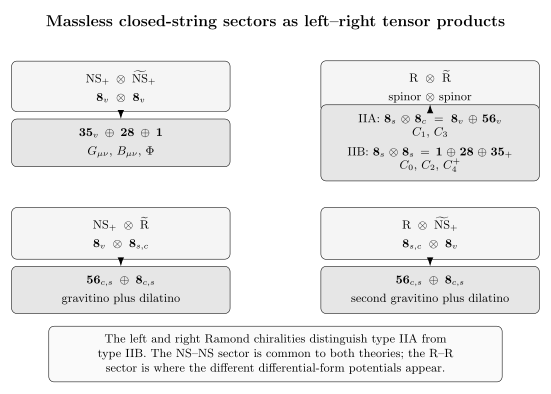
These are physical Spin(8) polarization spaces at a fixed nonzero null momentum, with complex amplitudes and no Chan–Paton multiplicity. Majorana reality does not halve these counts again. NSNS and RR give 128 bosons; the mixed sectors give 128 fermions. The RR forms are transverse potential polarizations. The displayed IIB choice uses and one four-form duality, ; its parity conjugate uses and . The diagram records tensor products, not a geometric scale.
The NSNS sector and its reducible gauge freedom
Section titled “The NSNS sector and its reducible gauge freedom”The massless state has polarization multiplying . The two supercurrent constraints require
Longitudinal null states act independently on the two indices:
The parameters are redundant: , gives no change. This is the simplest example of gauge-for-gauge redundancy in the state description. Starting with transverse covariant components and removing gauge directions gives .
To exhibit those components, choose an auxiliary null vector with and form the projector
Its mixed-index form satisfies , annihilates , and has trace eight. Project both indices to obtain . Changing changes a representative of the same gauge class. Let . Then
The scalar polarization of unit norm is . Hence
The symmetric traceless part is the graviton, the antisymmetric part is the NSNS two-form, and the scalar is the dilaton. The count is . A covariant expression using would neither select the physical transverse trace nor preserve the constraints. The relation between this scalar and the string-frame metric trace also involves the Einstein-frame field redefinition.
In position space the symmetric and antisymmetric null directions become the linearized transformations and . The antisymmetric parameter has its familiar redundancy . Exercise 2 derives the symmetric and antisymmetric quotient counts separately.
Ramond tensor products produce form fields
Section titled “Ramond tensor products produce form fields”There are two related descriptions: the ten-dimensional covariant bispinor in a vertex operator, and its eight-dimensional physical polarizations. Keeping them distinct prevents an incorrect form-parity rule.
The covariant vertex contains field strengths
Section titled “The covariant vertex contains field strengths”Let be the two-spinor polarization matrix and use the charge-conjugation map from the RR vertex construction:
Here has two spinor-coordinate indices, whereas is a matrix acting on one spinor space. Their distinction matters. The identities and
give and . A degree- gamma product changes chirality by , so a nonzero coefficient obeys
Thus equal ten-dimensional chiralities give odd field strengths; opposite chiralities give even field strengths. The familiar potential degrees are one lower. Applying the chirality rule for an endomorphism directly to would miss the minus sign supplied by .
The two Dirac conditions are
After the conversion by , they become left and right Clifford multiplication by on . Their sum and difference give, degree by degree,
These are the plane-wave versions of and in flat space with constant dilaton. This field-strength interpretation is central to Polchinski’s RR charge analysis, equations (2)–(3). It is a linearized statement; it does not replace the nonlinear Chern–Simons modifications in supergravity.
From a field strength to transverse forms
Section titled “From a field strength to transverse forms”At nonzero null momentum define . Contracting the Bianchi condition with gives
Therefore is an ordinary form on the eight-dimensional transverse space. For the wave , one may choose the potential polarization , because . Potential gauge transformations leave unchanged. The physical bispinor has already been constrained; a further quotient by a Dirac image would remove physical states incorrectly.
The resulting massless RR content is
| Theory | Independent strengths | Potential polarizations | Count |
|---|---|---|---|
| IIA | transverse one- and three-forms | ||
| IIB | , with five-form duality | scalar, two-form, one duality of four-form |
For the usual IIB orientation the spacetime condition is . It selects one eigenspace of acting on the transverse four-form; the opposite chirality choice selects the other. The two eigenspaces each have dimension 35. This is a condition on the field strength and its physical polarization, not an assertion that a ten-dimensional four-form potential equals its own ten-dimensional Hodge dual.
Equivalently, the physical spinor tensor products are
The labels and in the last two rows refer to a fixed transverse orientation. Exercise 3 constructs these spaces from eight-dimensional Clifford blocks. Their even/odd form pattern is different from the ten-dimensional field-strength pattern because both the dimension and the physical object have changed.
The mixed sectors contain gravitini and dilatini
Section titled “The mixed sectors contain gravitini and dilatini”A physical NS–R polarization is a transverse vector-spinor , with and eight spinor components. Let denote transverse Clifford matrices. The gamma trace
has the opposite transverse chirality to . Every occurs, because gives . Consequently
The kernel has dimension . It gives the physical gravitino polarizations; the gamma trace gives the eight dilatino polarizations. Gamma-tracelessness projects onto the gravitino species, not onto the entire mixed-sector state space. Imposing it on all states would discard a physical dilatino. The complementary projectors were derived in the vertex exercises.
The R–NS sector gives another such pair. In IIA the two ten-dimensional gravitini have opposite chirality; in IIB they have the same chirality, while the two dilatini have the opposite chirality to the gravitini. Thus
Each chiral supercharge is a ten-dimensional Majorana–Weyl spinor with 16 real components. Two of them give 32 real supercharges: for IIA and , or its parity conjugate, for IIB. The count of supercharge components is not the eight-polarization count of a propagating massless spinor: the global charge is a zero-momentum symmetry operator, not such a particle wave. Weigand, sections 6.6–6.7, develops the connection between these tensor products and supergravity multiplets.
Parity, worldsheet reversal, and T-duality
Section titled “Parity, worldsheet reversal, and T-duality”Three different operations affect the Ramond sectors:
Here is a target-space orientation reversal: it acts on both spacetime spinors. It preserves whether their chiralities agree. IIA admits a parity operation exchanging its two chiral supersymmetry multiplets; in a fixed left/right GSO presentation this includes interchanging the sectors. A fixed-orientation IIB spectrum instead goes to its parity conjugate, with the other five-form duality. These statements concern the spectrum and chirality. Establishing a symmetry of the full action also requires the appropriate tensor and pseudotensor parity assignments for its fields.
Worldsheet orientation reversal exchanges left and right. The displayed rule records its sector labels only; its phases on individual states must be included when making the type I projection.
The third operation is T-duality along a compact spatial circle. In the usual worldsheet description it reflects the right-moving coordinate and its fermion partner while leaving the left-moving ones unchanged. The corresponding Clifford action flips only the right Ramond chirality. It exchanges IIA at radius with IIB at radius . This is an equivalence of compactified theories, not a claim that their uncompactified ten-dimensional chiral spectra are identical. The full construction appears in circle compactification and RR T-duality.
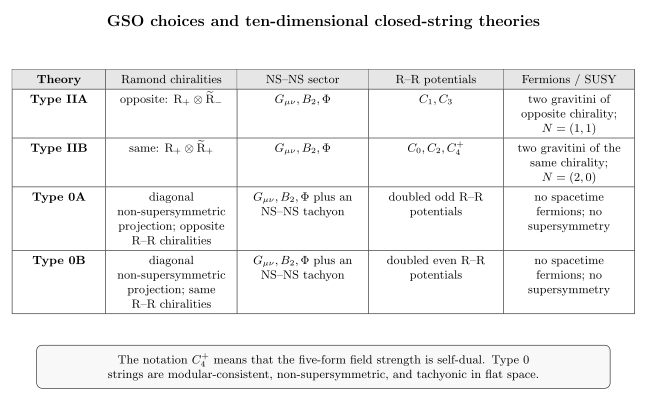
The signs label the two ten-dimensional Ramond chiralities. Equal signs give IIB and opposite signs give IIA. These are actions on sector labels: individual worldsheet-parity phases are additional data. In a fixed IIA presentation, combining target parity with exchange of the two sectors returns the chosen pair; a target orientation reversal takes IIB to its parity conjugate. T-duality also changes the circle radius. The diagram has no geometric scale.
Type 0 retains different pairs of sectors
Section titled “Type 0 retains different pairs of sectors”Supersymmetry is not forced by level matching or modular invariance alone. The two oriented type 0 theories retain
There are no mixed NS–R or R–NS sectors, and hence no spacetime fermions in these closed-string spectra. The ground state survives with
The NSNS massless fields still contribute 64 states. Both allowed RR pairs now survive, giving 128 RR states. In 0A this means two copies of the one- and three-form polarizations. In 0B it means two scalars, two two-forms, and both dualities of the transverse four-form:
The last two spaces combine into an unconstrained four-form polarization, or equivalently an unconstrained five-form field strength in spacetime. They are not two independent unconstrained four-forms. Each type 0 theory thus has 192 massless bosonic polarizations, no massless fermions, and the additional tachyon.
These spectra and the unconstrained 0B five-form are discussed explicitly by Klebanov and Tseytlin, introduction and section 2. The tachyon signals an instability of the flat background used for this spectrum. Curvature, flux, or a tachyon condensate changes the background problem and requires a separate fluctuation analysis. The spectrum calculation alone does not establish stabilization in such a background.
A limited modular check of the sector pairing
Section titled “A limited modular check of the sector pairing”It is useful to see how the two type II choices and the two type 0 choices can all pass a modular test. For the eight transverse fermions, let be the characters of the NS-even-oscillator, NS-odd-oscillator, and two Ramond GSO sectors. Thus describes and describes . These characters include the fermionic vacuum factor; they are not full string partition functions.
With , the unrefined theta-function expressions are
The theta functions have argument zero and modulus ; is the Dedekind function. Although and as unrefined functions, the sectors remain different representations. Keeping rotation fugacities, or simply retaining the character labels, preserves that information.
Their leading terms and the transverse boson factor give
This checks the tachyon and massless multiplicities directly. For example, the sector begins with one closed tachyon after multiplication by the bosonic oscillator factors; it has no massless term satisfying level matching.
The fermionic sector-pairing factors are
The minus signs in the type II expressions are the spacetime fermion signs in a vacuum supertrace, not negative numbers of physical states. Jacobi’s identity makes these unrefined type II expressions vanish. It expresses Bose–Fermi cancellation, not an empty spectrum.
Angelantonj and Sagnotti, section 3.1, develops these characters and their modular transformations. Exercise 6 verifies the pairing matrices under the two modular generators. This is a check of the sector choice. The complete torus amplitude also needs the common bosonic and zero-mode factors, integration measure, and modular integration domain, developed on the one-loop page.
Exercises
Section titled “Exercises”Exercise 1: closed normalization and a forbidden pairing
Section titled “Exercise 1: closed normalization and a forbidden pairing”Derive the chiral weight of from its OPE with the stress tensor. Use the canonical ghost weights to obtain the mass and level-matching conditions in NSNS, NS–R, and RR. Determine the first massive type II mass. Can a left NS state with pair with a right Ramond ground state in uncompactified flat space? Explain why an chiral state cannot pair with at any level.
Solution
The contraction gives, after the two contractions in ,
The NS matter weight is ; the R weight has the additional spin-field contribution . Adding ghost weights and respectively gives . Each chiral weight must vanish, so
At the massless level the pairs are , , and for NSNS, NS–R, and RR. In the mixed case the unequal matter weights are compensated by unequal ghost weights.
The next allowed value of both and is one. Thus the first massive type II level has , compared with for the open superstring. The proposed NS–R pair has left value one and right value zero. No common can make both constraints vanish. Adding further oscillator excitations on the right can repair the mismatch; merely changing the common uncompactified momentum cannot.
In the number of half-integer fermionic excitations is even, so their total level, including integer bosonic levels, is an integer. Therefore is half-integer. In R, is integer. They can never be equal. Compactification can introduce distinct left and right momentum contributions, but that is a different problem with additional data.
Exercise 2: the reducible NSNS gauge quotient
Section titled “Exercise 2: the reducible NSNS gauge quotient”Let for a nonzero null vector in dimensions. Define . Show directly that the NSNS polarization quotient is . Count its symmetric and antisymmetric parts, including the redundancy of the gauge parameters. Then decompose a transverse representative into orthogonal graviton, two-form, and unit-normalized scalar pieces.
Solution
The two transversality constraints put the covariant polarization in . The kernel of the natural map to is
Its two summands each have dimension and intersect in the one-dimensional space spanned by . Its dimension is . Equivalently, the parameter map has the one-dimensional kernel . Thus
On symmetric tensors the gauge map is . It is injective on , including the direction . The quotient dimension is
On antisymmetric tensors the map is . Its kernel is , so its rank is . The quotient dimension is
For these are 36 and 28. In an orthonormal basis of , write , with symmetric traceless and antisymmetric. The first two pieces are orthogonal under , and both are orthogonal to the trace. Since , the scalar unit tensor is , whose coefficient is . Therefore
Covariantly, replace by . The physical symmetric traceless dimension is , and the scalar completes it to 36. This decomposition takes place after the gauge quotient, not in the full ten-dimensional tensor space.
Exercise 3: constructing the transverse RR representations
Section titled “Exercise 3: constructing the transverse RR representations”Let eight Euclidean Clifford generators obey , and let . Its eigenspaces each have dimension eight. Use antisymmetrized gamma products to construct the even blocks and odd blocks . Derive the and decompositions, including the four-form duality. Why does the eight-dimensional answer not establish the ten-dimensional form-parity rule?
Solution
The full sixteen-dimensional Clifford representation has a basis of ordered products , one for each subset of the eight indices. Even products preserve chirality; odd products reverse it. Restricted to a single chiral block, products of complementary degree are related by multiplication by . Thus even degrees six and eight add no new matrices beyond degrees two and zero, while odd degrees five and seven add none beyond three and one.
For four distinct indices, Clifford anticommutation gives
For example, . On , complementary four-form matrices agree with the orientation sign; on they have the opposite relation. The 70 four-index products therefore span 35 matrices in each chiral block. The degree-zero and degree-two matrices give another independent matrices. Trace orthogonality of Clifford products, with the complementary-degree relation imposed, gives
For an odd block, the independent degree-one and degree-three matrices give
The Spin(8) chiral representations admit invariant bilinear forms, so their tensor products can be identified with these matrix spaces. This yields the physical RR decompositions. The two sets of 35 combine into all transverse four-forms in type 0B.
In ten dimensions the charge-conjugation map instead reverses the relevant Weyl pairing, and the covariant symmetric-picture vertex carries an -form field strength rather than its transverse -form polarization. Neither fact is captured by simply reading the parity of these eight-dimensional gamma blocks.
Exercise 4: the ten-dimensional bispinor and its physical kernel
Section titled “Exercise 4: the ten-dimensional bispinor and its physical kernel”Starting with and , derive the form-parity selection rule. Count the unconstrained covariant form spaces for equal and opposite chiralities. Then explain their reduction from 256 to 64 physical amplitudes. Why does a possible degree-zero term not supply an additional propagating scalar in massless IIA?
Solution
Using ,
Since , the two equations require . Thus equal chiralities select odd degrees, and opposite chiralities select even degrees.
Over the complexified ten-dimensional Lorentz algebra, equal chiralities give the independent form dimensions
The five-form occupies one duality sector. Degrees seven and nine are related to three and one by chirality. Opposite chiralities give
with degrees six, eight, and ten related to the displayed ones. These are covariant representation dimensions before the two massless Dirac equations, not physical polarization counts.
At nonzero null , the kernel of inside each 16-dimensional Weyl space has dimension eight. Imposing the left equation restricts one tensor factor; imposing the right equation restricts the other. Hence the simultaneous space is the tensor product of two eight-dimensional kernels, of dimension 64. This argument counts two constraints on two indices, not a quotient of one Dirac kernel by another space.
The equivalent form equations are and . At degree zero, the first is simply for every . Since , it forces . A constant Romans mass is a zero-momentum background parameter in massive IIA, not a missing particle in this perturbative spectrum. At degree one, by contrast, may be proportional to and describes the propagating IIB axion. The remaining form equations reduce the strengths to the transverse potential polarizations counted in the main text.
Exercise 5: three operations on chirality pairs
Section titled “Exercise 5: three operations on chirality pairs”Represent a reflection of the ninth spatial direction by a Clifford action proportional to on a Weyl spinor. Show that it reverses chirality and maps a massless Dirac solution to one at reflected momentum. Compare its action on both factors with its action on only the right factor. Determine which chirality pair is preserved by . Finally show why an orientation reversal exchanges the two five-form dualities.
Solution
The Clifford relation implies . Thus gives . A choice of phase or equivalent Pin lift on a Weyl subspace does not change this conclusion.
Let differ from by . Anticommuting through all other gamma matrices gives
Therefore implies . Acting on both left and right spinors gives and preserves their product. Acting on only the right gives and reverses the product. For the string interpretation of the latter, the reflected variables are the right-moving circle variables; the radius and winding/momentum data transform as well.
Since exchanges the entries,
It fixes either opposite-sign pair and exchanges the two equal-sign pairs. This is the chirality content of the parity operation of IIA after exchanging its two chiral multiplets. It does not establish all phases in an orientifold projection.
For an orientation-reversing isometry , the volume form changes sign. The defining identity for the Hodge star consequently gives
If , then . Thus parity changes a self-dual five-form into an anti-self-dual one. This explains why the two fixed-orientation IIB choices are parity conjugates while the total number of polarizations remains 35.
Exercise 6: modular pairing without erasing the spectrum
Section titled “Exercise 6: modular pairing without erasing the spectrum”Use the formal character vector . Its modular matrices are
Verify the four sector-pairing expressions in the main text are invariant. Test the tempting truncation , which keeps just the bosonic sectors of IIB. Then derive the type 0 massless count and explain what the vanishing type II unrefined supertrace does and does not imply.
Solution
The matrices follow from the theta transformations: under , and exchange while is fixed, with the common square-root factor canceled by ; retaining the resolved spinor characters determines the displayed four-dimensional action. Under , and exchange, acquire , and acquires . Their fourth powers give the stated .
Write a pairing as . It is invariant when and . Let
One finds , , and , with the same eigenvalue for . Therefore and are invariant. The 0B matrix is the identity. The 0A matrix is
which commutes with both modular matrices. Since and is unitary, both type 0 pairings pass the test.
The proposed bosonic truncation has . Its transformed component is
whereas the original component is zero. It is not a modular-invariant way to delete the spacetime fermions. The additional sectors of type 0 are essential to its different consistent pairing.
For counting masses, multiply each chiral character by for the transverse bosonic oscillators. The functions each start with eight level-zero states. The function begins at and has only half-integer shifted levels, so it contributes a tachyon but no level-zero state. Each type 0 pairing therefore gives NSNS and two sets of RR massless states: , all bosonic. Its tachyon has , hence .
For IIB, the massless supertrace is , although there are 128 bosons and 128 fermions. Jacobi’s identity extends this cancellation through the unrefined oscillator series. It is a signed trace, not the dimension of the Hilbert space. This finite character test concerns modular covariance of the sector pairings; it does not supply the full torus integration measure, classify all backgrounds, or prove tachyon stability.
References
Section titled “References”- Angelantonj, Carlo, and Augusto Sagnotti. “Open Strings.” Physics Reports 371 (2002), 1–150; erratum 376 (2003), 339–405. arXiv:hep-th/0204089; doi:10.1016/S0370-1573(02)00273-9. Section 3.1 derives the SO(8) characters and four oriented ten-dimensional sector pairings.
- Gliozzi, Ferdinando, Joël Scherk, and David I. Olive. “Supersymmetry, Supergravity Theories and the Dual Spinor Model.” Nuclear Physics B 122 (1977), 253–290. doi:10.1016/0550-3213(77)90206-1.
- Klebanov, Igor R., and Arkady A. Tseytlin. “D-Branes and Dual Gauge Theories in Type 0 Strings.” Nuclear Physics B 546 (1999), 155–181. arXiv:hep-th/9811035; doi:10.1016/S0550-3213(99)00041-3. The introduction and section 2 specify the type 0 spectra and the unconstrained 0B five-form.
- Polchinski, Joseph. “Dirichlet-Branes and Ramond–Ramond Charges.” Physical Review Letters 75 (1995), 4724–4727. arXiv:hep-th/9510017; doi:10.1103/PhysRevLett.75.4724. The opening field-strength construction explains the covariant RR vertex constraints.
- Weigand, Timo. Introduction to String Theory. Heidelberg University lecture notes, winter semester 2011–2012. Author’s lecture notes. Sections 6.6–6.8 discuss closed spectra, GSO choices, and differential-form representations.