
Worldvolume Flux, BIons, and F/D Bound States
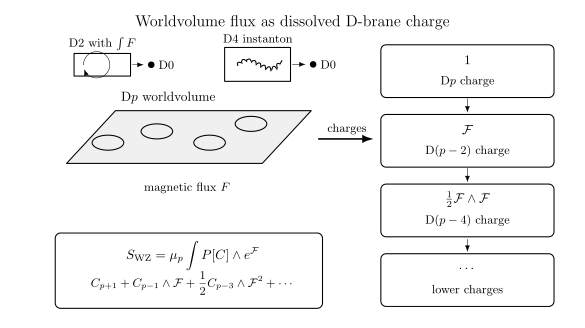
A D-brane gauge field can carry the charge of another brane. Magnetic flux on a D2 carries D0 charge; an instanton on a D4 does the same in four spatial dimensions. Electric displacement carries fundamental-string charge. These statements become quantitative when the source couplings, flux integers, and energy are calculated together.
We use the shared tensions, RR potentials and trace normalization, the DBI action, and the positive supersymmetry algebra. The examples have flat string-frame metric, constant dilaton, and vanishing background and axion. The BIon calculation retains all powers of first derivatives in Abelian DBI; control of omitted higher derivatives and backreaction is a separate issue.
Magnetic flux as a Ramond–Ramond source
Section titled “Magnetic flux as a Ramond–Ramond source”Set for the calculations below. On one brane, the relevant terms of the WZ coupling are
For a stack, these terms contain the fundamental matrix trace; . This is a statement about the indicated topological couplings, not a proposal for an exact non-Abelian DBI determinant. The relation of gauge-bundle topology to RR sources is developed in Douglas, equations (3)–(5).
Suppose two spatial worldvolume directions form an oriented compact surface . The integer
is the first Chern number of its line bundle. Integrating the second WZ term over that surface gives
Thus a unit of flux induces a unit of D source charge. The sign follows from the orientations of the worldvolume and . Negative flux reverses the induced charge, without making the brane tension negative.
These simple integer statements concern and the flat cycles used here. In backgrounds with nontrivial , curvature, or additional Chern–Simons couplings, the coefficients in a local source action and globally quantized conserved charges require a more careful distinction.
A fluxed D2 and a wrapped D1
Section titled “A fluxed D2 and a wrapped D1”Wrap a positive D2 on a rectangular torus with lengths . For uniform flux,
The time direction factors out of the determinant. The spatial block has determinant , so the total rest energy is
A nonzero flux lowers the energy below that of a separated D2 and D0-branes. The spatially uniform configuration preserves sixteen supersymmetries through a combined charge projector. It does not impose the two separate projectors of a D0 and D2 at different positions.
The same square root has a geometric explanation. The oriented boundary conditions are
Use and . The first condition becomes Neumann along , while the second makes constant along the endpoint history. The dual D1 therefore has oriented slope . Since , it wraps the cycle , with length
The coupling also changes, . Consequently and . Retaining the coupling transformation is necessary for an absolute energy comparison.
A magnetic line bundle of degree maps to a D1 on the cycle. The torus coordinates in the drawing are normalized by their periods; the physical slope is . Matching edges are identified, so a crossing is not an endpoint. The equality of DBI energy and wrapped-string energy includes the dual string coupling.
Instanton number and D0 charge on a D4
Section titled “Instanton number and D0 charge on a D4”For a stack of D4-branes, the coupling to the RR one-form is
Use the fundamental trace from the overview. On the four spatial directions, define
For a smooth instanton embedded in , , with the usual finite-action boundary condition on , is an integer. Since , this configuration carries units of D0 charge. For a general bundle the WZ expression is its second Chern character; it should not be called its second Chern class without accounting for the first Chern class.
The leading matrix Yang–Mills action gives the energy above the D4 rest energy,
The positive Euclidean spatial norm gives
Self-duality or anti-self-duality saturates the bound. The matrix coupling is twice the coupling obtained with a unit Abelian generator; mixing the two actions would give a factor-of-two error in this mass.
An instanton is the gauge-field description of the Higgs branch of the D0–D4 system. The full system also has a branch on which D0-branes separate from the D4. The branches meet at a small-instanton singularity, where the smooth gauge description needs additional degrees of freedom. A single commutative on flat does not supply the smooth localized instanton just used. These distinctions are explicit in Polchinski, section 5.4. A large instanton compared with gives a controlled Yang–Mills description; its quantized charge does not certify a small instanton’s derivative expansion.
Electric flux and the compact Wilson line
Section titled “Electric flux and the compact Wilson line”A homogeneous D1 along has, at zero axion,
Its canonical electric displacement and Hamiltonian density are
Why is an integer? Temporarily wrap the D1 on a circle of length . In temporal gauge, its uniform gauge mode is the holonomy . A large gauge transformation shifts by . The total Lagrangian is , and hence
Wavefunctions have integer momentum . There is no extra circumference multiplying this integer. The dimensionless field is continuous; it is its conjugate displacement that is quantized. This is the compact gauge argument of Witten, section 2, also developed on page 18.
To identify the spacetime charge, restore a small . DBI depends on , so its source derivative is . Positive therefore means positive oriented F1 charge, with the worldsheet coupling . For one D1,
For D-strings the BPS bound has the general norm . Its saturation is a statement about the full system and its quantum states. It cannot be established by assigning fractional, individually quantized flux to unrelated Abelian branes.
Two charges in the positive supersymmetry algebra
Section titled “Two charges in the positive supersymmetry algebra”The charge norm can be derived without guessing a square root. Work in the orthonormal real parameter basis and the corresponding Hermitian generating charges used on page 21. These components are not the covariant charge columns in .
First fix the sign of the F1 term. A positively oriented pure-winding ground state has positive coupling to and chiral momenta , at zero center-of-mass momentum, where . Multiplication of the left and right massless spinor constraints by gives and . This agrees with the NS charges in Polchinski’s algebra, equations (104)–(108). It fixes the sign of the charge term, not just its squared eigenvalues.
On the left/right IIB doublet of allowed parameters the resulting involutions are
Here the Pauli matrices act on the doublet. In particular is exactly the shared positive-D1 graph . Both matrices are Hermitian in the real orthonormal basis. Their charge signs are calibrated to and .
Let . The rest-frame algebra, with its normalization supplied by type II supersymmetry, is
Squaring the charge matrix cancels the cross term:
Its eigenvalues are , each sixteen-fold, where . Positivity requires . At nonzero charge and saturation, the unbroken parameters obey
Thus a homogeneous saturated string preserves sixteen of the thirty-two bulk supersymmetries. DBI and Wilson-line quantization independently reproduce the tension; they do not derive the complete quantum supersymmetry algebra.
The distinction between anticommuting and commuting charge matrices also explains D0/D2 versus D0/D4. Anticommuting matrices give a combined square-root bound. Two independent commuting matrices give an additive bound and typically an eight-dimensional joint eigenspace. The detailed graph calculation is in Exercise 3.
Charge lengths and the existence of states
Section titled “Charge lengths and the existence of states”At zero axion, put the integral charges at the points of a Euclidean plane. Their distance from the origin is . The triangle inequality implies that a noncollinear split costs energy. Positive collinear splits are at threshold.
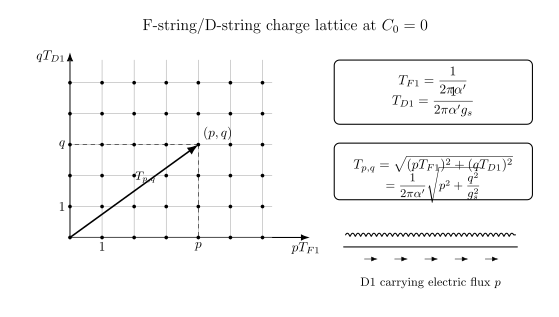
At , the vertical coordinate is , so adjacent integer D1 charges are two units apart. The vector is primitive, while is twice it and has twice its BPS tension. The two-step constituent path is longer than the diagonal. This is a statement about charge norms and possible thresholds; existence of a normalizable quantum bound state requires additional dynamics.
The type IIB primitive-string spectrum has precisely that additional string-theory input, discussed in Witten’s bound-state analysis. The norm alone does not prove it. For a nonprimitive vector, the formula permits separated copies at threshold; it does not classify every quantum state at that threshold. Axion dependence and the full duality action belong to the next page.
A BIon from the nonlinear electric equations
Section titled “A BIon from the nonlinear electric equations”A localized string endpoint on a D3 excites both its electric field and a transverse scalar. Let be the physical transverse displacement, and define the local dimensionless vectors
For static fields and zero magnetic field, the matrix in the DBI determinant is
The opposite off-diagonal signs matter. The Schur complement, using , gives
Differentiation and a Legendre transform yield
The inversion and the scalar equation are worked out in Exercise 4. The Hamiltonian admits the square completion
On the corresponding BPS branches , one obtains , , and . The exact displacement becomes
The coefficient is constant. Consequently Gauss’s law implies away from sources. Merely asserting that three vectors are parallel would not establish this. The full scalar equation reduces to the same harmonic equation on the branch. This is the nonlinear extension of the string-spike calculation in Callan and Maldacena, sections 2–3.
Endpoint orientation, flux and energy
Section titled “Endpoint orientation, flux and energy”There is a useful sign distinction between outward displacement flux and endpoint source charge. With endpoint action , a variation of gives
Indeed ; its integration by parts produces the plus sign above. Define the signed outward flux by
For and an upward spike choose
Then points outward and the endpoint has charge . Reversing the electric branch produces inward flux and positive endpoint charge at the same upward scalar profile. In either case the coefficient magnitude is .
Subtract the unexcited D3 rest energy and retain a shell . Direct integration gives
The energy per unit physical spike length is exactly . The geometric and energy cutoffs are the same surfaces; an arbitrary subtraction at one end would obscure this comparison.
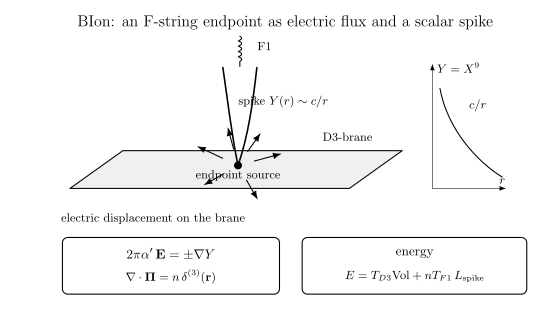
The plotted upward solution has , , and on . Outward displacement flux corresponds to endpoint charge with the stated endpoint action. Finite radial cutoffs regulate the infinite spike. The profile and energy relation are quantitative within Abelian DBI; the drawing does not resolve the string-scale core.
The coordinate field can exceed one. Its local orthonormal value is : the induced spatial metric has changed. The homogeneous flat-D1 critical-field bound must not be applied after discarding that metric.
The spike is locally BPS, but its asymptotic D3 and attached string impose two independent compatible conditions. It preserves eight bulk supersymmetries, rather than the sixteen of a homogeneous string. For a string along the transverse direction, the D3 graph and commute and have an eight-dimensional common eigenspace. The sign of the second eigenvalue follows the oriented attached string; the sign choices in the scalar and electric profiles must follow it.
A magnetic spike uses , where , and . Quantized magnetic flux gives and energy . It represents a D-string ending on the D3. The factors of are essential because has units of inverse length squared, whereas is dimensionless.
The singular limit is not a proof that a single-brane effective action controls all higher derivatives or gravitational backreaction. The charge and regulated BPS energy are robust diagnostics; identifying a regime in which every correction is small requires additional scale analysis. Large instantons and slowly varying outer portions of a spike are more directly controlled than their shrinking cores.
Exercises
Section titled “Exercises”Exercise 1: The line bundle, its minimum energy, and its dual cycle
Section titled “Exercise 1: The line bundle, its minimum energy, and its dual cycle”Construct the degree- line bundle on the rectangular D2 torus using . Derive its flux quantization, show that a uniform field minimizes the Abelian DBI energy at fixed flux, and verify both T-dual boundary conditions and the absolute wrapped-D1 energy.
Solution
At , the potential differs by with . A unit-charge section transforms by . Periodicity in requires . Thus the transition function has winding , even though is not globally one periodic one-form.
Let . For ,
Jensen’s inequality gives , with equality only for constant apart from measure-zero exceptions. The determinant therefore yields the minimum energy within this Abelian static sector.
The two dual conditions are
The first fixes the tangent derivative condition; the second fixes the transverse location. Over one period the lift changes by , giving the cycle . Finally
because follows from the transformed coupling. Keeping fixed in this comparison would fail. Negative reverses the winding and induced D0 charge; the length and energy depend on .
Exercise 2: A traced instanton with the D0 mass
Section titled “Exercise 2: A traced instanton with the D0 mass”Let and . Define the self-dual ‘t Hooft symbols by and . Use the regular-gauge connection
Compute its curvature, topological charge and Yang–Mills energy, retaining the trace normalization. Explain the limits and .
Solution
Since , components obey . Differentiating the rational connection and using the ‘t Hooft-symbol identities gives
The sign of does not reverse . With and ,
The radial integral is
Multiplication by gives , so . The WZ coefficient is , and
The instanton must be embedded in a non-Abelian stack. Large suppresses field-strength and derivative corrections to the Yang–Mills calculation. As , the same integral remains quantized but its density concentrates and the smooth effective description fails. The D0–D4 Higgs branch meets the branch with a separate D0; this is not the disappearance of the conserved D0 charge.
Exercise 3: Combined charge and simultaneous projectors
Section titled “Exercise 3: Combined charge and simultaneous projectors”Using the shared and , compare D0/D2 and D0/D4. Construct the saturated charge projector for each case. Repeat the eigenvalue argument for the F1/D1 matrix, and count the supersymmetries of an F1 ending transversely on a D3.
Solution
In IIA, has inverse , while has inverse itself. Multiplying the full block matrices gives
For signed D0 charge and positive wrapped D2 charge , the involution
has square one and trace zero. Its positive eigenspace has dimension sixteen; is the saturated projector. Requiring separately would instead give a contradiction: their anticommutator would act as two on the same vector. The uniform fluxed D2 obeys the combined condition.
For nonzero positive D0 and D4 charges, the commuting involutions have four joint eigenspaces, each of dimension eight. The norm matrix has eigenvalues , so and
has rank eight. Negative charges replace the appropriate plus sign by a minus sign. This is the threshold algebra associated with a self-dual or anti-self-dual instanton, in addition to the D4 rest energy.
In IIB, and imply the same anticommuting calculation for and . The explicit rest matrix divided by two is
Its zero eigenspace at has dimension sixteen. The minus sign in is fixed by the oriented NS charge in the chiral algebra; anticommutation alone would not select it.
For a D3 along and F1 along , direct multiplication yields . Their product and each individual involution have trace zero on the allowed thirty-two-dimensional parameter space. Therefore has rank eight. This is the localized BIon count. It must not be inferred from the half-BPS homogeneous F/D string count.
Exercise 4: An exact vector Legendre transform
Section titled “Exercise 4: An exact vector Legendre transform”For independent, not necessarily parallel and , invert the electric displacement derived from the DBI determinant. Obtain the Hamiltonian, its square bound, and the full static scalar equation. Check precisely when harmonicity follows.
Solution
Write and . Then and . The inverse matrix is . Set
Substitution into the determinant gives
The Legendre transform is . Expanding verifies . Hence , with equality on , where the right side is positive.
Varying in the Lagrangian, holding the electric field fixed, gives
Equivalently, varying the Hamiltonian at fixed displacement gives . On either BPS branch both currents reduce to , while . Thus the scalar equation and source-free Gauss equation both reduce to . Alignment without would not have this consequence.
The inverse formula also makes the physical electric domain transparent: whenever . On the radial branch its square is , below one even where the coordinate magnitude exceeds one.
Exercise 5: A signed source and a regulated string segment
Section titled “Exercise 5: A signed source and a regulated string segment”Derive the electric source equation from . For an upward radial spike, determine both electric branches and their exact coefficient. Check the distributional equation and the shell energy. Then repeat the flux and energy calculation for a magnetic spike.
Solution
The variation yields after integration by parts. The endpoint contributes . Therefore , not its sign-reversed version.
For , , let label . Since ,
Using verifies the same source equation distributionally. It fixes . The branch has outward and negative endpoint charge; reverses those signs. A compact holonomy or unit string endpoint supplies the integer charge, not the classical radial equation alone.
Directly integrating on the shell gives
For a purely magnetic field the determinant instead is . It completes to . On the energy above the brane is again . The integer flux gives
Thus and . In particular an upward profile with positive magnetic flux uses . The WZ term identifies that flux with the oriented D1 charge; electric displacement and magnetic flux have different normalization factors.
These are regulated exterior solutions. A boundary force at the attachment accounts for the scalar source; the scalar equation is not being asserted source-free at the excised endpoint. Taking sends the physical string length and its energy to infinity. It does not supply a resolved microscopic cap.
Exercise 6: What the charge norm does and does not prove
Section titled “Exercise 6: What the charge norm does and does not prove”For nonzero integral at , characterize equality in the BPS triangle inequality. Explain the primitive/nonprimitive distinction without deriving quantum existence from an energy formula. Obtain the weak-coupling binding energy relative to F1 and D1 constituents.
Solution
Associate to each charge. The norm inequality is saturated exactly when the nonzero vectors are parallel with the same orientation. Because rescaling the second axis is invertible, this is also positive collinearity of the integer pairs.
Write with and primitive . Bezout’s identity shows that any integer vector proportional to has an integer proportionality factor: if , then the factor equals . A primitive vector therefore has no nontrivial decomposition into smaller nonzero positive collinear integer vectors. A vector with is at threshold for copies. In general
This proves the absence or presence of a particular energy threshold. It does not construct a normalizable bound-state wavefunction. The primitive spectrum uses the non-Abelian/string-theory input discussed by Witten; nonprimitive threshold configurations do not by themselves settle the full quantum spectrum.
For fixed and ,
The energy gained relative to separated straight constituents is
The expansion is not uniform as grows. It also does not prove that an arbitrary classical non-Abelian field ansatz realizes the saturated state. The compact rotor is a direct Abelian construction; general requires more information.
References
Section titled “References”- Curtis G. Callan, Jr., and Juan M. Maldacena, “Brane Dynamics From the Born-Infeld Action,” Nuclear Physics B 513 (1998), 198–212, doi:10.1016/S0550-3213(97)00700-1, arXiv:hep-th/9708147. Sections 2–3 derive the electric and magnetic spikes, their nonlinear Hamiltonian, and the string-energy interpretation.
- Michael R. Douglas, “Branes within Branes,” Rutgers report RU-95-92 (1995), arXiv:hep-th/9512077. RR source couplings and instanton realizations of lower-dimensional branes.
- Joseph Polchinski, “TASI Lectures on D-Branes,” in Fields, Strings and Duality, edited by Costas Efthimiou and Brian Greene (World Scientific, Singapore, 1997), pp. 293–356, arXiv:hep-th/9611050. Sections 4.3–4.5 treat charge bounds and bound states; section 5.4 distinguishes Higgs and Coulomb branches.
- Edward Witten, “Bound States Of Strings And p-Branes,” Nuclear Physics B 460 (1996), 335–350, doi:10.1016/0550-3213(95)00610-9, arXiv:hep-th/9510135. Compact electric-flux quantization and the non-Abelian dynamics underlying the string spectrum.