
Holographic Anomalies and the Central Charges of N=4 SYM
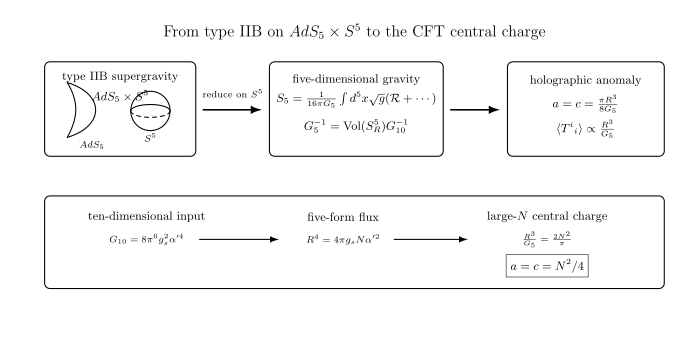
A conformal field theory can have a nonzero stress-tensor trace on a curved background even when all beta functions vanish. This Weyl anomaly measures a quantum response to geometry. In holography, it comes from a logarithmic divergence of the gravitational action near the AdS boundary.
For five-dimensional Einstein gravity, the result is
On , flux quantization then gives at leading large . We will derive the sign and coefficient through an exact spherical example and a general near-boundary calculation, then compare with the protected field-theory answer. The gravitational calculation uses the leading two-derivative action; it does not include quantum bulk corrections.
The boundary metric and the stress tensor
Section titled “The boundary metric and the stress tensor”The shared metric-source definition, together with the Euclidean source prescription, gives
Thus the stress tensor extracted from the Euclidean on-shell action is
Here is the response to the four-dimensional boundary metric. Its definition is distinct from the worldsheet stress tensor used in the earlier string quantization pages.
A Weyl variation changes lengths locally:
Consequently,
This fixes the sign of the anomaly. The variation of has the opposite sign.
A diffeomorphism instead has . Integrating by parts gives when there are no other sources, no diffeomorphism anomaly, and no boundary contribution. Conservation and a nonzero Weyl anomaly are therefore compatible: they concern different variations of the metric.
The three curvature terms in four dimensions
Section titled “The three curvature terms in four dimensions”Write the anomaly as
where and are the Ricci tensor and scalar of the boundary metric. The two curvature invariants are
The coefficient multiplies the Euler density; on a smooth closed four-manifold,
The coefficient multiplies the Weyl tensor squared and also fixes the separated-point stress-tensor two-point function. They are independent data in a general four-dimensional CFT.
The coefficient depends on the subtraction scheme: a finite local counterterm changes it. Such a term cannot change or . We use the scheme with for the Einstein calculation below; Exercise 2 derives the effect of changing this scheme.
A sphere measures the Euler anomaly
Section titled “A sphere measures the Euler anomaly”On a round four-sphere of radius ,
Its volume is , while . Therefore
A constant Weyl rescaling is a change of , so
The sphere partition function thus determines from its logarithmic radius dependence. It does not determine , because the Weyl tensor vanishes on the sphere.
The Euclidean AdS filling
Section titled “The Euclidean AdS filling”Euclidean with a spherical conformal boundary has metric
The center is , and the boundary is approached as . Cut off the geometry at . With the shared curvature and outward-normal definitions, the required action is
The Gibbons–Hawking term makes the metric Dirichlet variation well defined. The two displayed counterterms remove the leading power divergences. A logarithmic counterterm will be added after its coefficient has been found.
The Einstein equation and its trace give
Hence the bulk integrand is negative, and the Euclidean action becomes positive:
At the outer surface,
Cancel the power divergences explicitly
Section titled “Cancel the power divergences explicitly”Introduce the dimensionless prefactor
The three action terms are
The primitive needed in the first line is
Combining all three terms cancels their exponentially growing pieces and gives the exact finite-cutoff expression
Only the bulk integral contributes the term linear in , but the boundary terms are essential to obtain a finite subtraction with the stated constants.
To identify the boundary radius and the ultraviolet regulator, set
The metric becomes
Its boundary representative is . A cutoff corresponds to .
The coefficient of this logarithm is . Comparison with the sphere response gives
The logarithmic counterterm on this geometry is , where is a subtraction scale with inverse-length units. Taking gives
The displayed constants belong to the chosen minimal subtraction scheme. A finite local curvature counterterm can change them. The universal result is
with exactly the sign predicted by the boundary anomaly.
For the exact spherical Einstein filling, . Both axes are dimensionless. The action includes the bulk, Gibbons–Hawking, and power counterterms; the remaining logarithm is subtracted afterward. The limiting value measures its coefficient, while the finite-cutoff deviation is explicitly .
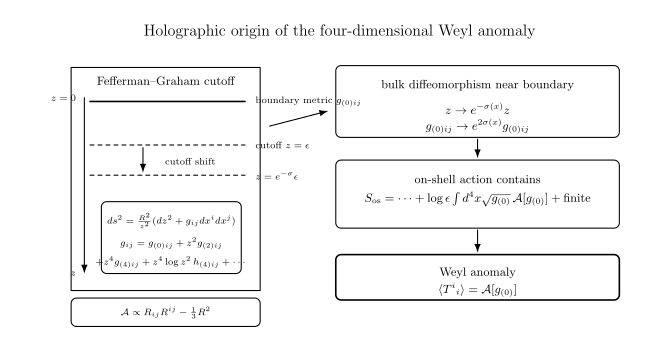
The local anomaly from the near-boundary geometry
Section titled “The local anomaly from the near-boundary geometry”The spherical calculation supplies one integrated answer. To determine the anomaly for an arbitrary smooth boundary metric, use Fefferman–Graham coordinates:
The local expansion in four boundary dimensions is
The leading coefficient is the boundary metric source. The equations determine and the relevant traces locally from it, while part of contains state-dependent response data. This distinction is the metric counterpart of the source/response separation on page 32.
We need only enough of the Einstein equations to determine the logarithmic volume term. All traces and curvatures in the following calculation use .
The first Einstein coefficient
Section titled “The first Einstein coefficient”At the first nontrivial order, the tangential Einstein equation is
Taking its trace in four dimensions gives . Substitution then yields
For a sphere, this is , agreeing with the exact spherical metric.
The radial Einstein equation can be written directly in terms of derivatives as
Let , , and . Inserting the expansion, the coefficient at order is
The logarithmic and nonlogarithmic terms must vanish separately. Thus
This supplies the trace needed for the action without determining the full state-dependent tensor . The general expansion and its response interpretation are developed by de Haro, Solodukhin, and Skenderis.
The determinant term that produces a logarithm
Section titled “The determinant term that produces a logarithm”Use . Since ,
with
The first Einstein coefficient gives
Therefore
The on-shell bulk action contains
The first two terms give powers of . The third gives , so its local logarithmic coefficient is
Thus contains . The logarithm here is understood together with a reference length; the counterterm combines it into .
The remaining terms preserve this coefficient. A finite logarithm in or the volume counterterm would be proportional to , which vanishes. In the intrinsic-curvature counterterm, the logarithmic correction first appears at a positive power of and vanishes at the boundary. These terms remove power divergences and affect finite local terms, but supply no additional finite logarithm at this order.
A radial cutoff change gives a Weyl response
Section titled “A radial cutoff change gives a Weyl response”For a constant passive change of defining coordinate,
The same regulated surface is described by . A space-dependent also requires a tangential coordinate shift to maintain Fefferman–Graham gauge.
The logarithmic counterterm has the form
or its equivalent local expression in the induced cutoff metric. Changing the defining function shifts the renormalized action by . Since , the anomaly is
in the chosen scheme. This is the four-dimensional holographic anomaly derived by Henningson and Skenderis.
Finally,
Comparison with the anomaly definition establishes
The equality follows from the curvature combination produced by the Einstein equations. It is not inferred merely from there being one gravitational coupling. Additional higher-derivative terms can change that combination and allow .
Two complementary uses of the anomaly. The sphere has zero Weyl tensor, so its logarithmic radius response determines alone. General curved boundary data distinguish the Euler and Weyl-squared terms; the two-derivative Einstein calculation yields their equal coefficients. This is a schematic comparison of measurements, with no geometric scale implied.
Flux quantization fixes the N-squared coefficient
Section titled “Flux quantization fixes the N-squared coefficient”The preceding result concerns five-dimensional gravity. To compare it with the D3-brane gauge theory, reduce on the physical sphere of radius . The shared Einstein-frame normalization and D3-brane parameters give
The Einstein term integrated over gives
It follows that
Every factor has a role: has units of length to the eighth power, the physical internal volume has units of length to the fifth power, and is dimensionless. Using the unit-sphere volume without its would spoil both the dimensions and the coefficient.
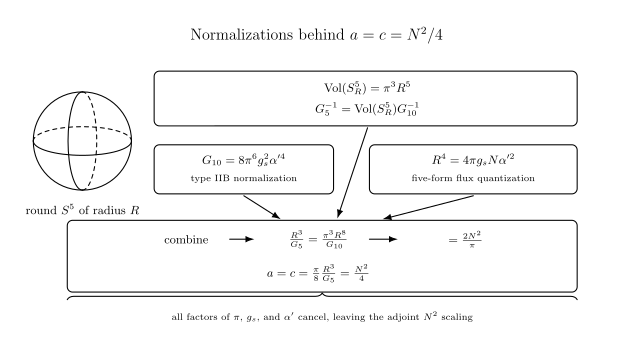
For the unwarped solution in the shared Einstein-frame normalization, radius and flux data combine with the physical internal volume to give . In the two-derivative approximation this fixes . The arrows represent algebraic substitutions, not a flow between theories.
Free fields and the protected answer
Section titled “Free fields and the protected answer”The free-field anomaly contributions in four dimensions are
| Field | ||
|---|---|---|
| One real conformal scalar | ||
| One Weyl fermion | ||
| One gauge vector |
These weights, including the gauge-field contributions, are summarized in Gubser’s discussion of Einstein spaces and CFTs. An vector multiplet contains six real scalars, four Weyl fermions, and one vector, all in the adjoint representation. Consequently,
For gauge group , there are generators:
The equality with the interacting answer uses supersymmetry and the protected anomalies of the superconformal R current. It is not established by free-field arithmetic alone. Exercise 5 derives the result from the R-anomaly relations of Anselmi, Freedman, Grisaru, and Johansen.
For , the additional free center-of-mass vector multiplet contributes to both coefficients. The interacting sector and that decoupled multiplet must be distinguished. Classical supergravity reproduces the leading term; resolving the order-one difference on the gravity side requires a quantum calculation beyond the one performed here.
What this comparison does and does not protect
Section titled “What this comparison does and does not protect”The anomaly coefficients remain fixed along the conformal family. The finite-temperature entropy does not enjoy the same protection. In the classical black-brane regime,
at leading large , as derived on page 28. The weakly coupled gas has a different entropy coefficient while retaining the same and .
Thus and measure specific stress-tensor responses, rather than a universal coefficient for every observable with an scaling. A large value of also does not by itself guarantee a classical Einstein dual. For the simplest D3 supergravity calculation, small string curvature requires , and weak string coupling requires . The planar limit followed by large , or the sufficient window , makes those approximations explicit.
The stress-tensor two-point coefficient
Section titled “The stress-tensor two-point coefficient”In flat Euclidean space, conformal invariance fixes the separated-point form to
where
The tensor is symmetric in each index pair and trace-free. Its radial dependence and inversion matrices together enforce conservation away from coincidence; Exercise 1 verifies these statements directly.
With this definition,
One way to see why the normalization is fixed is the distributional argument of Osborn and Petkou, section 8. Define the transverse differential operators
The same separated-point correlator can be written as
The subtraction coefficient here is , because projects transverse to one direction. It differs from the subtraction in the inversion tensor.
To extend to coincidence, differential regularization gives
Hence the scale derivative of the correlator has coefficient multiplying . To compare with the anomaly, perturb the flat metric by a compactly supported . The quadratic term is
Its second variation therefore contributes . Each metric-source derivative carries a factor of , so extracting the stress correlator requires an additional factor of four, as derived in Exercise 1:
The Euler integral is topological and the term has been set to zero. Equating the two scale-derivative coefficients gives the stated relation.
For theory this means
Classical gravity gives its leading term. Local changes of scheme alter contact terms, not this separated-point coefficient.
Common pitfalls
Section titled “Common pitfalls”Using an action derivative as a generating-functional derivative. The shared Euclidean relation is . It fixes the sign of the metric response and gives a negative integrated trace on for positive .
Inferring both coefficients from a sphere. A round sphere has . The equality requires the general curvature calculation or another independent observable.
Treating a cutoff expression as already renormalized. The finite-cutoff sphere action has a correction proportional to . Counterterms and the boundary limit are part of extracting the anomaly.
Extending protected data to thermal physics. The exact field-theory anomaly coefficients and the coupling-dependent entropy coefficient answer different questions. Their common leading scaling is not a nonrenormalization theorem for the entropy.
Exercises
Section titled “Exercises”1. Conservation, traces, and metric derivatives
Section titled “1. Conservation, traces, and metric derivatives”Verify that the separated-point stress-tensor two-point function above is trace-free and conserved. Then determine the factor relating two covariant metric derivatives of to the connected correlator at distinct points.
Solution
First use . Tracing the inversion tensor gives
Conservation involves differentiating both the power of and the inversion matrices. Let . The useful identities in four dimensions are
They imply
For the symmetrized product, direct differentiation gives
The derivative of is , so the two contributions cancel. The identity holds for ; it does not discard the contact terms required by Ward identities at coincident insertions.
To identify the source factor, perturb the metric by . The Euclidean action varies as
Thus the Boltzmann weight has a linear insertion . The quadratic connected term in its logarithm is
At distinct points,
The two source factors supply . The metric dependence of the measure and of the stress tensor itself supplies additional terms supported at coincidence.
2. Change the subtraction scheme
Section titled “2. Change the subtraction scheme”Add the finite term
on a smooth closed boundary. Determine the resulting change of and show why it cannot change the logarithmic radius response on .
Solution
In four dimensions,
The terms proportional to cancel, leaving
On a closed manifold, integration by parts twice moves the Laplacian onto . Because ,
Therefore . The sign would reverse if the same finite term were added to rather than to the action.
On the round sphere,
It shifts the action by , independent of . It changes the finite constant but leaves unchanged.
3. Distinguish a and c on a product of spheres
Section titled “3. Distinguish a and c on a product of spheres”Take the boundary metric to be a product and set . Calculate the integrated anomaly. Explain how it complements the round- measurement.
Solution
For each two-sphere, , , and . Since the product has no mixed curvature components,
Substitution into the invariant definitions gives
The volume is . The Euler integral is therefore , consistent with . The scalar curvature is constant, so the term vanishes. The integrated anomaly is
For equal radii it is , which becomes in the Einstein case .
Unlike the round four-sphere, this product has a nonzero Weyl tensor even when its two radii agree. Once the round sphere has fixed , the product response can determine . This calculation uses the local CFT anomaly; it does not assume a unique or explicitly known bulk filling of this boundary geometry.
4. Normalizable metric data change the response
Section titled “4. Normalizable metric data change the response”For a flat boundary, consider the asymptotic solution
Find its stress-tensor response and explain why it does not change the anomaly. Work to the displayed order and keep the outward normal directed toward decreasing .
Solution
The induced metric and normal are
Thus
The trace has no order- correction because is trace-free.
For the displayed Euclidean action, varying the bulk plus Gibbons–Hawking term with respect to gives
The volume counterterm supplies inside the same bracket. Multiplying by , as required by , gives the cutoff response
The intrinsic-curvature terms vanish in the boundary response for this flat-source perturbation: derivatives of carry additional positive powers of . Inserting and into the displayed terms gives
The response to the boundary representative is obtained by undoing its conformal scale:
It is conserved and trace-free. Meanwhile and , so : the anomaly of the flat source remains zero.
The calculation separates response data from the local anomaly determined by the source metric. It establishes the formal near-boundary response; it does not prove that every transverse trace-free choice of extends to a regular global bulk state.
5. Recover the protected result from R anomalies
Section titled “5. Recover the protected result from R anomalies”For a four-dimensional SCFT, use
where the traces sum over Weyl fermions with their superconformal R charges. Regard SYM as one vector multiplet and three adjoint chiral multiplets. Derive and and distinguish from .
Solution
The gaugino has R charge . Each chiral scalar has superconformal R charge , so its Weyl fermion has charge . Writing ,
The supplied anomaly relations give
Hence gives , whereas gives . The difference is precisely the anomaly of one free vector multiplet.
The protection argument uses the superconformal R current and its fermionic anomaly coefficients. In this theory the charges are fixed by the supersymmetry and superconformal structure; their protected anomalies determine and throughout the conformal family. This does not license replacing an unknown interacting superconformal R symmetry by arbitrary ultraviolet free-field charges in another theory.
6. Replace the internal sphere
Section titled “6. Replace the internal sphere”Consider an unwarped solution with constant dilaton and only self-dual five-form flux. Normalize the dimensionless internal metric by and let . The physical internal metric is .
With the shared orientation and positive D3 charge, the calibrated internal flux is . Use the corresponding oriented flux quantization to derive the leading central charges. Here , so equals the shared modified field strength . Then insert .
Solution
Flux quantization gives
Therefore
The physical internal volume is , so . Substituting into the Einstein result gives
At fixed flux, the radius also changes when the dimensionless volume changes. Accounting for both effects is why the final answer is inversely proportional to .
For , recovers . For the supplied volume,
This inverse-volume law was analyzed by Gubser. The geometry and associated field theory are developed on page 35.
The calculation assumes the stated product solution and leading two-derivative action. It does not establish that every positive Einstein five-manifold defines a stable string background or has an identified CFT dual.
References
Section titled “References”- Anselmi, Damiano, Daniel Z. Freedman, Marcus T. Grisaru, and Andreas A. Johansen. “Nonperturbative Formulas for Central Functions of Supersymmetric Gauge Theories.” Nuclear Physics B 526 (1998), 543–571. arXiv:hep-th/9708042. doi:10.1016/S0550-3213(98)00278-8.
- de Haro, Sebastian, Sergey N. Solodukhin, and Kostas Skenderis. “Holographic Reconstruction of Spacetime and Renormalization in the AdS/CFT Correspondence.” Communications in Mathematical Physics 217 (2001), 595–622. arXiv:hep-th/0002230. doi:10.1007/s002200100381.
- Gubser, Steven S. “Einstein Manifolds and Conformal Field Theories.” Physical Review D 59 (1999), 025006. arXiv:hep-th/9807164. doi:10.1103/PhysRevD.59.025006.
- Henningson, Måns, and Kostas Skenderis. “The Holographic Weyl Anomaly.” Journal of High Energy Physics 07 (1998), 023. arXiv:hep-th/9806087. doi:10.1088/1126-6708/1998/07/023.
- Osborn, Hugh, and Anastasios C. Petkou. “Implications of Conformal Invariance in Field Theories for General Dimensions.” Annals of Physics 231 (1994), 311–362. arXiv:hep-th/9307010. doi:10.1006/aphy.1994.1045.