
String Interactions and the Free Boson CFT
How can a theory with a quadratic worldsheet action describe interacting strings? The answer has two parts: the worldsheet can change topology, and its local quantum fields create and absorb string states. This page develops the free-boson conformal field theory needed for that construction. The logarithmic contraction, its contact terms, and the momentum-conservation factor will all follow from one Gaussian path integral.
The prerequisites are the canonical modes and cylinder-to-plane map and the shared conventions. Here we return to the covariant coordinate fields , including the timelike coordinate. They are not the physical transverse oscillators used to count states. The reparametrization ghosts and the integration over worldsheet geometries enter the complete string amplitude later.
Splitting strings and smooth worldsheets
Section titled “Splitting strings and smooth worldsheets”A closed string traces a cylinder as it propagates. One closed string splitting into two traces a surface with three cylindrical ends, usually called a pair of pants. A time slicing makes the splitting look like a distinguished event, but the Euclidean surface can be smooth everywhere. The location of that event depends on the slicing; it is not a point at which a new local interaction term must be inserted into the free coordinate action.
Thus the flat-target-space matter theory remains locally Gaussian on a fixed worldsheet. Interactions require summing surfaces of different topology, integrating their moduli, and inserting operators representing the external states. The Gaussian matter integral is one ingredient of that construction, not the entire amplitude.
For an oriented closed surface of genus , the constant-dilaton term is
The surface weight is . If each canonically normalized external closed-string vertex includes a factor , a genus- amplitude with external strings has the coupling dependence
Here still contains the matter and ghost correlators and the moduli integral. In this formula belongs to the filled surface: punctures mark the external vertices. Alternatively, one may remove disks around the punctures and describe asymptotic cylindrical ends. Their circles are not physical open-string boundaries, and the two descriptions must not count the same external normalization twice. Tong derives this topology expansion in §6.1.1 of his string-theory lectures.
A second useful geometry is a long, thin tube joining two components of a worldsheet. Euclidean evolution along a tube of length inserts a sum over intermediate states. For a Hamiltonian eigenvalue , its length dependence is , and
Analytic continuation exposes a pole when the appropriate intermediate state goes on shell. Identifying precisely requires the physical-state and ghost conditions; the geometric point is that ordinary factorization poles arise from degenerating smooth surfaces.
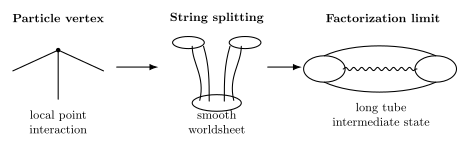
The upper surface has three asymptotic closed-string ends. The lower degeneration isolates propagation along a long Euclidean tube. The drawings show topology and sewing, not a chosen physical metric or a pointlike worldsheet interaction; the end circles are not open-string boundaries.
Radial ordering and local expansion domains
Section titled “Radial ordering and local expansion domains”The map , with , sends a constant Euclidean-time slice of the closed-string cylinder to a circle of radius . Later cylinder times therefore lie at larger radii. Euclidean time ordering becomes radial ordering on the plane. For the bosonic operators considered here,
At equal radii one specifies a limiting radial separation. Fermionic operators would also require the exchange sign. The letters in this formula label two plane points; no longer denotes the cylinder coordinate.
Two different expansion regions will appear below. Expanding a contraction in oscillator modes about the origin requires, for example, . A local operator product expansion about the insertion at instead uses the separation . In a correlator with other insertions, its convergence region is bounded by the nearest other insertion to . These are related tools, but their circles generally have different centers.
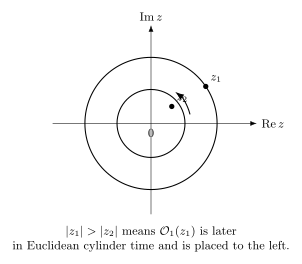
For the radial mode sum, places the later operator on the larger origin-centered circle. For the local expansion about , the relevant condition is , where is the distance to the nearest spectator insertion. The positions are schematic; the two domains are not interchangeable.
The Gaussian source functional and its zero mode
Section titled “The Gaussian source functional and its zero mode”Removing the constant mode before inversion
Section titled “Removing the constant mode before inversion”Wick rotation of worldsheet time does not make the kinetic term of the timelike target coordinate positive. To justify an ordinary convergent Gaussian integral, first take positive Euclidean target coordinates. The resulting contractions can then be analytically continued to Lorentzian target momenta and . The final Lorentzian formulas below use that continuation.
There is a second subtlety even for a positive scalar: a constant field has zero action. As an infrared regulator, first work on a flat periodic worldsheet region of complex area , and separate
The constant target position is a genuine integration variable. The kinetic operator can be inverted only on the nonconstant fields .
Integrating the shared free action by parts gives
There is no boundary term on the periodic region. Its mean-zero Green function satisfies
The subtraction projects out the constant function: integrating either side over gives zero. Writing simply on the full space would miss this obstruction.
Completing the square
Section titled “Completing the square”Introduce a source through the nonzero-mode integral
Only the mean-zero part of couples to . The prime indicates that the constant mode is omitted. Since annihilates that mode, solves the projected source equation. Completing the square yields
A translation of the nonzero-mode integration variables therefore gives
Differentiating twice at gives the two-point function; after target continuation,
Four differentiations give the three pairings of four fields. Higher even correlators are sums over pairings, while odd correlators vanish. This is Wick’s theorem as a consequence of the source functional. The connected generating functional is quadratic, so connected correlators with more than two elementary fields vanish.
The same sign and normalization follow from a Schwinger–Dyson identity. Integrate a functional derivative of over the mean-zero fields. Differentiating the insertion gives the projected delta function; differentiating the weight gives . Consequently,
An equation of motion inside an ordered correlator thus has a contact term at an insertion. Away from insertions, the usual homogeneous local field equation holds, up to the explicit infrared projection when using this regulator.
The local logarithm and the global prescription
Section titled “The local logarithm and the global prescription”Near coincidence, the Green function has the universal part
Here is a reference coordinate scale, with the same coordinate units as . It is not a new target-space length. On the compact regulator also supplies the term; boundary conditions or global geometry determine its remaining form. On the plane, an infrared prescription fixes the additive normalization of the logarithm. The singular local contraction is independent of these choices, whereas an unqualified plane correlator of itself is not.
We will use the plane prescription for local normal ordering and plane correlators. Changing its additive constant rescales composite exponential operators. Their normalizations must be changed consistently, rather than treating the arbitrary as an observable. The infrared issue and the local Schwinger–Dyson argument are discussed in Polchinski’s introductory lectures, §1.1.
The logarithm as a distribution
Section titled “The logarithm as a distribution”Why does a logarithm solve a point-source equation if it is harmonic at every nonzero separation? Integrate over a disk of coordinate radius around . Using the shared doubled complex measure and ,
The flux is independent of and is concentrated at the origin in the distributional limit.
A smooth regulator makes this statement explicit. Set
Direct differentiation and integration give
As , this positive kernel approaches when integrated against a smooth test function. Therefore the plane Green function obeys
The derivative with respect to the second argument has the opposite sign, because . Thus
in this plane prescription. At separated points the mixed contraction is zero; as a distribution it is not zero. A compact-domain Green function can additionally contribute a smooth, regulator-dependent term. This distinction matters whenever an equation of motion is integrated through an insertion.
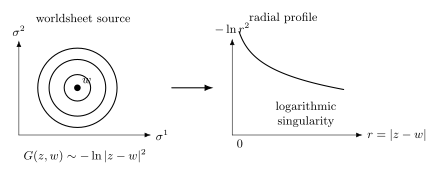
The curves use dimensionless worldsheet coordinates, , and the displayed regulator values. The lower panel plots , not a probability density in : normalization uses . Differentiating both arguments gives the positive mixed contact term; applying both derivatives to the first argument gives the negative Green-equation source. The limiting logarithm is singular, although every regulated curve is smooth.
Operator products and normal-ordered fields
Section titled “Operator products and normal-ordered fields”From contractions to local expansions
Section titled “From contractions to local expansions”An operator product expansion (OPE) expresses two nearby insertions as a sum of local operators at one point. It is an equality inside correlators in the appropriate expansion region, and it includes both singular and regular terms. We will use below specifically when displaying only the pole terms of a current product.
Differentiating the logarithmic contraction at separated points gives
There are analogous antiholomorphic formulas. The mixed product has no separated-point pole, but retains the contact distribution derived above. A pole OPE and an identity between distributions answer different questions.
We can independently recover the double pole from canonical quantization. In the zero-momentum vacuum, the holomorphic expansion from page 6 gives
For , annihilators in the outer operator contract with creators in the inner one:
The sum uses for . Both the minus sign, from , and the factor match the Gaussian calculation. The closed string has an independent antiholomorphic oscillator family; the contact term is compatible with that independence because it is supported only at coincidence.
Point splitting and the remaining regular product
Section titled “Point splitting and the remaining regular product”A product at the same point is not defined by simply setting in a singular correlator. Plane normal ordering subtracts the specified local contraction before taking the limit. For example,
Before the limit, the bracket is a regular bilocal normal-ordered product. Taylor-expanding that product generates the local operators in the OPE. Thus subtracting the logarithm does not discard all remaining information about the two insertions.
Likewise, contraction of target indices gives
The factor is , not : this is the covariant matter CFT. The next page uses this composite to construct its stress tensor. Plane local subtraction is the operation used here; the finite difference between plane and cylinder vacuum energies was treated in page 6.
Plane waves, descendants, and momentum conservation
Section titled “Plane waves, descendants, and momentum conservation”The exponential OPE
Section titled “The exponential OPE”Define the normal-ordered matter operator
Expanding each exponential and pairing fields between the two factors sums all cross-contractions. Their exponent is , so Wick’s theorem gives the distinct-point identity
The colon on the right removes contractions among all fields inside it. To obtain a local OPE, let and Taylor-expand the remaining regular product:
The omitted terms begin at second order in the separation within the brackets. They need not be nonsingular after multiplication by the prefactor. For sufficiently negative , even the first descendants are singular. Keeping only is a leading-term approximation, not a list of every singular operator.
A single derivative can contract with any field in the exponential. The sum is
These are matter operators for arbitrary momenta. The conditions for a physical integrated or unintegrated string vertex, including conformal weights and ghosts, have not yet been imposed.
Why the zero mode imposes momentum conservation
Section titled “Why the zero mode imposes momentum conservation”For exponential insertions, their dependence on the constant coordinate is
The nonzero modes see imaginary point sources
Substituting these in the Gaussian functional gives in the exponent. Normal ordering removes the self-contractions. Each unordered pair occurs twice and leaves
To state its normalization, normalize the nonzero-mode vacuum integral, but retain the ordinary noncompact target zero-mode integral. Then
and the plane matter correlator in the chosen subtraction prescription is
An overall normalization of the matter path integral has been fixed by this choice. Dividing also by the infinite zero-mode volume and still retaining this delta-function normalization would be inconsistent. On a compact target, the zero-mode integral instead gives the corresponding discrete momentum selection rule. The source calculation with the zero mode separated is developed in Tong’s §6.2.2.
With the momentum delta factor stripped off, a neutral two-point function is proportional to
Its scaling and zero worldsheet spin give and . Scaling alone is not a proof of primarity; the stress-tensor OPE calculation supplies that proof. In Lorentzian target signature can be negative; there is no contradiction with the nonpositive covariant matter sector discussed in the spectrum calculation.
Bulk exponential correlators provide the matter part of closed-string sphere amplitudes. Open-string boundary correlators require the image construction, which changes the contraction by a factor of two; exercise 6 derives it. The next page develops conformal transformations, while tree-level amplitudes combine these ingredients with the remaining string-theory data.
Exercises
Section titled “Exercises”1. Coupling powers under sewing
Section titled “1. Coupling powers under sewing”Determine the powers of for a sphere with four closed-string insertions and a torus with one insertion. Recover both answers by sewing three-ended spheres. Explain why the asymptotic circles are not physical open-string boundaries.
Solution
For the filled surface with normalized vertices, the power is . Thus a sphere four-point amplitude is of order , and a torus one-point amplitude is of order .
A three-ended sphere represents a cubic closed interaction of order . Sewing one end of each of two such surfaces leaves four ends and no handle, giving . Sewing two ends of a single three-ended sphere to each other creates one handle and leaves one external end, giving order .
The Euler characteristic of a surface with the asymptotic disks removed is . It is additive under these circle sewings, since the sewing cylinder and its boundary circles have Euler characteristic zero. Each three-ended sphere has . Two give , appropriate to ; self-sewing leaves , appropriate to .
This is consistent with only because the external-state normalization has already been incorporated into this description. One must not multiply by again. The circles are cross-sections of propagating closed strings; an actual open-string boundary instead carries boundary conditions on the worldsheet fields and changes the physical problem.
2. A finite Gaussian and a missing inverse
Section titled “2. A finite Gaussian and a missing inverse”For real , evaluate with
Find and . Then explain what changes if one eigenvalue of is zero.
Solution
The determinant is and both eigenvalues are positive. The inverse and the shifted quadratic form are
Translation of the integration variable gives
Two source derivatives give . Four derivatives give one pairing of the two equal-index pairs and two cross-pairings:
If the matrix has a zero eigenvector, the integration in that direction has no Gaussian suppression, and the inverse and the normalized integral above do not exist on the full space. Removing that coordinate allows inversion on the remaining subspace. If the omitted coordinate is a physical position , it must eventually be treated separately: a real linear source generally makes divergent, whereas an imaginary source gives the distribution . This is exactly the distinction between the nonzero-mode field Gaussian and the target position integral.
3. A contact term invisible at separated points
Section titled “3. A contact term invisible at separated points”Using above, calculate its integral over a disk of radius , establish its weak limit, and determine the sign of .
Solution
The angular integral in the doubled measure gives
The total mass is one, and the mass outside any fixed positive radius is . For a smooth bounded test function , choose a small disk where is uniformly small. The contribution from that disk is bounded by this small difference; the outside contribution tends to zero by the tail estimate. Therefore
Differentiating the logarithm gives
Since the second-argument derivative reverses sign,
For every fixed , the right-hand side tends to zero. Its integral remains . Interchanging the pointwise limit with an integral through the shrinking peak would lose the contact term.
4. Recovering oscillator commutators from an OPE
Section titled “4. Recovering oscillator commutators from an OPE”Define the holomorphic current and its modes by
All contours are counterclockwise. Derive the oscillator commutator from the current OPE, explaining the contour deformation.
Solution
The two factors of cancel the negative free-boson contraction, giving
In , radial ordering puts the contour outside the contour. In the reversed product it lies inside. Subtracting the products leaves a small positively oriented contour around :
The inner residue is . This remains valid for negative integer , since the small contour encloses and not the origin. The outer integral then gives
Regular OPE terms contribute no residue to the small contour. The calculation recovers the canonical algebra, including its timelike sign, from local CFT data.
5. A neutral three-point function and its current insertion
Section titled “5. A neutral three-point function and its current insertion”For a single Euclidean target scalar, take the momenta at . Find the matter correlator with its momentum delta function stripped off. Check its scaling and determine the correlator with one additional insertion. Explain the behavior at large .
Solution
Let . Removing the self-contractions and using the three pairwise products gives
The zero-mode integration enforces before this factor is interpreted; one should not replace a momentum delta function by a finite numerical value at zero.
Under a simultaneous positive dilation with held fixed, the product scales as . The sum of operator dimensions is
in agreement with that scaling.
The derivative contracts with each exponential. Dividing the resulting correlator by the stripped three-point function gives
The coefficient of is proportional to the total momentum and vanishes. The leading large- term is therefore proportional to . More generally, the current insertion contains , so momentum conservation removes its term. The global zero mode and the local current OPE are consistent descriptions of the same translation symmetry.
6. Why boundary contractions are doubled
Section titled “6. Why boundary contractions are doubled”Put a Euclidean scalar on the upper half-plane. Construct the Green functions for Neumann and Dirichlet boundary conditions by reflection across the real axis. Find the boundary two-point function and scaling dimension of a Neumann exponential operator. Explain what happens to the Dirichlet constant mode.
Solution
For in the upper half-plane, reflect the source to and set
At real, the two distances to and are equal. Their normal derivatives are opposite, so , whereas their difference gives . The reflected source lies outside the physical upper half-plane, so it enforces the boundary condition without adding an interior source.
Taking both insertion points to distinct real values gives
Consequently the cross-contraction of boundary exponentials is
For , the two-point function scales as . A boundary primary of weight has a two-point function proportional to , giving . This is twice the total bulk dimension and four times either bulk chiral weight. As in the bulk, the full primary property can also be checked with the stress tensor.
The image does not introduce a second independent boundary oscillator family; it relates the two bulk chiral sectors at the boundary. For Dirichlet conditions the boundary value of is fixed, its fluctuations vanish there, and its constant value is not integrated over as a translation zero mode. Momentum conservation from that integral therefore applies to the Neumann directions, not automatically to the fixed Dirichlet ones. See Tong’s §§4.7 and 5.4.2 for the boundary construction.
References
Section titled “References”- Joseph Polchinski, What Is String Theory?, lectures at the 1994 Les Houches Summer School, report NSF-ITP-94-97 (1994), arXiv:hep-th/9411028. §1.1 develops the free-field path integral, contact terms, normal ordering, and the local OPE.
- David Tong, Lectures on String Theory (2009), arXiv:0908.0333. §§4.3.1–4.3.2 discuss the free boson; §4.6.2 relates modes to contours; §§4.7 and 5.4.2 treat boundaries; §§6.1.1 and 6.2.2 develop topology weights and Gaussian vertex correlators.