
Superstring Vertex Operators and Pictures
A vertex operator tells the worldsheet path integral which spacetime particle enters or leaves a scattering process. Its polarization is constrained by BRST closure, and gauge-equivalent polarizations give the same physical state. The familiar massless vector, graviton, dilaton, and Ramond fermions can all be identified this way.
Two operations must be kept distinct. Picture changing changes the superghost representation of a state while preserving ghost number. Descent converts an unintegrated vertex at a fixed puncture into a density to be integrated over a moving puncture. For an open NS state, the zero-picture unintegrated operator is , whereas its integrated density is . The extra term is essential even though it drops out of some elementary tree correlators.
We work with on-shell massless states of the critical RNS string in flat ten-dimensional spacetime, with constant background dilaton. The shared spacetime and boson normalization, canonical fermions and supercurrent, and BRST construction apply throughout. Overall string couplings, external-state normalization constants, and consistent overall cocycle phases are suppressed; relative coefficients inside a vertex are retained. The open-string vector example initially has Neumann boundary conditions in all ten directions. We explain its reduction to a D-brane below.
Boundary plane waves and bulk plane waves
Section titled “Boundary plane waves and bulk plane waves”The momentum in a vertex is physical spacetime momentum. A boundary operator and a bulk chiral operator carrying the same momentum therefore cannot be interchanged without a factor of two.
Write the bulk coordinate as . On the upper half-plane, Neumann boundary conditions identify along the real axis, up to an irrelevant constant. Consequently,
The shared chiral propagator immediately gives
The boundary contraction is four times the chiral contraction. Equivalently, it is twice the full-plane bulk propagator evaluated at real separated points. The latter factor of two is the image contribution enforcing the boundary condition.
For a closed string there is no such replacement of the exponential:
This distinction reproduces the different open- and closed-string mass scales. It also fixes the momentum coefficients generated by the supercurrent. In the open calculation below, is the canonically normalized doubled chiral fermion; its OPE remains .
Gaussian contraction of boundary plane waves gives the Koba–Nielsen factor,
The zero-mode integral supplies momentum conservation. The nonzero modes supply the powers of separations. Fermion, derivative, and ghost contractions still have to be included; this factor alone is not a scattering amplitude.
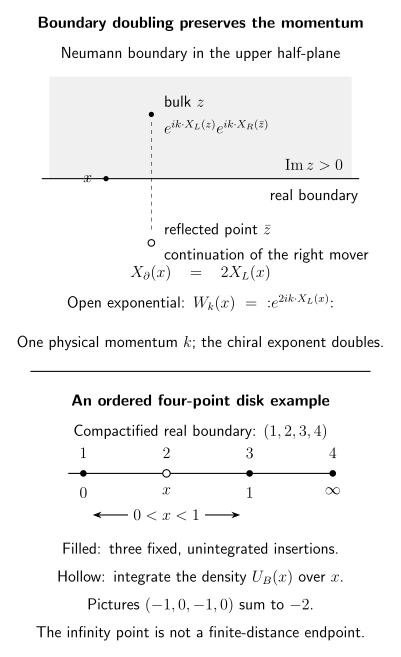
Neumann reflection identifies the two coordinate fields on the boundary, giving . The lower diagram anticipates a color-ordered disk amplitude with punctures , . Pictures sum to ; the three fixed punctures supply the three insertions. The worldsheet geometry is schematic.
The NS vector from a matter supermultiplet
Section titled “The NS vector from a matter supermultiplet”The massless NS state is represented in the matter theory by
The subscript indicates that this matter operator is fermionic. Its conformal weight is . The superghost dressing has , so the density and unintegrated vertex are
The density must have weight one and the unintegrated vertex weight zero. Both requirements give . This is not yet the whole physical-state condition: the supercurrent tests the polarization.
The double pole imposes transversality
Section titled “The double pole imposes transversality”Using the shared , contract it with . A simultaneous and contraction gives a double pole. The two single contractions give the superpartner:
where
Thus makes a matter superconformal primary of weight . Its descendant has weight one. The order of the two fermion factors in this expression is part of the formula. Factoring out leaves
An overall phase can be absorbed into a vertex normalization; changing the relative sign between these two terms cannot.
The unprojected NS ground state provides a useful comparison. Its density is , without . Weight one then requires , or . It is the NS tachyon. The supersymmetric GSO projection discussed on the spectrum page removes this state and retains the vector. The conformal-weight calculation itself does not impose that projection.
BRST completion and descent
Section titled “BRST completion and descent”The weight-one matter descendant does not by itself determine the full unintegrated vertex. The BRST transformations of a physical matter supermultiplet are
Together with , these imply
For example, the BRST variation of contains ; the variation of contains . The remaining terms cancel with the derivative terms in . Retaining only would spoil closure.
Descent uses the antighost residue, not picture changing:
Here has a pole with and is regular with the remaining factors. Since , either density obeys . Its integral is BRST invariant up to endpoint or moduli-boundary contributions.
| Representative | Conformal weight | Ghost number | Picture |
|---|---|---|---|
This is the operator distinction underlying the covariant construction of Friedan, Martinec, and Shenker, sections 5.1–5.3. The explicit complete zero-picture vertex also appears in Berkovits, section 2, with a different supercurrent phase convention.
Gauge equivalence is visible in both representatives
Section titled “Gauge equivalence is visible in both representatives”For , the fermion bilinear vanishes by antisymmetry, and . Therefore
The first equation identifies a total derivative in the integrated coupling. The second identifies a BRST-exact unintegrated state. Thus is a gauge identification, not an additional physical polarization.
At a fixed nonzero null momentum, leaves nine components, and quotienting by the direction leaves eight. On a flat D-brane with a propagating worldvolume momentum, these become vector polarizations and transverse scalars. The sum remains eight. In the usual supersymmetric coincident-brane setting, their low-energy interactions form dimensionally reduced ten-dimensional super Yang–Mills theory; orientifold projections and other boundary constructions can change the gauge group and spectrum. A generic D-brane does not support a ten-dimensional propagating vector.
Picture changing preserves the type of insertion
Section titled “Picture changing preserves the type of insertion”The picture-changing operator has ghost number zero, picture , and weight zero. Applied appropriately to , it produces the cohomology class of , including the ghost completion. Applied to an integrated representative, it gives the corresponding integrated class after the required finite-product and descent prescriptions. It cannot directly turn a ghost-number-one vertex into a ghost-number-zero density.
The matter part explains the two terms in : multiplies the simple pole of . The full also contains ghost terms, which supply the full unintegrated result. Keeping only is therefore a way to compute the matter superdescendant, not a general formula for picture changing a complete vertex.
For states at fixed , use the mode . For local vertices, specify a finite OPE prescription rather than assuming that an arbitrary coincident product is defined. The previous page’s discussion of small-space picture maps explains the restrictions and the difference between these constructions. In particular, equivalence at generic nonzero on-shell momentum does not imply an unrestricted isomorphism at zero momentum, or justify arbitrary picture-changing collisions in higher-genus amplitudes.
The Ramond vertex and its Dirac equation
Section titled “The Ramond vertex and its Dirac equation”A Ramond ground-state spin field has matter weight . Its canonical ghost dressing has . The massless open-string representative is
Weight zero gives . We use the state–operator notation of the spin-field page: creates the basis state , and are its polarization coordinates. The sum is a linear state–operator map. Gamma matrices act on the coefficient column according to
Contracting both fields in with the Ramond matter vertex now gives
In the BRST current, multiplies this expression. The ghost OPE with supplies , leaving a simple pole proportional to . BRST closure therefore requires
The GSO projection selects one ten-dimensional Weyl chirality. A Dirac spinor has 32 complex components; the selected Weyl space has 16, and the Dirac kernel at nonzero null has dimension eight. These are eight independent complex one-particle polarization amplitudes at fixed momentum. A Majorana reality condition on a spacetime field relates Fourier coefficients; it is not another halving of that polarization count.
There is no additional quotient of this canonical -picture kernel by : at null momentum such a quotient would remove the desired states. The different quotient description in picture and its map to this kernel are derived on the spin-field page. Together with the eight NS polarizations, the Ramond states give the on-shell gauge multiplet before Chan–Paton multiplicities. The state–operator and spin-field construction is also developed in Polchinski, volume II, sections 10.3–10.5.
Closed NSNS vertices and the physical dilaton
Section titled “Closed NSNS vertices and the physical dilaton”A closed state has independent left and right chiral factors. At the massless NSNS level,
Each chiral density has weight , so . The two supercurrent constraints impose
The gauge identification is
For this shift to remain within the displayed transverse on-shell representatives, require . Off-shell field transformations need not be restricted in that way.
Project first, then separate the trace
Section titled “Project first, then separate the trace”Choose an auxiliary null vector with . The tensor
projects onto the eight-dimensional spacelike subspace perpendicular to and :
For example, the trace is . Project the physical tensor,
Because the original tensor is transverse to , this changes only its gauge representative. Its irreducible decomposition is
Here is symmetric and transverse traceless, is antisymmetric, and labels the scalar polarization. In an orthonormal transverse basis these are the familiar decomposition of an matrix:
The unit-normalized scalar polarization is , since its squared norm is one. The tensor would fail transversality and is not this physical polarization. Changing changes the representative by a gauge term, as Exercise 3 verifies.
This scalar is the propagating dilaton state at nonzero momentum. Relating its amplitude to a canonically normalized spacetime field requires the corresponding Einstein-frame field redefinition and external-state normalization. Zero-momentum dilaton insertions, including their ghost and worldsheet-curvature contributions, require a separate treatment; the auxiliary-vector construction itself assumes .
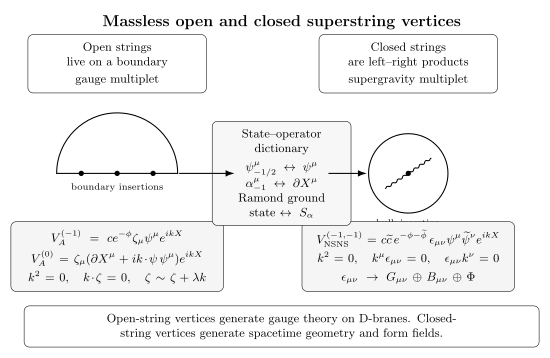
At nonzero null momentum the physical NSNS tensor lives in an eight-dimensional transverse space. Its 64 polarizations split as . The scalar uses the transverse identity, or covariantly , rather than the ten-dimensional metric. The diagram describes representations and does not depict a spatial geometry.
The zero-picture bulk density
Section titled “The zero-picture bulk density”The closed chiral plane wave carries , whereas the open doubled wave carried . Applying the same supercurrent contraction therefore gives the chiral vector factor
The corresponding fully integrated density is
Its unintegrated representative has a BRST completion on each side, including the terms containing and . It is not universally just times this matter density. Two-sided antighost descent recovers the integrated density. In picture , where the simple ghost factorization above applies, that descent directly removes .
Mixed sectors and R–R field strengths
Section titled “Mixed sectors and R–R field strengths”The NS–R and R–NS massless vertices replace one NS fermion by a spin field and its picture- dressing. The corresponding polarization is a vector-spinor: it is transverse and gauge-equivalent in its vector index and satisfies the Dirac equation and GSO chirality condition in its spinor index. After these conditions, one mixed sector has or , hence 64 polarizations. Its gamma trace gives an eight-component dilatino; the gamma-traceless part gives a 56-component gravitino. Exercise 4 constructs the actual projector, rather than relying on the count alone.
For the R–R sector, write the two spinor polarization coordinates as a matrix . The canonical vertex is
The two chiral BRST constraints give
The transpose in the right constraint matters: has two spinor-coordinate indices, not one spinor and one dual index.
Converting a bispinor into differential forms
Section titled “Converting a bispinor into differential forms”Let be the charge-conjugation matrix satisfying . Define the Clifford matrix associated with the polarization by
The antisymmetrized gamma matrices use unit-weight antisymmetrization. The expansion defines the form coefficients; the GSO chirality conditions will relate some degrees by Hodge duality. The two Dirac constraints become
To interpret them, identify a Clifford matrix with its differential-form coefficients and write . Left multiplication by acts as . On a degree- form, right multiplication acts as . All allowed degrees have the same parity. Adding and subtracting the two equations therefore separates the conditions
For a plane wave these are the linearized Bianchi identity and field equation, and . Thus the symmetric-picture R–R vertex naturally contains field strengths, rather than gauge potentials. This interpretation and its flat-background scope are explicit in Polchinski’s R–R charge paper, equations (2)–(3). Nonlinear supergravity field strengths with Chern–Simons corrections are a different construction.
At nonzero momentum the first equation also lets us reconstruct a potential locally. Contracting it with the auxiliary gives
Consequently with . The factor follows from the plane wave . The potential is defined only up to , which leaves unchanged. Exercise 5 reduces this description to transverse polarizations.
Chirality selects the allowed form degrees
Section titled “Chirality selects the allowed form degrees”Let the left and right Weyl chiralities be . Their constraints are and . In ten dimensions, . Hence
A degree- gamma product commutes or anticommutes with according to . A nonzero term must therefore satisfy
Equal chiralities give the odd field strengths of type IIB; opposite chiralities give the even field strengths of type IIA. Hodge-dual degrees are not independent. For propagating massless states one may choose
| Theory | Independent field strengths | Potentials | Physical polarizations |
|---|---|---|---|
| Type IIA | |||
| Type IIB | with the five-form duality constraint |
With the conventional type IIB orientation, the five-form condition is written . It halves the transverse four-form potential’s polarizations to 35. A degree-zero field strength cannot carry a nonzero-momentum wave satisfying ; this statement does not exclude the constant mass parameter of massive type IIA backgrounds.
The vertex construction thus gives the same closed-string states as the tensor products in the type II spectrum discussion, while also identifying their linearized field equations.
Inserting vertices in a disk amplitude
Section titled “Inserting vertices in a disk amplitude”A disk has three real conformal Killing parameters, the group . In an all-open amplitude, three punctures may be fixed and the remaining punctures are integrated in an ordering domain. The three fixed vertices supply the three zero modes. Independently, the disk’s superghost background charge requires total picture , including any explicit picture-changing insertions.
For the cyclic order , choose
One convenient four-vector amplitude is
The pictures are , and the ghost numbers are . The final zero-picture vertex contains both and . In this particular tree correlator, its term leaves only two insertions and has no insertion to compensate; its expectation value vanishes. That is why a computation of this amplitude may use only at the last puncture. It is not a reason to omit the term from the BRST representative.
The plane-wave part, after the usual conformal limit at infinity and momentum conservation, becomes
where and for massless external states. The rest of the correlator supplies additional rational functions of and the polarization dependence. It would be incorrect to integrate this exponential factor alone and call it the four-vector amplitude.
The construction of vertex operators and the explicit ghost contractions are developed in Friedan, Martinec, and Shenker, section 5.4. Exercise 2 below checks the three-vector correlator’s position independence and gauge invariance. The next page on tree amplitudes and Chan–Paton factors develops the ordered integrals, color traces, and Yang–Mills interpretation.
On a sphere, three closed punctures instead supply three and three insertions. Total picture must be separately in each chiral sector. Integrating a closed puncture removes both reparametrization ghosts through descent; it does not change either picture. Mixed open/closed disk insertions require their own real moduli count, worked out in Exercise 6.
Common pitfalls
Section titled “Common pitfalls”A matter descendant is not the complete unintegrated vertex. has weight one and ghost number zero. The zero-picture local physical representative is .
The open momentum factor is not a choice of units. At the same physical momentum, a boundary wave is and a closed chiral wave is . Their derivative contractions and conformal weights differ accordingly.
The dilaton is a physical transverse trace. The ten-dimensional metric alone is not a transverse scalar polarization. Projecting first also makes the count precise.
R–R field strengths and potentials have different roles. The canonical symmetric-picture vertex obeys two Dirac equations that become a Bianchi identity and a field equation. Potential gauge transformations should not be imposed as an additional quotient on its already physical bispinor polarizations.
Exercises
Section titled “Exercises”Exercise 1: the boundary coupling and dimensional reduction
Section titled “Exercise 1: the boundary coupling and dimensional reduction”Rewrite the integrated open vector density in terms of the boundary coordinate and the linearized field strength . Show directly that the coupling changes by a total derivative under . Explain how the massless polarizations reduce on a flat D-brane, and count the bosonic polarizations on a D3-brane.
Solution
On a Neumann boundary, . Anticommutativity gives
Substitution into the superdescendant gives
This is a boundary gauge-potential coupling accompanied by its fermion term. For , the two terms involve and its field strength, respectively. Their relative coefficient is fixed by worldsheet supersymmetry, not independently adjustable. The displayed normalization is the vertex normalization, not a determination of the spacetime gauge coupling.
For , . The remaining variation is
Its integral along a closed boundary vanishes when no operator collisions intervene. For an ordered interval in an amplitude, endpoint terms must be treated together with factorization and BRST identities; one cannot discard them without specifying the amplitude prescription.
For a static flat D-brane, translation momentum is conserved only in the Neumann worldvolume directions. An open massless state has in the Dirichlet directions. The components obey the worldvolume transverse condition and gauge equivalence, leaving vector polarizations for nonzero null worldvolume momentum. The components are scalar polarizations and are unaffected by . Under T-duality their boundary couplings involve the normal derivative of a Dirichlet coordinate, describing a transverse displacement; one should not set them to zero because the tangential derivative of that coordinate vanishes.
A D3-brane therefore has bosonic polarizations. In a supersymmetric stack of coincident oriented branes in flat space, the scalar fields are the six reduced components of the ten-dimensional gauge field, with Chan–Paton multiplicities added separately. This is the origin of the bosonic field content of four-dimensional super Yang–Mills theory. The transverse-fluctuation interpretation follows directly from the D-brane boundary conditions discussed by Polchinski, equation (4) and the following discussion.
Exercise 2: a position-independent three-vector amplitude
Section titled “Exercise 2: a position-independent three-vector amplitude”At distinct finite real points , compute the three-vector disk correlator using pictures . Keep the relative coefficient between the derivative and four-fermion contributions, but suppress the common disk and Chan–Paton normalization. Show that the result is independent of the three positions and vanishes when any polarization is replaced by its momentum. Explain why a nonzero three-point result requires analytic continuation of real Lorentzian massless kinematics.
Solution
All three vertices are unintegrated. Only the part of the third vertex can saturate the three zero modes. Write and choose a consistent overall ghost and cocycle phase. Then
Momentum conservation, , and three-point kinematics imply for . Hence the Koba–Nielsen factor is one, apart from the momentum delta function.
For the derivative part of , contract with and with the other two exponentials. The result after multiplying the ghost factors is
Using , the position factor reduces to one:
The fermionic term in has the fixed ordering . Normal ordering excludes a contraction between these two fields. Wick’s signs give
Its denominator has canceled the remaining ghost factor. Adding and using transversality gives the cyclic expression
This is proportional to the color-ordered Yang–Mills three-vector structure. An overall sign or phase is convention dependent; the cancellation and relative terms are not.
Set . The middle term vanishes because , and the other two combine to
Cyclic symmetry proves the other two Ward identities. Changing the relative sign in would spoil this cancellation.
For real Lorentzian null momenta obeying momentum conservation, the three momenta are collinear, and all momentum–transverse-polarization products in this expression vanish. The nonzero analytic three-point coupling is defined by complex momenta or an equivalent analytic continuation. It determines the local interaction and factorization residues even though real massless three-particle scattering has this degenerate kinematics.
Exercise 3: changing the reference vector of the dilaton
Section titled “Exercise 3: changing the reference vector of the dilaton”For fixed nonzero null , take two null vectors and satisfying . Prove that the two unit scalar polarizations differ by a physical gauge shift. Show that the scalar label extracted from a transverse tensor is independent of this choice. Finally, explain how double projection of a transverse tensor changes only its gauge representative.
Solution
Write , so . Directly,
This is the allowed on-shell gauge shift with . The transverse scalar state therefore does not depend on the reference vector, although its ten-dimensional representative does.
For a tensor satisfying ,
The terms containing vanish. This trace is unchanged by an allowed gauge transformation, since its variation is . It is also the trace of the double-projected tensor, by idempotence of .
To see the gauge equivalence explicitly, define
Then
All terms are gauge terms; for example choose and . Their contractions with vanish by the original transversality and . Projection is therefore a choice of representative in the quotient, not an extra physical-state constraint.
In the frame and , the mixed projector is zero in the two longitudinal directions and the identity in the eight remaining spatial directions. Its trace and squared norm are eight. This makes both the unit scalar normalization and the count explicit.
Exercise 4: extracting a gravitino and a dilatino
Section titled “Exercise 4: extracting a gravitino and a dilatino”After imposing the physical vector and spinor constraints, write a mixed-sector polarization as , where labels the transverse vector space and is one eight-dimensional spinor representation. Let transverse Clifford matrices map to and back, with . Construct the gamma-trace and gamma-traceless projectors. Prove idempotence and count the two resulting representations.
Solution
The gamma trace is a spinor of the opposite transverse chirality,
Since , define
Then and . The matrix acting on vector-spinors is
Multiplication gives
The complementary projector has image parameterized by the arbitrary eight-component , so its rank is eight. The original space has dimensions, leaving rank 56 for .
These are the massless little-group representations of a dilatino and a gravitino. The decomposition is made after the covariant Dirac equation and vector gauge quotient have selected the physical transverse states. Imposing gamma-tracelessness on the entire mixed-sector vertex would incorrectly discard the dilatino; it is a projection onto one particle species, not a condition on their direct sum.
Exercise 5: from R–R constraints to transverse forms
Section titled “Exercise 5: from R–R constraints to transverse forms”Let a degree- polarization obey and at a nonzero null momentum. Using and , show that it can be written uniquely as with transverse to both and . Count the physical polarizations, and recover the IIA and IIB totals. Why does the gauge freedom of a potential not remove these polarizations?
Solution
The contraction identity
gives . Set . Since contractions anticommute,
Thus is an -form on the physical eight-dimensional transverse space. Conversely, any such gives and
The reconstruction is injective: if and , contraction with gives . Therefore there are independent polarizations before any duality constraint.
A potential can be chosen as , since . Adding changes the potential but leaves the field strength, and hence , unchanged. The eight-dimensional form already describes gauge-invariant propagating data; there is no further potential gauge quotient to apply to it.
For IIA, the independent strengths have :
For IIB, the independent strengths have . The first two give . The five-form duality condition restricts the transverse four-form to one eigenspace of the eight-dimensional Hodge star. Complementary four-index sets pair under that star, so its two eigenspaces each have half of dimensions. Hence
These counts match the tensor product of two eight-dimensional physical Ramond spinor spaces. The argument describes nonzero-momentum linearized waves; constant fluxes, global cohomology, and brane sources require additional information.
Exercise 6: one closed string and two open strings on a disk
Section titled “Exercise 6: one closed string and two open strings on a disk”A disk contains one bulk massless closed insertion and two boundary massless open insertions. Count the real moduli after fixing conformal Killing transformations. Give explicit positions and ghost insertions that implement this count. First take the closed state to be NSNS and both open states NS. Then take the closed state to be R–R and again both open states NS. Find consistent picture assignments without separate picture-changing insertions. Explain why these necessary counts do not establish that the amplitudes are nonzero.
Solution
The bulk point contributes two real coordinates and each boundary point one. Subtracting the three parameters of leaves
real modulus. Choose the bulk point and one boundary point . These fix all three conformal Killing parameters. The second boundary point is integrated over the appropriate real boundary domain; the point at infinity must be covered consistently when dividing the domain into orderings.
The unintegrated closed vertex provides in upper-half-plane notation, and the fixed open vertex provides . After doubling the ghost sector,
up to the common ghost normalization. The integrated open vertex has no . This supplies exactly the three real conformal Killing ghost modes; there are not three independent left modes and another three independent right modes on a disk.
For an NSNS closed state choose picture , already contributing total disk picture . Both open vertices may then be in picture zero, one unintegrated and one integrated. Use the complete BRST representative at the fixed open point; its component is the one saturating the displayed correlator.
For an R–R closed state choose , contributing . Put the fixed NS open state at picture and the integrated NS open state at picture zero. The total is again , with no additional picture-changing insertion.
The remaining matter and superghost correlators are nontrivial. On a D-brane, right-moving fields are reflected into left-moving fields with the appropriate Neumann/Dirichlet reflection matrix, and spin fields require its spinor counterpart. Momentum is conserved along the brane; the brane can absorb transverse momentum. Chirality, polarization, Chan–Paton traces, and dynamical couplings can still make a charge-balanced amplitude vanish. Ghost and picture counting specify a possible amplitude construction, not its value.
References
Section titled “References”- Berkovits, Nathan. “Manifest Spacetime Supersymmetry and the Superstring.” Journal of High Energy Physics 2021, no. 10 (2021), 162. arXiv:2106.04448. Section 2 discusses the RNS vertex representatives and their ghost completion.
- Friedan, Daniel, Emil Martinec, and Stephen Shenker. “Conformal Invariance, Supersymmetry and String Theory.” Nuclear Physics B 271 (1986), 93–165. Author-hosted full text. Sections 5.1–5.4 develop physical vertices, pictures, and tree amplitudes.
- Polchinski, Joseph. “Dirichlet-Branes and Ramond–Ramond Charges.” Physical Review Letters 75 (1995), 4724–4727. arXiv:hep-th/9510017; doi:10.1103/PhysRevLett.75.4724. The opening discussion identifies the R–R field-strength equations and the physical meaning of D-brane boundary conditions.
- Polchinski, Joseph. String Theory, Volume II: Superstring Theory and Beyond. Cambridge University Press, 1998. Sections 10.3–10.5 treat spin fields, superghost pictures, and physical vertex operators. Publisher-distributed preview.