
String Theory I Introduction
These pages develop the material of Professor Igor R. Klebanov’s one-semester course, “Introduction to String Theory,” taught in Spring 2010. The initial drafts were prepared with the assistance of AI and have since been reviewed and edited by me. The site is still under construction; although I have tried to ensure accuracy, some errors may remain. If you notice any significant mistakes, I would greatly appreciate your feedback.
String theory connects a two-dimensional quantum field theory on a worldsheet to particles and interactions in spacetime. This course develops that connection from the classical string actions through quantization, conformal field theory, scattering amplitudes and superstrings. It ends with T-duality and the dynamics and charges of D-branes. String Theory II continues toward string dualities, black branes and holography.
Perturbative strings and worldsheet physics
Section titled “Perturbative strings and worldsheet physics”The recurring question is how a worldsheet calculation acquires a spacetime meaning. Oscillator constraints determine particle polarizations; conformal invariance constrains backgrounds; vertex correlators become scattering amplitudes; and boundary conditions describe D-branes. The pages develop these connections through derivations, checks of limiting cases and normalizations, explicit statements of scope, and solved exercises.
The bosonic string is the first working example. Its tachyon and critical dimension are physical features of that model, not conclusions that can be transferred unchanged to the superstring. The later RNS construction adds worldsheet fermions, projects the spectrum, and leads to Type I and Type II theories. Low-energy actions are identified with their approximation regimes. Holography is developed in the second course after these foundations.
Prerequisites
Section titled “Prerequisites”You should be comfortable with special relativity, Lagrangian and Hamiltonian mechanics, elementary quantum field theory, path integrals, complex analysis and basic Lie algebra representations. Two-dimensional conformal field theory is developed within the course. The relativistic particle introduces reparametrization constraints in a simpler setting, while the free-boson CFT begins the operator methods used later.
How to read the course
Section titled “How to read the course”The numbered pages form one main sequence. The following stages describe how its questions develop.
- Pages 01–09: classical strings and quantization. Derive the actions, constraints and mode expansions, then compare covariant and light-cone descriptions of the spectrum. State counting leads to the Hagedorn scale.
- Pages 10–19: conformal fields and physical states. Learn OPEs, conformal representations, ghosts and moduli. Anomaly cancellation and BRST cohomology explain which gauge-fixed states are physical.
- Pages 20–24: amplitudes and spacetime fields. Compute tree amplitudes and factorization, identify the massless fields, and derive their leading effective equations from scattering and worldsheet renormalization.
- Pages 25–33: the RNS superstring. Construct NS and Ramond states, derive the GSO projection and Type II spectra, and use spin fields and picture changing to compute open-string couplings. Orientation projection and Chan–Paton factors lead to Type I theory.
- Pages 34–36: duality and D-brane dynamics. Exchange momentum and winding, turn Wilson lines into brane positions, and connect stretched strings to gauge fields, the DBI action and RR charge.
On a first pass, follow the physical question and reconstruct the central derivation before opening an exercise solution. On a return pass, use the exercises to test a changed assumption or a new example. The global conventions below are the reference for signs and normalizations throughout the course. Polchinski’s two volumes and Tong’s lectures provide complementary treatments; complete references appear at the end of this page.
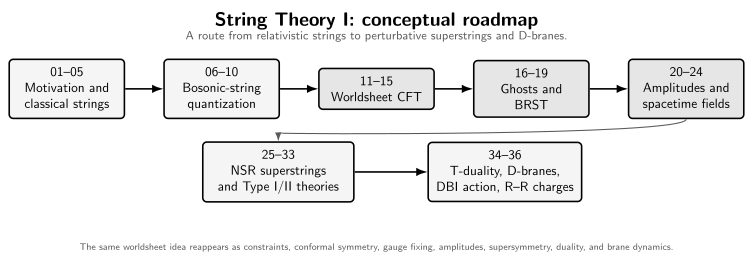
The main reading sequence and the question addressed at each stage. Page ranges are consecutive; the arrows indicate progression through the course, not a claim that one result alone proves the next stage. This is a schematic guide with no physical scale.
Table of contents
Section titled “Table of contents”| Page | Title | Main topics |
|---|---|---|
| 01 | Why Strings? Regge Behavior and Dual Resonance Models | Regge trajectories, string scales, compact dimensions and Veneziano duality. |
| 02 | The Relativistic Point Particle | Reparametrization, the einbein, the mass-shell constraint and the proper-time propagator. |
| 03 | The Nambu–Goto and Polyakov Actions | Worldsheet area, transverse fluctuations, Casimir energies and the auxiliary metric. |
| 04 | Worldsheet Symmetries, Boundary Conditions, and Conformal Gauge | Diffeomorphisms, Weyl symmetry, residual conformal maps and endpoint conditions. |
| 05 | Classical Rotating Strings and the Regge Slope | Energy and angular momentum, the classical Regge bound and folded strings. |
| 06 | Mode Expansions and Canonical Quantization | Open and closed modes, oscillator commutators and the cylinder-to-plane map. |
| 07 | Covariant Virasoro Constraints and Bosonic Spectra | Virasoro constraints, null-state quotients, level matching and low-lying spectra. |
| 08 | Light-Cone Quantization and the Critical Dimension | Transverse oscillators, the intercept and the Lorentz-anomaly calculation. |
| 09 | Hagedorn Growth and String Thermodynamics | Physical-state degeneracies, eta-function asymptotics and thermal limits. |
| 10 | String Interactions and the Free Boson CFT | Worldsheet topology, Gaussian correlators, zero modes and normal ordering. |
| 11 | Stress Tensor, Primaries, and Conformal Transformations | Stress-tensor contours, primaries, descendants and Ward identities. |
| 12 | Vertex Operators, OPEs, and the Virasoro Algebra | Exponential and tensor vertices, conformal families and the central extension. |
| 13 | Radial Quantization and State–Operator Correspondence | States from local insertions, cylinder evolution and the Schwarzian term. |
| 14 | Highest-Weight Modules, Null States, and the Kac Determinant | Verma modules, Gram forms, singular vectors and null-state equations. |
| 15 | Minimal Models, Ward Identities, and Correlators | Minimal models, Ising conformal blocks, monodromy, crossing and fusion. |
| 16 | Bosonic Physical States and the No-Ghost Structure | Physical matter vertices, gauge descendants and the no-ghost theorem. |
| 17 | The bc Ghost System and Ghost Zero Modes | Graded contractions, central charge, ghost number and sphere zero modes. |
| 18 | The Polyakov Path Integral and Moduli | Faddeev–Popov zero modes, Beltrami pairings, punctures and the modular quotient. |
| 19 | Weyl Anomaly, Liouville Theory, and BRST Quantization | Weyl response, the Liouville mode, BRST cohomology and vertex descent. |
| 20 | Tree-Level String Amplitudes from Worldsheet Correlators | Sphere correlators, Möbius fixing, Koba–Nielsen factors and the moduli integral. |
| 21 | The Virasoro–Shapiro Amplitude and Factorization | The complex beta integral, closed-string poles, residues and the Regge limit. |
| 22 | Massless Closed-String Vertices and Gauge Invariance | Tensor polarizations, graviton, two-form and dilaton states, and gauge equivalence. |
| 23 | The Low-Energy Effective Action | Cubic amplitudes, string-frame interactions, genus weights and Einstein frame. |
| 24 | Sigma-Model Beta Functions and the Linear Dilaton | The Ricci beta function, Weyl invariance and the exact linear-dilaton CFT. |
| 25 | Worldsheet Supersymmetry and the NSR Action | Worldsheet fermions, local supersymmetry, superspace and the supercurrent. |
| 26 | Superconformal Algebra and NS/R Sectors | Super-Virasoro modes, spin structures, Clifford zero modes and intercepts. |
| 27 | The Open Superstring Spectrum | Endpoint doubling, NS and Ramond constraints, and unprojected physical states. |
| 28 | Ten-Dimensional Spinors and Ramond Ground States | Clifford modules, Majorana–Weyl reality and massless Spin(8) polarizations. |
| 29 | The GSO Projection and Open-String Supersymmetry | GSO projectors, massive multiplets and all-level Bose–Fermi matching. |
| 30 | Closed Superstring Sectors and Type II Theories | Level matching, mixed-sector spinors, RR form polarizations and Type IIA/IIB. |
| 31 | Bosonization, Spin Fields, and Superghosts | Spin fields, cocycles, superghost dressing, picture number and its cohomology scope. |
| 32 | NSR Vertex Operators and Picture Changing | BRST-complete vertices, picture changing, descent and fermion/vector disk couplings. |
| 33 | Type I Strings, Orientifolds, and Chan–Paton Factors | Worldsheet parity, endpoint projections, color traces and the Type I tadpole condition. |
| 34 | Closed-String T-Duality and Enhanced Symmetry | Canonical radius duality, the self-dual spectrum, current algebra and radius deformations. |
| 35 | Open-String T-Duality and D-Branes | Wilson-line holonomy, brane positions, stretched masses and worldvolume fields. |
| 36 | D-brane dynamics, tachyon condensation, and RR charges | DBI dynamics, electric flux, tachyon energy cancellation and electric/magnetic RR charge. |
Global conventions
Section titled “Global conventions”These conventions apply throughout String Theory I unless an explicit conversion is being made.
Units, spacetime metric, and string scale
Section titled “Units, spacetime metric, and string scale”We use and a mostly-plus spacetime metric:
We keep explicit. It has dimension of length squared and determines the tension, string length, and characteristic mass scale:
Special choices such as are used only when explicitly identified.
Spacetime curvature, dilaton, and gravitational normalization
Section titled “Spacetime curvature, dilaton, and gravitational normalization”Our curvature convention is
In particular, a round sphere has positive scalar curvature. For expansions about a constant asymptotic dilaton, distinguish the total field, its dimensionless fluctuation, and the string coupling:
In dimensions, the Einstein metric is normalized to agree with the string metric at infinity. The gravitational couplings and the canonical scalar are
The unshifted string-frame prefactor is ; equivalently it is . Thus , whereas and are dimensionless. In a constant background, also denotes the background value. These are spacetime fields: the worldsheet Weyl parameter and the bosonized superghost are separate objects. These definitions do not assign a numerical value to the bosonic gravitational coupling or determine its value after compactification. For , they agree with the String II normalization. The effective-action page derives the frame transformation and scalar kinetic term.
Matrix gauge fields
Section titled “Matrix gauge fields”Chan–Paton generators and the matrix gauge potential are Hermitian, with . With the gauge coupling in front of the action, use
For an adjoint field , . The representation trace and its normalization must be specified with the action; the D3-brane matrix normalization is used in the holographic dictionary.
Worldsheet coordinates and integration measure
Section titled “Worldsheet coordinates and integration measure”Lorentzian worldsheet coordinates are
In conformal gauge we use light-cone coordinates
On a Euclidean worldsheet, write , , and
Our complex integration measure is twice the ordinary coordinate area:
The delta function is normalized in this measure, so
In real-coordinate covariant integrals, denotes the ordinary metric area element; it does not include this extra factor of two.
Free matter fields and ghosts
Section titled “Free matter fields and ghosts”For free coordinates in flat target space, the Euclidean action and two-point singularity are
Accordingly, the bulk exponential has weights . Boundary operators use the doubling construction, derived where it is needed.
The reparametrization ghosts have holomorphic weights and :
Tildes denote the antiholomorphic sector. Ghost number is for , for , and for the identity vacuum , with the same assignments in the antiholomorphic sector.
Worldsheet fermions
Section titled “Worldsheet fermions”The RNS fermions have canonical normalization: their target-space index is a vector index, and their worldsheet spinor components are dimensionless when the worldsheet coordinates are dimensionless. In Lorentzian signature we use real Majorana components and
Thus with . The flat, gauge-fixed matter action is
Its chiral fermion term is . In particular, depends on on shell. With and , it continues to the holomorphic field; continues to the antiholomorphic field. No additional fermion phase is needed with these choices.
On a flat Euclidean worldsheet, the fermion action and OPEs are
The two chiralities have no singular mixed OPE in the bulk. Euclidean chiral fields are treated as independent Grassmann fields; the real Lorentzian Majorana condition is not imposed separately on each Euclidean component. The matter currents are
Their weights are and , and free coordinate multiplets have in each chiral sector. Some pages use the alternate name for the supercurrent. These normalizations keep explicit; setting is an explicitly stated specialization. The corresponding rigid transformations and Lorentzian constraints are summarized in the String II overview and derived in the RNS pages.
Bosonization and superghost pictures
Section titled “Bosonization and superghost pictures”Chiral matter bosons obey and have stress tensor . A normalized complex fermion is represented by , with cocycles supplying the statistics between different species. Ramond spin fields belong to twisted charge sectors.
For the commuting superghosts, the ordered OPEs are
Their bosonization uses an anticommuting pair of weights and a scalar , written when unambiguous:
Cocycles make odd, so these ordered products are even. Ghost number and picture are distinct gradings, with currents
Thus has ghost number and picture ; have ghost numbers and pictures . Both and have picture zero. Derivatives preserve both charges. The small Hilbert space is , with . Derivations appear on bosonization, spin fields, and superghosts and ghosts, superghosts, and BRST.
Worldsheet superspace
Section titled “Worldsheet superspace”Euclidean worldsheet superspace has independent odd coordinates and . Odd derivatives act from the left; odd coordinates, fermion fields, and supersymmetry parameters anticommute. The ordered Berezin measure is
The rightmost integration acts first. The covariant odd derivatives and supertranslation generators are
With , the scalar matter superfield is
Here is an auxiliary field. With dimensionless worldsheet coordinates, , , and have dimensions of length, while the canonical fermions and odd coordinates are dimensionless. Parameters are written on the left in . These odd coordinates are worldsheet spinor coordinates; they are distinct from the target-space spinors used in the Green–Schwarz formulation. The worldsheet supersymmetry page derives the component action and transformations with these definitions.
Stress tensors and normal ordering
Section titled “Stress tensors and normal ordering”The holomorphic stress tensors and central charges are
Here is the number of free coordinates. More generally, and refer to the complete matter sector, including any internal CFT. In the bosonic string, ; the RNS string also includes the superghost stress tensor .
For variations of the Euclidean worldsheet metric, we use
The partition function has weight and the Euclidean effective action is . A metric-source tensor defined instead by has the opposite sign: . The worldsheet convention above fixes the signs in Weyl variations.
For classical Lorentzian calculations, distinguish the Hilbert stress tensor from the constraint tensor with the tension removed:
For the bosonic Polyakov action, let be the induced metric. Then
This is not the holomorphic CFT stress tensor . With the Euclidean definition above, the free theory has and , with normal ordering understood. Thus a classical constraint and a canonically normalized stress tensor have the same vanishing condition but different normalization factors.
Ordinary colons in local fields denote plane OPE normal ordering. When oscillator normal ordering uses a different vacuum, it is marked separately; its constant shifts are derived explicitly in the state-space calculation.
References
Section titled “References”- Joseph Polchinski, String Theory, Vol. 1: An Introduction to the Bosonic String (Cambridge University Press, 1998), doi:10.1017/CBO9780511816079; Vol. 2: Superstring Theory and Beyond (Cambridge University Press, 1998), doi:10.1017/CBO9780511618123.
- David Tong, String Theory, University of Cambridge Part III lecture notes (2009; revised 2012), arXiv:0908.0333.
Further reading
Section titled “Further reading”- Katrin Becker, Melanie Becker and John H. Schwarz, String Theory and M-Theory: A Modern Introduction (Cambridge University Press, 2007), publisher page. A continuation toward compactification, branes and dualities.
- Michael B. Green, John H. Schwarz and Edward Witten, Superstring Theory, Vol. 1: Introduction and Vol. 2: Loop Amplitudes, Anomalies and Phenomenology (Cambridge University Press, 1987; 25th-anniversary edition, 2012), Vol. 1, Vol. 2. Detailed superstring constructions and consistency calculations.
- A. M. Polyakov, Gauge Fields and Strings (Harwood Academic Publishers, 1987; open-access edition, Routledge, 2021), doi:10.1201/9780203755082. The path-integral and two-dimensional field-theory perspective.
- Barton Zwiebach, A First Course in String Theory, 2nd ed. (Cambridge University Press, 2009), doi:10.1017/CBO9780511841620. An introductory complement with geometric explanations and worked examples.