
Low-Energy Limits: DBI, Type I, and Type II Supergravity
String amplitudes describe an infinite tower of particles, but experiments at energies well below the string scale cannot produce its massive levels. Their virtual effects survive as local interactions among the massless fields. Open strings give gauge theory and D-brane dynamics; closed strings give gravity, the dilaton, and antisymmetric tensor fields. The purpose of this page is to derive the leading actions and explain what their coefficients and gauge symmetries mean.
We use the overview’s dilaton and Einstein-frame normalization and brane tension and matrix trace definitions. In particular, the total dilaton , its fluctuation , and the canonical field have different roles. The default Einstein metric agrees with the string metric at infinity. The Ramond–Ramond potentials below are not rescaled by ; we track those factors explicitly. Their nonlinear relation to the potentials in the D-brane coupling will also matter.
The vertex construction and disk-amplitude calculation provide the scattering input. We concentrate on bosonic two-derivative supergravity and the leading D-brane action. Fermions supply the supersymmetric completion, but their full interactions are outside this page.
Matching amplitudes to a local action
Section titled “Matching amplitudes to a local action”There are two independent approximations. Small dimensionless Mandelstam invariants , , and the other independent channel invariants permit a derivative expansion, while small local string coupling suppresses string loops. On a curved background, the first condition also requires small curvature and field-gradient invariants in string units. A low external frequency alone does not make a strong background field weak.
Consider the color-ordered four-vector amplitude derived on the preceding page:
Its leading term contains the massless Yang–Mills exchange poles. If , with its coupling suppressed, then
The poles have canceled from this difference. Its first term is a local four-field interaction of type. This illustrates the matching procedure: reproduce the exchange diagrams of the fields already retained, subtract them, and use the remaining analytic momentum dependence to determine contact operators. On-shell amplitudes determine these coefficients modulo field redefinitions and other terms invisible to the chosen perturbative data. They do not identify a unique off-shell Lagrangian.
For a coincident stack of oriented D-branes, the leading gauge action has the shared normalization
Here is the worldvolume metric appropriate to this action. With , the component coefficient is . The ten-dimensional vector and its adjoint Majorana–Weyl gaugino each have eight physical polarizations. Dimensional reduction gives and transverse scalar matrices ; the corresponding transverse position is . The detailed embedding dynamics will be developed on the DBI page.
The dilaton counts worldsheet topology
Section titled “The dilaton counts worldsheet topology”For a constant dilaton, the Euclidean worldsheet coupling includes the boundary curvature term:
The boundary orientation and geodesic-curvature sign are chosen as in Gauss–Bonnet; a flat unit disk has . For a surface represented by handles, boundaries, and crosscaps, . The path-integral weight is . Thus a sphere contributes , while a disk and each contribute .
These weights explain the NSNS sphere factor and the D-brane disk factor . They are weights before canonically normalizing external fields. In particular, the absence of an explicit from the usual RR kinetic terms does not make them loop effects: their potentials use a different normalization. Type I also has crosscap contributions and their associated tadpole conditions; the orientifold page treats that consistency problem.
The DBI determinant and two gauge normalizations
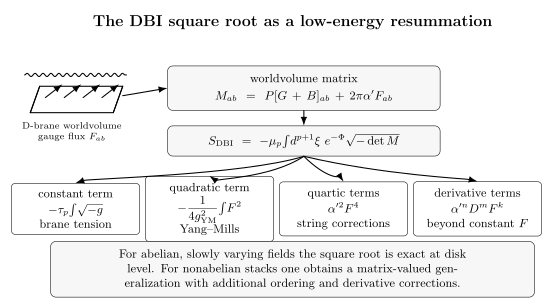
Section titled “The DBI determinant and two gauge normalizations”For a single type II D-brane, the leading disk action for slowly varying fields is
The pullback is . Under , the boundary gauge field changes by , so is invariant. The prefactor may equally be written , using the overview’s physical tension .
DBI sums powers of a constant Abelian field strength. It omits derivatives of that field and higher-curvature corrections. Consequently it can describe some strong, slowly varying fields that Yang–Mills theory cannot. Near a critical electric field, the fluctuation scales and derivative expansion need separate scrutiny. A symmetrized color trace is not an exact all-orders non-Abelian replacement; Tseytlin, sections 2 and 6, explains this distinction.
Set and , and write and . The quadratic term follows from an ordinary trace over worldvolume indices:
Therefore
The trace here is unrelated to the Chan–Paton trace. For a unit Abelian generator, comparison with gives
For matrices, the quadratic disk term is . Comparing it with the matrix action above instead gives
Thus , while . Both follow from the same determinant with explicitly different generator/field normalizations. Their dimensions are .
The curves show the normalized DBI square-root factor in the Lagrangian for a pure electric or magnetic field, with and . The electric branch is restricted to . This factor is not the electric energy density; the Legendre transform in Exercise 1 diverges as . Both axes are dimensionless.
Physical NSNS fields and their string-frame equations
Section titled “Physical NSNS fields and their string-frame equations”At nonzero null momentum, the physical NSNS polarization is a tensor on the eight-dimensional transverse space. Choose an auxiliary null vector with . The projector
has rank eight. For a transverse representative , define . Then
The normalized scalar tensor is , and the physical count is . Changes of change the representative by gauge terms, as derived on the vertex page. The spacetime dilaton is this independent scalar degree of freedom, not an additional trace added to an already decomposed tensor. Its relation to a metric trace depends on the frame: linearizing gives around the common flat background.
The leading NSNS action in string frame is
The form norm appearing in these kinetic terms is , so . It includes the Lorentzian metric signs. This definition will make the component and differential-form actions agree.
The coupling is because the action contains the total dilaton. Equivalently, replace by in this entire NSNS formula: . An additional must not be inserted afterward.
Varying the action gives
Here the metric equation has been combined with the dilaton equation. For example, the dilaton variation produces times the displayed Lagrangian bracket and . Integrating the latter with the weight produces , including the coefficient . Exercise 3 derives the metric combination and checks a nonconstant background.
These equations also govern leading Weyl invariance of the supersymmetric sigma model with metric, two-form, and dilaton couplings. Its bosonic background-coupling terms contain , , and . Worldsheet fermions complete that model. This argument constrains the NSNS sector; it does not derive RR interactions from a sigma model in which RR couplings have been omitted. Tong, section 7.3, develops the variation and frame method in the bosonic setting; the critical superstring action here is ten-dimensional.
Deriving Einstein frame
Section titled “Deriving Einstein frame”Write in dimensions. The curvature transformation is
Using the shifted dilaton and physical coupling, the coefficient of is . Choose . This sets that coefficient to one. The Laplacian is then a total derivative in the Einstein measure, and the remaining dilaton kinetic coefficient is
The apparently positive string-frame scalar kinetic term has mixed with the metric; in the physical scalar has the ordinary coefficient :
Substituting the shared makes its quadratic kinetic action . Frame changes are field redefinitions; physical scattering agrees after the fields and their normalizations are transformed together.
A general form-field weight
Section titled “A general form-field weight”Consider a string-frame term . The volume contributes and the inverse metrics contribute . Hence
In ten dimensions the exponent is . This single calculation controls all the form kinetic terms below.
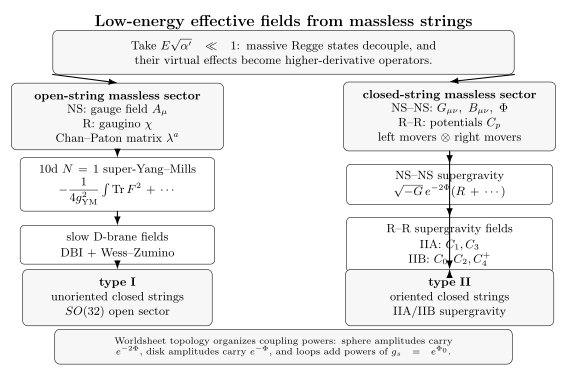
The diagram uses the asymptotically normalized transformation in ten dimensions. The parameter specifies the original string-frame factor ; is the field-strength degree. Constant coupling factors are separate. In particular, a disk gauge term has exponent , whereas a sphere gauge term has exponent .
One often encounters instead . This is the overview’s unshifted metric, related by . With , actions use and total- exponents. With , they use and shifted exponents, with the RR constants translated as follows:
The same accompanies a metric-independent RR Chern–Simons term after changing the common gravitational prefactor. We keep these factors instead of redefining the RR potentials and silently changing their charge or axion normalization.
Type I gauge fields and the positive dilaton exponent
Section titled “Type I gauge fields and the positive dilaton exponent”The type I projection retains the metric, dilaton, an RR two-form , and an open-string gauge multiplet. It removes the NSNS two-form. In the following expression, means the physical gauge coupling measured at with the shared matrix trace; its absolute relation to the orientifold normalization is not needed for the frame argument.
The gravitational, RR kinetic, and gauge kinetic terms have the structure
This is not a complete anomaly-canceling action: includes Yang–Mills and Lorentz Chern–Simons corrections, and further curvature and Green–Schwarz terms are required. Their coefficients depend on the specified gauge and Lorentz traces. We do not assign them by a coefficient-free equality. The properly normalized full theory and its relation to the heterotic description are discussed in Johnson, section 5.4; his connection and potential definitions must be translated together.
For the displayed gauge term, and . Therefore
The exponent follows from : volume, two inverse metrics, and disk factor respectively. A sphere gauge term would have and the opposite exponent. Quantum consistency selects the familiar type I construction, but this kinetic-term calculation does not derive its tadpole or anomaly cancellation.
Type II form fields and their interactions
Section titled “Type II form fields and their interactions”The Ramond vertex analysis gives the minimal propagating potentials:
| Theory | NSNS fields | RR potentials | RR physical polarizations |
|---|---|---|---|
| Massless IIA | metric, , dilaton | ||
| IIB | metric, , dilaton |
The last belong to a self-dual five-form field strength, not a self-dual four-form potential. Magnetic dual potentials may be added in a democratic formulation, but duality constraints prevent doubling the spectrum. Here IIA means the massless theory with Romans parameter ; a nine-form and its nondynamical top-form flux are not additional propagating states in this minimal list.
The linearized equations on the vertex page used independent closed and co-closed RR forms. Nonlinear interactions with modify both field strengths and Bianchi identities. The modified quantities must be derived with their gauge transformations, rather than assumed to be exterior derivatives.
Massless IIA in string frame
Section titled “Massless IIA in string frame”Define , , and
A convenient set of local gauge transformations is
Then . These formulas apply away from localized magnetic sources, so .
With the standard, unrescaled RR potentials, the bosonic action is
The Chern–Simons term uses , not . Its variation under the transformations above is a boundary term. Below we derive its coefficient and sign from eleven dimensions. This action agrees with the massless IIA action in Johnson, equation (251), since .
IIB in the normalized Einstein frame
Section titled “IIB in the normalized Einstein frame”For IIB let and . The modified strengths are
Their Bianchi identities follow by differentiating and using the odd degree of the three-forms:
For and , take
The derivative of this transformation cancels both variations in . With fixed under these gauge transformations, is invariant as well.
The bosonic pseudo-action, written in the default asymptotically normalized metric, is
All norms in this formula use . In the unshifted metric , the same action has prefactor , total- exponents, and no explicit in the RR bracket or relative Chern–Simons coefficient. That translation is essential when comparing references.
The pseudo-action must be varied before imposing
In Lorentzian ten dimensions, on five-forms. The variation of the full pseudo-action gives
which agrees with the Bianchi identity after self-duality. Omitting the Chern–Simons variation would incorrectly give a sourceless equation in a flux background. Exercise 5 derives this result and explains why substituting self-duality into the Lagrangian first loses dynamics. The source on the right here is the smooth three-form flux product; additional localized brane sources require additional action terms.
The symmetric definition of is related to the potential used in Sen, section 3, by . Then . That paper also makes clear why the pseudo-action prescription is not a theorem forbidding covariant actions with additional fields.
The unrescaled axion belongs to , not . Its duality transformations and the two-form doublet are developed on the IIB duality page.
Translating to the D-brane coupling basis
Section titled “Translating to the D-brane coupling basis”A potential’s normalization and its nonlinear field definition are separate choices. Use the overview’s Wess–Zumino potential basis in the D-brane coupling , where ; see Myers, equation (3). Applying the shared IIB translation gives
For example, differentiating the shift contributes both and ; combining the first with leaves the symmetric five-form above. This relative sign and shift cannot be replaced by an overall charge rescaling.
The gauge transformations also agree. Define
Then and . Because and is gauge invariant, the corresponding variation of the Wess–Zumino integrand is . It is a boundary term on a smooth patch. Global patching, magnetic sources, and higher-degree dual potentials need additional care. Whenever RR potentials appear in brane couplings, their field definition must be translated along with their kinetic terms.
Deriving IIA from the eleven-dimensional action
Section titled “Deriving IIA from the eleven-dimensional action”Eleven-dimensional supergravity contains a metric and a three-form , with . Its bosonic action is
It is the low-energy supergravity limit of M-theory, not a complete description of M-theory at all energies. The original construction is due to Cremmer, Julia, and Scherk.
Let have period and retain fields independent of . To keep the eleven-dimensional and ten-dimensional metrics equal on the noncompact asymptotic directions, use the shifted dilaton:
The factors preserve the normalization of the ten-dimensional RR potentials while using physical eleven-dimensional lengths. The metric and form decomposition in Saffin, appendix A, equations (A.5)–(A.9), takes this form after identifying his one-form and his three-form . They are not new local fields. This ansatz is the constant rescaling of the familiar total-dilaton reduction; the minus sign in fixes the orientation of KK charge relative to .
Differentiation gives the horizontal/vertical split
The sign follows from . Under , the compensating changes and preserve the ansatz. The last transformation differs from by an exact form, since .
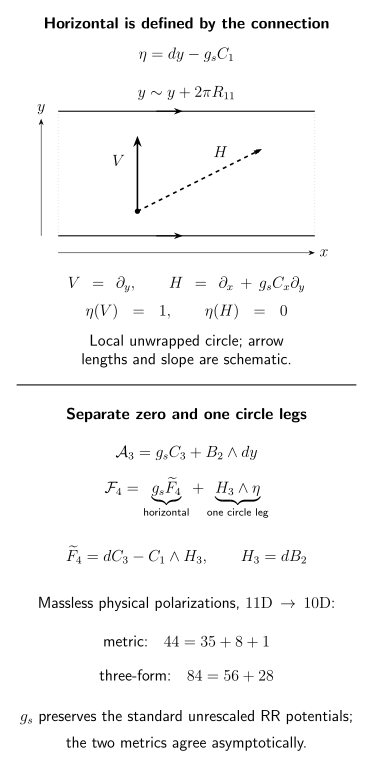
The circle one-form is , and . The factors keep the usual ten-dimensional RR charge normalization in asymptotically matched metrics. The polarization counts describe massless zero modes. The circle and its base are schematic; no radius scale is drawn.
The kinetic terms, not just the field list
Section titled “The kinetic terms, not just the field list”The metric determinant is
A horizontal four-form uses four inverse base metrics, contributing to its norm. The component uses three inverse base metrics and one inverse circle metric, contributing . Consequently
The same reduction of the Ricci term gives, before discarding a derivative,
One way to obtain this expression is to first reduce a circle metric , whose scalar curvature is , and then set , .
Integration by parts is weighted here:
Thus the scalar coefficient becomes , exactly the string-frame coefficient. Integrating the circle gives . The resulting action has NSNS coefficient and RR coefficient , as required. Exercise 4 derives the Chern–Simons term with the same signs.
The radius and brane interpretation
Section titled “The radius and brane interpretation”A unit KK momentum has mass in the common asymptotic metric. Matching it to the D0 tension gives
Define by . The gravitational reduction and the shared then give
These relations use physical lengths in the matched asymptotic metrics. They should not be read as statements about an unconverted coordinate radius in an unshifted metric. At strong IIA coupling, KK modes become light and ten-dimensional supergravity ceases to be a uniform truncation.
The three-form couples electrically to an M2-brane through . Its magnetic dual object is an M5-brane: for an electric spatial -brane in dimensions, the magnetic spatial dimension is . Wrapping the M2 on the circle gives the fundamental string, while leaving it unwrapped gives a D2-brane. Exercise 6 checks the tensions, charges, and polarization counts; the full dictionary appears on the M-theory brane page.
Exercises
Section titled “Exercises”Exercise 1: electric energy and the DBI branch
Section titled “Exercise 1: electric energy and the DBI branch”On a flat D3-brane take and , with all other independent components zero. Put , , and . Derive the determinant, its quartic expansion, the electric displacement , and the Hamiltonian density. Explain why the electric square root in the figure is not the energy. For , relate the result to a T-dual moving brane.
Solution
The matrix splits into two blocks,
On the branch connected to zero field,
Since , the quadratic term has the Maxwell sign derived in the main text. Differentiating at fixed gives
Eliminating instead gives
The Lagrangian magnitude tends to zero at , while the energy at fixed electric field diverges. The divergence does not say that an arbitrary finite electric displacement has infinite energy; the Legendre-transformed expression answers that different question.
For , T-duality along the electric direction sends and hence . The Lagrangian becomes the relativistic factor , and the Hamiltonian becomes . This explains the subcritical branch geometrically. It does not justify neglecting derivative or quantum effects arbitrarily close to the critical limit.
Exercise 2: the canonical dilaton coupled to a brane
Section titled “Exercise 2: the canonical dilaton coupled to a brane”Convert the Abelian DBI action to the default Einstein frame with . Find the dilaton powers multiplying the tension/embedding term and the quadratic gauge term on a D-brane. Expand to first order in the canonical field . What is special about a D3-brane?
Solution
The induced string metric is . Factoring this out of the -dimensional determinant gives
To quadratic order in the gauge field, with ,
The two inverse metrics, or equivalently the two explicit factors , shift the gauge exponent by . With , the linear couplings are
For , the Einstein-frame tension and the embedding determinant at have no explicit dilaton factor. In particular, the leading transverse-scalar kinetic term from that determinant has no direct linear dilaton coupling in these variables. The gauge term retains and couples to . This distinction matters in the D3 absorption calculation. Interactions involving the metric, field redefinitions, higher orders, or other bulk fields are not excluded by this statement.
For , the gauge exponent becomes , reproducing the Type I disk scaling derived in the main text. The matrix action has the same exponent after the appropriate trace normalization is applied.
Exercise 3: vary the NSNS action and test a linear dilaton
Section titled “Exercise 3: vary the NSNS action and test a linear dilaton”Derive the inverse-metric variation of the NSNS action, keeping the total-dilaton weight. Show that its equation is . Then test , , and in critical ten-dimensional theory. Which condition on is required, and where is weak coupling reliable?
Solution
Let and vary . The weighted curvature term gives
up to a boundary term. The derivatives of the weight are
Variation of cancels the explicit from the curvature term. Finally,
so the inverse-metric coefficient divided by is
The dilaton equation sets the bracket to zero, leaving . Independently, in the kinetic term gives after integration by parts. These variations must be combined before identifying the leading sigma-model equations.
For a linear dilaton in flat space, the metric and equations vanish automatically: its Hessian is zero. The remaining dilaton equation is , hence must be null, including . A nonzero spacelike or timelike slope would require a changed central-charge balance or other background fields, outside this critical flat ansatz.
The local coupling is . Even a null solution is perturbatively weak only in a region where this is small; it need not have a globally weakly coupled completion or an ordinary asymptotically flat scattering interpretation.
Exercise 4: the circle reduction of the Chern–Simons term
Section titled “Exercise 4: the circle reduction of the Chern–Simons term”Using the shifted KK ansatz, derive the ten-dimensional topological term from . Keep on the right and assume the ten-dimensional orientation followed by is the eleven-dimensional orientation. Verify the IIA Bianchi identity and gauge invariance. State which boundary terms are discarded.
Solution
Use the coordinate-basis expressions and . A term contributing to the circle integral contains exactly one . The resulting coefficient is
Terms with no are eleven-forms on a ten-dimensional base and vanish; terms with two vanish by antisymmetry. With ,
Thus the square bracket equals . Dropping this total derivative on a patch with compactly supported variations gives
This uses . On manifolds with physical boundaries or nontrivial gauge patches, the discarded terms and global flux data must be treated separately; the derivation is a local bulk-action calculation.
The invariant horizontal field is , so . Under , the two contributions to cancel. Under , its field strength does not change.
For completeness, the topological term itself is gauge invariant up to a derivative. Its variation is . Its variation contains , since . This checks the action as well as the field strength.
Exercise 5: a sourced self-dual five-form
Section titled “Exercise 5: a sourced self-dual five-form”Vary the -dependent terms of the IIB pseudo-action with the other potentials and metric held fixed. Derive the sourced equation and show that it agrees with the Bianchi identity after self-duality. Why must one vary before imposing that constraint? Give a local self-dual field for which the scalar kinetic invariant vanishes but the metric variation does not.
Solution
Put . The relevant terms are
At fixed metric, , and variation of the quadratic term gives a factor two. Since ,
Hence . Both the half-strength kinetic term and the displayed Chern–Simons coefficient are needed. Differentiating gives the same source: .
For a self-dual odd-degree form, . Substitution into the action before variation would remove a term whose unconstrained variation supplies nonzero equations and stress. Moreover, the Hodge star itself varies with the metric, so the self-dual subspace depends on that metric.
For a concrete local example, let in an orthonormal mostly-plus frame, and take . Since , this is self-dual. The electric and magnetic contributions cancel in , but
Thus its gravitational source is not zero. With and constant , this also solves the local form equations, though flat space is not a solution of the full Einstein equation with that nonzero stress. A local form-field test must not be mistaken for a complete background solution.
Exercise 6: physical zero modes and wrapped M2 normalization
Section titled “Exercise 6: physical zero modes and wrapped M2 normalization”Decompose the eleven-dimensional bosonic polarizations under the ten-dimensional little group and compare them with IIA. Count the IIB bosons independently, including the self-dual field. Then use to check the tension and electric charge of an unwrapped M2 and an M2 wrapped once on the physical circle.
Solution
An eleven-dimensional massless graviton is a symmetric traceless tensor of with components. Splitting yields an symmetric traceless tensor, vector, and scalar:
The three-form has components and decomposes into a transverse three-form and two-form:
These give the IIA metric, , dilaton, , and . Its total is bosons. In IIB, an unconstrained transverse four-form has components. Its eight-dimensional duality projection retains , so the total is again. These are physical massless polarizations; gauge-dependent components of the covariant potentials have not been counted.
Using ,
For an unwrapped brane, its electric coupling is , precisely the D2 charge normalization. For one wrapped circle,
The term in gives after integrating the circle. Both the fundamental-string tension and its two-form charge therefore agree. Omitting the in the horizontal RR component would spoil the unwrapped D2 charge even though the list of reduced fields would look unchanged. Reversing the brane or circle orientation reverses the charge, not the positive tension.
The magnetic partner of the electric M2 has spatial dimension , giving the M5. This charge argument explains why field strengths and their Hodge duals describe different brane sources without introducing extra propagating bulk modes.
References
Section titled “References”- Cremmer, Eugène, Bernard Julia, and Joël Scherk. “Supergravity Theory in 11 Dimensions.” Physics Letters B 76 (1978), 409–412. doi:10.1016/0370-2693(78)90894-8.
- Johnson, Clifford V. D-Brane Primer. TASI lectures, 2000; in Strings, Branes and Gravity, edited by Jeffrey A. Harvey, Shamit Kachru, and Eva Silverstein, World Scientific, 2001, 129–350. arXiv:hep-th/0007170; doi:10.1142/9789812799630_0002. Sections 5.4 and 8.4 discuss supergravity actions and the eleven-dimensional interpretation.
- Myers, Robert C. “Dielectric-Branes.” Journal of High Energy Physics 1999, no. 12 (1999), 022. arXiv:hep-th/9910053; doi:10.1088/1126-6708/1999/12/022. Equation (3) gives the Wess–Zumino potential basis, distinguished here from the IIB pseudo-action variables.
- Saffin, Paul M. “Type IIA Killing Spinors and Calibrations.” Physical Review D 71 (2005), 025018. arXiv:hep-th/0407156; doi:10.1103/PhysRevD.71.025018. Appendix A gives the circle reduction used here after the explicit field translation.
- Sen, Ashoke. “Covariant Action for Type IIB Supergravity.” Journal of High Energy Physics 2016, no. 7 (2016), 017. arXiv:1511.08220; doi:10.1007/JHEP07(2016)017. Section 3 states the conventional five-form equations and potential redefinition; later sections construct an action with additional fields.
- Tong, David. Lectures on String Theory. University of Cambridge lecture notes, 2009. arXiv:0908.0333. Sections 7.3 and 7.6 develop the NSNS action, frame transformation, and Abelian DBI approximation.
- Tseytlin, Arkady A. “Born–Infeld Action, Supersymmetry and String Theory.” In The Many Faces of the Superworld, edited by Mikhail A. Shifman, World Scientific, 2000, 417–452. arXiv:hep-th/9908105; doi:10.1142/9789812793850_0025.