
Open String Field Theory and Tachyon Condensation
An unstable D-brane carries an open-string tachyon. What configuration replaces the brane when this field condenses? Bosonic open string field theory makes this a question about a classical action for the entire open-string spectrum. We will construct a solution whose energy cancels the original brane tension and whose shifted BRST operator has no physical open-string cohomology on an appropriate space of fluctuations.
The calculation connects three descriptions: gluing worldsheets defines the interaction, a small algebra of string fields produces the solution, and a cylinder ghost correlator determines its energy. A finite approximation using only the tachyon will provide a useful comparison. The result concerns a static open-string vacuum in a fixed bulk background; it does not solve time-dependent decay or remove the closed-string tachyon of the bosonic theory.
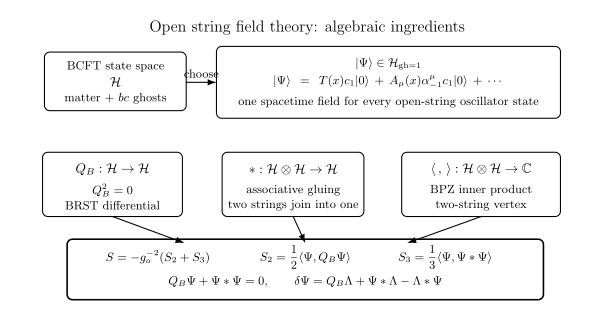
A string field on a fixed boundary CFT
Section titled “A string field on a fixed boundary CFT”A bulk conformal field theory specifies a perturbative closed-string background. Boundary conditions specify the D-branes on which open strings end. We work with a bosonic matter boundary CFT of central charge , together with the ghosts of central charge . This is the bosonic BRST system, even though much of this volume concerns superstrings.
The necessary ghost and BRST constructions are developed in the three-ghost functional and bosonic BRST quantization. We use the shared bosonic SFT normalization for spacetime units, the coupling , BPZ inversion and the ordered ghost functional.
An off-shell string field has ghost number one and is Grassmann odd. In a flat background its expansion in string-unit momentum begins schematically as
The ellipsis contains infinitely many massive and ghost excitations. The coefficients are spacetime fields; the basis states include the ghosts needed to describe gauge constraints. Off shell, neither the coefficients nor their momenta have been restricted to physical BRST cohomology.
For the explicit energy calculation we take one flat, space-filling D25-brane. More general boundary CFTs provide other starting points. Well-defined classical solutions can describe changes of the boundary configuration while the bulk CFT remains fixed. A one-to-one correspondence between every formal solution and every possible boundary CFT is a stronger claim than we need.
BPZ pairing and the star product
Section titled “BPZ pairing and the star product”A state prepared by a worldsheet path integral can be paired with another state by gluing their local-coordinate boundaries. For states represented by local operators, the BPZ pairing is
where is the shared BPZ inversion. The local-coordinate maps and the order of ghost insertions are part of this definition. BPZ pairing is bilinear; it is not a positive-definite Hilbert-space inner product.
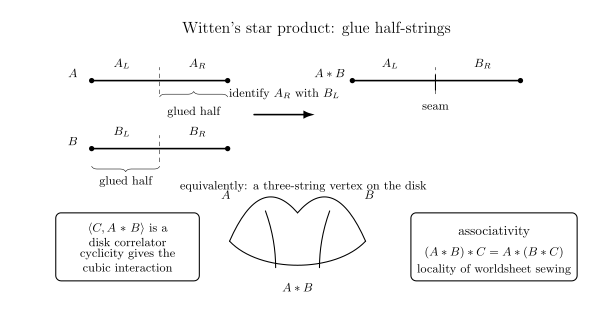
Witten’s star product joins the right half of one open string to the left half of another. Equivalently, one glues the corresponding strips. Pairing the result with a third state gives the three-string vertex. We write juxtaposition for this product when no ambiguity arises, and use
Here is the identity string field, distinct from the conformal map also denoted . The ghost zero modes require total ghost number three in a nonzero open-string disk trace. Thus and have precisely the required ghost number.
Surface states, the identity and infinite-width limits need not be normalizable Fock-space vectors. Their meaning is specified by their contractions with suitable test states and by which products and limits exist. This issue will matter at the tachyon vacuum.
Witten’s cubic action and gauge symmetry
Section titled “Witten’s cubic action and gauge symmetry”The classical action is
The interaction is cubic in the full string field, although it contains an infinite collection of component-field interactions. Its algebraic consistency follows from associativity, , and the identities
The parity is or . These identities hold when the products, trace and BRST contour deformation are well defined. The action and gluing construction originate with Witten.
Variation with the graded signs retained
Section titled “Variation with the graded signs retained”Because and are odd, BRST integration by parts gives
The even field can then be moved past without a sign. The two variations of the quadratic term agree. Likewise, moving an odd field past the two other odd fields in the cubic trace gives a plus sign, so its three variations agree. Therefore
For an even, ghost-number-zero parameter , the infinitesimal gauge transformation is
To see why the nonlinear terms are required, define the ghost-number-two curvature and the shifted BRST operator,
A direct expansion yields
The first identity is the Bianchi identity. Together with cyclicity it gives
The second explains why fluctuations around a classical solution have a nilpotent kinetic operator. Around , physical linearized states are the ghost-one cohomology of . Around a solution , they are instead the ghost-one cohomology of .
Siegel gauge and the propagator
Section titled “Siegel gauge and the propagator”The condition leads to the formal propagator , using
This is the total plane Virasoro generator, including the ghost contribution. In particular, the zero-momentum tachyon state has . One must not add the intercept a second time.
For a positive-real eigenvalue , . This motivates the strip representation
on its convergent spectral domain. It is not an ordinary convergent integral on the tachyon state, or at a propagator pole. Analytic continuation and the pole prescription are additional ingredients in amplitudes. Sewing these propagator strips to cubic vertices gives a geometric description of perturbation theory.
Wedge states and the KBc algebra
Section titled “Wedge states and the KBc algebra”The coordinate
maps the open-string local-coordinate region to a strip. In this coordinate, the Fock vacuum contributes a strip of width one. The wedge state , with , contributes width and obeys
In the alternative notation for wedges, and . The shift is a local-coordinate convention, not a discrepancy in the geometry.
If is paired with a Fock test field, that field supplies another unit strip: the resulting cylinder has circumference . A trace made only from wedge segments and zero-width insertions has circumference equal to the sum of those segment widths.
The wedge parameter measures added strip width. Sewing widths and gives ; pairing this product with a Fock test field gives circumference . The diagrams use the dimensionless sliver coordinate and are schematic in vertical height. The unit test patch is absent from a trace composed entirely of wedge segments and zero-width insertions.
Define the generator by
The fields and are an antighost line insertion and a boundary ghost insertion in this strip construction. Their ghost numbers are and ; both are odd, while is even and has ghost number zero. The contour identities give
For example, follows from the local identity integrated on the strip contour. The relation comes from moving the b contour through c and using their simple-pole OPE. The ordered product represents in this algebra. generally does not commute with c, and is not the oscillator mode .
An inverse built from positive-width wedges
Section titled “An inverse built from positive-width wedges”The useful resolvent is
It commutes with and , but not with c. Its inverse property can be checked before removing cutoffs:
The lower endpoint tends to the identity. The upper endpoint vanishes in polynomially bounded test contractions. Products involving nearly zero-width wedges still require a check for operator collisions. This is a geometrical definition of a resolvent, not an assumption that K has the same spectrum as .
An analytic tachyon-vacuum solution
Section titled “An analytic tachyon-vacuum solution”The Erler–Schnabl solution is
It has the required ghost number and parity. Both terms in its numerator matter. First, the algebra gives
so and
For its square, temporarily write . The numerator is because . The useful intermediate identity is
Indeed, replacing the first by leaves , and follows from , and . Consequently,
The first term on the second line vanishes because and . In the remaining term, and . Thus follows from the declared algebra, without fitting finitely many component fields.
A real representative
Section titled “A real representative”The compact expression above is not manifestly real. With denoting BPZ followed by Hermitian conjugation, K, B and c are real and product order reverses. The numerator is real, since reversing gives .
Set
Then
Because , it is algebraically related to by . On the regular correlators used below, cyclicity gives the same action.
Why the open-string cohomology disappears
Section titled “Why the open-string cohomology disappears”An explicit odd, ghost-number-minus-one field is
The shifted operator around obeys
For a closed fluctuation , the derivation rule now gives
Every closed fluctuation for which these products exist is exact. This is a contracting homotopy, and it removes the physical ghost-one cohomology on that domain. The same A works for the real representative because it commutes with .
Both differentials raise ghost number by one. Around the tachyon vacuum, multiplication by A lowers it by one and satisfies . The diagram displays part of the complex; the homotopy claim requires an admissible fluctuation space closed under these products. It is not an inverse on arbitrary singular string fields.
The domain qualification has a concrete meaning: an insertion placed exactly where the solution’s c ghost approaches the local-coordinate boundary can produce a divergent collision. Such singular states are not automatically included in the homotopy argument.
The vacuum energy from a cylinder correlator
Section titled “The vacuum energy from a cylinder correlator”To compare with a brane tension, use a static configuration and divide the action by its time interval and spatial volume. Let
Here , with the hatted quantities defined in the shared normalization. The energy is measured relative to ; the original D25-brane tension has not been included in S.
For a solution, multiplying its equation of motion by and tracing gives . Therefore
We now evaluate the resulting kinetic trace explicitly.
Fixing the cylinder sign by the insertion order
Section titled “Fixing the cylinder sign by the insertion order”For positive widths , set . In the trace
take the three ordered c insertions at , , , modulo L. A common translation can keep them away from a coordinate-map pole. In particular, the first insertion lies to the right of the second and third: the ordering is part of the calculation.
Under , each c has weight and supplies the inverse derivative . Combining these factors with the ordered plane polynomial gives
The sign is positive for positive widths with this ordering. Interchanging two c insertions would reverse it. Since ,
Only the derivative of survives at . The minus sign comes from the definition of K, not from a choice of a negative brane tension.
Evaluating the Schwinger integral
Section titled “Evaluating the Schwinger integral”For , the contribution of to the kinetic trace is BRST exact:
Here and . In the BRST primitive, the B and K line insertions each have strip scaling dimension , while the three c insertions each have dimension . The net dimension is : uniformly shrinking the widths produces a positive power of their scale, rather than an identity divergence. This regularity allows the BRST contour to be deformed without a surviving endpoint anomaly for the correlators at hand; see Erler and Schnabl, §2.1.
Expanding the remaining two resolvents gives
The total width and its fractional division are natural variables:
The integration region becomes , . Thus
The two integrals are and . The remaining integrand is bounded by , so both small and large total widths are integrable. Exercise 5 quantifies the cutoff error.
The shared disk normalization gives . We have therefore obtained
Together with the contracting homotopy, this is the evidence that the homogeneous solution represents disappearance of the original brane’s open-string sector.
Level truncation and the scope of tachyon condensation
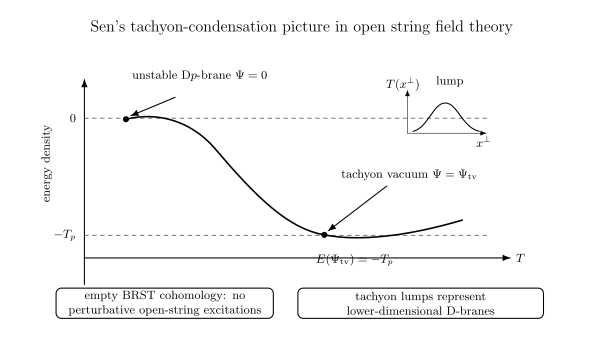
Section titled “Level truncation and the scope of tachyon condensation”A useful first approximation retains only the zero-momentum tachyon,
Writing , the volume-normalized kinetic pairing is . The three-string local-coordinate maps give the cubic coefficient , where . Exercise 2 derives both numbers. The resulting potential is
Besides the unstable stationary point , it has a local minimum at
This is about of the required energy cancellation. It is already a meaningful test because its normalization is fixed independently by the disk amplitude and the brane tension. The calculation and its extension to higher retained fields are due to Sen and Zwiebach.
The solid curve is the specified cubic component truncation, with dimensionless coefficient t and vertical axis . Its marked minimum is calculated, not a sketch of the full potential. The dashed line is the exact solution’s energy ratio ; it assigns no value of t to that infinite-component solution. The displayed horizontal interval is finite, and the local minimum is not a claim that the cubic potential is bounded below globally.
Higher-level calculations retain additional component fields and interactions, usually after fixing a gauge. They can improve the vacuum-energy estimate, but a short sequence is not a convergence theorem. Solving a truncated action also differs from truncating the component expansion of an already known analytic solution; the latter can require resummation. The tachyon coefficient and the shape of an off-shell component potential depend on field coordinates and gauge choices.
Infinite-width limits and the phantom contribution
Section titled “Infinite-width limits and the phantom contribution”Schnabl’s earlier analytic solution uses a regulated discrete sum of wedge states. A large-wedge term, often called the phantom term, must be retained in the limiting prescription even when it becomes invisible in ordinary Fock-state overlaps. The Erler–Schnabl solution used here instead has a continuous Schwinger representation and does not require appending that same discrete subtraction.
The underlying issue is that convergence in a chosen set of linear test pairings need not imply convergence of the nonlinear action. A related formal expression is
For bounded test pairings in which tends to a sliver limit, this weighted average tends to that limit as . The integrand tends pointwise to zero at each fixed t, while widths of order continue to contribute. Exchanging the limit and integral loses this contribution. Exercise 6 proves the corresponding statement for scalar test functions.
The sliver can act as a projector in appropriate regulated products. One cannot infer that every weak limit commutes with star multiplication, or that a gauge transformation becoming singular at its endpoint preserves all observables by continuity.
What remains to establish for lower-dimensional branes
Section titled “What remains to establish for lower-dimensional branes”Sen’s tachyon-condensation picture also relates spatially varying configurations to lower-dimensional D-branes. Such a claim requires constructing a nonuniform solution and checking its tension and boundary observables. The homogeneous solution above does not perform that task, and iterating a known tension ratio does not supply the missing construction.
The bosonic BCFT kink analysis has its own assumptions; Sen’s descent construction is a useful further comparison. These unstable bosonic branes should not be assigned the Ramond–Ramond charge or K-theory classification of Type II brane–antibrane systems. The bulk bosonic theory itself still contains a closed-string tachyon.
Common pitfalls
Section titled “Common pitfalls”Treating K as a commuting number. K commutes with B and functions of K, but not with c. Commuting it through c erases the terms that enforce the nonlinear equation of motion.
Reading the one-component minimum as the exact vacuum. The point solves a truncated problem. The exact solution contains infinitely many components, and its invariant energy does not determine a preferred tachyon coordinate.
Using formal cohomology identities without their domain. The equation proves exactness of a closed only if is defined and the derivation identity holds. Singular collisions and nonuniform limits require separate treatment.
Exercises
Section titled “Exercises”Exercise 1: curvature and finite gauge transformations
Section titled “Exercise 1: curvature and finite gauge transformations”Derive the Bianchi identity and for a field of either parity. For an even invertible regular field U, prove that
has curvature . Explain why the regularity assumption matters for a putative pure-gauge tachyon vacuum.
Solution
Since is even,
Adding cancels these terms; the two terms also cancel. This proves the Bianchi identity before imposing an equation of motion.
Let . Apply Q to using the derivation rule, and include the commutator part of acting on , whose parity is . The terms containing cancel pairwise. The surviving terms are
The curvature is even, which is why the final commutator has no parity-dependent sign.
For the finite transformation, differentiating gives
Write and , both odd. Then
Adding leaves . A regular invertible transformation therefore maps solutions to solutions. Near , the finite formula gives .
A singular endpoint may destroy the existence of or the trace manipulations needed for gauge invariance. Thus a family of regular pure-gauge configurations can approach a limit whose energy is not obtained by naively continuing the pure-gauge value. Along a regular path connected to the identity, the infinitesimal gauge-invariance argument ensures that the energy is unchanged.
Exercise 2: the cubic tachyon coefficient and field coordinates
Section titled “Exercise 2: the cubic tachyon coefficient and field coordinates”For the three-string vertex use
Derive the kinetic and cubic coefficients of the field , and calculate its stationary energy. Then set with constant and track both coefficients. Which result is unchanged, and which coordinate is not?
Solution
The three insertion points are , and the map derivatives are . Their ordered plane correlator is . Each ghost contributes an inverse map derivative, so the normalized cubic vertex is
For the kinetic term, . The infinity pairing gives
Thus the normalized potential is . Its derivative vanishes at and . The second derivatives of the normalized potential are and , respectively. Substitution at the local minimum gives
After the invertible component rescaling,
The stationary value is unchanged, while its coordinate changes. Keeping the new cubic coefficient but forgetting the quadratic factor would change the problem. This is a consistent reparametrization of the same component slice; it does not modify only one leg of the cubic vertex, which would generally spoil its cyclic symmetry. It also does not turn this slice into the exact infinite-component solution.
Exercise 3: two Schwinger integrals
Section titled “Exercise 3: two Schwinger integrals”Derive the cutoff identity for and compare its domain with that of the Siegel-gauge Schwinger integral. Evaluate the latter on eigenvalues and . Finally, explain why a wedge–Fock overlap has circumference but the three-c trace in the energy calculation has circumference .
Solution
Since , integration over gives
Its limiting inverse property follows in test contractions where the lower boundary is the identity and the weighted upper boundary vanishes. This leaves a separate question about singular products inside other observables.
For a scalar Virasoro eigenvalue,
At it tends to . At it is and diverges. The analytic continuation of to is , but this is not the value of the divergent real Schwinger integral. At the cutoff integral equals S and exposes a pole. An amplitude prescription must handle those issues explicitly.
The ghost contribution gives at zero momentum. K instead generates translation of the wedge boundary in the sliver construction; equating these generators would conflate different operators and domains.
A Fock test state inserts its unit local-coordinate strip when it is sewn to . Hence the resulting circumference is . In , the three c insertions carry zero added width; the only strips have widths a, b and d. There is no additional Fock test patch.
Exercise 4: a failed candidate and the real homotopy
Section titled “Exercise 4: a failed candidate and the real homotopy”Evaluate the equation-of-motion residual of . Show that the real representative inherits the equation of motion and the homotopy A. For a fluctuation of arbitrary parity, identify the exact assumption needed to conclude that a closed state is exact.
Solution
Since ,
One cannot cancel these terms by commuting R through c. The extra numerator term in supplies precisely the products that reduce the full square to . Omitting it is not a harmless simplification of the solution.
Write . On the relevant algebraic domain and . Its curvature is therefore
Moreover, and , so . A commutes with F because it contains only B and a function of K. The transformed shifted differential consequently obeys
Let denote either shifted differential. Because A is odd, independently of the parity of ,
If , then . The needed assumption is that lies in the admissible state space and that its product and BRST variation exist. A formal similarity transform alone does not establish this for arbitrary midpoint or identity-localized distributions. For the action, cyclicity gives equal kinetic traces only when the corresponding correlators and limiting operations are legitimate.
Exercise 5: the energy integral with explicit cutoffs
Section titled “Exercise 5: the energy integral with explicit cutoffs”Starting with the ordered three-ghost cylinder correlator, derive the sign of the K-insertion trace. Cut the total width to and obtain the exact error in the energy. Find its leading small- and large-T behavior. What result would follow from omitting the Jacobian u? Finally, distinguish an independent cubic contraction from a cubic trace inferred from the equation of motion.
Solution
Put and . Then
Multiplying the three ordered differences and the three inverse derivatives cancels every cosine factor. Taking yields the positive sine product in the body, without choosing square-root branches.
At b=0 that product vanishes. In its derivative, only the factor with argument survives. Applying supplies the minus sign and gives
After , , the absolute Jacobian is u. Integration over v gives . The truncated energy is less negative than the limiting energy, and the positive error is
The small-width term is ; the large-width term is . At , choosing gives an error about . These bounds control this kinetic-energy integral, not every possible singular string-field observable.
Without the Jacobian u, the first integral would be instead of , giving the incorrect energy .
The calculated kinetic trace is . Contracting the equation of motion then requires . This is a consistency consequence, not an independent evaluation of the cubic correlator. An independent test would evaluate that correlator with its own regulated integrations and compare the result.
Exercise 6: a nonuniform large-width limit
Section titled “Exercise 6: a nonuniform large-width limit”Let f(t) be bounded and measurable for and tend to as . Prove
Evaluate the integral for , with constant P and X. Explain the relation to weak sliver limits, and what this argument does not prove about string-field products, the action or lower-dimensional branes.
Solution
Since the exponential kernel has integral one, subtract inside the integral. For any , choose so that for . If everywhere, then
The first term tends to zero; the second is at most . Because is arbitrary, the limit follows.
For the example the answer is exactly
The integrand tends to zero at every finite t, but the integral tends to P. When , there is no integrable bound independent of that permits discarding the large-width region. For and , the bound does exist, consistently with the zero limit.
Apply the scalar result to a bounded test pairing of having a limit. It then establishes the corresponding weak limit of . It does not establish that star multiplication or the action is continuous in this topology, so it cannot justify removing a phantom contribution from a different regulated construction.
Likewise, the homogeneous vacuum’s energy and cohomology do not construct a spatially varying lump. A lower-dimensional-brane claim requires its own solution, finite tension and boundary observables. Neither this scalar limiting theorem nor the existence of a formal sliver projector supplies those additional results.
References
Section titled “References”- Theodore Erler and Martin Schnabl, “A Simple Analytic Solution for Tachyon Condensation,” Journal of High Energy Physics 10 (2009), 066. doi:10.1088/1126-6708/2009/10/066; arXiv:0906.0979.
- Martin Schnabl, “Analytic Solution for Tachyon Condensation in Open String Field Theory,” Advances in Theoretical and Mathematical Physics 10 (2006), 433–501. arXiv:hep-th/0511286.
- Ashoke Sen, “Descent Relations Among Bosonic D-branes,” International Journal of Modern Physics A 14 (1999), 4061–4078. doi:10.1142/S0217751X99001901; arXiv:hep-th/9902105.
- Ashoke Sen and Barton Zwiebach, “Tachyon Condensation in String Field Theory,” Journal of High Energy Physics 03 (2000), 002. doi:10.1088/1126-6708/2000/03/002; arXiv:hep-th/9912249.
- Edward Witten, “Non-commutative Geometry and String Field Theory,” Nuclear Physics B 268 (1986), 253–294. doi:10.1016/0550-3213(86)90155-0.