
Classical Rotating Strings and the Regge Slope
A longer string can carry more angular momentum, but tension makes it more energetic. For a freely rotating open string, these effects combine into the classical relation . We will derive it from an explicit solution, identify the center-of-mass frame, and prove that this solution maximizes a component of angular momentum at fixed energy within a specified classical sector. Folded strings then explain why other trajectories have smaller slopes.
The setting is a free classical string in flat, noncompact target spacetime. The open string has Neumann conditions in every target direction and no endpoint masses. We use the global conventions and the equations and currents derived on the conformal-gauge page. Quantum intercepts are discussed only as a preview at the end.
A rigidly rotating open string
Section titled “A rigidly rotating open string”On , consider
with the other spatial coordinates zero. The positive constant has dimensions of length. It is both the half-length of the spatial segment and the conversion between dimensionless worldsheet time and target time,
At fixed , the signed coordinate along the segment is . As goes from to , the string runs from through its center to . Its instantaneous physical length is .
The physical angular velocity and velocity field are
Consequently . The endpoints move at unit speed, the midpoint is stationary, and the string rotates counterclockwise in the displayed orientation. The frequency in is not a dimensionful angular velocity.
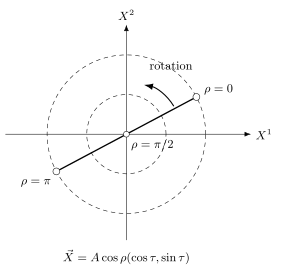
At , the endpoint lies at and moves upward, while lies at and moves downward. The physical angular velocity is , and the speed varies as . The segment geometry is exact for this solution; arrows show velocity directions schematically.
Wave equation, endpoint conditions, and constraints
Section titled “Wave equation, endpoint conditions, and constraints”Both nonzero spatial coordinates have second and derivatives equal to minus themselves. Hence . Their first spatial derivatives are proportional to , so all Neumann conditions hold at and . A sine spatial profile would not satisfy the same conditions.
The wave equation is only part of the problem. Including the negative target-time contribution gives
The velocity and the spatial tangent are perpendicular, and the two diagonal contributions cancel. Therefore
The induced metric is
It is nondegenerate and timelike in the interior. At the endpoints it degenerates because the endpoint trajectory is null and . This does not make the auxiliary conformal-gauge metric singular. As explained on the previous page, lightlike endpoint motion is a property of an all-Neumann endpoint; a string held by Dirichlet supports need not have lightlike endpoints.
Target-space charges and the rest frame
Section titled “Target-space charges and the rest frame”The translation and rotation charges are
They are conserved here because the corresponding current fluxes vanish at the all-Neumann endpoints. The energy is
The spatial momentum is explicitly zero:
Thus the displayed solution is already in its center-of-mass frame. Its invariant mass obeys , with , so .
For the angular momentum, the two terms add:
Writing for this orientation,
Eliminating gives
The dimensions provide a useful check: , , and angular momentum is dimensionless in units with . A larger tension gives a smaller slope in a plot of against .
Where the energy and spin are located
Section titled “Where the energy and spin are located”The densities per unit worldsheet coordinate are particularly simple:
Uniform coordinate energy density does not mean uniform density along the physical segment. At a fixed target time,
Thus the positive densities per unit arclength are
The absolute value in matters: decreases as increases. When integrating with increasing , these expressions define positive densities on .
There is also a direct physical derivation. The velocity is transverse to the local string tangent, so a small segment has Nambu–Goto Lagrangian . Its energy and momentum magnitude are
Using and the sign of the tangential velocity gives . This reproduces the densities obtained from the worldsheet currents.
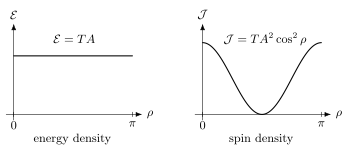
The coordinate panel uses and densities normalized by and . The physical panel uses and arclength densities normalized by and . Solid curves show energy and dashed curves show spin. The physical curves diverge as and are truncated in the drawing; both endpoint singularities are integrable. The panels use different integration measures, so their plotted areas should not be compared directly.
Near the endpoint , put . Then
The energy in a terminal segment of physical length is therefore finite and tends to zero:
There is no infinite point energy attached to the massless endpoint. The divergent density expresses the increasingly large Lorentz factor of nearby string elements.
The total energy is , whereas tension times the instantaneous length is . The latter is the sum of the local segment rest energies for this transverse motion. It is not the invariant mass of the whole rotating string, which includes the internal kinetic energy even in the center-of-mass frame. A static straight segment of the same length would require supports and would be a different boundary problem.
Why the first harmonic maximizes spin
Section titled “Why the first harmonic maximizes spin”An explicit solution establishes a trajectory. To call it a leading classical trajectory, we should show that no allowed configuration in the comparison class carries more angular momentum at the same energy.
Consider an isolated all-Neumann string with timelike total momentum, in its center-of-mass frame. Assume that temporal conformal gauge is available,
Then . Since , the mean spatial position is time independent. Translate the origin so that
Because , this change of origin does not change the angular momentum. The constraints are
Let . For a mean-zero Neumann profile, the cosine expansion has no constant mode:
Orthogonality gives
Consequently . This is the sharp Neumann Wirtinger inequality on this interval; equality for a nonzero profile requires only the first spatial harmonic. The argument applies componentwise to a vector profile of finite energy.
Let and let be a right-angle rotation. Cauchy–Schwarz, Wirtinger, and give
It follows that
Equality requires all of the intermediate inequalities to be equalities. Apart from constant translations, there can be no motion outside the chosen plane. At a given time,
The wave equation evolves these initial data into the circularly polarized first harmonic. Thus the rotating segment saturates the bound; higher spatial harmonics cannot do so. This is a bound on a classical component of angular momentum in the rest frame, not a derivation of a quantum spin spectrum.
When temporal conformal gauge is available
Section titled “When temporal conformal gauge is available”The gauge assumption can be made precise using the residual maps from the previous page. The time coordinate obeys the wave equation and Neumann conditions, so, after absorbing constants, write
Suppose everywhere. Define by
and use the common residual function . Then and , so it preserves both strip boundaries. In the new coordinates, .
This construction requires the time chiral derivatives to remain nonzero with a consistent future orientation. It is not a proof that every possible embedding admits a single global temporal chart. Ordinary null endpoints, or the folds considered next, can have a degenerate induced metric while still satisfying ; induced-metric degeneracy alone is not the criterion for failure of this gauge.
Higher harmonics and folded closed strings
Section titled “Higher harmonics and folded closed strings”A useful family of open-string solutions is
The factor in is essential: it makes the time contribution cancel the spatial terms in the constraints. The physical angular velocity is still , because the angle is and the target time is .
At a fixed time, the segment is covered times. There are interior folds at , , and the length counted along the string is . Integrating the charges gives
The smaller slope expresses the distribution of energy among multiple coincident strands and higher modes. It does not mean that the fundamental tension has changed. At a fold, the induced metric degenerates, but the Polyakov embedding and its wave equation remain smooth. The local Nambu–Goto/Polyakov elimination argument applies away from these degeneracies.
For a closed string, use the first-harmonic embedding but take . It goes from one end of the segment to the other and back, covering the same geometric segment twice. The points are folds, not physical endpoints. Both strands contribute:
The half slope therefore already has a classical explanation. The physical length counted along this closed string is , even though its geometric span is . Exercise 6 derives the corresponding sharp closed-string bound from the periodic Wirtinger inequality.
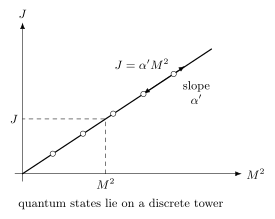
With horizontal coordinate and vertical coordinate , the first open harmonic lies on and the folded closed solution on . The curves describe continuous classical families in their rest frames. They contain no quantum intercept or discrete-state prediction. The same fundamental tension enters both relations.
What quantization adds
Section titled “What quantization adds”Classically, and are continuous. Quantization replaces the continuous family by oscillator states and introduces normal-ordering constants. An angular-momentum quantization rule by itself does not determine those constants: the full fluctuation and constraint problem must be treated.
For the free critical bosonic string in flat spacetime, the leading open and closed trajectories are
These statements assume the standard critical bosonic spectrum, including its physical-state conditions; they are not conclusions of the classical calculation above. The order-one intercepts become small relative corrections at large spin. The classic analysis of the free string and its Lorentz consistency is due to Goddard, Goldstone, Rebbi, and Thorn; Tong’s lectures, especially sections 2.3 and 3.1.3, explain the connection to the highest-spin states.
Interactions, curved backgrounds, or massive endpoints require additional analysis. In particular, the free formulas do not justify a general claim that all quantum effects leave a trajectory unchanged. The next page develops the mode expansions; the physical-state and spectrum page explains the mass conditions.
Exercises
Section titled “Exercises”1. Worldsheet frequency versus physical angular velocity
Section titled “1. Worldsheet frequency versus physical angular velocity”Describe the first rotating solution using and , with . What are its coordinate frequency, spatial interval, and time-coordinate coefficient? Show that its physical angular velocity, energy, and spin are unchanged. Explain why changing only the frequency in the spatial embedding while retaining would generally violate the constraints.
Solution
The reparametrized embedding is
on . The coordinate frequency and time coefficient are and . Their ratio gives
The passive coordinate change makes the auxiliary metric ; a constant positive Weyl rescaling returns it to . In this representative,
Thus the coordinate period changes while the physical charges and angular velocity do not. If instead the spatial solution contains and phase but time remains , then . The necessary time coefficient is , as in the higher-harmonic solution. A frequency change is not automatically a gauge transformation with all other data held fixed.
2. How much spin is near the endpoints?
Section titled “2. How much spin is near the endpoints?”For , find the fractions of total energy and angular momentum contained in the central portion . Evaluate them at . Explain why the outer half of the geometric length can carry most of the angular momentum without an infinite endpoint contribution.
Solution
Integrate the arclength densities with increasing signed coordinate and use . The central energy is
The central angular momentum is
Dividing by the total charges gives
At , the central portion has half the total geometric length, but its energy fraction is and its spin fraction is
The two outer portions carry of the energy and approximately of the spin. The extra in the spin density strongly suppresses the center. Both fractions approach one smoothly as ; the endpoint divergence integrates to a finite value, and the contribution of a shrinking endpoint cap tends to zero.
3. Higher harmonics at fixed energy
Section titled “3. Higher harmonics at fixed energy”For the th open harmonic, verify the constraints and compute the length counted along the string. Compare its radius, physical angular velocity, length, and spin with the first harmonic at the same total energy. Identify the null folds and determine whether the two physical endpoints occupy opposite ends of the geometric segment.
Solution
The spatial velocity and tangent have squared norms and and are perpendicular. With this gives
The spatial derivatives vanish at both boundaries because is an integer. The total length is
Let the first harmonic at the chosen energy have half-length . Since , the th harmonic has
The counted length stays fixed, but it is packed into a smaller multiply covered segment. The spin decreases despite the larger angular velocity because the energy lies at smaller radii.
The points have and unit target speed. For they are internal folds; are the physical endpoints. The endpoint positions have relative sign : odd places them at opposite ends of the segment, while even places them at the same geometric end. Coincident points remain distinct points of the parametrized string.
4. Compare open and folded closed strings fairly
Section titled “4. Compare open and folded closed strings fairly”For the first-harmonic closed embedding on , compute its spatial momentum, physical length, energy, and angular momentum. Compare the open and closed solutions first at equal half-length , and then at equal total energy. Explain why the latter comparison produces a half slope even though the two strings have the same tension.
Solution
The integral of over the circle vanishes, so the closed solution also has . Its length is
The integrals of and give
At equal , the closed string has twice the length, energy, and spin of the open solution. This does not mean twice the spin at fixed energy: the energy also doubled.
For equal energies, let and denote the open and closed half-lengths. Then , and
Both have the same counted length and tension, but the closed string covers a smaller segment twice. Eliminating its own radius and energy gives . The folds carry no separate point masses and are not endpoints at which a boundary condition must be imposed.
5. Boost the center of mass
Section titled “5. Boost the center of mass”In at least four target dimensions, boost the first open solution with speed along , perpendicular to its rotation plane. Use the convention
Compute the boosted energy, momentum, angular velocity, and endpoint speed. Which mass variable belongs in the Regge relation?
Solution
Since the unboosted is zero,
while retain their original expressions. Integrating their time derivatives gives
The angular-momentum integrand is unchanged, so . At fixed , the phase evolves with
The transverse speed is and the longitudinal speed is . Therefore
At the endpoints this is one, as required by Lorentz invariance; at the center it is . Finally,
Replacing by the boosted energy squared would give an incorrect factor . Choosing a boost perpendicular to the rotation plane makes unchanged; a generic boost also mixes angular-momentum and boost-generator components.
6. The sharp bound on arbitrary coordinate intervals
Section titled “6. The sharp bound on arbitrary coordinate intervals”Repeat the maximum-spin argument for an open string on a dimensionless interval , and for a closed string of coordinate period . Work in temporal conformal gauge and in the center-of-mass frame. Derive the sharp constants and describe the equality profiles. Does changing the coordinate interval change the physical Regge slope?
Solution
In either case, and the integrated constraint is
For a mean-zero Neumann profile, the smallest nonzero wave number is . Hence
The same Cauchy–Schwarz and arithmetic–geometric mean steps give
Equality selects and circular time evolution of coordinate frequency . The amplitude is . Thus the open-string slope is independent of the coordinate interval.
For a mean-zero periodic profile, the smallest nonzero wave number is , so
To characterize equality, let . The first-harmonic profile is , and Cauchy–Schwarz requires in the chosen plane. The other local constraint now matters:
Therefore and are parallel. A shift of the periodic coordinate combines them into , with . Its circular time evolution is the folded rotating segment. The bound is attained in the class that allows these smooth Polyakov embeddings with folds. If nondegeneracy of the induced metric everywhere is required, this saturating folded solution is excluded.
The ratio of the two sharp constants comes from the first nonzero Neumann and periodic wave numbers for the same coordinate length. Both results are expressed entirely in physical and after cancels.
References
Section titled “References”- Goddard, Peter, Jeffrey Goldstone, Claudio Rebbi, and Charles B. Thorn. “Quantum Dynamics of a Massless Relativistic String.” Nuclear Physics B 56 (1973), 109–135. doi:10.1016/0550-3213(73)90223-X. Classical constrained-string mechanics, quantization, and Lorentz consistency.
- Tong, David. Lectures on String Theory. University of Cambridge Part III lecture notes, 2009; revised 2012. arXiv:0908.0333, especially sections 1.3, 2.3, and 3.1.3 on classical constraints and free-string Regge trajectories.