
The RNS Spectrum and the GSO Projection
The RNS oscillator space contains many more states than a string can physically carry. The constraints remove longitudinal excitations; the Ramond zero modes supply spacetime spinors; a further choice of projection selects a consistent set of sectors. For the supersymmetric GSO choice studied here, the open-string tachyon is removed and the massless spectrum contains eight vector polarizations and eight spinor polarizations. These are the on-shell degrees of freedom of a ten-dimensional supersymmetric gauge multiplet.
We first derive this result for free open strings in flat ten-dimensional spacetime with Neumann conditions in every direction. Chan–Paton multiplicities are omitted. The shared target-space and oscillator conventions, canonical RNS fermions, and plane versus oscillator ordering on the previous page apply throughout. The distinction between the plane generator, the physical intercept, and the spinor reality condition will be essential.
Physical constraints turn oscillator levels into masses
Section titled “Physical constraints turn oscillator levels into masses”In old covariant quantization, positive-frequency constraints annihilate a physical matter state:
The fermion index is half-integer in NS and integer in R. The critical theory also requires the following zero-mode conditions, expressed using the plane matter generators:
The Ramond mass-shell condition follows from , because and the plane algebra gives . The converse is not valid in the covariant indefinite state space: alone does not impose . Its finite shift cannot be dropped while still calling a plane generator.
The previous page derived the sector vacuum weights. Inserting the open-string zero mode therefore gives
Since , the physical-state conditions become
Thus the statement “the Ramond intercept is zero” refers to the oscillator mass formula; it does not say that the covariant Ramond matter ground state has plane weight zero. The same physical conditions will later follow from the BRST construction and its ghosts. Here we use the critical physical-state conditions and derive their consequences, rather than attempting a proof of BRST equivalence at every level.
The transverse description checks the intercepts
Section titled “The transverse description checks the intercepts”After solving the constraints in light-cone gauge, the independent oscillators have indices . Their number operator is
The first sum already weights a bosonic excitation by , because . Ramond zero modes do not appear in : they change the ground-state polarization without changing its level.
For each transverse boson–fermion pair, the regulated cylinder vacuum energy is in NS and zero in R. Applying the regulated calculation from the previous page to eight pairs gives and . The light-cone formula agrees with the covariant result.
There are three distinct quantities here:
| Quantity at zero momentum | NS | R |
|---|---|---|
| Covariant matter plane vacuum weight | ||
| Covariant matter cylinder vacuum energy | ||
| Transverse cylinder vacuum energy |
The full covariant matter system has ten coordinate multiplets, whereas the physical transverse system has eight. Replacing one row by another would give the wrong NS mass formula. The transverse Hilbert space is positive; the covariant oscillator space initially includes a timelike negative-norm direction. One must impose the constraints and identify physically null states before interpreting its dimensions as particle polarizations. Weigand, sections 6.4–6.5, develops these two descriptions side by side.
The NS massless vector is a quotient space
Section titled “The NS massless vector is a quotient space”The NS oscillator vacuum is annihilated by all and with positive index. Its level is zero, so before projection it describes a tachyon with . The next level contains
Although it was created by a worldsheet fermion oscillator, this state transforms as a spacetime vector and belongs to the spacetime bosonic sector. Worldsheet oscillator parity and spacetime statistics are different notions.
Using the supercurrent modes derived previously,
only acts nontrivially on the one-fermion state. For , the bosonic annihilator commutes through the fermion and kills the vacuum. For , the fermion has index at least ; it anticommutes through without a contraction and kills the vacuum. The remaining term gives
Thus the polarization is transverse: . The higher positive constraints are then automatic at this level, but transversality alone leaves nine components. The ninth is null.
At the same null momentum, form the descendant
The precursor vacuum at is not itself a physical NS ground state: its plane weight is zero rather than . Its descendant has the required weight. Moreover,
The momentum delta function in the state norm is suppressed. The higher positive constraints also annihilate this descendant. It is orthogonal to every physical state because . Adding it changes no physical amplitude. The polarization space is consequently
For nonzero null momentum, choose with . Transversality gives ; the equivalence can set both components to zero. The remaining eight have positive norm . They form the vector representation of , the double cover of the rotation subgroup of the massless little group. This derivation is the string origin of the gauge equivalence of a massless vector.
The assumption matters: special zero-momentum states require a separate analysis. The counts below refer to ordinary propagating states at nonzero momentum.
Ramond zero modes generate a spacetime spinor
Section titled “Ramond zero modes generate a spacetime spinor”The Ramond vacuum is annihilated by positive modes, but there is no condition that all zero modes annihilate it. Instead,
The ground states therefore carry a representation of the ten-dimensional Clifford algebra. The Lorentz transformations acting on this space are generated by
This is why the Ramond ground state is a spacetime spinor even though the elementary field has a target-space vector index.
Five binary occupations give 32 components
Section titled “Five binary occupations give 32 components”To construct the complex representation, temporarily use ten Euclidean Clifford generators satisfying . The Lorentzian generators can be represented by and for . Pair the Euclidean generators into five creation and annihilation operators:
They obey and . Starting with a Clifford vacuum annihilated by the , each occupation can be zero or one. The resulting states form the complex Dirac representation. These auxiliary occupations organize the zero-mode representation; they are not positive-frequency string excitations and do not raise .
Define the chirality operator in this representation by
It commutes with the Lorentz generators, so its eigenspaces are Weyl representations. In the Clifford Fock construction, ; even and odd occupation each span 16 complex dimensions. Exercise 2 verifies the signs and dimensions explicitly.
The zero-mode constraint is the Dirac equation
Section titled “The zero-mode constraint is the Dirac equation”Write a Ramond ground state as . It has , so the mass formula gives . On this state all nonzero oscillator terms in vanish:
The notation means that the matrix acts on the spinor coefficients. The physical condition is precisely
Squaring gives , in agreement with the mass shell. At nonzero null momentum, however, is a nonzero nilpotent matrix; its kernel is only half of the Dirac space.
This count can be established without choosing explicit matrices. For , set . Then
The Dirac equation requires . On a Weyl eigenspace , with , the projector onto simultaneous solutions is
The traces of , , and vanish, whereas . Hence . Before a chirality projection the Dirac equation leaves 16 polarizations; after it, eight remain. They form one of the two inequivalent spinor representations and of . Which name corresponds to depends on the orientation used to label transverse chirality.
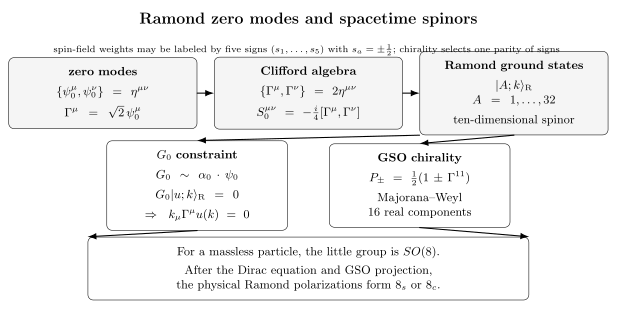
The dimensions refer to complex representation spaces and polarization amplitudes at fixed nonzero null momentum. The Weyl restriction and the Dirac kernel leave eight physical polarizations. Majorana reality is a condition on the spacetime field, not an additional division of this fixed-momentum count. The diagram is schematic, with no geometric scale.
Majorana reality is a different restriction
Section titled “Majorana reality is a different restriction”A ten-dimensional Dirac spinor has 32 complex components. A Majorana reality condition reduces this to 32 real field components. In signature , Majorana and Weyl conditions are compatible, giving a Majorana–Weyl field with 16 real components before its equation of motion. The massless Dirac equation leaves eight propagating polarizations.
This does not require the coefficients of a positive-frequency one-particle state to be real. At fixed momentum the eight polarization amplitudes can be complex, just as the amplitudes of a real gauge field can be complex. The field reality condition relates appropriate positive- and negative-frequency Fourier coefficients. Imposing reality again on the fixed-momentum polarization space would undercount states.
The supersymmetric GSO choice selects oscillator parity
Section titled “The supersymmetric GSO choice selects oscillator parity”The Gliozzi–Scherk–Olive projection selects eigenspaces of worldsheet fermion parity, with a sector-dependent vacuum action. We describe the choice that gives the supersymmetric open-string spectrum. Its connection to spacetime supersymmetry was established in the original papers by Gliozzi, Scherk, and Olive in 1976 and 1977. The construction of spacetime supercharges requires spin fields and will be developed on the next page.
Let count nonzero fermion creation operators modulo two. In NS, take
The minus sign assigns the NS oscillator vacuum parity . Keeping retains states with an odd number of fermion oscillators. In particular, it removes the tachyon and retains the massless vector. An odd sum of half-integer fermion frequencies, plus any integer bosonic level, is half-integer; the projected NS masses therefore satisfy .
In R, the zero modes must also transform under parity. The covariant operator on the oscillator space is
Keeping selects on the ground state. At excited levels it instead correlates the zero-mode chirality with the number of nonzero fermion oscillators: odd requires the opposite zero-mode chirality. Replacing the full operator by a ground-state chirality condition would give an incorrect massive spectrum.
Both parity operators commute with the and anticommute with the . Anticommutation is sufficient: if , then . Thus the physical constraint kernels are preserved. This is a consistency check on the projection, not by itself a proof that an arbitrary projected interacting theory is consistent.
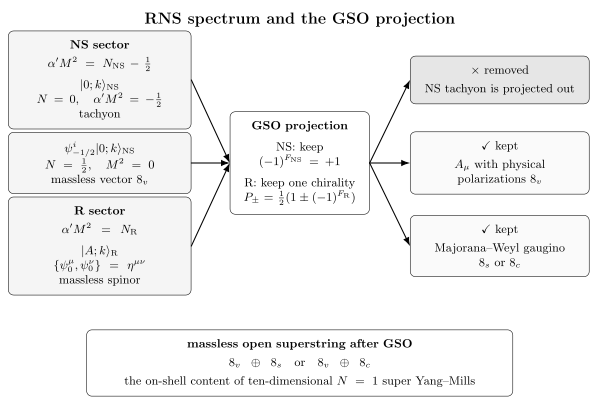
Selected open-string levels in flat ten-dimensional spacetime, with masses expressed as the dimensionless quantity . Counts are physical polarizations without Chan–Paton multiplicity. The NS choice retains odd oscillator parity; the R choice halves the physical ground-state degeneracy and correlates zero-mode chirality with excited-oscillator parity. The first massive count is derived in exercise 4.
What consistency does and does not establish
Section titled “What consistency does and does not establish”A GSO choice must fit into an interacting string construction. For an oriented closed string, summing spin structures must produce the appropriate torus modular invariance. For an annulus, the relevant relation is open/closed channel consistency: an open-string loop and closed-string exchange describe the same surface. These are related requirements, but “the annulus is modular invariant” is not a substitute for specifying its channels, boundary conditions, and closed sector. The distinction is developed in Polchinski, Chaudhuri, and Johnson’s notes.
Nor does one-loop consistency uniquely force spacetime supersymmetry. For example, Type 0 closed strings have a different sector choice, no spacetime fermions, and a perturbative tachyon; see Klebanov and Tseytlin. Here we select the supersymmetric open-string and Type II choices and determine their consequences. Removing the NS tachyon or matching the numbers of bosons and fermions is an important check, but constructing the supercharges and their action supplies additional information.
The massless multiplet and its low-energy interpretation
Section titled “The massless multiplet and its low-energy interpretation”The projected open-string massless states are a vector and a Majorana–Weyl spinor:
This is the field content of ten-dimensional super Yang–Mills theory, with 16 real supercharges. The equality of eight on-shell bosonic and eight on-shell fermionic polarizations is necessary for the multiplet; it does not mean that its off-shell field components have equal counts without auxiliary fields.
Chan–Paton labels attach gauge indices to these states. For oriented strings on coincident flat BPS D-branes of the appropriate Type II theory, they produce a worldvolume theory. At energies small compared with , its leading dynamics is the dimensional reduction of ten-dimensional super Yang–Mills to dimensions: components remain gauge fields, while the components become transverse scalar fields. Orientation projections can change the gauge group. Global charge cancellation and the consistent closed-string completion impose further restrictions; an arbitrary ten-dimensional Chan–Paton theory is not guaranteed by the free open spectrum alone. These brane interpretations are derived in Notes on D-Branes.
Closed strings pair two physical sectors
Section titled “Closed strings pair two physical sectors”A closed string has two independent oscillator systems. With no winding or compactification momentum, each contributes half the open-string zero mode, leading to
Equality of the shifted levels is level matching. In a mixed NS–R sector it is , not equality of the unshifted oscillator numbers.
The Type II projection uses the supersymmetric NS choice in both sectors. Equal ten-dimensional Ramond chiralities give Type IIB; opposite chiralities give Type IIA. At the massless level, the NS–NS states are : graviton, antisymmetric tensor, and dilaton. R–R states supply 64 further bosonic polarizations, and the two mixed sectors together supply 128 fermionic polarizations. Exercise 6 derives the level matching and count; the Type II spectrum page will identify the individual R–R fields and their gauge constraints.
Exercises
Section titled “Exercises”1. Choose a representative of each massless vector polarization
Section titled “1. Choose a representative of each massless vector polarization”Let be nonzero and null. Choose a second null vector with , and define
Show that is a rank-eight projector. For a physical polarization , prove that represents the same physical state and obeys both . Explain what changes when a different auxiliary is chosen, and why the physical norm is positive.
Solution
Acting on or gives zero because both are null and . If is orthogonal to both, . The span of is a nondegenerate Lorentzian two-plane, so its orthogonal complement has dimension eight and Euclidean signature. These facts already prove that and establish positivity on its image. Direct multiplication gives the same result; its trace is .
For a transverse polarization,
The second term is exactly a null-state shift. Its contraction with cancels , while its contraction with vanishes. A second admissible vector gives
so the two representatives differ by a gauge direction. No physical polarization depends on the auxiliary vector. Finally, for any complex ,
because is real, , and . In the eight-dimensional image of this is an ordinary positive Euclidean norm. It vanishes only for the zero class, although a nonzero covariant representative proportional to has zero norm.
2. Construct the Clifford space and count the Dirac kernel
Section titled “2. Construct the Clifford space and count the Dirac kernel”Using the five operators introduced in the text, reconstruct all ten Euclidean gamma matrices and then the Lorentzian ones. Derive the chirality operator and count its eigenspaces. Finally verify that, for , the simultaneous Weyl and Dirac conditions leave eight complex amplitudes. Explain why a Majorana condition is not another factor of two in this answer.
Solution
The inverse relations are
The canonical anticommutators imply and for . Setting gives ; the nine spatial generators retain positive square.
Let . Within one pair,
Moving through the nine spatial generators gives
Thus the positive-chirality states have even occupation and the negative-chirality states have odd occupation. Their dimensions are
For the chosen null momentum, . Multiplication by the invertible converts its kernel condition to , where . The two commuting involutions and admit the simultaneous projector in the text. Traces of the nonidentity Clifford products vanish, hence
The full Dirac kernel has rank 16 and splits into two such subspaces. The transverse chirality operator obeys . On , it follows that , which explicitly identifies a single transverse spinor chirality.
This calculation concerns complex amplitudes for a fixed momentum. A Majorana–Weyl spacetime field admits eight particle polarizations with complex one-particle amplitudes; its reality condition fixes the conjugate-frequency part of the field expansion. It does not replace this polarization space by four dimensions.
3. Test the full GSO operator on excited states
Section titled “3. Test the full GSO operator on excited states”Prove that the stated parity operators anticommute with every fermion mode, commute with every boson mode and , and anticommute with . In light-cone R quantization, let the transverse zero-mode chirality be and choose the ground eigenspace denoted . Determine which zero-mode chirality accompanies a state with one nonzero fermion oscillator. Contrast this with a state containing one bosonic oscillator. Also prove that every retained NS state has integer .
Solution
For a positive-frequency fermion oscillator, the number parity changes sign when either its creation or annihilation operator is applied. Therefore anticommutes with all nonzero fermion modes and commutes with the bosons.
In R, anticommutes with each zero mode. It commutes with a nonzero fermion mode: moving that mode through the product of ten zero modes produces ten minus signs. Conversely, commutes with zero modes, since each nonzero number operator is an even bilinear. Consequently anticommutes with zero and nonzero fermion modes alike. The NS vacuum sign does not change the same anticommutation argument in its sector.
Each term in has either two fermions or none, while each term in has one. Hence
These identities preserve the physical-state kernels. They also preserve the equivalence by physical null states, since parity acts invertibly on the state space and sends the relevant constraint descendants into constraint descendants.
After solving the longitudinal constraints, the R projection is represented, up to its overall chirality sign, by . Its eight zero modes generate a 16-dimensional Clifford space . If the retained zero-oscillator ground state is , then
have the same retained total parity. A state has the wrong parity. These expressions describe light-cone physical states; imposing only the covariant ground-state Dirac equation on an excited state would miss its additional oscillator terms in .
Finally, every NS fermion frequency is an integer plus . Modulo integers, the fermionic level is . Retained states have odd , so and . Since the smallest retained level is , the allowed masses are nonnegative.
4. Count and organize the first massive supermultiplet
Section titled “4. Count and organize the first massive supermultiplet”Enumerate all projected transverse NS states with and R states with . Show that each sector has 128 states at . For the massive rotation group , compare the NS count with a symmetric traceless rank-two tensor plus a three-form, and the R count with a gamma-traceless vector-spinor. Explain how these representations can contain both transverse spinor chiralities despite the R projection.
Solution
At NS level , odd fermion parity allows exactly three oscillator types:
The final indices are totally antisymmetric, and repeated indices give zero. No further type has the required level. The total is .
A symmetric traceless tensor in nine dimensions has components; a three-form has . Their restriction to transverse eight-dimensional rotations is
Meanwhile in the mixed oscillator state. Thus the transverse states have exactly the branching content of . This organization is consistent with Lorentz invariance of the critical physical spectrum; counting alone would not prove that invariance.
At R level one, the allowed states are
where the ground chirality reverses in the second term to compensate for odd oscillator parity. There are states. The spinor has dimension 16; a vector-spinor has components, and its gamma trace removes 16, leaving 128. The trace map is surjective: given a spinor , the vector-spinor has . Thus the subtraction is justified.
Under the 16-component spinor splits into . Restricting the nine-dimensional gamma-traceless vector-spinor gives
because the extra vector component supplies a spinor that is removed by the gamma trace. This agrees with the oscillator result. Both transverse chiralities are needed at a massive level, while the total R parity remains fixed. The level contains 128 bosonic and 128 fermionic polarizations, without Chan–Paton factors.
5. Count the projected spectrum with generating functions
Section titled “5. Count the projected spectrum with generating functions”Let be a formal counting variable and define , where . Derive the projected NS and R generating functions from the eight transverse oscillators. Compute the coefficients through , including an explicit NS count at . Finally use Jacobi’s product identity
to compare all mass levels. State what the equality does not establish by itself.
Solution
One bosonic oscillator of frequency contributes the geometric series ; one fermionic oscillator of frequency contributes . Inserting changes the latter factor to . Projection onto odd NS occupation therefore gives
The power converts oscillator level to mass level. In R, each nonzero oscillator configuration has exactly eight compatible zero-mode states: its fermion parity determines which chirality is retained. Consequently
The first product factor has expansion
and the factor contributes . Higher frequencies first contribute at . Hence
For a direct NS check at , group the states by the number of fermion oscillators. With one fermion, the possibilities are a frequency fermion; a frequency fermion plus one frequency-one boson; or a frequency fermion plus bosonic level two. They contribute
Here counts two frequency-one bosons in a symmetric product. With three fermions, either one has frequency and two have frequency , or all three have frequency and are accompanied by a frequency-one boson. These give
Finally five frequency- fermions give . Thus , matching R. The lower coefficients are the massless and first-massive counts already derived.
The stated product identity implies coefficient by coefficient. It is the theta-constant identity in product form; with the conventions of the NIST Digital Library of Mathematical Functions, sections 20.5 and 20.7, its nome is . For analytic products take ; as a formal series, only finitely many oscillator frequencies affect each coefficient.
This proves equality of physical bosonic and fermionic degeneracies in the chosen free spectrum. It does not construct the supercharge operators, show how they act on interacting amplitudes, or prove consistency of arbitrary boundaries and Chan–Paton factors. Those are additional requirements.
6. Match the mixed closed sectors and count Type II states
Section titled “6. Match the mixed closed sectors and count Type II states”In a noncompact Type II vacuum, determine the lowest two allowed oscillator-level pairs in each of NS–NS, R–R, NS–R and R–NS. Find their masses. At the massless level, decompose the NS–NS polarizations, count all bosons and fermions, and explain why the Type IIA/IIB chirality distinction changes representations without changing these totals. What would happen to the NS–NS ground state without the supersymmetric projection?
Solution
Each chiral sector obeys . After the supersymmetric projection, the lowest NS levels are , while the lowest R levels are . Matching the shifted levels gives
| Sector | Massless pair | First massive pair |
|---|---|---|
| NS–NS | ||
| R–R | ||
| NS–R | ||
| R–NS |
The first column has and the second has . Imposing in a mixed sector would wrongly exclude its massless fermions.
At the massless level, an NS vector from each side gives
These are transverse physical polarizations: the symmetric traceless part is the graviton, the antisymmetric part is the two-form, and the trace is the dilaton. They total 64. A pair of R spinors also gives bosonic polarizations. Each mixed sector has fermionic polarizations, so
The gamma-trace map in a mixed vector-spinor sector extracts an eight-dimensional spinor, leaving a 56-dimensional gamma-traceless part. These correspond to a dilatino and gravitino. R–R products depend on whether the two chiralities agree: they decompose as for equal transverse chirality and for opposite chirality. Thus the field representations distinguish IIB and IIA while both counts remain 64 in R–R. The detailed form-field interpretation requires their gauge symmetries and will be developed later.
Before the supersymmetric projection, the NS–NS pair would satisfy level matching but have . Level matching by itself therefore does not remove the tachyon; the sector choice is essential.
References
Section titled “References”- Gliozzi, Ferdinando, Joël Scherk, and David I. Olive. “Supergravity and the spinor dual model.” Physics Letters B 65 (1976): 282–286. doi:10.1016/0370-2693(76)90183-0.
- Gliozzi, Ferdinando, Joël Scherk, and David I. Olive. “Supersymmetry, supergravity theories and the dual spinor model.” Nuclear Physics B 122 (1977): 253–290. doi:10.1016/0550-3213(77)90206-1.
- Klebanov, Igor R., and Arkady A. Tseytlin. “D-Branes and Dual Gauge Theories in Type 0 String Theory.” Nuclear Physics B 546 (1999): 155–181. doi:10.1016/S0550-3213(99)00041-3; arXiv:hep-th/9811035.
- National Institute of Standards and Technology. Digital Library of Mathematical Functions, chapter 20, “Theta Functions,” sections 20.5 and 20.7, especially equation 20.7.5. Products and theta-constant identity.
- Polchinski, Joseph, Shyamoli Chaudhuri, and Clifford V. Johnson. Notes on D-Branes. Institute for Theoretical Physics lectures, report NSF-ITP-96-003 (1996). arXiv:hep-th/9602052.
- Weigand, Timo. Introduction to String Theory. Lecture notes, Universität Heidelberg, winter term 2011/12, sections 6.4–6.7. Author’s PDF.