
Calabi–Yau Compactification and Moduli
A compact internal space determines both the amount of supersymmetry visible in four dimensions and the fields that a low-energy observer can excite. For a smooth Calabi–Yau threefold with full holonomy, flux-free type II compactification preserves eight real supercharges. Its massless spectrum is controlled by two Hodge numbers, and , while the interactions of its scalar fields depend on metrics on the spaces of geometric deformations.
We will derive the connection between these statements. The main steps are to identify the allowed metric deformations, turn their internal wavefunctions into four-dimensional kinetic terms, and reduce the ten-dimensional form fields without double-counting dual descriptions. The final comparison is
Here counts vector multiplets beyond the gravity multiplet, and counts hypermultiplets. The shared Kähler geometry and internal orientation fix the metric, form and string-unit normalizations. The ten-dimensional fields are those of the type II low-energy actions.
Ricci-flat geometry and preserved supersymmetry
Section titled “Ricci-flat geometry and preserved supersymmetry”Consider the leading product background
with constant dilaton, vanishing background form fluxes, and no orientifold projection or branes. The internal space has real dimension six. For a classical geometric reduction, its curvature radii must be large compared with , the string coupling must be small, and the four-dimensional energies must lie below the relevant Kaluza–Klein masses. A large total volume does not ensure that every cycle remains large.
An almost complex structure is an endomorphism of the tangent bundle satisfying . Integrability means that its holomorphic directions arise from local complex coordinates; equivalently, its Nijenhuis tensor vanishes. A compatible metric obeys . Its associated two-form is .
For an integrable complex structure, the Kähler condition is equivalent to . Locally the Hermitian metric comes from a real function :
Changing by a holomorphic function plus its complex conjugate leaves the metric unchanged. This local potential is distinct from the Kähler potentials on moduli space that we will derive below.
The Ricci form of a Kähler metric is
In components, with ; the order of the two Dolbeault derivatives fixes the sign.
A Ricci-flat Kähler metric therefore requires vanishing first Chern class in real cohomology. Yau’s theorem supplies the converse existence statement: on a compact Kähler manifold with this condition, each Kähler class contains a unique Ricci-flat Kähler metric for the fixed complex structure. The theorem establishes existence and uniqueness; it usually does not supply an explicit metric. Yau’s announcement states this result and its application to projective hypersurfaces.
For the compactifications studied here we also require a nowhere-vanishing holomorphic three-form , and the holonomy of the Ricci-flat metric is exactly . These qualifications matter. Vanishing real alone does not establish holomorphic triviality of the canonical bundle, and holonomy contained in need not equal . The flat six-torus and have smaller holonomy and preserve additional supersymmetry.
Why does full holonomy give eight supercharges? A supersymmetry parameter contains an internal spinor obeying
Parallel transport must therefore leave invariant. The relevant spin group is , the double cover of . Its chiral spinor restricts as
There is one complex singlet of each conjugate internal chirality. The ten-dimensional Majorana condition relates the conjugate terms in the decomposition of a supersymmetry parameter; it does not double the number of independent four-dimensional supercharges. Each ten-dimensional type II parameter supplies four real supercharges, and the two parameters supply eight: four-dimensional .
The integrability condition
also explains Ricci flatness. Contracting with a gamma matrix and using the curvature Bianchi identity gives . In a positive-definite internal metric, Clifford multiplication by a nonzero real vector is invertible. Since is nonzero, every vector must vanish. This implication does not say that an arbitrary Ricci-flat manifold has a parallel spinor.
Hodge data and geometric zero modes
Section titled “Hodge data and geometric zero modes”On a compact Kähler manifold, differential forms split into types , and Hodge theory identifies cohomology classes with harmonic representatives:
Complex conjugation and duality give
Full holonomy supplies further information. On a compact Ricci-flat Kähler manifold, holomorphic forms are parallel. The representation on one-forms and two-forms has no holomorphic singlet, while its determinant representation has one. Thus
Together with connectedness, these facts determine the Hodge diamond from and .
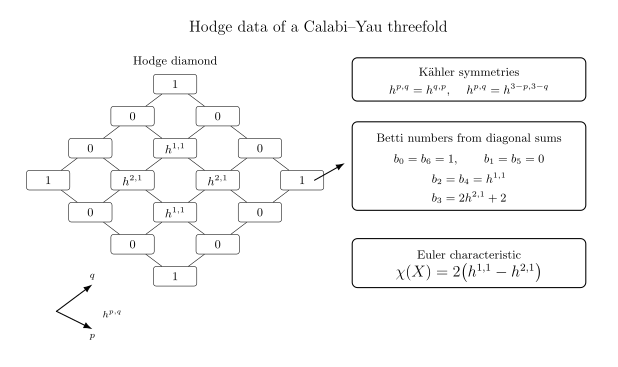
For a smooth compact threefold with full holonomy, only and are independent. Each horizontal row has fixed degree and sums to . This is a cohomology diagram, not a picture of the internal manifold.
Summing each fixed-degree row yields
Consequently,
The physical use of cohomology is easiest to see in a mode expansion. For a minimally coupled scalar, let , with the internal Laplacian chosen nonnegative. Expanding gives four-dimensional masses in the unwarped product metric. Form fields have the analogous expansion in eigenforms, after their gauge redundancies are removed. Their zero modes are harmonic forms.
Metric fluctuations require more care: they obey the linearized Ricci-flat equations modulo diffeomorphisms, rather than a scalar Laplace equation. On a Calabi–Yau threefold these fluctuations divide into real Kähler deformations and complex complex-structure deformations. We now construct both kinds and their kinetic metrics.
Kähler deformations and their kinetic metric
Section titled “Kähler deformations and their kinetic metric”Use the dimensionless forms of the shared definitions:
The represent an integral basis of the free part of . The coefficients must lie in the Kähler cone, where is represented by a positive Kähler form. An arbitrary choice of integral basis does not make this cone simply the region .
Define the intersection data
The dimensionless volume and its first two derivatives are
These are topological intersection numbers combined with continuous metric parameters. The physical string-frame volume is .
To obtain a kinetic metric, we need the inner products of the harmonic forms, using the shared dimensionless-metric operator . Decompose a harmonic form into a primitive part and a component along :
The coefficient is constant: the contraction of a harmonic form with the Kähler form is a harmonic function, hence constant on compact connected . In complex dimension three,
Substitution gives
It follows that
The left-hand side is a positive inner product on nonzero real harmonic forms. This is the geometric reason the apparently indefinite intersection expression produces a positive kinetic metric inside the Kähler cone.
The leading IIA reduction, expressed in four-dimensional Einstein frame and at fixed four-dimensional dilaton, gives
Here the scalar kinetic term is , with the reduced four-dimensional Planck mass. Equivalently, the real field-space line element is . The form-norm coefficient follows from the Einstein-frame reduction; Grimm and Louis, section 2 give the corresponding full leading action.
There is a useful independent check. Since the volume depends only on ,
The factor is essential. For one modulus with , the result is , regardless of the positive constant .
At large radius this metric also has a special Kähler description through a homogeneous cubic prepotential. In a compatible projective normalization its leading part is
The cubic is a classical large-radius result. Perturbative and worldsheet-instanton contributions can modify the exact prepotential. The geometric norm calculation above does not compute those contributions, and it is not a formula for the complete IIB hypermultiplet metric.
Complex-structure deformations and the period metric
Section titled “Complex-structure deformations and the period metric”Changing the complex structure changes which one-forms are holomorphic. Infinitesimally, describe the new coframe by
The Beltrami differential is a form valued in the holomorphic tangent bundle. Linearized integrability gives , while an infinitesimal coordinate change shifts by a -exact term. Thus inequivalent infinitesimal deformations belong to .
From the Beltrami differential to the metric
Section titled “From the Beltrami differential to the metric”The holomorphic volume form converts the vector index of into two form indices. With the usual component expansion of a three-form,
Because never vanishes, contraction is an isomorphism of the relevant bundles and hence of their Dolbeault cohomologies:
This explains the number . The extension of infinitesimal Calabi–Yau deformations to a smooth local family uses the mathematical unobstructedness result; the cohomology isomorphism alone is only a first-order calculation.
The relation to a metric fluctuation is also explicit. Expanding the Hermitian metric in the deformed coframe gives its component,
For a harmonic Calabi–Yau deformation, is primitive. Indeed, Kähler identities make a harmonic form, and . Primitivity is equivalent to symmetry of the lowered Beltrami tensor in this description, so
Its conjugate gives . The factor two follows from the two metric slots. It would change if one defined the deformation variable as a component of instead of the coframe coefficient used here.
The inverse relation and its normalization follow from
In particular, . A parallel has constant pointwise norm on each Ricci-flat fiber. The metric-deformation norm therefore reduces to
Here ; common length factors cancel in this ratio. For moduli coordinates and a tangent displacement , set . The right-hand side is then the real line element . The label on now enumerates moduli; each is itself an internal three-form.
Projecting out the normalization of Ω
Section titled “Projecting out the normalization of Ω”Choose a local holomorphic section over complex-structure moduli space, using a fixed cohomology basis to compare nearby fibers. Writing , its derivative decomposes as
The first term changes the choice of representative in the holomorphic three-form line; the second measures a change in complex structure. Hodge type makes .
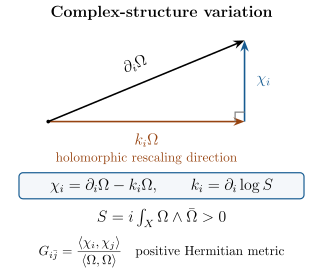
The decomposition separates a change of normalization from the primitive deformation. The normalized Hodge inner product of the latter gives the complex-structure metric. The drawing represents directions in cohomology space; angles and lengths are schematic.
Let
Holomorphic dependence and Hodge type give
The terms along cancel when we differentiate the logarithm:
The minus sign is compatible with positivity. In the shared internal orientation,
so the same result is
This is the Weil–Petersson metric on complex-structure moduli. It is also the leading IIB vector-multiplet metric and appears in the IIA hypermultiplet geometry. The distinction between the geometric metric and the complete hypermultiplet metric is described in Grimm and Louis’s IIA reduction.
Under a nonzero holomorphic rescaling ,
One must retain this holomorphic-section description during differentiation. Normalizing to a constant at every point generally requires a nonholomorphic rescaling; differentiating that constant would not calculate the metric.
Periods as local coordinates
Section titled “Periods as local coordinates”Choose a real symplectic basis of with
where . Write
Antisymmetry of the wedge product of three-forms then gives
The coefficients are periods in a compatible cycle basis. On a patch where , projective ratios provide special coordinates. The local holomorphic prepotential obeys . Neither a single period gauge nor a single coordinate patch need cover the entire moduli space.
Reducing the type II fields
Section titled “Reducing the type II fields”A four-dimensional vector multiplet contains one vector and one complex scalar; a hypermultiplet contains four real scalars. The gravity multiplet includes one vector, the graviphoton. We count propagating bosonic fields around the flux-free background, using the inherited bulk RR potentials. Their coefficient normalizations do not affect the multiplicities below.
The common NS fields give real metric moduli, internal -field scalars, one external two-form , and the dilaton. A massless two-form in four dimensions is locally dual to a scalar, so the NS sector has
The four-dimensional dilaton involves the volume: dimensional reduction of gives a factor . Thus one may define before the four-dimensional Einstein-frame rescaling. A variation of volume at fixed is not a variation at fixed ten-dimensional .
Type IIA
Section titled “Type IIA”The RR potentials reduce schematically as
There are no harmonic one-forms, so supplies no internal scalar. The expansion gives vectors and real RR scalars. A purely external three-form has no propagating local degree of freedom in four dimensions; its constant-flux branch is set to zero here.
The total number of vectors is . One combination is the graviphoton, leaving vector multiplets whose scalars are the . The remaining scalars number
Hence . The extra hypermultiplet includes the four-dimensional dilaton and the scalar dual to , together with RR partners. This local grouping does not assert that its kinetic metric is globally decoupled from the other hypermultiplets.
Type IIB and self-duality
Section titled “Type IIB and self-duality”The IIB RR potentials are . The axion gives one scalar, while gives internal scalars and one external two-form, dual to another scalar. For , use harmonic four-forms dual to :
The candidate vectors number , but the ten-dimensional five-form is self-dual. It relates their field strengths by four-dimensional electric–magnetic duality. An electric description therefore has only independent vectors. The same self-duality relates the two-forms to the scalars; they must not be counted twice. This reduction is explicit in Grimm and Louis, section 2.
Removing the graviphoton leaves vector multiplets, paired with the complex-structure moduli. The RR scalar count is , and therefore
This gives .
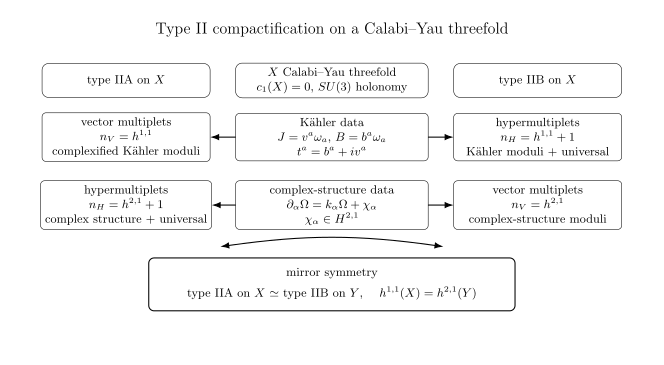
Both theories use the same smooth compact full- threefold. IIA vectors arise from and ; IIB vectors arise from and are halved by five-form self-duality. Each total includes one graviphoton. Scalar totals then determine the hypermultiplet counts in the flux-free theory.
The two-derivative scalar space locally separates into a special Kähler vector-multiplet sector and a quaternionic Kähler hypermultiplet sector. In this ungauged setting, corrections can change kinetic metrics without generating a generic scalar potential for the neutral moduli. Fluxes, gauging, orientifold projections and added branes can change that conclusion and require a new analysis.
Mirror symmetry and the noncompact conifold
Section titled “Mirror symmetry and the noncompact conifold”The IIA/IIB exchange on the same suggests the geometry of mirror symmetry. A mirror pair has
so . The physical statement is stronger: type IIA on and type IIB on describe equivalent compactifications, with the appropriate identification of their moduli and quantum corrections. Equal Hodge data alone do not prove this equivalence. In the vector sector, mirror symmetry turns quantum Kähler information on the IIA side into complex-structure period information on the IIB side.
The next page changes from a compact internal manifold to a local noncompact Calabi–Yau singularity. The conifold is
or, after a linear change of variables, the rank-one matrix locus . Away from the origin it has complex dimension three. Its Ricci-flat metric is a cone,
The metric radius satisfies , not the square root of that expression. Klebanov and Witten, section 2 derive this scaling and the link. A noncompact cone has different normalizability and boundary questions from a compact threefold, so the compact Hodge-counting formulas cannot simply be applied to it. D3-branes at its tip lead to the Klebanov–Witten example; the brane projection and near-horizon limit are additional ingredients.
Common pitfalls
Section titled “Common pitfalls”Replacing full holonomy by a weaker condition. Ricci flatness, trivial canonical bundle and full holonomy have different logical roles. A smaller holonomy group can change both the Hodge diamond and the number of preserved supercharges.
Normalizing Ω before differentiating it. A local holomorphic section is free to rescale holomorphically. A pointwise unit normalization is generally nonholomorphic and cannot be inserted into as if nothing changed.
Counting dual fields as independent fields. An external two-form and its scalar dual are alternative descriptions. In IIB, five-form self-duality also pairs the candidate electric and magnetic vectors; the graviphoton must then be separated from the vector-multiplet count.
Treating cohomology as a complete effective action. Hodge numbers count modes under the stated hypotheses. Their kinetic couplings require harmonic-form inner products and period data, and quantum corrections or added ingredients require further analysis.
Exercises
Section titled “Exercises”Exercise 1. A smaller-holonomy test
Section titled “Exercise 1. A smaller-holonomy test”The nonzero Hodge numbers of are and . An elliptic curve has all four entries equal to one. Use Künneth to find and for . Explain its type II supersymmetry and why the full- spectrum formula needs modification.
Solution
Künneth multiplies the Hodge polynomials, or equivalently convolves the pairs of indices. It gives
For , the contributions are and , so .
The second Betti number includes the nonzero holomorphic two-forms:
The real cohomology calculation is equally direct:
The holonomy is , and the spinor restricts as . There are two internal singlets for each ten-dimensional parameter, twice the full- count. Type II therefore preserves sixteen real supercharges, or four-dimensional .
The relation already fails here, and the harmonic one-forms supply additional reduction modes. The numerical coincidence and the vanishing Euler number do not restore the missing full-holonomy hypothesis.
Exercise 2. The quintic from parameters and characteristic classes
Section titled “Exercise 2. The quintic from parameters and characteristic classes”Let be a generic smooth degree-five hypersurface in . Use the facts that its polynomial deformations describe its complex-structure deformations and that Lefschetz gives . Count the polynomial parameters modulo rescaling and projective coordinate changes. Independently compute its Euler characteristic from
Find the type IIA and IIB multiplet counts.
Solution
A homogeneous degree-five polynomial in five variables has
coefficients. Overall multiplication does not change its zero locus, and has complex dimension . At a generic smooth point, where continuous stabilizers do not change this count,
The supplied deformation-theoretic fact is necessary: coefficient counting by itself would not establish that every abstract deformation is polynomial.
Expanding the Chern-class expression through degree three gives
Thus and
This agrees with . The Betti numbers include and . Type IIA has one vector multiplet and hypermultiplets; type IIB has vector multiplets and two hypermultiplets, in each case in addition to the gravity multiplet. The calculation checks topological and spectrum data; it does not construct the Ricci-flat metric.
Exercise 3. A two-modulus metric and positivity
Section titled “Exercise 3. A two-modulus metric and positivity”A smooth bicubic hypersurface in has hypersurface class . Use and to derive its triple intersections. For in the ambient positive cone , calculate , prove positivity, and check
Solution
An integral over the hypersurface inserts in the ambient integral. Therefore , while . Including the three permutations of each mixed term gives
The complex Hessian is one quarter of the real Hessian in :
The first diagonal entry is positive, and
Sylvester’s criterion then establishes positivity throughout this cone. This is a particular geometric intersection form; it does not imply that an arbitrary cubic produces a positive metric.
Homogeneity gives a more general check. Write . Since the volume is cubic,
Contracting the second relation with gives . Also and , so
This last identity is often called a no-scale identity. Here it follows from the homogeneous kinetic potential; no scalar potential has been introduced in the ungauged theory.
Exercise 4. A solvable complex-structure metric
Section titled “Exercise 4. A solvable complex-structure metric”Use a flat six-torus with unit real coordinate periods and
This is a geometry example with smaller holonomy, not the full- compactification used for the spectrum. Calculate , the projected deformation and its metric. Explain the effect of and of a pointwise unit normalization.
Solution
Let . Direct wedge multiplication in the positive orientation gives
Writing , we have
Consequently,
The projected form is primitive for the product Kähler metric. Its wedge pairing divided by the pairing, with the required minus sign, again gives .
At this also checks the Beltrami factor. The new coframe has after its holomorphic rescaling is separated. With , metric compatibility gives . Its contribution to the real metric-deformation norm is .
A holomorphic rescaling changes by , whose mixed derivative vanishes. In contrast, has unit but is not holomorphic in . The derivation that identified the Hessian with the projected norm assumed in the fixed cohomology trivialization. Applying it to and declaring the metric zero would violate that assumption.
Exercise 5. Electric and magnetic IIB vectors
Section titled “Exercise 5. Electric and magnetic IIB vectors”At one point in moduli space choose a real symplectic pair of three-forms with and . Take
where are four-dimensional two-form field strengths. Derive the consequence of ten-dimensional self-duality and recover the IIB vector count. Why must the scalar/two-form modes of also be counted only once?
Solution
With product orientation , the product-star rule is
For the sign is positive. Therefore
Self-duality requires
These are consistent because on Lorentzian two-forms. They specify one Maxwell field and its magnetic dual, rather than two independent Maxwell fields. The internal relation on three-forms makes the ten-dimensional square positive.
There are independent electric fields. One belongs to the gravity multiplet, leaving vector multiplets. The local symplectic frame used in the exercise is not a claim that the Hodge star has this simple form in one fixed integral basis throughout moduli space.
The components of with one external and four internal indices contain derivatives of the scalars. Self-duality relates them to components with three external and two internal indices, which are field strengths of . Keeping both descriptions would count each propagating degree of freedom twice. Retaining only the scalars gives the RR scalar total and the hypermultiplet count derived in the page.
Exercise 6. The conifold link and its metric radius
Section titled “Exercise 6. The conifold link and its metric radius”Write the conifold as the rank-one matrix locus , with . Explain the quotient by and identify the fixed-radius link. A holomorphic residue three-form scales as under . Use this to find the exponent of a homogeneous Kähler potential and the relation between the algebraic and metric radii. Derive the Ricci-flat cone condition on the link.
Solution
A nonzero rank-one matrix factors into a column and a row, uniquely up to . The positive real part of this quotient can be fixed by . At a fixed nonzero common norm, and lie on two three-spheres, and the remaining phase acts as
The link is therefore , of real dimension . The rank-one locus away from its vertex has complex dimension . This identifies the link as ; it does not identify the metric induced from the ambient flat with the Ricci-flat conifold metric.
Let . Under positive real scaling , a Kähler potential and its Kähler form have weight . Thus has weight . The residue has weight two, so has weight four. Compatibility of the Calabi–Yau volume forms requires
The metric radius consequently scales as :
Finally, for with a five-dimensional link, the additional Christoffel symbols are
Substitution into the Ricci tensor gives
Ricci flatness requires , the Einstein normalization used on the next page. The conifold is noncompact, so this local metric construction does not by itself define a four-dimensional compactification with the finite-volume spectrum counted above.
References
Section titled “References”- Grimm, Thomas W., and Jan Louis. “The effective action of N=1 Calabi–Yau orientifolds.” Nuclear Physics B 699 (2004), 387–426. arXiv:hep-th/0403067. doi:10.1016/j.nuclphysb.2004.08.005. Section 2 gives the unorientifolded IIB reduction used here.
- Grimm, Thomas W., and Jan Louis. “The effective action of Type IIA Calabi–Yau orientifolds.” Nuclear Physics B 718 (2005), 153–202. arXiv:hep-th/0412277. doi:10.1016/j.nuclphysb.2005.04.007. Section 2 and Appendix A describe the unorientifolded moduli metrics and special geometry.
- Klebanov, Igor R., and Edward Witten. “Superconformal Field Theory on Threebranes at a Calabi–Yau Singularity.” Nuclear Physics B 536 (1998), 199–218. arXiv:hep-th/9807080. doi:10.1016/S0550-3213(98)00654-3.
- Yau, Shing-Tung. “Calabi’s conjecture and some new results in algebraic geometry.” Proceedings of the National Academy of Sciences 74 (1977), 1798–1799. doi:10.1073/pnas.74.5.1798.