
Relativistic Particles, Branes, and the Birth of the String
A relativistic particle traces a curve through spacetime; a string traces a surface. Requiring the action to depend on that geometry, rather than on the coordinates used to describe it, leads to reparametrization symmetry and constraints. It also explains why a nearly straight string oscillates in transverse directions.
We will follow this argument from the particle action to the Nambu–Goto action, then quantize the small oscillations of a long string. For a string with fixed endpoints and only transverse massless modes, the result is
The linear term measures the tension. The negative inverse-length term is a quantum effect that depends on the massless fields and their boundary conditions. Deriving it will distinguish a fundamental string from a string used as an effective description of a confining flux tube.
The calculations use the shared spacetime and worldsheet conventions. We begin with classical geometry and a free scalar propagator; spin, worldsheet fermions, and the conditions for a complete quantum string theory enter later.
The relativistic particle and its constraint
Section titled “The relativistic particle and its constraint”Let describe a timelike curve in a spacetime with metric . A dot denotes a derivative with respect to its arbitrary parameter . The elapsed proper time along the curve is
The geometrical action for a particle of mass is
Under an orientation-preserving change , the velocity acquires the inverse Jacobian and acquires the Jacobian. Their product in is unchanged. Different parametrizations describe the same spacetime curve.
In flat spacetime, choose temporarily. Then
The usual nonrelativistic kinetic energy appears after the constant rest-energy term. This check fixes the sign of the relativistic action.
Before making that gauge choice, the canonical momentum is
Contracting with the inverse spacetime metric gives
Thus the momenta cannot be chosen independently: they obey the mass-shell constraint. In flat spacetime, the future-directed branch has , while .
The canonical Hamiltonian computed from the reparametrization-invariant Lagrangian vanishes:
This does not mean that the particle has zero energy. generates evolution in the redundant parameter . Once is used as a physical clock and the constraint is solved, the Hamiltonian is the nonzero energy ; exercise 1 derives it. The distinction between a gauge generator and a physical energy will recur for strings. For a further treatment of the classical particle and string actions, see Tong, section 1.
The einbein and the massless particle
Section titled “The einbein and the massless particle”Introduce an auxiliary worldline field , the einbein, and replace the square root by
Under a reparametrization, is a scalar and is invariant:
Both terms in the action are consequently invariant. There are no derivatives of , so its equation is a constraint rather than an independent propagation equation:
For , choose the positive-einbein branch. It gives
The condition selects the sign of the worldline lapse and the orientation of its invariant parameter. It does not impose a future-directed spacetime trajectory: that is a separate condition on . For example, reversing the time direction of a timelike curve leaves and the positive solution for unchanged.
The einbein action also has a well-defined massless limit:
Its equations in flat spacetime are
For constant , the solution is a straight null line with constant momentum . The equation for now constrains the trajectory without determining in terms of . Substituting directly into would instead erase the variational problem. Nor may one eliminate using the massive formula, which divides by .
A useful form that treats the two masses uniformly is
Varying gives and recovers the einbein action. Varying imposes the mass shell directly. The Hamiltonian is a multiple of that constraint.
The worldline modulus and the scalar propagator
Section titled “The worldline modulus and the scalar propagator”For an open worldline with fixed endpoints, use a dimensionless parameter . Since has dimension length, the einbein action requires
The positive number is invariant under reparametrizations that preserve the endpoints. It cannot be gauged away. Indeed, the coordinate change
sets on the same unit interval. Thus the local einbein fluctuations are gauge freedom, while remains as one ordinary integration variable.
The name proper-time parameter requires care. On a classical massive trajectory, , so the elapsed spacetime proper time is . The modulus itself has dimension length squared, and it remains useful for a massless particle, whose elapsed proper time along a null trajectory is zero.
Fixing the normalization and the Feynman sign
Section titled “Fixing the normalization and the Feynman sign”Let
be the time-ordered two-point function of a canonically normalized free real scalar . With the shared mostly-plus signature and the action , its momentum-space expression is
It satisfies . Specifying the time-ordered correlator matters: an inverse differential operator defined without the Feynman factor of is a different quantity.
At fixed , the first-order particle action gives the kernel
Its normalization is fixed by . Integrating out the momenta gives the equivalent position path integral with exponent
The path-integral measure is understood with the kernel normalization just stated. To obtain the propagator, integrate over the modulus:
The factor is required by the factor in the worldline Hamiltonian. It can be absorbed by defining , but it cannot simply be omitted. At fixed momentum the calculation is elementary:
Taking yields the Feynman prescription. A symbolic expression does not by itself fix this overall normalization.
The propagator path integral sums over off-shell paths; it is not restricted to classical, future-directed timelike curves. Its causal prescription comes from the integration contour and the , rather than from assigning every path a monotonic target-space time.
The Euclidean heat kernel
Section titled “The Euclidean heat kernel”The convergent Euclidean counterpart makes the Gaussian normalization particularly transparent:
The Fourier transform is , so
Equivalently, gives the familiar kernel . This is the Schwinger parameter representation of the inverse Klein–Gordon operator. It concerns a propagator between two fixed endpoints; closed worldline loops have an additional residual symmetry and a different modulus measure. The worldline method and its relation to field-theory amplitudes are developed in Schubert’s review.
The string generalization will replace a one-dimensional metric by a two-dimensional metric. Gauge fixing will again leave global geometric parameters, now the moduli of a worldsheet.
Induced geometry on a brane
Section titled “Induced geometry on a brane”A -brane has spatial dimensions. Its history is a -dimensional worldvolume with local coordinates , , embedded by . A tangent displacement on the brane maps to
Its spacetime squared interval is therefore
This defines the induced metric. It is determined by the embedding; it is not an independent field. For a nondegenerate timelike worldvolume, it has one negative eigenvalue and . The geometric action is
Here denotes a generic brane tension. A generic -brane need not be a D-brane; identifying it as a D-brane would add the charge and tension relations in the overview, as well as worldvolume fields absent from this purely geometric action.
To identify the coefficient, take a flat, static brane of spatial volume and use its spacetime coordinates as worldvolume coordinates. Then and
Its energy is , so is energy per unit spatial volume and has mass dimension .
| Object | Spatial dimension | History | Geometric coefficient |
|---|---|---|---|
| Particle | Worldline | ||
| String | Worldsheet | ||
| Membrane | Three-dimensional worldvolume |
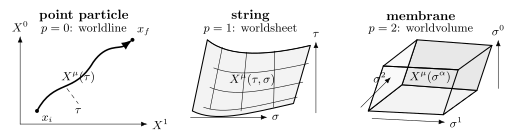
Time evolution adds one dimension: a spatial -brane sweeps out a -dimensional worldvolume. The drawings are schematic embeddings, not additional target-space dimensions assigned to the objects.
The bosonic area term for a fundamental string has . Thus , with the string length . Gauge fields on D-branes, string couplings to background form fields, and fermions require additional action terms. Reparametrization invariance permits such terms; it does not uniquely determine a complete microscopic theory.
The Nambu–Goto worldsheet
Section titled “The Nambu–Goto worldsheet”For a string, use coordinates and write . In flat spacetime the induced metric is
so its determinant gives
The Nambu–Goto action is consequently
It is invariant under target-space Poincaré transformations and under changes of the two worldsheet coordinates. The latter relabel the same embedded surface; they do not generate a new physical string configuration.
The equations describe a stationary worldsheet area. In Lorentzian signature, “stationary” is more precise than asserting that every solution is a minimum. To obtain the equations in flat spacetime, use
After integration by parts, the bulk variation vanishes when
This is nonlinear because the metric in the equation itself depends on . The next page introduces an independent auxiliary metric and the Polyakov action to organize these equations and their constraints.
Open and closed spatial strings
Section titled “Open and closed spatial strings”An open string has an interval as its spatial parameter space, with two endpoints. A closed string has a circle and no spatial endpoints. With the standard closed-string period,
in noncompact target directions. If a direction is a circle of radius , the corresponding coordinate may instead differ by , where the integer is winding number.
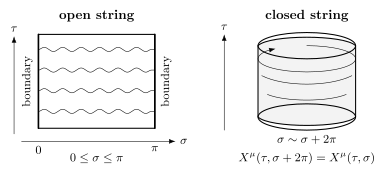
The strip and cylinder distinguish an interval from a periodic spatial coordinate. Their coordinate widths are not physical string lengths. A finite segment of either history can also have initial and final time slices.
Varying the open-string action also produces an endpoint term. Define the worldsheet momentum current
At the two spatial boundaries, the variational principle requires
An endpoint coordinate held fixed has there: a Dirichlet condition. A freely varied coordinate instead requires the corresponding momentum flux to vanish: a Neumann condition. In conformal coordinates this becomes in the freely varied directions. Endpoint constraints supplied by D-branes will later give these boundary conditions a dynamical interpretation.
For a closed string, the spatial boundary contributions cancel by periodicity. Neither the open-string interval nor the closed-string period fixes the physical length: that length is determined by the embedding and its induced metric.
Static gauge and the transverse fields
Section titled “Static gauge and the transverse fields”Consider a nearly straight string between prescribed endpoints separated by in the direction. A convenient local coordinate choice is
Here and are length-valued spacetime coordinates used on the worldsheet, rather than the dimensionless coordinates used for oscillator expansions. This choice is possible where the projection onto is nonsingular and the string can be represented as a graph. A folded string may require another gauge or several coordinate patches.
Dots and primes in this section mean and . Substituting into the induced metric gives
where the products sum over transverse components. Hence
For small slopes and velocities, ,
The corresponding action is
The quadratic equations are wave equations,
The positive kinetic energy and equal time- and space-derivative coefficients show that small transverse waves propagate at the target-space speed of light. The constant term yields the positive classical energy .
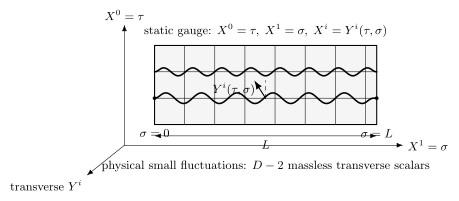
At a fixed target-space time, labels the longitudinal position and changes the string’s transverse shape. For fixed endpoints, . The displacement is schematic and need not have the same plotting scale as .
There are embedding fields and two coordinate freedoms, leaving local transverse fields in this gauge. A tangential change of an embedding is a coordinate change; a normal displacement changes its shape. For a flat -brane, the same count gives transverse embedding fields. This counts only the geometric sector, not any additional gauge, internal, or fermionic fields.
Transverse translations act by constant shifts of . The absence of a mass term reflects this symmetry: the fields describe the low-energy fluctuations associated with the broken transverse translations of a straight brane. For a finite string, fixed endpoints constrain these shifts and remove the constant mode, while leaving the same bulk wave equation.
Canonical fields are
They have mass dimension zero in two dimensions. The first interaction, obtained by expanding the determinant one order further, is
Thus scattering corrections at momentum scale are organized by , as well as by any other microscopic mass scale in an effective string. For wavelengths comparable to , the long-string expansion requires . A small-amplitude expansion and a long-wavelength expansion are related here, but neither licenses extrapolation of the truncated action to arbitrary slopes or energies.
Long confining strings and the Lüscher term
Section titled “Long confining strings and the Lüscher term”In a confining gauge theory, external heavy sources can be connected by a flux tube with an energy proportional to their separation. At distances large compared with its thickness, a stable flux tube admits a string description. Its tension is a property of the gauge theory; it need not be the tension of a fundamental string in flat spacetime.
For the following calculation, assume zero temperature, a straight long tube with fixed endpoints, a gap to additional bulk and worldsheet excitations, and exactly massless transverse bosons with relativistic propagation. String breaking must be absent or negligible in the range of separations considered. These assumptions justify retaining the quadratic worldsheet fields. They are explicit in the modern treatment of long open strings by Aharony and Field.
Dirichlet endpoints give the normalized mode expansion
Orthogonality on reduces the action to independent oscillators:
There is one real oscillator per and per transverse direction. Its zero-point energy is , so the unrenormalized sum is
The sum diverges. To separate its local ultraviolet contribution from its finite dependence on , introduce a regulator of dimension length and damp each mode by . With ,
It follows that
The divergent term is proportional to length and renormalizes the tension. Endpoint self-energies can contribute a constant . The remaining inverse-length term gives
This is the Lüscher term, first obtained in the effective-string analysis of Lüscher, Symanzik, and Weisz. Zeta-function regularization gives the same finite term by the analytic continuation ; it does not make the ordinary sum of positive integers converge.
In four spacetime dimensions the correction is . Its contribution to the force is attractive, . The coefficient does not depend on because the canonically normalized small-wave frequencies are set by . Interactions generate smaller corrections, and a detailed expansion requires the allowed bulk and boundary operators.
Universality here has definite limits. Extra light internal modes or fermions can change the vacuum energy; periodic or mixed endpoint conditions change the mode sum. A fundamental superstring therefore does not automatically have the bosonic flux-tube coefficient. The effective long-string result also does not require : the critical dimension concerns a complete fundamental bosonic string, whereas this calculation is a low-energy expansion around a long string in a specified spacetime.
Common pitfalls
Section titled “Common pitfalls”The worldline modulus is not an elapsed clock time. On a unit parameter interval, has dimension length squared. Only on a massive classical solution is the elapsed proper time .
A vanishing canonical Hamiltonian is not zero physical energy. Reparametrization invariance introduces a constraint. Choosing a spacetime clock and solving the constraint produces the physical Hamiltonian.
Static gauge is a local description. It describes transverse displacements where the embedding is a graph. It need not cover folds, degenerations, or every classical solution in one coordinate patch.
The Lüscher coefficient counts modes and boundary conditions. Its familiar value assumes only the transverse bosons with fixed endpoints. It is not a universal answer for every theory called a string theory.
Exercises
Section titled “Exercises”1. Recover the physical particle Hamiltonian
Section titled “1. Recover the physical particle Hamiltonian”In flat spacetime, begin with the first-order einbein action and impose . Solve the constraint on the positive-energy branch and derive the reduced action and Hamiltonian. Explain why the result is compatible with before gauge fixing.
Solution
The flat-space constraint is . Positive energy means , so
In the first-order action, . The constraint term vanishes after solving it, leaving
Thus . Its velocity equation is . Eliminating gives and .
The original vanishing Hamiltonian concerned changes of the arbitrary label on the worldline. The reduced Hamiltonian concerns changes of target-space time. These are different generators. The same reduction for gives for a nonzero null momentum.
2. Fix the einbein without removing its modulus
Section titled “2. Fix the einbein without removing its modulus”On , take with and . Find the endpoint-preserving coordinate transformation that makes the einbein constant. Check its dimensions and explain what changes in the relation to proper time when .
Solution
The invariant modulus is
The required new coordinate is
It takes to and to , and its derivative is . The density transformation law gives
Both coordinates are dimensionless, while and have dimension . A further endpoint-preserving reparametrization cannot change their integral.
For a massive classical solution, the einbein constraint yields . For a massless solution, and even though is an admissible modulus. In constant-einbein gauge, with . The parameter controls an affine description of the null line, rather than a nonzero proper time along it.
3. Evaluate the massless Euclidean propagator
Section titled “3. Evaluate the massless Euclidean propagator”Using the heat kernel in the text, evaluate for , , and . Check the four-dimensional coefficient and identify the infrared problem at .
Solution
Start from
Set . The integral becomes
In , this is . It has dimension , as expected for the inverse Laplacian.
For , the radial Laplacian annihilates . The delta-function normalization follows by integrating over a small ball:
At , the large- integrand behaves as , producing an infrared divergence. One must supply an infrared scale, a mass, or a subtraction. A subtracted massless Green function has the form ; the arbitrary length reflects the undetermined additive constant.
4. Derive the first transverse interaction
Section titled “4. Derive the first transverse interaction”Expand the static-gauge determinant through fourth order in first derivatives and obtain the interaction for . Test the result on a wave on an infinite string. Does the quartic correction vanish, and is the determinant itself special?
Solution
Let , , and . Each of is second order in derivatives. The exact determinant is
Using and keeping fourth-order terms,
Multiplication by and the rescaling give
For , write . Then , , so and . The quartic bracket vanishes, and in fact exactly. This is a useful algebraic check on both relative signs. It does not mean that the wave has zero energy: the energy is obtained from the Hamiltonian before imposing the special traveling-wave profile. Such a profile on an infinite string also avoids the fixed-endpoint condition, which would generally reflect it into a wave moving in the other direction.
5. Change the boundary conditions in the Casimir calculation
Section titled “5. Change the boundary conditions in the Casimir calculation”Compute the finite zero-point energy per real massless scalar for three cases: Dirichlet at both endpoints of an interval of length ; Dirichlet at one endpoint and Neumann at the other; and a periodic spatial circle of circumference . For the last case, interpret the background as a straight string winding a compact target direction. Explain the mode degeneracy and compare with the open-string Lüscher coefficient.
Solution
For Dirichlet–Dirichlet conditions, with and one real sine mode for each . Removing the length-proportional divergence gives
For mixed Dirichlet–Neumann conditions, the spatial modes are , with . Their regulated sum follows from
Taking minus the derivative with respect to gives . Its finite part therefore yields
For a real periodic field, every has two independent real modes, sine and cosine, with frequency . The zero-frequency mode has no oscillator zero-point energy. Thus
The periodic coefficient is four times the Dirichlet–Dirichlet coefficient: a factor of two from the frequencies and a factor of two from the real-mode degeneracy. Multiplying by gives the corresponding transverse-boson results. These comparisons show why a count of fields alone is insufficient without their boundary conditions.
6. Check the inertia of a moving brane
Section titled “6. Check the inertia of a moving brane”A flat brane of coordinate spatial volume moves uniformly in one transverse direction, , with . Use its induced metric to find the Lagrangian, total transverse momentum, and energy. Relate the result to the dimensions and interpretation of .
Solution
In static gauge the induced metric is diagonal, with and in the spatial worldvolume directions. Hence
The energy is
A uniformly moving flat brane thus has the relativistic inertia of an object with rest energy . Since and energy has dimension , the tension has dimension . For , this reduces to the point-particle calculation.
References
Section titled “References”- Aharony, Ofer, and Matan Field. “On the Effective Theory of Long Open Strings.” Journal of High Energy Physics 2011, no. 1, 065 (2011). arXiv:1008.2636; doi:10.1007/JHEP01(2011)065.
- Lüscher, Martin, Kurt Symanzik, and Peter Weisz. “Anomalies of the Free Loop Wave Equation in the WKB Approximation.” Nuclear Physics B 173, no. 3, 365–396 (1980). doi:10.1016/0550-3213(80)90009-7.
- Schubert, Christian. “Perturbative Quantum Field Theory in the String-Inspired Formalism.” Physics Reports 355, 73–234 (2001). arXiv:hep-th/0101036; doi:10.1016/S0370-1573(01)00013-8.
- Tong, David. Lectures on String Theory. University of Cambridge lecture notes (2009; revised 2012), section 1. arXiv:0908.0333.