
Thermal Strings and the Hagedorn Transition
An exponentially large number of massive string states can compete with Boltzmann suppression. The same effect appears in the Euclidean worldsheet description as a winding state becoming massless. Understanding why these descriptions agree requires keeping track of three different objects: a trace over one-string states, the partition function of a gas, and a connected torus amplitude.
We will derive this relation for weakly coupled type II strings in flat ten-dimensional spacetime, with the metric treated as a fixed background. The result is a perturbative Hagedorn threshold, not a derivation of the interacting high-temperature phase. The global spacetime and worldsheet conventions, the torus measure and spin structures, and the circle momentum and winding lattice supply the prerequisites.
Thermal traces and Euclidean winding
Section titled “Thermal traces and Euclidean winding”Let have circumference , so that and . The temperature is . For a Hamiltonian , the ordinary thermal trace and free energy are
The trace glues the final configuration to the initial one. Bosonic fields are periodic on the resulting Euclidean circle. A fermionic coherent-state trace contains an additional minus sign in this gluing, so spacetime fermions are antiperiodic. Consequently their frequencies are
Periodic spacetime fermions instead compute , where is spacetime fermion parity. This graded trace becomes a supersymmetric index only when supersymmetry, the spectrum, and convergence justify cancellation of paired states. It is not the ordinary thermal ensemble. Exercise 1 makes the distinction in a finite oscillator system.
Particles also have paths that wrap Euclidean time: these are worldline windings. Strings have the additional possibility that the spatial circle of the worldsheet wraps the thermal circle. In a torus path integral both worldsheet cycles can wind. With the coordinates used on the preceding page,
where and each have period one. The cycle changes by , and the cycle changes it by . These integer map labels are distinct from the worldsheet spin structures.
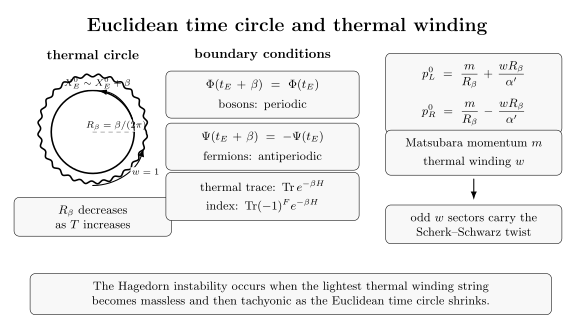
The target circle has circumference . The coordinate cuts of the worldsheet polygon carry and ; matching opposite edges are identified. The arrows specify orientation, and the drawing is schematic. Spacetime spin transport constrains the worldsheet spin sum but does not identify the two kinds of boundary condition.
From a one-string trace to a free gas
Section titled “From a one-string trace to a free gas”Let and be sums of over single-string bosonic and fermionic states, respectively. They include spatial momenta and physical polarization multiplicities. A bosonic mode with energy has occupation numbers , whereas a fermionic mode has occupations . Their contributions to the gas partition function are and . Taking the logarithm gives
Thus is not exactly the one-string trace. Its term controls the leading high-energy exponential singularity, while all are needed for the Bose and Fermi occupation factors. A connected genus-one worldsheet computes at this order; exponentiating connected contributions produces .
For one bosonic species of mass in noncompact spatial dimensions, the vacuum-subtracted free energy is
Expanding the logarithm and applying the Gaussian identity
turns the square-root Hamiltonian into a proper-time integral. The spatial momentum integral contributes . The factor from the identity cancels from the logarithm, giving
For a fermionic species, insert in this sum. The proper time has dimensions of length squared. The factor is the classical action of a worldline wrapping the thermal circle times. The omitted term is the temperature-independent vacuum contribution. Opposite orientations have already been combined in the positive- sum.
This particle calculation fixes the normalization with which the modular string expression must agree. The relation between the free gas, the strip integral, and the long-string limit is developed in Kruczenski and Lawrence, sections 2–3 and Mertens, Verschelde, and Zakharov, sections 2–3.
The thermal spin sum
Section titled “The thermal spin sum”Write a chiral worldsheet spin structure using binary labels : is NS and is R around , while specifies the fermion-parity insertion in the trace. These correspond to theta characteristics on page 14. The usual chiral GSO coefficient is .
First take . A map wrapping the temporal worldsheet cycle times transports a spacetime state around the thermal circle times. A mixed NS–R or R–NS state must therefore acquire , while NS–NS and R–R states acquire . The required factor is . Interchanging the worldsheet cycles exchanges the spin labels as well; modular covariance then requires the partner factor involving . The complete thermal multiplier is
In particular, the thermal sum is not obtained by retaining the zero-temperature GSO sum and modifying only the bosonic lattice. After summing the chiral spin structures at zero chemical potential, define
The factor accounts for the transverse bosonic oscillators. The odd-spin contribution vanishes in this vacuum trace because of its fermion zero modes. Jacobi’s identity gives the useful nonzero blocks
| modulo two | Role | |
|---|---|---|
| The supersymmetric vacuum cancellation | ||
| The ungraded one-string Bose-plus-Fermi trace | ||
| Odd spatial winding with a reversed NS projection | ||
| The other temporal parity in odd spatial winding |
This unrefined vacuum expression is the same for IIA and IIB. It does not determine the distinction between their Ramond chiralities: the zero-mode-sensitive spin trace and the chosen GSO projection still carry that information, as explained on page 12.
There is a direct modular check. The transformations of the map labels that preserve their classical action are
Under , is taken to the relabelled block without a residual weight. Under , it acquires the common phase . The phase cancels against its antiholomorphic conjugate. Meanwhile has holomorphic modular weight , so is invariant. Checking the three nonzero blocks is essential; the identity alone tests none of these factors.
Matsubara momentum and the odd-winding ground state
Section titled “Matsubara momentum and the odd-winding ground state”The torus map action is
At fixed spin labels, Poisson resummation over acts on a Gaussian times . If and , the needed identity is
Reversing the summation label puts the momentum in the form . Therefore spacetime bosons have integer momentum and spacetime fermions half-integer momentum. This is a consequence of the full spin-dependent sum, rather than an extra imposed rule.
For odd, the factor reverses each NS projector. The NS–NS oscillator ground state, projected out at zero temperature, now survives. It has integer thermal momentum and admits , with winding . Its left and right oscillator numbers vanish and level matching holds. Using the sector oscillator intercept on each NS side gives
Here is a mass in the nine-dimensional Euclidean spatial problem. It is not the mass of an additional asymptotic Lorentzian particle. The field and its conjugate form one complex thermal scalar.
For comparison, the closed bosonic ground state has intercept one on each side. Its analogous winding mass is , yielding . The bosonic theory already has a zero-winding tachyon, so this does not define a stable thermal background without an additional prescription.
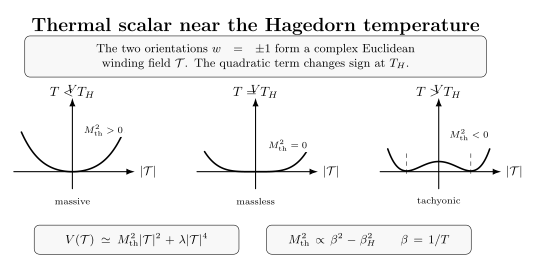
For flat type II strings the curve is exactly with . The two winding orientations form one complex field. Negative mass squared makes its Gaussian saddle unstable. This plot contains no assumption about a stabilizing quartic interaction or the resulting high-temperature phase.
Modular unfolding and the thermal gas
Section titled “Modular unfolding and the thermal gas”Before unfolding the physical string integrand, it is useful to see the operation in a genuinely convergent example. Use the dimensionless radius and the invariant circle kernel from page 15:
The integral converges. In the Hamiltonian representation its cusp grows only as , so the integrand falls as .
The zero map contributes . Every nonzero pair is with and primitive. Modular transformations take a primitive pair to . Its stabilizer is generated by the translation . Tiling by the corresponding modular images replaces by the strip .
In , the pairs and describe the same modular image, but the original lattice sum contains both. Keeping that factor of two, or equivalently summing signed , gives
Thus
This nonzero result checks both the modular orbit counting and T-duality. Angelantonj, Florakis, and Pioline, section 3.2 derive the same integral by a different method and explain the need for care with divergent modular integrals. An oscillator-free kernel is a mathematical example; it is not by itself the partition function of a critical two-dimensional string theory.
The normalized type II torus expression
Section titled “The normalized type II torus expression”For the flat thermal background, the connected one-loop result is
There is one ten-dimensional constant-mode normalization, with Euclidean volume . The factor is the usual real-field one-loop normalization; its consistency will be checked by matching the gas. There is no second independent momentum Gaussian to multiply into this expression. The spin-dependent map sum already represents the thermal coordinate. Its zero orbit vanishes here by .
For in the noncompact flat background, the thermal integral and its orbit rearrangement converge. Applying the preceding unfolding argument, including the two orientations, gives
The notation in this formula is the positive wrapping number, rather than the dimensionless radius used in the example above. At even the spin sum vanishes. At odd , , whose leading absolute square is : the bosonic and fermionic massless physical polarizations.
The integral projects onto level-matched states. At every mass level, the oscillator trace weights the states by . Setting consequently gives
This is exactly from the particle gas. In a supersymmetric zero-temperature spectrum , explaining why only odd wrapping survives. Thermal supersymmetry is nevertheless broken: the result adds bosons and fermions at odd wrapping, rather than cancelling them.
Unfolding is not a prescription for assigning a value to a divergent tachyonic integral. One must first specify a common convergent domain or a regulator and its continuation. A cusp cutoff in maps to a collection of regions in the strip, not to the simple horizontal cutoff . Exercise 2 makes this distinction explicit.
Exponential degeneracy and the Hagedorn scale
Section titled “Exponential degeneracy and the Hagedorn scale”At large oscillator level , the transverse chiral theory has effective central charge for type II strings and for bosonic strings. The leading Cardy growth is
For a level-matched closed string, multiply the two chiral degeneracies and use . This yields
The two values of reproduce the winding thresholds derived above. The mass-level degeneracy is not yet a density per unit energy: changing variables from to and integrating center-of-mass momentum supply additional powers. Write the resulting large-energy one-string density schematically as
Then contains . For the tail converges; for it diverges exponentially. At equality, the power matters: the trace converges if , and its th energy moment converges only if . A finite value at the threshold need not be analytic there.
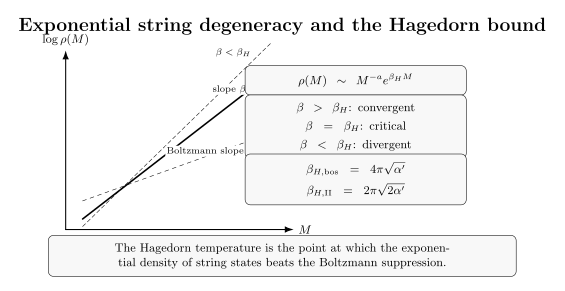
The plotted model is , with and . The power is appropriate to the flat nine-dimensional asymptotic tail derived below, but the finite-range curves are illustrative. At the minimum is ; eventual growth does not require the curve to have become positive within the plotted interval.
The equality between an enormous oscillator sum and a light Euclidean winding state is a channel relation. It does not mean that the massive strings have disappeared from the spectrum. Their collective contribution has a simpler description in a different degeneration of the worldsheet.
The thermal scalar and infrared singularities
Section titled “The thermal scalar and infrared singularities”Near from above, retain and the NS–NS ground state in the fundamental-domain cusp. Poisson resummation of the temporal winding gives the zero-momentum prefactor
The ground-state exponential is . The two winding orientations cancel the torus factor . With , the singular part therefore becomes
where in the flat type II example. The cutoff restricts the approximation to long proper time. Shorter tubes and heavier states contribute terms analytic near . This is the heat-kernel representation of for one complex scalar. Inserting another would incorrectly count only one winding orientation.
For , the integral itself is finite at . Its th derivative with respect to contains and diverges at the upper endpoint when , logarithmically at equality. Up to analytic terms, for non-even ,
Even gives the corresponding term. In , the first nonanalytic term has power and the fifth derivative diverges. The temperature dependence of has a nonzero first derivative at , so the same leading threshold order appears in derivatives with respect to .
The density prefactor also follows without guessing an oscillator power. Let and , so that . Substituting in the long-time integral gives
The singular part of equals that of the trace, since evaluates the high-energy density at a strictly larger inverse temperature. Thus , giving for . This argument, including its dependence on spatial size, is discussed in Horowitz and Polchinski, section 2.
Finite volume and the unstable Gaussian
Section titled “Finite volume and the unstable Gaussian”In a periodic spatial box, replace by . At sufficiently large , the isolated zero mode dominates:
The threshold behavior is therefore different if the finite-volume limit is kept until the end. This statement concerns the additional thermal-scalar singularity; an exactly zero-energy massless boson in a free finite box already requires a prescription for its occupation zero mode. One can fix those background collective modes or regulate them separately without changing the winding-state analysis.
If the thermal-scalar operator develops negative spectrum, the Gaussian integral about is unstable. Analytically continuing its determinant can diagnose that instability; it does not construct a new equilibrium state. Interactions, massless-field exchange, and gravitational backreaction can change the phase structure or cause a transition before the free threshold. A positive quartic potential and a continuous transition do not follow from the mass formula alone.
In an AdS/CFT setting, deconfinement also involves comparing different bulk saddles with the same boundary data. At fixed ‘t Hooft coupling, the connected genus-one gas contribution is of order , whereas a classical black-hole contribution can be of order , since its action scales as . The black D3-brane thermodynamics on page 28 develops the latter scaling. A full Hawking–Page comparison requires the competing free energies and the chosen boundary geometry; the winding mass around one background is not that comparison.
Thermal winding in a static curved background
Section titled “Thermal winding in a static curved background”Consider a slowly varying, static string-frame background
with , no mixed time-space components, and vanishing Kalb–Ramond field. The dilaton is the field in the global frame definitions. The locally measured circumference is , but the mode also pays a spatial gradient energy.
At leading order in the derivative expansion, the winding action has the form
An overall positive field normalization has been absorbed into . The factor belongs to the full spacetime volume element before reducing on the thermal circle. It cannot be removed while leaving the kinetic operator unchanged. One way to derive the winding term is to reduce a momentum-mode action and apply the local T-duality rules, temporarily suppressing a radius-dependent constant in the dilaton shift: , . The measure is invariant under this local part of the transformation. The full shift also includes , as on page 15; its constant factor can be absorbed into the field normalization here. The momentum contribution becomes . Selecting gives the displayed action. See Horowitz and Polchinski, equation (3.1) and Mertens, Verschelde, and Zakharov, section 5.
Integration by parts gives the self-adjoint operator in the measure :
For boundary conditions that remove surface terms, the bottom of its spectrum satisfies
A negative value of somewhere is not sufficient to make this quotient negative. Conversely, a trial function with a negative quotient proves a negative spectral contribution and an unstable quadratic direction. Calling it a negative eigenvalue additionally requires a discrete mode or suitable bound-state assumptions; on noncompact space the bottom may belong to a continuum. Exercise 6 gives a confining example with a discrete spectrum.
These statements describe a leading quadratic operator in a specified background. Curvature and higher-derivative corrections, extra light modes, boundary conditions, and interactions must be controlled before identifying an exact string threshold. In particular, a thermal circle that contracts at a smooth Euclidean horizon is not globally the noncontractible circle used in the flat winding argument. The Tolman redshift by itself does not prove a winding tachyon at every horizon or determine the black-hole phase diagram.
Exercises
Section titled “Exercises”Exercise 1: Occupations, an index, and a normalized gas
Section titled “Exercise 1: Occupations, an index, and a normalized gas”For a bosonic and a fermionic oscillator of the same energy , compute their ordinary and graded partition functions, derive the connected occupation expansion, and explain the Euclidean fermion boundary sign. Then evaluate the massless free energy per polarization in three spatial dimensions from the proper-time formula. Keep the Bose and Fermi numerical coefficients.
Solution
Writing , the separate ordinary traces are and . Their product is , so
The fermionic graded trace is . The paired graded trace is therefore one: the zero-energy vacuum is unpaired, while the positive-energy states cancel. An offset in the vacuum energy or a nonconvergent continuum requires separate analysis; this finite example is not a general proof of index independence.
For a fermionic coherent state , the ordinary trace may be written as a Grassmann integral of . Its endpoint minus sign gives antiperiodic fields. Inserting changes the endpoint to , giving periodic fields. Fourier expansion then produces half-integer or integer Matsubara frequencies, respectively.
For and , put in the proper-time integral:
Multiplication by yields
These are per physical polarization. The alternating sum gives the familiar ratio. A Dirac field requires its full particle, antiparticle, and spin multiplicity; it is not one polarization.
Exercise 2: A cutoff does not commute with naive unfolding
Section titled “Exercise 2: A cutoff does not commute with naive unfolding”For the convergent circle kernel, redo the nonzero-orbit integral with only the unfolded strip restricted to . Determine its exact sum and its leading difference from the unrestricted answer. Explain why this difference is not the tail removed by cutting the original fundamental domain at .
Solution
With , substitution gives
The truncated nonzero strip sum is consequently
Let and . Differentiating before taking gives
Using and integrating,
By contrast, the complete Hamiltonian kernel has cusp behavior at fixed , so its fundamental-domain tail is plus exponentially small terms. The zero orbit alone has tail . These different allocations are expected: modular images of a horizontal cutoff are curved regions, and separating the orbits before imposing a new rectangular cutoff changes which points are omitted.
Both unregulated expressions converge to , and the two opposite primitive orientations are indispensable for that result. For a tachyonic oscillator kernel, neither taking the cutoff to infinity nor exchanging the sum and integral is justified in the same way. One must specify a common regulator or continuation rather than equate independently truncated divergent integrals.
Exercise 3: Resolve the thermal projection before the vacuum trace vanishes
Section titled “Exercise 3: Resolve the thermal projection before the vacuum trace vanishes”Work at fixed left and right spin labels. Show how temporal-winding parity gives Bose or Fermi thermal momentum, and how odd spatial winding changes the NS projector. Use the first NS excitations to identify which low states survive. Finally verify the transformation of the nonzero chiral blocks, including its common phase.
Solution
Set in the Poisson identity in the main text. The resulting momentum is . If or , the shift is integral and can be absorbed into . If exactly one sector is R, the shift is half-integral. This proves the spin-statistics assignment in the thermal spectrum directly from the phase.
In a chiral NS sector the usual GSO sum is proportional to . In an occupation basis with fermion creation operators, it retains odd . The extra changes the projector to
For even , the vacuum is removed and the eight states survive. For odd , the vacuum survives and those eight states are removed. At chiral level one, the eight states and the states survive the odd-winding projector. Pairing two NS vacua gives the thermal ground state at , . Pairing higher states additionally requires the usual momentum-winding level matching.
The theta transformations are , , , and under . Thus
The integer action uses the simultaneous map , as in the main text; because depends only on parity, either direction of this relabelling gives the displayed identity. The common phase drops out of . Under , the exchange of and exchanges the two winding parities. The surviving zero-momentum odd-winding state is therefore compatible with modular covariance, not an isolated ad hoc reversal of one projector.
The unrefined trace cannot distinguish the two Ramond chiralities. Keeping that information requires the Ramond zero-mode projection or a refined trace; it cannot be reconstructed by assigning a nonzero value to a vanishing vacuum character.
Exercise 4: Obtain the power prefactor from oscillator asymptotics
Section titled “Exercise 4: Obtain the power prefactor from oscillator asymptotics”Use the transverse chiral type II generating function . Determine its small- behavior at , estimate its coefficient growth by a saddle point, and recover the power after level matching and center-of-mass integration. Explain why the full gas has the same leading Hagedorn singularity as its first occupation term.
Solution
Modular transformation gives
For , the inverse-coefficient integral has exponent . Its stationary point is , and its exponential is . The factor gives , while the Gaussian width of the steepest-descent contour gives . Hence, up to a constant,
At a level-matched closed level, square this result. Since and , the density per unit rest mass is .
For a very massive string with momenta relevant to the thermal trace, . The Gaussian momentum integral in nine spatial dimensions is
It changes the power in the high-mass trace to . Equivalently, at fixed large total energy , write inside . The resulting momentum Gaussian again contributes , and the Jacobian tends to one. This gives , in agreement with the thermal-scalar inverse Laplace transform.
At , the one-string trace and its first four energy moments have convergent tails. The fifth does not. For every fixed , the occupation term uses , so its exponential suppression remains strict in a neighborhood of . The leading nonanalyticity of therefore comes from . The remaining terms are still necessary for the complete free energy and its low-energy Bose/Fermi statistics.
Exercise 5: A box changes the critical singularity
Section titled “Exercise 5: A box changes the critical singularity”Put the complex thermal scalar in a periodic cube of side and let . Derive both the momentum and image expressions for its heat trace. Identify the crossover between the finite-box logarithm and the noncompact power law. Compute the leading singular fifth derivative of in nine noncompact dimensions, and recover the finite-box high-energy density.
Solution
For a periodic cube,
The equality follows by Poisson resummation in every spatial direction. If , the zero image dominates and the heat trace is approximately the noncompact volume factor. If , the zero momentum mode dominates and .
The singular determinant is . Its relevant large-time scale is . Thus gives the noncompact regime, whereas gives the finite-box logarithm. For the latter,
This is one complex mode, so the logarithm has coefficient one. The other eigenvalues remain separated by a gap of order .
In the noncompact case, differentiate the regulated proper-time integral five times with respect to , keeping the smooth factor fixed when quoting the leading singular term:
Changing the lower limit to zero here affects only terms that are less singular. Lower derivatives of the nonanalytic term vanish at the threshold, while analytic contributions from shorter times remain.
Finally, converts the finite-box logarithm into . Thus the finite-box asymptotic density has the power , instead of the noncompact . Sending before the threshold and keeping finite until afterward therefore give different singular asymptotics. Neither manipulation determines the interacting phase for .
Exercise 6: The measure can change the lowest eigenvalue
Section titled “Exercise 6: The measure can change the lowest eigenvalue”Write the spatial measure as and derive a unitarily equivalent operator in the measure . Then consider the one-dimensional model , , and , where and have dimensions of inverse length squared. Find the exact lowest eigenvalue and explain why the pointwise sign of is insufficient. This is an operator model, not an assertion that these functions solve string background equations.
Solution
The original kinetic operator is . Set . This map is unitary because . Direct differentiation gives
The last two terms are required by the measure; omitting them changes the spectrum. In the example they give
Let . The normalized-measure eigenfunctions are harmonic-oscillator wavefunctions, with eigenvalues
Even if grows in an alternative example with a different measure, it is its weighted norm that would decide admissibility. Here ensures , so itself decays and is normalizable in the weighted norm.
The instability criterion is . For instance, at and , the local mass is negative near the origin but . Localization costs gradient energy. Conversely, the exact Gaussian trial function gives a negative Rayleigh quotient once the stated threshold is crossed.
For the actual leading thermal action, . Curvature and dilaton gradients therefore affect the operator in addition to the local circumference. Applying this model to a string background would require checking its equations, derivative expansion, boundary conditions, and global winding sector first.
References
Section titled “References”- Angelantonj, C.; Florakis, I.; Pioline, B. “A new look at one-loop integrals in string theory.” Communications in Number Theory and Physics 6 (2012), 159–201. doi:10.4310/CNTP.2012.v6.n1.a4, arXiv:1110.5318. Section 3.2 evaluates the convergent one-circle modular integral; the surrounding discussion treats convergence and regularization.
- Horowitz, G. T.; Polchinski, J. “Self Gravitating Fundamental Strings.” Physical Review D 57 (1998), 2557–2563. doi:10.1103/PhysRevD.57.2557, arXiv:hep-th/9707170. Section 2 derives the thermal-scalar density and volume dependence; equation (3.1) gives the static metric and dilaton action. Its subsequent self-interacting single-string analysis is distinct from a complete thermal-gas phase diagram.
- Kruczenski, M.; Lawrence, A. “Random walks and the Hagedorn transition.” Journal of High Energy Physics 07 (2006), 031. doi:10.1088/1126-6708/2006/07/031, arXiv:hep-th/0508148. Sections 2–3 connect the gas, modular channels, long strings, and a thermal winding operator.
- Mertens, T. G.; Verschelde, H.; Zakharov, V. I. “Near-Hagedorn Thermodynamics and Random Walks: a General Formalism in Curved Backgrounds.” Journal of High Energy Physics 02 (2014), 127. doi:10.1007/JHEP02(2014)127, arXiv:1305.7443. Sections 2–3 discuss the thermal worldsheet and flat-space comparison; section 5 derives the leading winding action and identifies measure and higher-derivative qualifications.