
Covariant Virasoro Constraints and Bosonic Spectra
The oscillator algebra describes more states than a string can physically possess. Covariant quantization retains timelike oscillators to make Lorentz symmetry manifest; the Virasoro conditions and the identification of null states must then remove the unphysical polarizations. At the first massless open level this procedure produces a vector with 24 polarizations. At the next level it produces a massive spin-two particle with 324 polarizations.
We derive these results in flat, noncompact spacetime, then apply the same reasoning to closed strings and their graviton, two-form, and dilaton. The oscillator construction and global conventions supply the algebra and normalizations. The low-level calculations below are explicit; the statement that the physical inner product is positive at every level requires the no-ghost theorem.
Physical-state constraints and null descendants
Section titled “Physical-state constraints and null descendants”The classical conditions cannot all be imposed as annihilation conditions on a quantum state. The matter algebra contains a central term. In particular,
If every positive and negative mode annihilated a nonzero state with , the first relation would require and the second would then require . This is not the desired string theory.
The old covariant prescription instead defines a physical subspace by
Closed strings obey another copy with tildes. The intercept belongs to the physical-state condition. The plane-normal-ordered matter operator has already been defined; it is not redefined by inserting . In particular, the matter cylinder Casimir shift derived on the preceding page is a different quantity.
The inner product on can be degenerate. Its radical is the subspace
States differing by a vector in represent the same physical state. Thus the state space of interest is , with its induced inner product. A vector of zero self-norm is not automatically in the radical of an arbitrary indefinite inner-product space; orthogonality to all physical states matters.
Virasoro descendants provide a useful source of such vectors. For any physical bra and any ,
A sum of negative-mode descendants is therefore orthogonal to all physical states. If that sum itself satisfies the physical conditions, it belongs to . The qualification is essential: a generic descendant need not be physical.
Mass shells and the first open-string levels
Section titled “Mass shells and the first open-string levels”Let be the momentum eigenvalue. Acting with the zero-mode constraint on an open-string level- state gives
For closed strings the two zero-mode equations give
The matching statement here assumes noncompact coordinates and equal left and right intercepts. Momentum and winding modify the difference of zero-mode terms in a compact direction, as derived in the preceding page’s winding exercise.
We now specialize to the critical bosonic values , , except where a dependence on or is explicitly tested. These values will be derived from light-cone Lorentz consistency on the next page.
| Open level | Mass | Physical content at the critical values |
|---|---|---|
| One tachyonic scalar | ||
| Massless vector, 24 polarizations | ||
| Massive symmetric traceless tensor of , 324 polarizations |
The tachyon is an instability of the chosen perturbative vacuum. Its negative mass squared is distinct from negative norm: absence of ghosts does not establish vacuum stability.
The massless vector and its quotient
Section titled “The massless vector and its quotient”At level one, write
The oscillator commutator with a Virasoro generator gives
Thus . Higher positive modes automatically annihilate a level-one state. At nonzero null , the space of allowed vectors has dimension , but it contains the null line spanned by itself.
The state along this line is a descendant:
It is physical because , and the preceding adjoint argument makes it orthogonal to every physical state. Therefore
The quotient has positive-norm polarizations. For example, choose with . Transversality sets , and the null shift can set both components to zero. The remaining norm is .
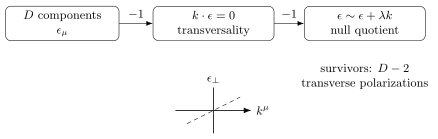
At nonzero null momentum, lies inside . The physical vector space is the quotient by this null direction, not the full Lorentzian orthogonal complement. Its dimension is in the critical bosonic string. The diagram represents subspaces and a quotient, not distances or Euclidean angles.
The first massive open level
Section titled “The first massive open level”The two partitions of oscillator level two, and , give the general state
There is no factor of multiplying in this definition. Introduce the dimensionless momentum
At , the mass shell is . The norm before imposing constraints is
with unit oscillator-vacuum normalization. Both terms can have either sign before the physical conditions are used.
Deriving the tensor and vector constraints
Section titled “Deriving the tensor and vector constraints”Using gives
In the second line, the annihilator produced by contracts with the other level-one oscillator. This supplies one trace of with our chosen normalization. All with annihilate the state by level counting. The independent conditions are therefore
They do not by themselves require or to be transverse and traceless. Those simpler conditions will characterize a representative after the null quotient.
The vector and scalar null families
Section titled “The vector and scalar null families”First consider a level-one seed , where and . Its eigenvalue is zero, rather than the physical value one. It obeys for . Consequently is a physical level-two descendant. Expanding it gives the shifts
where parentheses denote symmetrization with weight . There are independent vector shifts. They are often called type-I null states.
At there is one additional, scalar null state:
The seed vacuum has . The Virasoro algebra yields
Thus this particular descendant is physical and null at . Its possible negative self-norm in a different dimension does not by itself exhibit a physical ghost there: its condition would fail. Exercise 3 derives these relations without assuming the result.
The oscillator forms
show that adding produces
This is the type-II scalar null state. Since it is a sum of descendants and is physical, it is orthogonal to every physical state, not merely to itself.
A unique transverse traceless representative
Section titled “A unique transverse traceless representative”The 25 vector null shifts remove the component of orthogonal to , and the scalar null shift removes its component along . Explicitly, choose
Because , this obeys , and the combined shifts set . The physical constraints then give
In the massive rest frame , the first condition removes every time index. The surviving is a symmetric traceless tensor in 25 Euclidean spatial dimensions. Its norm is
which is positive unless the representative vanishes. No nonzero combination of the displayed null shifts preserves : contracting with first gives , then . Thus the representative is unique and the level-two quotient is complete.
The number of polarizations is
Equivalently, 351 symmetric-tensor coefficients plus 26 vector coefficients give 377; the 26 conditions and one condition leave 350; quotienting 25 vector nulls and one scalar null leaves 324. This is the symmetric traceless representation of the massive little group , conventionally called massive spin two. The transverse oscillator count agrees, but the covariant calculation above also explains how the representation and positive norm emerge.
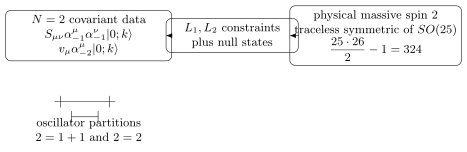
At , , and , the constraints and the null quotient are distinct reductions. Removing 25 vector null directions and one scalar null direction allows , leaving a transverse traceless with 324 polarizations. The counts concern one momentum and exclude Chan–Paton multiplicities; the diagram is schematic.
What the no-ghost theorem adds
Section titled “What the no-ghost theorem adds”The first two excited levels now have an explicitly positive physical quotient. This does not prove positivity at arbitrary oscillator level. The no-ghost theorem of Brower and of Goddard and Thorn supplies that result: for the critical free bosonic string, with , , one timelike target coordinate, and nonzero momentum, the physical subspace is positive semidefinite, and its quotient by the null states is isomorphic to the Fock space of 24 transverse oscillators. The closed-string statement applies to both sectors with level matching imposed.
The nonzero-momentum qualification is consequential. At , the level-one transversality equation becomes empty and its descendant vanishes. The timelike level-one state is then not removed by the argument above. Exceptional zero-momentum states require separate treatment and are not ordinary propagating polarizations.
Nor does free-state positivity alone uniquely select the critical interacting theory. In the standard integer-dimensional old covariant model, the wider no-ghost range includes with , as well as the critical point ; it does not include every point with . Daszkiewicz, Hasiewicz, and Jaskólski discuss this distinction in Section 2 of Free Strings in Non-Critical Dimensions. Exercise 4 constructs a physical negative-norm state at directly. Subcritical free models have different longitudinal state content and do not establish the Weyl consistency of the flat critical Polyakov theory.
The all-level theorem is used here as an external result. The explicit level-one and level-two quotients illustrate its mechanism; the light-cone construction gives the complementary description with transverse oscillators from the outset.
Closed strings and physical massless tensors
Section titled “Closed strings and physical massless tensors”The critical closed-string ground state has . At the first matched excited level, , the state is
The two positive-mode conditions act on the two indices independently:
Null descendants identify
Thus the physical polarization belongs to the tensor product of two massless-vector quotients. In a transverse basis , it is a matrix with positive norm .
A covariant transverse projector
Section titled “A covariant transverse projector”A covariant representative can be selected with a second null vector satisfying
This choice is possible for nonzero null and selects a transverse Euclidean subspace. Define
It obeys
Acting with on both indices chooses a representative of the same physical class. Changing changes this representative by a null-state gauge transformation. It does not change the physical state.
Graviton, two-form, and dilaton
Section titled “Graviton, two-form, and dilaton”Let and . The physical decomposition is
These three mutually orthogonal pieces are the massless graviton, antisymmetric two-form, and dilaton polarizations. The trace subtraction uses the rank- transverse metric. Replacing it with the unrestricted -dimensional would fail both transversality and the intended tracelessness.
A normalized covariant representative of the scalar polarization is
It is transverse and has unit norm; it is not simply . The identification with a spacetime dilaton field involves the field variables of the low-energy action, developed later. Here we have established the scalar’s physical polarization and its distinction from the graviton trace-free part.
The little-group dimensions are
which sum to . For , this is .
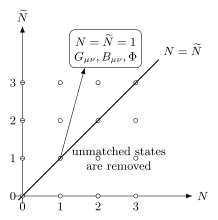
At nonzero null momentum, gives after both null quotients. Its symmetric traceless, antisymmetric, and trace pieces have dimensions 299, 276, and 1. The decomposition uses the physical transverse metric, and the blocks are schematic rather than areas proportional to their dimensions.
Physical tensors on the leading Regge trajectory
Section titled “Physical tensors on the leading Regge trajectory”A state with the largest possible angular-momentum component at open level uses only first-harmonic oscillators:
Because these creation operators commute, only the completely symmetric part of contributes. Symmetry alone is not enough to make the state physical. The positive modes give
The second coefficient counts pairs of first-harmonic oscillators. For , produces an annihilator that cannot contract with another , so vanishes. Therefore the leading tensor must be transverse, and for also traceless. At massive levels these are symmetric traceless rank- representations of the rest-frame little group . Level one instead has the massless quotient already described.
To see the maximal angular momentum concretely, choose a spatial rotation plane and a complex transverse vector . It satisfies , so is traceless as well as transverse. Each factor carries , giving . An oscillator of mode number costs level but contributes at most one unit to this component; hence no state at that level can have a larger value. Here “spin ” refers to the symmetric traceless representation and its largest rotation eigenvalue, not a single label in 26 dimensions.
Using the critical mass shell gives
For closed strings, the highest-spin component uses first-harmonic oscillators in each matched sector. The completely symmetric traceless rank- component is physical; its highest-weight state uses the same in both sectors and has . Therefore
These are free critical bosonic-string trajectories. Their large-spin slopes agree with the classical rotating strings; their intercepts are quantum information. A generic tensor with the same oscillator content need not satisfy transversality or trace constraints, and the leading trajectory does not exhaust all states at a given level.
Exercises
Section titled “Exercises”1. Strong constraints and physical matrix elements
Section titled “1. Strong constraints and physical matrix elements”Suppose both and annihilate a state for all , while . Derive the contradiction for . Then show that the old covariant prescription nevertheless makes all matrix elements of vanish between physical states.
Solution
The commutator gives . A nonzero state would require . The commutator then gives , impossible for .
For physical and , the matrix element with vanishes because . For , write with and use
The matrix element vanishes by . Hence
This weak statement is compatible with the central extension. It does not say that each negative-mode operator annihilates a physical ket or that its action remains in the physical subspace.
2. Construct a positive massless representative
Section titled “2. Construct a positive massless representative”For nonzero null , choose null with . Given a vector with , show that is a gauge-equivalent representative orthogonal to both and . Evaluate for in four dimensions and exhibit the positive norm.
Solution
The mixed-index projector acts as
This is precisely a null shift with . Contracting with gives zero because ; contraction with also vanishes. Since the shift is along a null vector orthogonal to , the norm is unchanged.
For the stated momentum choose
Then , , and
The representative is , with norm . The same construction leaves Euclidean components in general dimension. This four-dimensional calculation illustrates the quotient geometry; it does not replace the critical string by a four-dimensional model with no additional worldsheet sector.
3. Derive the level-two scalar null state
Section titled “3. Derive the level-two scalar null state”Let be a Virasoro primary of weight and unit norm. Compute the Gram matrix of and at central charge . Set , find the combination annihilated by , and determine when it is physical and null.
Solution
Commuting positive modes to the right gives
For example, , while
At ,
Thus . The action is
Higher positive modes vanish by level. The descendant has total weight , so it is a physical state for precisely when this remaining condition holds, namely at .
Its norm is
At the critical dimension it is orthogonal to every physical state because it is a sum of descendants. A negative value of this expression at concerns a nonphysical vector and does not contradict the no-ghost theorem.
4. Test the domain of a no-ghost claim
Section titled “4. Test the domain of a no-ghost claim”At open level two let , where , and work in its rest frame. Consider the spatially rotationally invariant ansatz
Use the physical constraints to determine and , then compute the norm. Evaluate it at for general , and at . Explain what these tests do and do not establish.
Solution
With , the condition gives . The condition becomes
Hence
All higher positive modes vanish. The mass shell follows from , so these states are physical. Their norm is
At , , this reduces to
It is positive for , null at , and negative for . At the critical point this is the scalar null state above, multiplied by .
For , we instead have and
This is an explicit physical ghost, disproving the claim that all are allowed. A negative-norm physical state cannot be removed by quotienting vectors orthogonal to every physical state. Conversely, checking positivity of this one family at another parameter value does not prove an all-level no-ghost theorem.
5. Count closed massless states and normalize the scalar
Section titled “5. Count closed massless states and normalize the scalar”Starting from a general tensor at nonzero null momentum, count the independent transverse constraints and gauge shifts. Recover physical polarizations. Show that has unit norm and that changing the null reference vector only changes its representative by a gauge shift.
Solution
Imposing transversality in both indices leaves components. Equivalently, the two sets of equations have one common equation, so their combined rank is .
Each transverse gauge parameter has components. The pair of parameters has a one-dimensional redundancy:
Thus the gauge shifts span dimensions. The quotient count is
For , the sequence is , consistent with .
Idempotence of the projector gives , so
If is another null reference with , then and
This is an allowed gauge shift. The normalized scalar state is therefore independent of the reference choice as a physical equivalence class. Its positive norm is not the Lorentzian norm of an unrestricted trace tensor.
6. Distinguish the leading spin from the full level
Section titled “6. Distinguish the leading spin from the full level”At the critical open level , find the dimension of the symmetric traceless rank-three representation of the massive little group. Compare it with the number of states made from 24 transverse oscillators at total level three. Construct a highest-weight state with and show why a symmetric but traceful tensor does not automatically describe a physical leading state.
Solution
A symmetric rank-three tensor in dimensions has components. Its trace is a vector with components, and the trace map is surjective. Therefore the traceless dimension is . For the massive little group, , giving
The transverse oscillator partitions of three are , , and . They give
Thus 300 states lie outside the leading rank-three representation. That number equals the dimension of an antisymmetric rank-two tensor of , although a dimension match alone is not a derivation of its transformation law.
Choose in a spatial plane of the rest frame. It obeys and . Then
is annihilated by and and carries . Higher positive modes vanish, and its mass is , as required by .
By contrast, a symmetric transverse tensor with nonzero trace gives
Such a monomial is not itself physical. Lower-spin states at the same level generally require different tensor combinations and oscillator partitions; symmetry and the mass shell alone do not solve the Virasoro conditions.
References
Section titled “References”- Brower, Richard C. “Spectrum-Generating Algebra and No-Ghost Theorem for the Dual Model.” Physical Review D 6 (1972), 1655–1662. doi:10.1103/PhysRevD.6.1655. Original construction and no-ghost theorem using the physical spectrum-generating algebra.
- Daszkiewicz, Marcin; Hasiewicz, Zbigniew; and Jaskólski, Zbigniew. Free Strings in Non-Critical Dimensions. Report ITPUWr 916 (1997), arXiv:hep-th/9712207. Full text, Section 2. Distinguishes the parameter range of the free old covariant no-ghost result from the critical light-cone theory.
- Goddard, Peter, and Thorn, Charles B. “Compatibility of the Dual Pomeron with Unitarity and the Absence of Ghosts in the Dual Resonance Model.” Physics Letters B 40 (1972), 235–238. doi:10.1016/0370-2693(72)90420-0. Original physical-state counting and absence-of-ghosts result.
- Tong, David. String Theory. University of Cambridge Part III Mathematical Tripos lecture notes (2009), arXiv:0908.0333, version 3 (23 February 2012). Full text. Sections 2.1 and 2.3 discuss covariant quantization and the closed spectrum; Section 3.1.3 discusses the open spectrum and its leading Regge trajectory.