
Factorization Puzzles, Ensembles, and Open Problems
The island formula and replica wormholes give one of the sharpest semiclassical answers ever obtained for the black-hole information problem. They explain how a gravitational entropy calculation can reproduce a Page curve. They also reveal a deep moral: in gravity, the region whose degrees of freedom compute an entropy need not be the region one would naively identify in a fixed semiclassical geometry.
But the Page curve is not the end of the story.
The modern island calculation teaches us how fine-grained entropy can behave in semiclassical gravity. It does not, by itself, give a complete microscopic account of black-hole evaporation in every theory of quantum gravity. In particular, replica wormholes and Euclidean wormholes force us to confront a structural question:
This is the factorization puzzle. It is not a minor technicality. It asks what the gravitational path integral is actually computing.
This capstone page explains four intertwined ideas:
- what islands and replica wormholes have achieved;
- why exact boundary theories factorize;
- how ensembles, baby universes, and -states help organize the puzzle;
- what remains open after the Page curve.
The goal is not to make the subject look more mysterious than it is. The goal is to state precisely where the progress is solid, where the interpretation is subtle, and where future work must still explain the microscopic theory.
What islands explain
Section titled “What islands explain”Before discussing the puzzles, let us be fair to the breakthrough.
In the old Hawking calculation, the radiation entropy is computed using the exterior semiclassical region alone. The result grows monotonically:
In a unitary evaporation process, the fine-grained entropy of all Hawking radiation cannot keep increasing after the black hole has lost more than half of its original entropy. It should instead follow a Page curve:
The island formula explains how this can arise from semiclassical gravity. For a nongravitating radiation region coupled to a gravitating region, the entropy is computed by
At early times, the dominant saddle has no island:
At late times, a new saddle dominates. The radiation region is supplemented by an island behind, or near, the horizon. The matter entropy is then computed for , and the area term prevents the entropy from growing without bound.
This is a genuine achievement. It says that the Page curve is not invisible to semiclassical gravity. It is visible once the correct fine-grained entropy prescription is used.
However, this achievement should be interpreted carefully.
The island formula computes an entropy. It does not immediately tell us a local, step-by-step microscopic mechanism by which each outgoing Hawking quantum carries information. It also does not completely define the nonperturbative gravitational path integral. That is where factorization enters.
What remains after the Page curve
Section titled “What remains after the Page curve”The strongest conservative summary is:
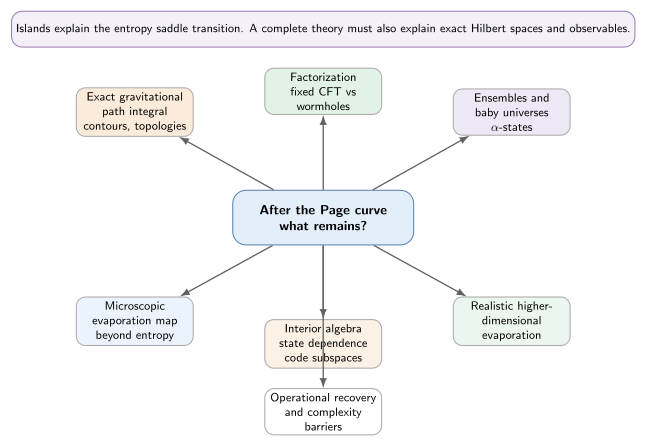
The remaining questions include:
- What is the exact Hilbert space behind the semiclassical gravitational path integral?
- In a fixed AdS/CFT dual pair, why do Euclidean wormhole contributions not violate factorization?
- Are wormholes computing observables of a single theory, ensemble averages over many theories, or something more refined?
- How does interior reconstruction work at the operator-algebra level beyond leading semiclassical order?
- How are islands realized in realistic higher-dimensional evaporating black holes without artificial baths?
- Which nonperturbative saddles should be included, and along what integration contour?
- How does computational complexity limit operational information recovery?
A useful slogan is:
The Page curve is a necessary signature of unitarity. It is not the whole -matrix.
Boundary factorization
Section titled “Boundary factorization”In ordinary quantum theory, decoupled systems factorize. Suppose we have two independent quantum systems with Hilbert spaces and . The combined Hilbert space is
and the Hamiltonian is
The thermal partition function then factorizes:
In Euclidean field theory language, if the boundary manifold is a disconnected union , then a fixed decoupled CFT obeys
This is not a conjecture about large . It is a basic consequence of decoupling.
In AdS/CFT, this expectation becomes sharp. If the bulk theory is exactly dual to one definite boundary CFT, then the exact gravitational answer should reproduce the exact boundary answer. Hence disconnected boundary components should factorize whenever the boundary theory is a direct product of decoupled theories.
The gravitational tension
Section titled “The gravitational tension”The tension is that the bulk gravitational path integral seems to sum over all bulk geometries with the prescribed asymptotic boundaries. For a disconnected boundary , there are two qualitatively different classes of bulk geometries:
- disconnected bulk fillings, where and are filled separately;
- connected bulk wormholes, where one spacetime connects the two asymptotic boundaries.
Schematically,
If is nonzero, the right-hand side does not obviously factorize.
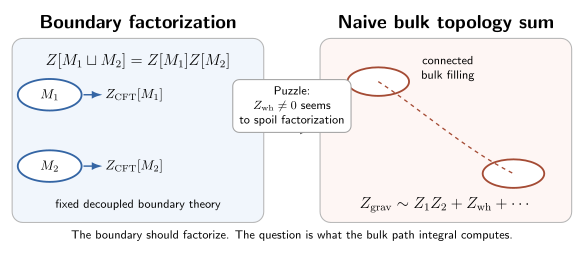
The puzzle is especially clean because it is not about black-hole evaporation per se. It appears already in Euclidean partition functions. It asks how to reconcile two principles:
Something in this naive statement must be refined. Possibilities include:
- the gravitational path integral computes an ensemble average, not one fixed CFT;
- connected saddles are canceled by other saddles or nonperturbative effects;
- the path integral needs extra data, such as an -state;
- the correct integration contour excludes some saddles;
- the semiclassical expansion is not sufficient to answer an exact factorization question.
Different models realize different parts of this list.
Ensembles versus fixed theories
Section titled “Ensembles versus fixed theories”The simplest way to see why wormholes and nonfactorization can coexist is to compare a fixed theory with an ensemble of theories.
Let label different Hamiltonians or boundary theories. In a fixed member of the ensemble, the partition function on a disconnected boundary factorizes:
But the ensemble average of the product is
This is generally not equal to the product of ensemble averages:
The difference is the connected ensemble correlator:
Thus an ensemble average naturally produces connected correlations between disconnected boundaries. From this viewpoint, Euclidean wormholes compute connected ensemble correlations.
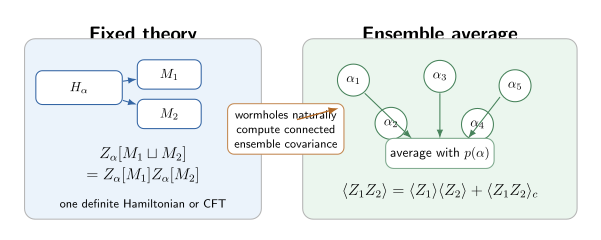
This does not mean every holographic theory is an ensemble. It means that some simple gravitational path integrals, especially JT gravity, are naturally interpreted as ensemble averages.
JT gravity and random matrices
Section titled “JT gravity and random matrices”Jackiw-Teitelboim gravity provides the cleanest example. The Euclidean JT path integral can be organized as a sum over two-dimensional surfaces of different genus and number of boundaries.
For asymptotic boundaries, one obtains an expansion of the form
where is the topological extremal entropy, is the genus, and is the number of boundaries. The exponent contains the Euler characteristic
A disk has and contributes with weight . A cylinder has and contributes with weight . Relative to two disconnected disks, the cylinder is suppressed by :
This is small, but it is not zero.
Saad, Shenker, and Stanford showed that JT gravity is described by a double-scaled random matrix integral. In this interpretation,
is not a violation of factorization. It is a connected correlator in an ensemble of boundary Hamiltonians.
This is a beautiful resolution for JT gravity. But it also sharpens the question for ordinary AdS/CFT. A standard holographic CFT, such as a definite large- gauge theory, is not usually presented as an ensemble of CFTs. If its bulk path integral contains wormholes, what exactly do those wormholes compute?
The spectral form factor as a diagnostic
Section titled “The spectral form factor as a diagnostic”A useful quantity is the spectral form factor,
For an ensemble, the averaged spectral form factor is
The connected part is sensitive to correlations between energy levels. In random matrix theory, these correlations produce the famous ramp and plateau structure. In JT gravity, connected wormholes capture part of this late-time spectral correlation.
This teaches an important lesson: wormholes can encode statistical correlations of spectra extremely well. The hard question is whether those correlations describe an ensemble average, a typical member of the ensemble after suitable averaging, or a precise observable of one fixed theory.
Baby universes and -states
Section titled “Baby universes and α\alphaα-states”The language of baby universes gives another way to organize the issue.
A Euclidean wormhole connecting two asymptotic boundaries can be viewed as a process in which an asymptotic universe emits or absorbs a closed baby universe. In a third-quantized description, boundary insertions act as operators on a baby-universe Hilbert space. Schematically, let
be an operator that creates an asymptotic boundary with sources . These operators commute in simple models:
Then one may choose simultaneous eigenstates, called -states:
In such a state, products factorize:
But a generic gravitational path integral state may be a superposition or mixture of -states:
Then
which is an ensemble average and need not factorize.
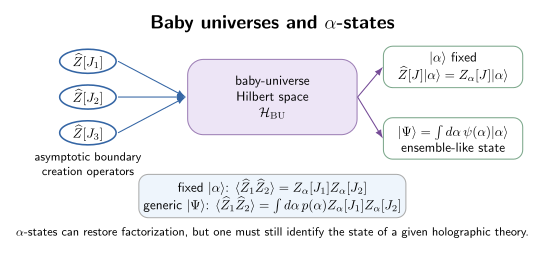
This framework is conceptually powerful, but it is not a magic eraser. It replaces one question with another: which -state, if any, corresponds to a given exact holographic theory? In a UV-complete theory of quantum gravity, should there be many -states, or only one? Do baby universes represent genuine physical sectors, or are they artifacts of an incomplete low-energy path integral?
Those questions remain central.
Why this matters for replica wormholes
Section titled “Why this matters for replica wormholes”Replica wormholes are not the same as ordinary Euclidean wormholes between two independently prepared CFTs. They arise in entropy computations, where one evaluates quantities such as
using a replicated path integral. The replicas are not independent physical universes in the same sense as two unrelated boundary CFTs. They are copies introduced by the entropy calculation.
Still, the two subjects are deeply related. Both involve summing over geometries with nontrivial topology. Both raise questions about what the gravitational path integral computes. Both are sensitive to nonperturbative information.
The key distinction is:
The island calculation uses replica wormholes to obtain the fine-grained entropy of radiation. The factorization puzzle asks whether the same or related path-integral rules are compatible with exact factorization in a fixed dual theory.
A good mental model is that the island formula gives a controlled semiclassical rule for a particular class of entropies, while factorization asks for the nonperturbative completion of the entire gravitational theory.
What would count as a complete solution?
Section titled “What would count as a complete solution?”A complete microscopic solution of black-hole information should do more than reproduce the Page curve. It should explain, in a precise quantum theory, how the following statements fit together:
- Unitary evaporation. Pure states evolve to pure states.
- Semiclassical locality. Low-energy effective field theory works in appropriate bulk regions.
- Smooth horizons. Infalling observers see ordinary local physics, at least in suitable states and regimes.
- Holographic encoding. Interior operators are redundantly encoded in exterior degrees of freedom.
- Fine-grained entropy. Radiation entropy follows the Page curve.
- Exact factorization. Decoupled boundary systems factorize.
- Nonperturbative definition. The gravitational path integral has a well-defined contour, Hilbert space, and set of observables.
- Operational recovery. Information can in principle be recovered, while complexity may make recovery practically impossible.
The modern island story addresses points 4 and 5 with unprecedented sharpness. It gives partial insight into 1. It is compatible with 2 and 3 in a subtle way because local semiclassical EFT can hold while the global entropy calculation includes nonlocal saddle information.
But points 6 and 7 remain especially delicate.
Open problem 1: What is the exact gravitational path integral?
Section titled “Open problem 1: What is the exact gravitational path integral?”The semiclassical gravitational path integral is usually written as
This notation hides many hard questions:
- What is the integration contour?
- Are complex metrics included?
- Which topologies are summed over?
- What are the correct boundary conditions?
- How are gauge redundancies divided out nonperturbatively?
- How are singular or nearly singular geometries treated?
- Which saddles are artifacts of a bad contour?
For ordinary QFT, the path integral can often be defined by canonical quantization, lattice regularization, Osterwalder-Schrader reconstruction, or other UV data. For gravity, especially with topology change, such definitions are much less complete.
The factorization puzzle is therefore not merely a paradox. It is a diagnostic for whether the formal path integral has been specified precisely enough.
Open problem 2: Are holographic theories ensembles?
Section titled “Open problem 2: Are holographic theories ensembles?”JT gravity appears to be dual to a random matrix ensemble. SYK-like models also involve disorder averages, although fixed-coupling questions are more subtle. But standard AdS/CFT examples are usually definite theories, not ensembles.
For example, a particular super-Yang-Mills theory with fixed gauge group and coupling is not normally treated as a random draw from an ensemble of CFTs. Its partition functions should factorize exactly.
This gives a fork:
If Euclidean wormholes appear in both settings, the interpretation cannot be identical in the two cases. Either the wormhole contributions are completed differently, or their role in fixed theories is more subtle than the naive semiclassical sum suggests.
Open problem 3: How does factorization occur in a fixed theory?
Section titled “Open problem 3: How does factorization occur in a fixed theory?”Several mechanisms have been proposed or studied in toy models.
One possibility is cancellation: connected wormhole contributions may be canceled by other saddles or by non-geometric contributions that are invisible in a limited semiclassical expansion.
Another possibility is state selection: choosing a definite -state may restore factorization, while the naive gravitational path integral computes a superposition or average over .
A third possibility is completion by microscopic discreteness: nonperturbative effects associated with the exact spectrum may restore factorization after the coarse-grained gravitational calculation produces an averaged answer.
A fourth possibility is contour dependence: some saddles that appear in a Euclidean analysis may not contribute to the properly defined path integral.
These options are not mutually exclusive. Different examples may realize different mechanisms.
Open problem 4: What is the exact algebra of the black-hole interior?
Section titled “Open problem 4: What is the exact algebra of the black-hole interior?”Pages 7—9 emphasized entanglement wedges, JLMS, and operator-algebra QEC. These ideas strongly suggest that interior degrees of freedom are encoded nonlocally and redundantly.
But the exact algebraic status of black-hole interior operators remains subtle. Questions include:
- Which operators are state-independent within a given code subspace?
- How large can the code subspace be before interior reconstruction fails?
- How should one describe the interior after the Page time when the radiation has an island?
- What is the exact role of the center, area operator, and edge modes?
- Can one define a single algebra that captures both exterior observers and infalling observers without contradiction?
The island formula says that, after the Page time, the radiation entanglement wedge includes an island. It does not automatically give a simple local dictionary for every interior operator in every state.
Open problem 5: What happens in realistic evaporation?
Section titled “Open problem 5: What happens in realistic evaporation?”Many clean island computations use JT gravity, double holography, branes, or nongravitating baths. These models are invaluable because they are calculable.
Realistic evaporating black holes introduce extra complications:
- higher-dimensional dynamics;
- asymptotically flat rather than AdS boundary conditions;
- gravitons in the radiation region;
- no obviously nongravitating bath;
- angular momentum and charge;
- greybody factors;
- backreaction over the full evaporation history;
- endpoint physics near the Planck scale.
The expectation is that the Page-curve lesson is robust. But the exact implementation of islands and reconstruction in fully realistic settings remains an active area of research.
Open problem 6: What is the role of complexity?
Section titled “Open problem 6: What is the role of complexity?”Even if information is present in the Hawking radiation, decoding it may be computationally infeasible. The Harlow-Hayden argument and Python’s-lunch geometries suggest that operational recovery can be exponentially hard.
Thus there are two different questions:
Complexity may protect semiclassical interior experience even when, in principle, the radiation encodes the interior. This is not a substitute for unitarity, but it may explain why no practical observer sees a paradox.
Open problem 7: Are horizons ordinary quantum subsystems?
Section titled “Open problem 7: Are horizons ordinary quantum subsystems?”The black-hole central dogma says that, as seen from outside, a black hole behaves like an ordinary quantum system with approximately
But gravity resists naive tensor factorization. Horizons are not ordinary material membranes, and subregions in gauge theory and gravity are described by algebras with centers and constraints.
This creates a tension between two useful pictures:
Both pictures are useful. A deeper theory must explain precisely how they are related.
A useful hierarchy of claims
Section titled “A useful hierarchy of claims”It is helpful to separate claims by strength.
Claim A: AdS/CFT is unitary
Section titled “Claim A: AdS/CFT is unitary”This is the broadest and most conservative holographic lesson. If the boundary CFT is an ordinary unitary quantum theory, then the dual bulk quantum gravity must be unitary.
Claim B: The Page curve follows from fine-grained entropy
Section titled “Claim B: The Page curve follows from fine-grained entropy”For a unitary evaporation process, the radiation entropy must eventually decrease. This follows from ordinary quantum mechanics and Page-type reasoning.
Claim C: The island formula reproduces the Page curve in controlled models
Section titled “Claim C: The island formula reproduces the Page curve in controlled models”This is the modern breakthrough. In JT gravity, double holography, and related settings, QES/island saddles give the correct Page-curve behavior.
Claim D: Replica wormholes justify the island rule
Section titled “Claim D: Replica wormholes justify the island rule”The gravitational replica trick shows how connected replica saddles lead to the island formula.
Claim E: The same path integral is fully understood nonperturbatively
Section titled “Claim E: The same path integral is fully understood nonperturbatively”This is much stronger and is not yet established in general.
Most confusion comes from treating Claim C or D as if it automatically implied Claim E.
Common pitfalls
Section titled “Common pitfalls”Pitfall 1: “The Page curve means the information problem is completely solved.”
Section titled “Pitfall 1: “The Page curve means the information problem is completely solved.””The Page curve is a major target, but it is an entropy diagnostic. A complete solution should also explain the exact microscopic Hilbert space, operator dictionary, evaporation map, and nonperturbative path integral.
Pitfall 2: “Wormholes always mean ensemble averages.”
Section titled “Pitfall 2: “Wormholes always mean ensemble averages.””Some models, especially JT gravity, strongly support an ensemble interpretation. But it does not automatically follow that every holographic theory is an ensemble. Fixed AdS/CFT duals require a more refined account.
Pitfall 3: “Factorization forbids all wormholes.”
Section titled “Pitfall 3: “Factorization forbids all wormholes.””Factorization forbids a nonzero connected contribution in exact decoupled boundary partition functions of a fixed theory. It does not mean every connected saddle is meaningless. Saddles may compute ensemble averages, approximate coarse-grained quantities, replica entropies, or contributions that are canceled or completed nonperturbatively.
Pitfall 4: “Baby universes are a complete solution by themselves.”
Section titled “Pitfall 4: “Baby universes are a complete solution by themselves.””Baby universes and -states provide a useful language for factorization. But one must still explain which state corresponds to a given theory, whether many -states are allowed in quantum gravity, and how this fits with holography.
Pitfall 5: “Semiclassical EFT must fail locally at the horizon after the Page time.”
Section titled “Pitfall 5: “Semiclassical EFT must fail locally at the horizon after the Page time.””The island formula modifies the global entropy prescription. It does not require a large local violation of effective field theory near the horizon in every description. The subtlety is global encoding, not necessarily local drama.
Exercises
Section titled “Exercises”Exercise 1: Factorization in a fixed theory
Section titled “Exercise 1: Factorization in a fixed theory”Let two decoupled quantum systems have Hamiltonians and . Show that
Solution
The combined Hilbert space is , and the decoupled Hamiltonian is
Since the two terms commute,
Therefore
Thus
Exercise 2: Ensemble nonfactorization
Section titled “Exercise 2: Ensemble nonfactorization”Let and be two observables depending on an ensemble label . Show that
is the covariance of and . Explain why this can be nonzero even though each fixed member of the ensemble factorizes.
Solution
The ensemble average is
The separate averages are
The connected correlator is
This is the covariance. It is nonzero whenever and fluctuate together over the ensemble. In the factorization problem, one can take
For each fixed ,
But after averaging over , the product average need not equal the product of averages.
Exercise 3: Topological weights in JT gravity
Section titled “Exercise 3: Topological weights in JT gravity”For an orientable surface with genus and asymptotic boundaries, the topological JT weight is proportional to
Compute the weights of a disk, a cylinder, and a torus with one boundary. Compare the cylinder to two disconnected disks.
Solution
A disk has and , so
and the weight is
A cylinder has and , so
and the weight is
A torus with one boundary has and , so
and the weight is
Two disconnected disks have weight
Thus the connected cylinder is suppressed relative to two disks by
It is small at large , but not zero.
Exercise 4: -states and factorization
Section titled “Exercise 4: α\alphaα-states and factorization”Suppose is a commuting family of boundary-creation operators and is a simultaneous eigenstate:
Show that correlators of factorize in the state.
Solution
Using the eigenvalue equation twice,
Taking the inner product with gives
Also,
Therefore
This is factorization in a fixed -state.
Exercise 5: Why the island formula does not automatically solve factorization
Section titled “Exercise 5: Why the island formula does not automatically solve factorization”Explain in a few paragraphs why reproducing the Page curve using islands is not the same as proving exact factorization of disconnected CFT partition functions.
Solution
The island formula computes fine-grained entropy. It is derived using a replica calculation for quantities such as . The replica geometries are part of an entropy computation for one physical state or setup.
Factorization, by contrast, concerns ordinary partition functions or correlators of decoupled boundary theories on disconnected manifolds. A fixed decoupled boundary theory should obey
A connected bulk wormhole between and seems to violate this statement unless it is canceled, excluded, reinterpreted as an ensemble covariance, or completed by additional nonperturbative effects.
Thus the two issues are related because both involve gravitational topology sums, but they are not identical. Islands address the Page curve. Factorization asks what the full gravitational path integral computes for disconnected physical boundaries.
Exercise 6: Classifying claims
Section titled “Exercise 6: Classifying claims”Classify each statement as established in controlled models, plausible but model-dependent, or open in general.
- JT gravity has an ensemble/random-matrix interpretation.
- Every AdS/CFT dual is an ensemble average.
- Islands reproduce the Page curve in JT and related models.
- The exact nonperturbative gravitational path integral is fully understood in all dimensions.
- Decoupled fixed boundary theories factorize.
Solution
- Established in controlled models. JT gravity is sharply connected to a double-scaled matrix integral.
- Open or generally false as stated. Standard AdS/CFT examples are usually fixed CFTs, not manifest ensembles.
- Established in controlled models. JT gravity, double holography, and related setups give Page-curve behavior from islands.
- Open in general. This is one of the deepest unresolved problems.
- Established. For a fixed decoupled boundary theory, factorization follows from ordinary quantum mechanics or QFT path-integral locality on disconnected components.
Further reading
Section titled “Further reading”- Phil Saad, Stephen H. Shenker, and Douglas Stanford, “JT gravity as a matrix integral”. The central reference for the random-matrix interpretation of JT gravity.
- Donald Marolf and Henry Maxfield, “Transcending the ensemble: baby universes, spacetime wormholes, and the order and disorder of black hole information”. A key modern treatment of baby universes and ensemble interpretation.
- Phil Saad, Stephen Shenker, and Shunyu Yao, “Comments on wormholes and factorization”. A focused discussion of the factorization puzzle and approximate -states.
- Geoff Penington, Stephen H. Shenker, Douglas Stanford, and Zhenbin Yang, “Replica wormholes and the black hole interior”. One of the central replica-wormhole derivations related to the Page curve.
- Ahmed Almheiri, Thomas Hartman, Juan Maldacena, Edgar Shaghoulian, and Amirhossein Tajdini, “Replica Wormholes and the Entropy of Hawking Radiation”. The companion derivation of replica wormholes and radiation entropy.
- Ahmed Almheiri, Thomas Hartman, Juan Maldacena, Edgar Shaghoulian, and Amirhossein Tajdini, “The entropy of Hawking radiation”. A broad review of islands, replica wormholes, and the modern Page-curve story.
- Jacob McNamara and Cumrun Vafa, “Baby Universes, Holography, and the Swampland”. A strong viewpoint on constraints on baby-universe Hilbert spaces in quantum gravity.
- Daniel Harlow and Edgar Shaghoulian, “Global symmetry, Euclidean gravity, and the black hole information problem”. A useful related perspective on Euclidean gravity, global symmetries, and information.
- Juan Maldacena and Liat Maoz, “Wormholes in AdS”. An earlier reference on Euclidean wormholes in AdS settings.
- Edward Witten, “Matrix Models and Deformations of JT Gravity”. A useful companion to the matrix-model side of the story.