
Unoriented Strings, Orientifolds, and Type I Theory
Worldsheet orientation reversal can be gauged just as an internal discrete symmetry can. For type IIB, the resulting closed-string projection keeps one ten-dimensional supergravity multiplet. It also introduces crosscaps, which couple to closed-string fields. Consistency of the flat supersymmetric background requires an open-string sector whose boundaries cancel those sources. The result is type I string theory with 32 Chan–Paton labels and gauge algebra .
The number 32 is a relative normalization of boundary and crosscap couplings. We derive it from the annulus, Möbius strip, and Klein bottle, including their different moduli. Throughout, the spacetime definitions and brane normalizations are those of the volume overview. The closed spectra and characters and Chan–Paton amplitudes supply the prerequisites. We consider the uncompactified, supersymmetric D9 construction, with no background flux or antibranes unless an exercise explicitly introduces them.
Worldsheet parity and the physical closed spectrum
Section titled “Worldsheet parity and the physical closed spectrum”On a closed string, exchanges left and right movers. In particular,
The fermionic sectors require relative phases as well as this exchange. We choose the supersymmetric type I parity, which preserves the diagonal combination of the two IIB supercharges. A useful construction is the graded exchange of the physical chiral multiplets. If are NS vectors or Ramond spinors, with spacetime grades and , its action is
Thus it exchanges NSNS factors with a plus sign and RR factors with a minus sign. On the mixed sectors it exchanges the two spaces. Exercise 1 checks that this action commutes with the diagonal odd supercharge. The condition alone would not fix these relative choices.
This is a statement about physical states, including the vacuum and cocycle phases. Exchanging two bare fermion oscillators and ignoring the phase of their vacuum would give an incomplete worldsheet calculation. Equivalently, a zero-picture NSNS vertex is a product of even chiral vector operators, whereas the chiral Ramond operators require the graded exchange sign.
At a fixed nonzero null momentum the NSNS polarization is an transverse matrix . The projector gives
The graviton and dilaton survive; the NSNS two-form is removed. The scalar is the transverse trace, represented covariantly by the rank-eight projector, not by .
For the same-chirality RR spinors, write the physical polarization matrix as . The corresponding projection is
The 28 is the transverse two-form polarization of . The symmetric scalar and four-form duality sector are removed. Hence are odd and is even under this parity. These are parities of the linearized fields; the five-form duality belongs to its field strength. The dual six-form describes the same propagating degrees of freedom as .
The two 64-dimensional mixed sectors are identified, leaving one gravitino and one dilatino, with polarizations. The closed spectrum therefore has
It is ten-dimensional supergravity with 16 real supercharges. Fixed-momentum polarization amplitudes remain complex; imposing the spacetime Majorana condition does not halve these numbers again.
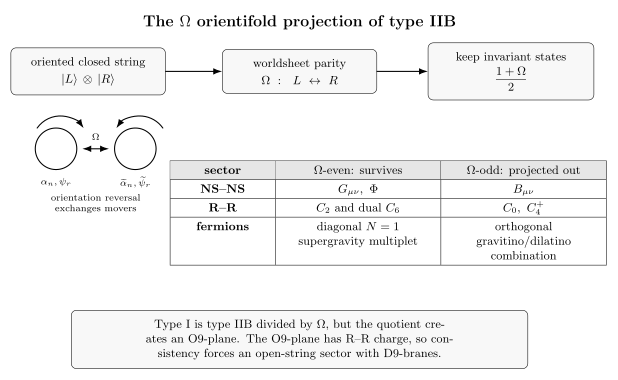
The matrices describe physical transverse polarizations at nonzero null momentum. The RR minus sign is part of the supersymmetric graded exchange, not the ordinary transpose rule for every spacetime tensor. The closed projection keeps 64 bosonic and 64 fermionic states. Endpoint reversal also transposes open-string Chan–Paton matrices, but their invariant form supplies additional information. For the symplectic case, uses an even-dimensional fundamental representation. All matrices and arrows are schematic.
Crosscaps and the required worldsheet surfaces
Section titled “Crosscaps and the required worldsheet surfaces”A crosscap is obtained by identifying antipodal points on a circular cut. The cut is not a physical boundary after the identification. A sphere with one crosscap is , a nonorientable surface. Gauging pure gives a space-filling O9 source because there is no target-space reflection restricting its location. More general orientifolds combine orientation reversal with a target-space action; they need not all have nonempty fixed loci.
For a connected vacuum surface with handles, boundaries, and crosscaps,
| Surface | Coupling weight | ||
|---|---|---|---|
| sphere | |||
| disk | |||
| projective plane | |||
| torus | |||
| annulus | |||
| Möbius strip | |||
| Klein bottle |
The disk and projective plane can have closed-string one-point functions at the same order. Sewing two such sources with a closed-string tube produces the three additional one-loop surfaces:
where denotes a boundary and a crosscap. The torus is also present. If denotes the parent oriented torus amplitude, the vacuum expansion at Euler characteristic zero includes
The first two terms implement the closed projector; the last two implement the open projector. The torus has no boundary or crosscap ends, so it is not one of the three source-exchange diagrams used below. Its modular integration is developed on the next page.
One can also distinguish a crosscap from a boundary by oscillator gluing. For a space-filling Neumann boundary at closed-channel time zero,
For the crosscap, opposite points of the closed string are identified with opposite normal directions. The result is
The alternating sign is the half-period shift along the string. Exercise 3 derives it from the embedding and its normal derivative. Fermion and ghost gluing complete these states; the displayed bosonic equations alone do not specify all their phases or normalization.
Endpoint reversal and the gauge algebra
Section titled “Endpoint reversal and the gauge algebra”An open string carries endpoint labels . Reversal exchanges them, so a Chan–Paton polarization is transposed. Allowing a unitary change of endpoint basis gives the linear map
For the vector, the oscillator contribution to is negative. This sign is visible without guessing a fermion-vacuum phase: its integrated boundary coupling is , which changes sign when the boundary orientation is reversed. Its supersymmetric completion has the same parity. Thus a surviving vector obeys
Applying twice conjugates by . Requiring this to act trivially on the full matrix algebra makes that product a scalar. Transposing once more gives
A unitary basis change brings a symmetric form to the identity. An antisymmetric nondegenerate form requires even and can be brought to
For , the vector polarization space consists of complex antisymmetric matrices and has dimension . With the shared Hermitian-generator convention, a real gauge-algebra basis is imaginary antisymmetric. Multiplication by gives real antisymmetric, anti-Hermitian generators of the compact algebra .
For , the condition preserves and gives , of dimension . Here means that the fundamental representation has dimension , so is even. These statements distinguish a complex polarization vector space from the real compact Lie algebra. The open gaugino belongs to the same adjoint space for this supersymmetric choice; each generator carries eight vector and eight spinor polarizations.
The Chan–Paton sign also determines the Möbius amplitude. The trace of the transpose map on the -dimensional matrix space is
Including the negative vector parity, the massless projection gives vectors. Define for the sign multiplying the Möbius character below. Then is orthogonal and is symplectic. The gauge projection and the crosscap interference sign cannot be chosen independently.
Direct-channel amplitudes with fixed moduli
Section titled “Direct-channel amplitudes with fixed moduli”The character variable is always . Let be the direct-channel integration variable in the following expressions. The required double-cover moduli are
These different arguments are physical: the Klein trace identifies the two closed chiral oscillator lists, while the annulus uses the open-string Hamiltonian. The Möbius trace adds an orientation reversal and hence alternating oscillator signs. A common momentum Gaussian is
Together with the loop measure , it gives . One way to check the common Gaussian is to compare the exponents and : their momentum terms are and respectively. Momentum has been continued to Euclidean signature for this integral. We suppress the same overall spacetime-volume and numerical normalization in all three amplitudes; none of the relative factors below is suppressed.
Using the characters of page 12, introduce the oscillator combination
For modular manipulations and must retain their sector labels, even though their unrefined functions coincide. We will separate their massless exchange contributions before interpreting a tadpole.
The direct amplitudes are
The factors and are the ordinary and parity-inserted Chan–Paton traces. The factor implements the projection. These normalized expressions and their interpretation are given in Angelantonj and Sagnotti, section 3.2, equations (142)–(148). We now derive the relative factors in the other channel.
Real Möbius characters and the P transformation
Section titled “Real Möbius characters and the P transformation”For a character with expansion , define its hatted value on the half-shifted line by
It is real for real degeneracies. For , ; for , the analogous exponent is . Thus . The phases of numerator and denominator cancel in each of these two ratios, but retaining the hats makes the alternating signs and the transformation rule unambiguous.
The Möbius modular map is
On hatted characters it is represented by . The square roots use the actual exponents , not arbitrary square-root signs. For , the matrices on page 12 give
In particular, the and hatted characters each have positive eigenvalue. The eta multiplier is
Consequently
The multiplier comes from eight transverse bosons; omitting it would change the tadpole coefficient. The character and eta transformation rules follow from the transformations, as explained in Angelantonj and Sagnotti, section 2.4, equations (85)–(91).
Closed-channel factorization and the number 32
Section titled “Closed-channel factorization and the number 32”Under , the formal character combination is invariant, while . Therefore
For the Klein bottle use and . For the annulus use and . Their measure transformations are
The integration limits reverse, canceling the negative Jacobian. For the Möbius strip use and the multiplier:
Thus the transverse amplitudes are
Large is a long closed-string tube. In this limit each of and approaches 8; the hatted versions have the same leading constant. Massive terms are exponentially suppressed. Suppressing that common massless factor, the three coefficients add to
The relative massless reflection coefficients can therefore be written as for the boundaries and for the crosscap. The terms are , , and . Since one Chan–Paton boundary contributes , the crosscap has times its coupling. This derives the factor 32 from modular transformations and the direct projection, rather than assuming the O9 charge at the outset.
For positive and the supersymmetric D9 choice, cancellation requires and . Since , the invariant Chan–Paton form is symmetric and the gauge algebra is . We use the usual perturbative name ; this calculation does not determine every nonperturbative global-form identification of the gauge group.
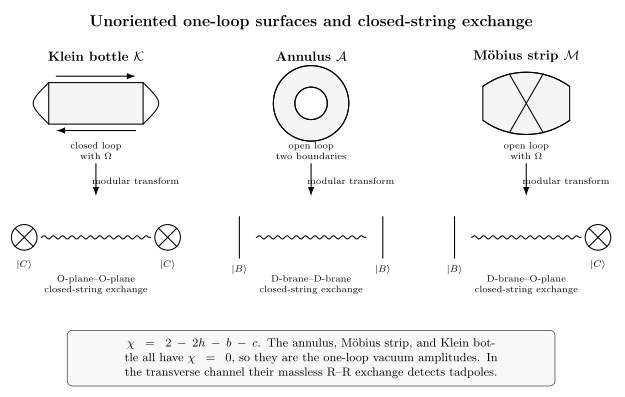
The tube ends distinguish physical boundaries from crosscaps. After suppressing one common normalization, their dimensionless reflection coefficients are and . Here is a source coefficient, not a central charge, and correlates it with the Chan–Paton form. The annulus, Möbius strip, and Klein bottle give , , and in the massless limit. The source square applies separately to the NSNS and RR sectors; it must be examined before subtracting their vacuum contributions. The tubes and identified circular cut are schematic, and the arrows indicate Euclidean closed-string propagation, not spacetime charge flow.
Why the vanishing vacuum trace is not enough
Section titled “Why the vanishing vacuum trace is not enough”Jacobi’s identity gives as an unrefined function. The complete supersymmetric vacuum amplitude consequently vanishes even before choosing . That cancellation compares NSNS exchange with RR exchange; it does not set either source to zero.
Keep the two contributions separate, for example by labeling the intermediate sector before taking the long-tube limit. Their divergent terms have the structure
The relative minus is the vacuum spin-structure sign. Each sector has a nonzero one-point source unless . Sewing with insertions that select a sector, or imposing the corresponding spacetime field equation, detects it. The NSNS source measures net tension; the RR source measures net charge. Supersymmetry makes their cancellation conditions coincide in this construction. Changing to antibranes or a different orientifold sign requires tracking the two signs separately, not reusing the same supersymmetric character formula.
The ten-form constraint and the low-energy interpretation
Section titled “The ten-form constraint and the low-energy interpretation”The propagating RR two-form in the type I spectrum is not the field electrically sourced by a D9-brane. The latter couples to a nondynamical ten-form potential. Write it as to identify the brane-coupling basis. A ten-form in ten dimensions has no ordinary eleven-form kinetic field strength and no nonzero-momentum particle polarization. The long-tube RR calculation probes a zero-momentum source, not an additional propagating ten-form particle.
In a common covering-space normalization, the D9 and crosscap source term is
Here denotes a common nonzero quotient normalization; it multiplies both sources and cancels from the constraint. The charge unit is the one in the overview. Variation with respect to the ten-form imposes locally. This is the spacetime meaning of the RR tadpole condition, described explicitly by Polchinski, equations (19)–(20).
There is no general prohibition on net RR charge in noncompact transverse space: an isolated lower-dimensional D-brane can send flux to infinity. D9 and O9 fill spacetime, so that possibility is absent. For lower-dimensional sources on compact transverse spaces, integrating the field equation gives the related global neutrality condition.
The O9 selected here has negative tension and negative D9 charge. Rather than relying on an O-plane superscript whose usage differs between references, its signs have been specified by its couplings. The total zero-field NSNS source is
The shared relation gives its physical tension at infinity. There is no extra factor multiplying . Both this disk/crosscap potential and the ten-form source vanish for 32 D9-branes. A net NSNS source would instead require a change of background; in this flat supersymmetric solution it cancels.
The remaining low-energy theory is supergravity coupled to the orthogonal gauge multiplet. Its properly framed kinetic terms distinguish from , and from . In the shared matrix normalization the gauge kinetic term is
The scaling follows from a disk: has dimension length. The precise coefficient must compare the orientifold normalization and the stated trace together; the tadpole ratio calculation has not fixed an absolute gauge coupling. In normalized Einstein frame this term has , as derived on page 11. The full anomaly-canceling action also has curvature and Green–Schwarz terms. Their coefficients require a consistent choice of gauge and Lorentz traces and RR potential basis.
Gauge and gravitational anomaly conditions
Section titled “Gauge and gravitational anomaly conditions”The type I massless fermions are chiral. One independent gauge-invariant obstruction can be exposed without deriving the full anomaly polynomial. For the orthogonal family, with the fundamental matrix trace and the adjoint trace,
Products here are products of curvature forms. The gaugino anomaly contains this sixth-order invariant. In the range near , the first term is irreducible: it cannot be canceled by a product of a four-form and an eight-form. Its coefficient vanishes at the same selected by the worldsheet calculation. Exercise 6 derives the identity from the orthogonal roots and also explains the independent gravitational condition .
For , . This number alone is not sufficient to prove cancellation of every gauge, mixed, and gravitational anomaly. The remaining polynomial must factorize appropriately, with the two-form transformation and counterterms normalized consistently. That complete result is the Green–Schwarz construction. The checks here establish two necessary coefficients and explain their relation to the perturbative orthogonal family; they do not replace the full construction or classify all possible ten-dimensional theories.
Exercises
Section titled “Exercises”Exercise 1: graded exchange and the surviving supergravity multiplet
Section titled “Exercise 1: graded exchange and the surviving supergravity multiplet”Let a chiral physical multiplet have an eight-dimensional even space and an eight-dimensional odd space . For homogeneous states, use . Show that and that it commutes with the diagonal odd operator
where reverses the grade. Determine the invariant dimensions in , , and the sum of the mixed sectors. Why would an ungraded exchange on all four sectors give the wrong supermultiplet?
Solution
Applying the exchange twice gives . In the first term of , the grade of is , so its sign is . In the second term, the total sign is . Hence
The invariant states are symmetric, of dimension . Their traceless and trace pieces give the 35 graviton and one dilaton polarizations. The invariant states are antisymmetric, of dimension , the RR two-form. An invariant mixed state has the form , so the two 64-dimensional spaces leave one copy of dimension 64. Thus and .
An ungraded exchange would retain the symmetric RR space, dimension 36, yielding 72 bosonic states while the mixed sector still has 64. More fundamentally, it fails to commute with the graded diagonal supercharge. This shows why the Ramond exchange sign matters. It does not derive every worldsheet phase from alone; it constructs the phase choice compatible with the retained supersymmetry.
Exercise 2: invariant Chan–Paton forms and the Möbius trace
Section titled “Exercise 2: invariant Chan–Paton forms and the Möbius trace”Derive from the involution condition on all matrices. Compute the trace of in the basis of matrix units, and use it to count vector states. For , write a general complex solution in blocks and verify the symplectic dimension. Explain the extra reality requirement for compact gauge generators.
Solution
Writing gives . A matrix commuting with every matrix unit is scalar, so . Rearranging gives ; transposing again gives . Therefore .
For the matrix unit ,
Summing over gives . The projector onto consequently has trace
For the symmetric form this is . For , put
The equation gives , , and . Thus its complex dimension is
In a Hermitian gauge-field basis, and ; the compact real algebra has this same real dimension. Equivalently, is anti-Hermitian and obeys . For the orthogonal form, Hermitian antisymmetric is imaginary antisymmetric, so is real antisymmetric. Arbitrary complex one-particle coefficients need not themselves satisfy this real-field condition.
The oscillator minus changes the Möbius massless trace to . This derives its correlation with the gauge algebra, rather than assigning the Möbius sign after choosing a group.
Exercise 3: boundary and crosscap gluing from geometry
Section titled “Exercise 3: boundary and crosscap gluing from geometry”At closed-channel time zero, impose Neumann normal derivative at a boundary. At a crosscap impose and . Derive the nonzero-mode gluing equations. Then use rectangles with coordinates , to distinguish annulus, Möbius strip, Klein bottle, and torus by their edge identifications and physical boundaries.
Solution
For , the coefficient of in is proportional to . In its time derivative the coefficient is proportional to . A Neumann boundary therefore gives the sum equal to zero.
At a crosscap, the position condition multiplies the first coefficient by ; for odd it requires . The reversed-normal condition multiplies the second by ; for even it requires . Together they give
The zero-mode normal condition sets the momentum emitted along a space-filling source to zero. This is one reason generic nonzero-momentum RR particle counting is not a classification of its tadpoles.
For the annulus identify and leave the edges as two separate boundaries. For the Möbius strip identify . The orientation reverses on going around the strip; the two remaining edges join into a single boundary. The gluing map has Jacobian determinant , so no continuous orientation can be transported around that loop.
Add to the twisted identification to obtain a Klein bottle, with no physical boundary. With the untwisted identification instead, the two pairs of opposite edges produce a torus, which is orientable. Both closed polygons have one vertex, two edges, and one face after identification, so . The annulus and Möbius strip retract onto a circle and also have . All four belong to the one-loop vacuum expansion; only the three source-exchange surfaces have boundary or crosscap ends in the transverse channel.
Exercise 4: a common long-tube regulator
Section titled “Exercise 4: a common long-tube regulator”Derive the three transverse coefficients directly from the fixed direct-channel integrals. Regulate massless propagation by in each surface. What direct-channel lower cutoffs correspond to this common regulator? Show why imposing the same lower cutoff in all three direct integrals does not preserve the common long-tube cutoff and can obscure the cancellation.
Solution
The modular multipliers are , , and for . After multiplying by , only remains. If , then . Thus
The common upper limit requires
For either separated massless sector, suppressing its common degeneracy and overall sign, the divergent term is
It vanishes for . A common direct cutoff instead permits tube lengths . It assigns the three massless terms the unequal ranges, giving
At the type I values this is , not zero. This mismatch is a regulator artifact: it compares source exchanges with different infrared cutoffs. A regulator introduced in the common closed propagator, such as , must likewise be transformed into with the appropriate for each direct channel. None of this licenses canceling NSNS and RR sources against each other; the regulated comparison is within one sector.
Exercise 5: charge, tension, and a nondynamical field
Section titled “Exercise 5: charge, tension, and a nondynamical field”Starting from the ten-form source and the NSNS source in the main text, derive the charge constraint and the dilaton source in normalized Einstein frame. Then introduce D9-branes and anti-D9-branes in the same negative-charge O9 background. Using only their charges and tensions, determine whether charge cancellation alone makes the NSNS source vanish. Contrast this with a lower-dimensional brane in noncompact transverse space.
Solution
A variation of has arbitrary compact support. Since there is no eleven-form kinetic term to balance its source, its equation is , hence . The argument does not require treating the propagating as a D9 electric potential.
Using in ten dimensions gives . The source becomes
Since , the coefficient of the canonical dilaton at fixed Einstein metric is
It vanishes with the charge in the supersymmetric construction. The Einstein-frame exponent, rather than just the explicit string-frame , is needed to identify the physical scalar coupling.
Antibranes have the same positive tension as branes and the opposite RR charge. The two source combinations are now
with the same common quotient factor suppressed. Charge cancellation gives , so . Both vanish only for . This is a source test, not a derivation of the antibrane open spectrum or its stability; its spin structures cannot be inferred from the supersymmetric expression unchanged.
For a lower-dimensional D-brane, integrating the RR field equation over a transverse ball relates its enclosed charge to a flux integral on the surrounding sphere. In noncompact transverse space that flux can reach infinity, so nonzero enclosed charge is allowed. In compact transverse space with no boundary, the integrated source must vanish. The D9 top-form equation is the space-filling version with no transverse flux available.
Exercise 6: two irreducible anomaly coefficients
Section titled “Exercise 6: two irreducible anomaly coefficients”For , take fundamental Cartan eigenvalues . The adjoint roots are for . For add the roots and one zero fundamental weight. Derive the sixth-order trace identity in the main text. Why does it impose more information than a dimension count?
For a separate gravitational check, use the chiral index densities: a Weyl spinor contributes , and a Rarita–Schwinger field contributes . Opposite chirality changes the sign; Majorana reality contributes a common factor . For formal tangent Chern roots , , use
Find the coefficient of the irreducible power sum in the type I fermion polynomial, and state what the two checks leave unproved.
Solution
For a pair , the four roots contribute
Put . Summing gives
for even . Since , this is exactly
For odd , the extra roots add , shifting by one in the same formula. Evaluating a Cartan element suffices because these are invariant polynomials. The curvature two-forms have even degree, so their products commute in this formal computation. Near the sixth-order power sum is an independent invariant; its coefficient must vanish before a four-form times an eight-form can cancel the remaining anomaly. Merely matching the number of gauge generators does not test this invariant.
For the gravitational term, the gravitino and gauginos have the same chirality, while the dilatino has the opposite one. Setting the gauge curvature to zero therefore gives the degree-twelve part of
One subtraction is the Rarita–Schwinger gauge contribution; the other is the dilatino. The index-density input is developed by Alvarez-Gaumé and Witten, including their spin- construction. This calculation extracts a coefficient from that input rather than deriving the anomaly descent theorem.
Writing for power sums, rather than Pontryagin classes, direct Taylor expansion gives
The coefficient multiplying the independent is consequently
Thus the irreducible gravitational term requires . For the orthogonal family this selects , agreeing with the gauge coefficient and the tadpole. The remaining terms involve products such as , , and gauge–gravity invariants. Their full factorization, the descent relations, and the normalized two-form counterterm are additional requirements. Neither of these two necessary checks alone proves complete anomaly cancellation or establishes the nonperturbative global gauge group.
References
Section titled “References”- Alvarez-Gaumé, Luis, and Edward Witten. “Gravitational Anomalies.” Nuclear Physics B 234 (1984), 269–330. doi:10.1016/0550-3213(84)90066-X. The spinor and Rarita–Schwinger index densities provide the input for the bounded gravitational calculation in Exercise 6.
- Angelantonj, Carlo, and Augusto Sagnotti. “Open Strings.” Physics Reports 371 (2002), 1–150; erratum 376 (2003), 339–405. arXiv:hep-th/0204089; doi:10.1016/S0370-1573(02)00273-9. Sections 2.4 and 3.2 give the direct/transverse transformations, hatted characters, and type I amplitudes. O-plane charge and tension signs have been stated explicitly here because superscript labels differ between references.
- Green, Michael B., and John H. Schwarz. “Anomaly Cancellations in Supersymmetric D = 10 Gauge Theory and Superstring Theory.” Physics Letters B 149 (1984), 117–122. doi:10.1016/0370-2693(84)91565-X.
- Polchinski, Joseph. “Dirichlet-Branes and Ramond–Ramond Charges.” Physical Review Letters 75 (1995), 4724–4727. arXiv:hep-th/9510017; doi:10.1103/PhysRevLett.75.4724. Equations (19)–(20) explain the ten-form source condition for D9-branes and the type I orientifold.