
Closed-String T-Duality and Enhanced Symmetry
A closed string on a circle carries both momentum and winding. Exchanging these two integers turns a circle of radius into one of radius without changing the physical spectrum. At the fixed radius , additional vector particles become massless and enlarge the gauge algebra from two Abelian factors to . The same calculation also reveals extra scalar fields and explains how changing the radius gives masses to the charged vectors.
We develop this example for the critical closed bosonic string, including its thermal winding mode. The course overview fixes the worldsheet coordinates, free-boson normalization, spacetime signature and string coupling. The bosonic ground-state tachyon remains present throughout; the exact compact-boson conformal field theory and its spectrum can be studied without interpreting the background as a stable vacuum.
Momentum and winding on a circle
Section titled “Momentum and winding on a circle”Compactify one spatial coordinate,
and denote the noncompact momentum by , . A periodic center-of-mass wavefunction has compact momentum , with . A closed string can also satisfy
The integer counts winding around the target circle. It is conserved in a continuous deformation of a closed-string configuration; at a string interaction, total winding is conserved even though individual strings can join or split.
Write . Its mode expansion is
The canonical momentum density is . Its integral and the winding condition give
Thus
Both momenta have dimensions of inverse length. Momentum costs an energy proportional to , whereas the energy of a wound string is proportional to its length, hence to . Their competition is the origin of radius inversion.
Mass shell and level matching
Section titled “Mass shell and level matching”Let and be the nonnegative left and right oscillator levels. The two physical-state conditions are
These are the bosonic intercept conditions. The corresponding plane matter vertices have weights ; the intercept is not an additional subtraction from those plane weights. Defining the 25-dimensional mass by , each equation separately gives
Subtracting them uses and yields level matching:
Averaging them gives the symmetric mass formula
Both conditions are needed. For example, allows , but not . A number obtained from the averaged mass formula for a level-mismatched assignment is not a physical string mass.
The generic massless fields
Section titled “The generic massless fields”At a generic radius, the massless states have and . Each side has 24 transverse oscillator polarizations, so there are real physical polarizations. Under the 25-dimensional massless little group they become
| Field | Physical polarizations |
|---|---|
| Graviton | |
| Two-form | |
| Two vectors from and | |
| Dilaton and radius scalar |
The two vectors couple to momentum and winding. Their left/right linear combinations correspond to the two compact-boson currents and .
Here “generic” excludes isolated radii where a Fourier or winding mode of the bosonic tachyon happens to become massless. Such extra scalar states do not by themselves enhance the gauge algebra. Exercise 2 classifies those exceptions.
Radius inversion and worldsheet duality
Section titled “Radius inversion and worldsheet duality”Introduce the dimensionless radius . Under
the left momentum stays fixed and the right momentum reverses:
The oscillator map that accompanies this transformation is
The levels, commutators, mass formula and level-matching condition are therefore preserved. On the chiral coordinate fields this is
The compact-boson operator products are preserved as well, with appropriate transformations of the zero-mode cocycles that ensure mutual locality of charged vertices. The coordinate and oscillator statement does not mean that every vertex is unchanged in a fixed cocycle basis. Exercise 1 constructs an explicit lift and displays its phases. This operator-algebra statement is stronger than agreement of mass eigenvalues alone; see Tong, §8.3 and the fuller compact-boson treatment in String II.
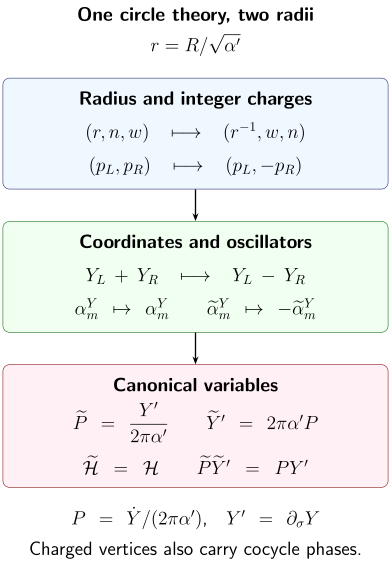
T-duality relates and by exchanging the integer charges and reflecting the compact right mover. The lower relations use ; primes there denote spatial derivatives. The diagram shows exact relationships, with no numerical coordinate scale. Charged-vertex cocycle phases are additional to the coordinate map.
Equations of motion and the canonical transformation
Section titled “Equations of motion and the canonical transformation”Differentiating and gives
The equality of the mixed derivatives of then requires
Thus the wave equation for is the integrability condition for its dual. Conversely, the wave equation for follows from equality of mixed derivatives of . This explains the interchange between an equation of motion and a differential identity without an unspecified Hodge-star sign.
There is an important distinction between this on-shell relation and an off-shell substitution into an action. The Lorentzian compact-coordinate Lagrangian density is
Swapping with negates this expression. It does not directly prove equality of the two Lagrangian densities. The canonical description gives the correct statement. With ,
The two positive terms in exchange, so the Hamiltonian is invariant. The momentum density is also preserved: . Exercise 4 explains a local generating functional and the care required by winding at its boundary.
The coupling also transforms
Section titled “The coupling also transforms”The compact-boson conformal field theories are equivalent at fixed worldsheet topology. To relate perturbative interacting string theories, the constant dilaton must transform too. Dimensional reduction of the string-frame gravitational term makes its 25-dimensional coefficient proportional to
Keeping this coefficient invariant under gives
This agrees with the path-integral measure transformation described by Tong, §8.3. The constant shift weights different worldsheet Euler characteristics correctly. It is not needed merely to check a free mass eigenvalue. For the bosonic theory, statements about vacuum amplitudes remain formal in the presence of the tachyon divergence.
Winding marginality and the thermal circle
Section titled “Winding marginality and the thermal circle”Consider first a spatial circle and the winding ground states
They satisfy level matching, and their masses are
They become massless at . This is already different from the self-dual radius .
The distinction is equally clear on the worldsheet. At zero noncompact momentum the two winding operators have compact-coordinate factors
Their real combination is proportional to . As an integrated perturbation it is irrelevant for , linearly marginal at , and relevant for . This is the compact-boson relevance criterion behind the Kosterlitz–Thouless analogy. Establishing a complete transition would require the coupled running of the perturbation and radius; the weight calculation alone does not establish it.
For thermal physics, Euclidean time is periodic with circumference , so its circle radius is . The first thermal winding pair consequently has the spatial fluctuation mass
The states of opposite thermal winding form one complex thermal scalar. This Euclidean mode is not an ordinary particle winding a Lorentzian time circle. Its threshold agrees with the density-of-states calculation. A worldsheet modular transformation relates the large density of highly excited strings to the infrared behavior of this winding mode; Kruczenski and Lawrence, §§2–3 explain this relation through the thermal scalar and random walks.
Two limitations matter. First, the zero-winding bosonic tachyon still has at every , so this calculation does not produce a stable bosonic ensemble below . Second, the precise nonanalyticity depends on the number of noncompact spatial dimensions: a massless winding mode need not make the infinite-volume free energy itself diverge at the threshold. Exercise 6 isolates this infrared question. Neither limitation changes the mass formula or the distinction between and .
The complete self-dual spectrum
Section titled “The complete self-dual spectrum”At , the chiral momenta become
For a massless state, the two shell conditions are
Since each term is nonnegative, and . These bounds make the following list exhaustive:
| Momentum and winding | Physical polarizations | |
|---|---|---|
The total is . A one-oscillator sector supplies a 25-dimensional massless vector with 23 polarizations and a compact scalar with one. Therefore the full massless content is
a graviton, a two-form, six vectors, a dilaton and nine compact scalars. The additional states contribute polarizations beyond the generic spectrum. These counts refer to physical polarizations at nonzero null noncompact momentum; exceptional zero-momentum cohomology is not being counted.
The nine scalar charges
Section titled “The nine scalar charges”The dimensionless current charges at this radius are
For the compact scalars, fills the nine weights of :
The center is the neutral radius scalar. The four axial weights arise from the internal polarization of the one-oscillator sectors. The four corners arise from the zero-oscillator states with two units of momentum or winding. Opposite weights describe conjugate fields, so the center plus four conjugate pairs gives nine real scalar components, eight of which are charged under the Cartan generators.
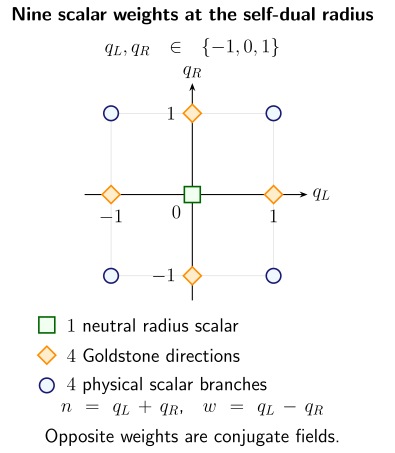
At , the nine real scalar components transform as with . The coordinate scales are equal. Opposite points are conjugate fields. The four extra vector fields have the axial charges too, with noncompact rather than compact oscillator polarizations. Under a radius deformation, the four axial scalars supply their longitudinal polarizations.
The level-one current algebra
Section titled “The level-one current algebra”The enhanced symmetry can be derived directly from the common free-boson OPE. On the left, define the currents
The proportionality includes zero-mode cocycles and constant phases, chosen so that and are conjugate and their opposite-charge OPE has positive leading coefficient. These phases do not change conformal weights. A lattice convention and a compatible choice are given in Exercise 1.
Each exponential has . Differentiating gives
Contracting one derivative with an exponential yields
For opposite charges, the exponential contraction produces a double pole. Expanding the remaining normal-ordered exponential one order further gives
Equal-charge products start at order and have no singular term. With , these results combine into
This is the affine algebra at level one. In modes,
Its zero modes form the ordinary Lie algebra. The right currents satisfy the same algebra and commute with the left currents. Ginsparg, §§8.6–8.7 derives this compact-boson enhancement; his Cartesian currents have a different normalization, so the coefficients above follow from the course OPE rather than an implicit change of convention.
Currents, vector particles and scalar particles
Section titled “Currents, vector particles and scalar particles”The matter parts of the massless vector vertices are proportional to
Each current supplies weight one on its side, and the derivative supplies weight one on the other. Physical polarization constraints impose transversality and identify longitudinal gauge representatives. The three left and three right currents therefore create six vector fields. Their zero-mode OPE residues explain the enhanced non-Abelian gauge algebra, not merely its dimension.
The nine scalar vertices instead have matter factors
For unintegrated closed-string vertices, multiply the weight- matter operator by . The expressions above specify particle content and charges; they do not replace the ghost prescription for amplitudes.
In a real Cartesian current basis, is a real matrix transforming in . Under the specified full perturbative compact-boson spectrum, the faithful action of the enhanced group is , with the diagonal center removed. Exercise 1 explains why the full charge lattice, including massive states, is needed to determine this global statement.
Radius deformation and the Higgs mechanism
Section titled “Radius deformation and the Higgs mechanism”To vary the radius while keeping the coordinate periodicity fixed, write , where . The Euclidean action is
Changing changes the coefficient of a free Gaussian theory. The corresponding operator is proportional to , hence to . This is an exactly marginal deformation: it moves along the family of compact-boson conformal field theories. In spacetime it is an expectation value of the neutral component , leaving the two Cartan gauge generators unbroken.
Vector masses and the missing polarizations
Section titled “Vector masses and the missing polarizations”Follow, for example, the states , away from the self-dual point. The right shell gives
All four charged vector branches have this mass. Their internal oscillator polarizations explain how the vectors acquire a longitudinal mode.
For this branch, combine the noncompact momentum and right compact momentum into the null 26-vector . A level-one right polarization satisfies
The constraint and the gauge identification leave physical polarizations. When , choose to set the compact component to zero. The remaining polarization is a massive vector in 25 dimensions, with 24 physical modes. When , this gauge transformation no longer removes ; the modes reorganize into a massless vector with 23 polarizations plus a scalar. The other charged branches work in the same way, using where appropriate.
Thus the four axial scalar weights supply the Goldstone directions for the four broken generators. Exercise 3 exhibits a smooth physical polarization class through the massless limit, rather than relying only on a count.
The four remaining charged scalars
Section titled “The four remaining charged scalars”The corner weights have no oscillator polarization to absorb. The pure momentum pair and pure winding pair have
They are massless at , but one conjugate pair is tachyonic on either side: momentum scalars for and winding scalars for . This is compatible with exact marginality of the radius operator. A consistent worldsheet CFT need not describe a stable spacetime vacuum.
With , the vector mass behaves quadratically near the symmetric point, while the scalar masses have opposite linear slopes:
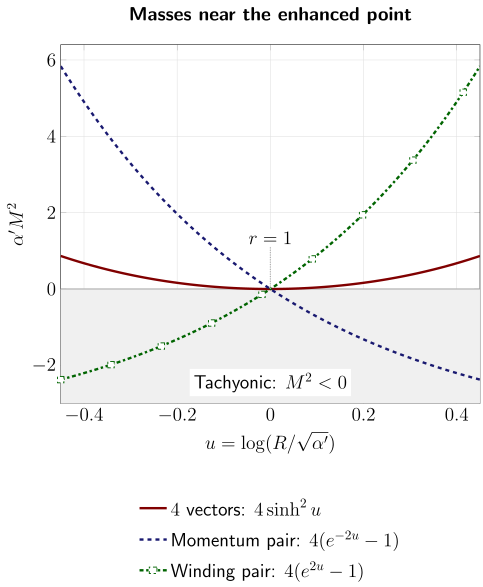
Exact bosonic-circle mass branches in dimensionless coordinates and . The vector curve represents four real charged-vector components; each scalar curve represents a conjugate pair, or two real scalar components. Negative values indicate tachyonic fluctuations. The neutral radius scalar remains massless. Radius inversion reflects and exchanges the two scalar curves; the thermal first-winding threshold concerns different states.
Why nine massless scalars do not mean nine moduli
Section titled “Why nine massless scalars do not mean nine moduli”At the enhanced point every has weights , so all nine scalar deformations are marginal to first order. Higher orders depend on their OPEs. A product of one chosen left current and one chosen right current can be rotated to , and therefore generates the same radius family in a rotated basis. An arbitrary sum of products need not do so.
For example, the simple-pole terms in the two current algebras imply
Integrating the term produces a logarithm, so this perturbation is not exactly marginal. Exercise 5 derives the general matrix criterion at this order and explains the separate all-order argument for rank-one products. The distinction between conformal weight and exact marginality is developed in Ginsparg, §8.6.
The enhancement described here is specific to the bosonic spectrum. On a supersymmetric Type II circle with the standard GSO projection, each allowed chiral oscillator level is at least its intercept. A massless state then requires both compact chiral momenta to vanish, so there are no analogous finite-radius extra vector states with nonzero momentum or winding. T-duality still acts, but the enhanced bosonic spectrum is not carried over unchanged. The next page instead applies the dual coordinate to open-string boundary conditions.
Common pitfalls
Section titled “Common pitfalls”Using the mass formula without level matching. Both chiral physical-state conditions must hold. A state that has in the average but violates is absent from the closed-string spectrum.
Identifying every special radius with gauge enhancement. The first winding ground state becomes massless at , whereas the extra vector currents appear at . Other isolated radii also support massless scalar modes of the bosonic tachyon.
Counting every charged scalar as a modulus. The enhanced theory has nine real compact scalars, including one neutral component. Along the radius family four become longitudinal vector polarizations, four acquire the scalar masses above, and one remains the radius modulus.
Exercises
Section titled “Exercises”Exercise 1. Charge lattice, cocycles and the center
Section titled “Exercise 1. Charge lattice, cocycles and the center”Set . For charges and , show that . Prove that the lattice is even and unimodular. Use
as the cocycle in the leading product of lattice vertices . Check associativity and the exchange sign, and find a lift of of the form . Finally determine the kernel of the center of on this perturbative compact-boson spectrum.
Solution
Expanding the two products cancels the momentum–momentum and winding–winding terms and leaves . In the integer basis its Gram matrix is
Its determinant is , so the integral lattice is unimodular. Its norm is even. The signature is ; this is not a positive-definite Euclidean charge lattice.
For a third charge , the two associativity exponents are
which agree. Also . This compensates the exchange sign of the left/right exponential factors.
Preserving the product under the duality map requires
The choice works: the two sides have the same exponent modulo two after expanding . It also obeys , so this chosen lift squares to the identity. Omitting the phase fails, for example, for and : their cocycle changes sign under exchange of momentum and winding.
In this cocycle convention, . For the left roots , choosing makes them conjugate and gives a positive leading opposite-root OPE. The analogous choice works for right roots . The chosen lift sends and , while stays fixed and changes sign. Thus preserving , and the left oscillators does not imply preserving all left charged vertices in a fixed cocycle basis. Other basis phases change the formula for the lift without changing the radius equivalence.
At the self-dual radius, the Cartan weights of any lattice state are and . The two individual center elements act as and . Their product is always , but either separate center acts nontrivially on the allowed state . Current descendants preserve this parity. Therefore the kernel on the full specified perturbative spectrum is the diagonal , and the faithful group is . Inspecting only the adjoint massless fields would not determine this kernel.
Exercise 2. Classify all massless radii
Section titled “Exercise 2. Classify all massless radii”For arbitrary , classify all integer and oscillator levels that can give . Distinguish the states responsible for vector enhancement from isolated massless scalar modes.
Solution
The two equations are
Nonnegativity forces .
If both levels equal one, both squares vanish. Adding and subtracting gives , valid for every radius.
If , the right square vanishes, so . The left square then gives , hence . Integrality implies and . If the levels are , the same reasoning gives , , again at . These four sectors contain the extra vector particles.
If both levels vanish, subtracting the squares gives . A nonzero pure momentum state has
and a nonzero pure winding state has
The choice cannot satisfy the shell equations in this case. These states have no oscillator index, so they are scalar modes. At they are precisely and , the four corner weights. The first winding pair instead becomes massless at .
This classification is exhaustive because there are no other allowed oscillator levels. It also shows why an accidental scalar threshold at another radius does not generate the chiral weight-one currents needed for an extra spacetime vector.
Exercise 3. Follow a longitudinal polarization through enhancement
Section titled “Exercise 3. Follow a longitudinal polarization through enhancement”Use three active components with metric and let
The last component is a compact chiral momentum. Show that represents a unit physical polarization. Find an equivalent representative with a finite limit as at fixed , and interpret the limit.
Solution
First . The proposed polarization obeys
Although its first two components diverge when , physical polarizations are equivalence classes modulo multiples of . Choose
Since , its first two components tend to zero. Thus
Its norm remains one because . At nonzero the representative with vanishing compact component is a longitudinal polarization of the massive 25-dimensional vector. At zero the same physical class becomes a compact scalar. The singularity in the first representative was a gauge-choice singularity, not loss of a physical state.
Taking for a left-root branch, or for a right-root branch with the appropriate compact sign, makes this the string Higgs mechanism. The limit is taken at fixed nonzero noncompact spatial momentum, so it does not invoke exceptional zero-momentum states.
Exercise 4. Canonical duality and winding at a cut
Section titled “Exercise 4. Canonical duality and winding at a cut”Consider the local generating functional
Derive the canonical transformation for variations fixed at a chosen cut. Explain why merely requiring periodic variations is insufficient when has winding. Then integrate the canonical relations to derive the global charge exchange and check the Hamiltonian and momentum densities.
Solution
Variation and integration by parts give
For variations with at the cut, the endpoint term vanishes. The type-one generating-functional relations then give
Periodic variations alone do not remove the endpoint term. If and , it equals
Thus the displayed functional is a local description with a fixed basepoint/cut prescription. It is not, without zero-mode and boundary treatment, a globally single-valued generating function on all winding sectors. The global charges can instead be checked directly from the canonical relations:
With , these equations become and . Conversely, exchanging the primitive momentum and winding units fixes this dual radius.
Finally,
The energy and spatial momentum densities are preserved. This canonical result does not require the false assertion that a direct derivative swap leaves the Lorentzian Lagrangian density unchanged.
Exercise 5. Current products and marginality
Section titled “Exercise 5. Current products and marginality”For a real matrix , set , with repeated indices summed from one to three. Show that its self-OPE contains
Determine when this leading logarithmic obstruction vanishes, and explain which part of the conclusion can be promoted to an all-order statement.
Solution
The required term is the product of the simple poles in the two current OPEs. Their factors of multiply to , giving the coefficient
For a matrix, the cofactor formula is
Cyclically permuting the three indices of either epsilon introduces no sign, so these expressions agree as stated. The integral is logarithmic; a nonzero coefficient produces a leading renormalization of the couplings.
Every cofactor is a signed minor. All such minors vanish precisely when . For nonzero rank one, write . Independent real rotations of the two current triplets align and with their respective third axes. The perturbation then becomes a multiple of , which changes the coefficient of a free compact-boson action. This independent Gaussian-theory argument establishes exact marginality along that direction to all orders, within the radius family.
Vanishing of a leading beta-function coefficient alone would not prove that general conclusion. Here the all-order result follows because the rank-one operator is symmetry-related to the known radius deformation. Conversely, for the cofactor matrix is , giving . The isotropic sum is already obstructed at this order.
Thus the nine scalar fields are legitimate linearized massless excitations, but arbitrary independent constant values of their nine components do not parameterize a nine-dimensional family of circle CFTs.
Exercise 6. Infrared behavior of the thermal winding mode
Section titled “Exercise 6. Infrared behavior of the thermal winding mode”Isolate the formal Gaussian contribution of the first thermal winding mode in noncompact spatial dimensions. Introduce a positive reference mass and write the large-proper-time tail, up to a constant, as
Here is a dimensionful proper time, and the lower cutoff separates the infrared tail from short-distance contributions. Determine which derivatives with respect to remain finite as . Explain the result for and its limitations.
Solution
The free spatial heat kernel contributes , while the determinant contributes . After derivatives, the infrared integral is proportional to
At zero mass, a power integral at its upper limit converges exactly when its exponent is less than . Therefore
is the convergence criterion. If , the integral is logarithmic and behaves as up to finite terms. If , setting gives the leading behavior
For , the free energy itself and its first twelve mass-squared derivatives have finite infrared limits; the thirteenth derivative is the first integer derivative that diverges. For negative , the exponential grows at large proper time and the Gaussian expression loses convergence.
This calculation concerns an isolated winding-mode contribution per spatial volume with a fixed infrared separation scale. It does not assert that the full bosonic string partition function is finite, because the zero-winding tachyon is still present. It also does not decide an interacting phase transition. It shows precisely why the appearance of a massless thermal scalar and divergence of the free energy itself are different claims.
References
Section titled “References”- Ginsparg, Paul. “Applied Conformal Field Theory.” In Fields, Strings and Critical Phenomena, Les Houches Session XLIX (1988), edited by Édouard Brézin and Jean Zinn-Justin. North-Holland, 1989, pp. 1–168. arXiv:hep-th/9108028, especially §§8.6–8.7.
- Kruczenski, Martín, and Albion Lawrence. “Random Walks and the Hagedorn Transition.” Journal of High Energy Physics 2006, no. 07, 031. arXiv:hep-th/0508148, especially §§2–3.
- Tong, David. String Theory. University of Cambridge lecture notes, 2009. arXiv:0908.0333, especially §§8.1–8.3.