
Radial Quantization and State–Operator Correspondence
A local operator is inserted at a point, whereas a quantum state specifies data on an entire spatial slice. Conformal symmetry connects these descriptions: the infinite past of a cylinder becomes the origin of a plane, and a spatial circle becomes the boundary of a disk. An insertion at the center prepares a state on that boundary.
This page develops that construction, including its normalization, its inner product and its application to free-boson oscillators. It uses the shared conventions and the OPEs and contour generators derived on the preceding page. The representation theory of descendant spaces is developed on the next page.
States on circles and evolution through an annulus
Section titled “States on circles and evolution through an annulus”On the Euclidean cylinder, a state is specified on a circle of constant . The map
sends that circle to . Increasing Euclidean time means moving outward. Time ordering therefore becomes radial ordering: the insertion at the larger radius acts on the left. The origin and infinity represent the two ends of the cylinder; neither is an ordinary finite-time slice.
Let denote boundary values of the CFT fields on a circle. The path integral over defines a kernel between two such boundary configurations:
Integrating this kernel against an initial wavefunctional gives the state at radius . Gluing two annuli means integrating over their common boundary values. It is the path-integral version of composing evolution operators.
The radial time interval is . With the common vacuum propagation factor divided out, the evolution operator is
An eigenstate of scaling dimension is multiplied by . The cylinder Hamiltonian also contains a state-independent Casimir term, derived below. Distinguishing that term from energy differences will prevent a spurious shift in the plane operator dimensions.
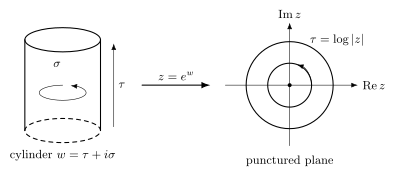
Under , the times give radii . Increasing is counterclockwise, and increasing is outward. An annulus of radius ratio evolves states through time ; the radial evolution described in the text has its common vacuum factor removed. The cylinder drawing is schematic.
For a reflection-positive CFT with a unique, normalizable lowest-energy state separated by a gap, Euclidean propagation projects onto that state:
A nonzero vacuum overlap is required to obtain a nonzero limit, and the convergence is exponential. With degenerate vacua, the limit is instead the projection onto the full ground-state space. It is not a general argument for positivity in the covariant string matter-plus-ghost theory. Timelike oscillators and ghosts have indefinite pairings, while a noncompact free boson has a continuous momentum spectrum and a delta-normalized zero-momentum vacuum. In those cases the local CFT construction remains useful, but this simple Hilbert-space projection needs additional care.
Global conformal transformations on the sphere
Section titled “Global conformal transformations on the sphere”The local conformal algebra contains vector fields . Which of them are nonsingular everywhere on the Riemann sphere?
At , regularity requires . Near infinity use :
Regularity at requires . Thus only survive. More generally, an everywhere regular holomorphic vector field has coefficient ; regularity at infinity excludes higher powers. Its finite transformations are the Möbius maps
Multiplying all four coefficients by the same nonzero number does not change the map. After imposing determinant one, the matrices and still give the same transformation. The faithful group acting on the sphere is therefore
It has three complex, or six real, parameters. On the real Euclidean surface, the antiholomorphic map is the complex conjugate of the holomorphic map; it does not supply another six independent real parameters. Independent barred and unbarred generators are useful in the complexified algebra.
The corresponding quantum generators obey
The central term vanishes because at . These are the global transformations that remain regular on the sphere. The other Virasoro generators are still meaningful local contour operators; they are not globally regular coordinate changes of an unpunctured sphere.
Why the stress tensor acquires a Schwarzian term
Section titled “Why the stress tensor acquires a Schwarzian term”The stress tensor is not an ordinary primary when . From the fourth-order pole in its OPE, the positive contour action defined on page 11 gives
For a passive coordinate change , the finite version is
where
This formula is local on a patch where is holomorphic and . Solving for gives the passive transformation law. For , expressing the transformed field at the same coordinate gives , including the anomalous term.
Derivation by point splitting
Section titled “Derivation by point splitting”For free bosons, define the stress tensor by subtracting the short-distance contraction before bringing the two fields together:
The separated derivatives transform by the chain rule. But the subtraction defined in the coordinate is proportional to , not . Consequently,
To evaluate the limit, write , and . Taylor expansion gives
Dividing these series cancels the possible simple pole and leaves
Since , the finite remainder is precisely . The anomaly arises from how the short-distance subtraction changes under the map.
For a general CFT, the same finite law integrates the infinitesimal stress-tensor transformation. Its consistency under successive maps follows from
Thus the two anomalous contributions combine correctly. Together with the infinitesimal law and the identity transformation, this fixes the local transformation along a smooth family of nonsingular maps. This argument concerns the local stress tensor; it does not settle possible global phases of a partition function.
For a Möbius map, the Schwarzian vanishes. The stress tensor therefore transforms as a weight-two field under the global conformal group, even though it is not a Virasoro primary. Such a field is called quasiprimary.
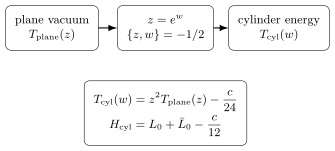
The two short-distance kernels agree in their double pole but differ by in their finite part. Multiplication by produces the stress-tensor shift. For , the Schwarzian is , giving . The separated points and their distances are schematic; the limit assumes .
Cylinder energy, angular momentum and the vacuum shift
Section titled “Cylinder energy, angular momentum and the vacuum shift”For , all three derivatives of equal , so . The stress tensor on the cylinder is therefore
For the nonchiral theories considered here, the two central charges agree. The generators on the cylinder of circumference are
Here generates spatial translations around the cylinder; on the plane it measures angular momentum, or conformal spin. A state of weights has energy and spin . These formulas assume equal left and right central charges; a gravitationally anomalous chiral theory requires separate treatment of its vacuum momentum.
The identity has plane weights . Hence
There is no additional constant in the plane . The cylinder Casimir term comes from the map and must not be inserted a second time into that operator. It is also distinct from the intercept in the physical string constraints. For example, transverse bosons have in each sector, whereas the covariant matter stress tensor in target dimensions has ; these are different CFT sectors.
If the cylinder has a dimensionful circumference , use , where and . Then
These are worldsheet cylinder energies, with units of inverse worldsheet length. They are not target-space string masses.
A local insertion prepares a state
Section titled “A local insertion prepares a state”The path integral over the unit disk with an insertion at its center defines a wavefunctional:
Its operator notation is
The notation includes renormalization of the local insertion; composite fields must already be defined by their appropriate subtraction prescription. Inserting the identity gives the disk with no disturbance and prepares the conformal vacuum .
Conversely, a scaling eigenstate on the circle can be propagated toward a shrinking circle. After compensating its known radial scaling, the boundary condition defines a local insertion at the limiting point. This is the state–operator correspondence in the chosen CFT sector. Finite linear combinations of such states give corresponding linear combinations of fields. A general Hilbert-space superposition may require a convergent infinite expansion or a distributional completion; it need not be represented by one finite polynomial in the elementary fields.
The sector matters. Twisted boundary conditions require twist fields, and fermionic spin structures must be specified when fermions are present. In a noncompact free-boson theory, fixed-momentum states and their vertex operators are generalized, delta-normalized objects. One can form normalizable wave packets by smearing momentum. These qualifications do not change the local oscillator formulas derived below.
This is a correspondence in the worldsheet CFT, before imposing the physical string conditions. The identity vacuum is not an on-shell string state. Physical string vertices additionally require the appropriate matter weights, gauge equivalences and ghost or BRST conditions.
Primary states and the regular vacuum
Section titled “Primary states and the regular vacuum”For a primary field of weights , the contour can be shrunk onto its insertion:
Therefore
The barred relations follow with the contour orientation fixed on page 12: when the contour is counterclockwise in the physical plane, includes the minus sign compensating the clockwise barred coordinate. The two sectors give the two weights independently.
For the identity, is regular at the origin. Expanding it as shows that
The constant term is , so
This state has weight two but is not primary when , since . Weight, primarity and being a nonzero state are distinct questions.
Multiple insertions inside a circle prepare another state on its boundary. Expanding that state in a basis of scaling eigenstates produces the OPE inside correlators whose other insertions lie outside the circle. This is why the position of the nearest outside insertion controls the local expansion’s domain, rather than the distance from an unrelated coordinate origin.
Gluing disks and taking an adjoint
Section titled “Gluing disks and taking an adjoint”To form an inner product, glue the disk preparing a ket to a reflected disk preparing its bra, integrating over the common boundary data. Euclidean time reflection acts on the plane as
It fixes the unit circle and exchanges its inside and outside. Reflection includes complex conjugation. For a scalar primary of dimension , with conjugate field , the resulting bra is
where the limit is along the positive real axis. If
then . Positivity of this number follows in a reflection-positive sector; it does not follow from conformal covariance alone.
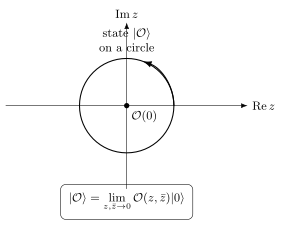
For a scalar primary with , the inside disk prepares and the reflected outside disk prepares its adjoint. The insertion at infinity includes the factor . Gluing produces the two-point pairing; it is positive in a reflection-positive sector. The geometry is schematic and the formula is a primary-field formula, not the transformation law of an arbitrary descendant.
For a spinning primary, the analogous factors are in the radial adjoint, with the conjugate field and its tensor phases fixed by continuation from the Lorentzian theory. In particular, the Hermitian stress tensor obeys
There is no Schwarzian contribution because inversion is Möbius. Comparing Laurent series on the two sides gives
The same reasoning gives . With a unit-normalized vacuum, it follows that
The two-point coefficient in the OPE is exactly the stress-tensor state’s norm. Thus a positive inner product requires ; strict positivity of this state requires .
Two qualifications are useful. First, a derivative of a primary acquires extra terms under inversion. Multiplying its conjugate by alone does not construct the correct bra; exercise 4 derives the missing term. Second, conformal sewing can also define a bilinear BPZ pairing using holomorphic inversion. That operation is linear, whereas a Hermitian adjoint is conjugate-linear. Neither the sewing construction nor the relation establishes positivity for timelike matter or ghosts.
The exact free-boson oscillator–operator map
Section titled “The exact free-boson oscillator–operator map”For a free boson, the identity state has zero momentum. Regularity of implies for , and similarly for the barred oscillators. Define
The OPE derived on page 10 is
Taking the current contour gives . Positive modes annihilate the state. Its weights are ; for noncompact real momenta the state normalization contains a momentum delta function.
Subtract the momentum pole before taking the limit
Section titled “Subtract the momentum pole before taking the limit”Acting on the momentum state, the full mode expansion reads
The limit does not exist until the first term is subtracted. The required local field is jointly normal ordered:
Thus it creates . For higher derivatives, differentiate the expansion times and subtract the differentiated momentum pole. The only constant creation term comes from , with coefficient . Therefore the exact dictionary is
The phase and factorial follow from the shared mode expansion. There is no unspecified proportionality factor. In particular, with separate normal ordering would leave the derivative–exponential contraction unsubtracted.
Several oscillators and both chiralities
Section titled “Several oscillators and both chiralities”For several creation modes, take a single normal-ordered product of all derivative fields and the exponential, subtracting every pairwise contraction. The holomorphic map is
Every antiholomorphic oscillator adds the same coefficient and a barred derivative inside those colons. Examples are
These normal products are local fields defined by the plane subtraction prescription. Mixed contact distributions at coincident points do not supply an additional oscillator family or an extra factor in this separated-point state map.
If the mode levels are and , the corresponding weights are
Being a weight eigenoperator does not imply primarity. For example,
The corresponding chiral factor is primary only if . It is one building block of a closed-string vertex, not by itself a complete closed-string gauge boson. The open-string boundary construction has its own doubling factors, as explained on page 12.
Finally,
At , this derivative vanishes because . Nevertheless, is generally nonzero and corresponds to a current. The current is a new primary, not a derivative of the identity. This simple example already shows why one oscillator Fock sector need not be a single Virasoro family.
Exercises
Section titled “Exercises”Exercise 1. Regular vector fields and the Möbius quotient
Section titled “Exercise 1. Regular vector fields and the Möbius quotient”Show that a holomorphic vector field regular on the whole sphere has the form . Explain why the global group is rather than a faithful action of . Check explicitly that inversion belongs to this group even though it sends a finite point to infinity.
Solution
Write the entire coefficient as . In the coordinate , the vector field is
Regularity at forces for . The three coefficients are the infinitesimal translation, dilation/rotation and special conformal parameters.
A nonsingular matrix defines , and every nonzero scalar multiple of defines the same map. Normalizing its determinant to one leaves the ambiguity . The determinant-one matrices have three complex parameters, so the quotient has six real parameters; dividing by this discrete ambiguity does not change the dimension.
For inversion, choose
The apparent pole at is a regular image point in the second sphere chart. A coordinate denominator vanishing is not itself a singularity of the sphere map. By contrast, a branched map such as is not a Möbius automorphism.
Exercise 2. Composition and a map with a branch point
Section titled “Exercise 2. Composition and a map with a branch point”Derive the Schwarzian chain rule. Then compute the Schwarzian of for an integer on a patch excluding zero. If the stress tensor in the coordinate has zero expectation value, explain why the resulting negative coefficient of is not a negative-norm or negative-energy state in a unitary plane CFT.
Solution
Let . The Schwarzian can be written as . For a composite map,
Differentiating and subtracting half the square gives
The last term vanishes by definition of , leaving the chain rule in the main text.
For , , so
Thus a locally pulled-back vacuum has
The derivation is valid on a patch where the map is one-to-one and . At the origin, , and a full punctured neighborhood is covered times. This is not a globally regular change of coordinates preparing the ordinary plane vacuum or an ordinary positive-energy state in its sector. Extending the construction across the branch point requires specifying different geometry or sector data. The local stress transformation alone supplies no counterexample to unitarity.
Exercise 3. A cylinder correlator measures an energy gap
Section titled “Exercise 3. A cylinder correlator measures an energy gap”Take a scalar primary of dimension , with plane two-point function . Map it to a cylinder of circumference . Find its vacuum two-point function at equal spatial position and Euclidean time separation , and extract the short-time behavior and the large-time energy gap.
Solution
Set and . Since , each insertion contributes the primary Jacobian . At and ,
For , , recovering . For ,
The spectral expansion of a vacuum correlator involves , so the lightest state coupled to this primary has gap . Its absolute energy is
The vacuum Casimir energy cancels in the gap. This is a zero-temperature correlator on a spatial circle; a thermal interpretation would require a different choice of which cylinder direction is Euclidean time.
Exercise 4. The bra of a derivative is not a primary bra
Section titled “Exercise 4. The bra of a derivative is not a primary bra”For a holomorphic primary of real weight , take with consistent local branches. Use radial conjugation to construct the bra of . Evaluate its norm directly from the two-point function and compare with .
Solution
For this chiral field, the radial adjoint is . Differentiating with respect to yields
Sending to zero along the positive real axis, with , therefore gives
The two needed correlators follow by differentiating with respect to and then :
Substitution gives . The algebra gives the same result:
The extra primary term and the sign from differentiating the inverse coordinate are both essential. Treating as a primary of weight would give an incorrect pairing. In a positive sector with , this norm also requires ; the classification of null descendants is a separate question.
Exercise 5. Momentum subtraction and two creation modes
Section titled “Exercise 5. Momentum subtraction and two creation modes”For one spacelike free boson, derive the local fields corresponding to , and at nonzero momentum. State explicitly which contractions must be subtracted in the last case. Check their oscillator norms after factoring out the momentum delta function.
Solution
The first two subtractions are
Both create times the corresponding state for . At general , the singular term being subtracted is
For the two-oscillator field, put , and define their contractions with each other and with the exponential by
Wick’s theorem gives the jointly ordered product as the limit of
The final term corrects the double subtraction of the two derivative–exponential contractions. Removing only would leave momentum poles; removing only and would leave the derivative–derivative pole. After all subtractions, only the product of the regular creation parts survives. Therefore
Using and unit oscillator-vacuum pairing at fixed momentum, the norms are , and , respectively. The two level-two states are orthogonal because . These positive results use a spacelike boson; a timelike oscillator changes the one-particle norm’s sign.
Exercise 6. The identity, the current and the stress tensor
Section titled “Exercise 6. The identity, the current and the stress tensor”For one spacelike boson at zero momentum, distinguish the three states , and . Identify their local operators, primarity and norms. Also identify and explain why this does not make the current a derivative of the identity.
Solution
Since , . The current
has mode expansion and creates . Its OPE with is that of a primary of weight one. Equivalently, , which annihilates the zero-momentum vacuum for . Its norm is one.
The stress tensor creates
The dictionary maps this state to . Its norm is . It is quasiprimary but not primary: and .
Finally,
This state has norm , consistently with exercise 4 at . It is a derivative of the current, which is a different nonzero primary. It is not a derivative of the identity. The oscillator sector therefore contains both the identity family and states generated from the current, before one undertakes any full decomposition into Virasoro representations.
References
Section titled “References”- Ginsparg, Paul. “Applied Conformal Field Theory.” In Fields, Strings and Critical Phenomena, Les Houches, Session XLIX (1988), edited by Édouard Brézin and Jean Zinn-Justin, pp. 1–168. Amsterdam: North-Holland, 1989. arXiv:hep-th/9108028. Sections 3.4–3.5 develop in- and out-states, radial adjoints and the primary-state conditions.
- Tong, David. Lectures on String Theory. University of Cambridge lecture notes, 2009, revised 2012. arXiv:0908.0333. Sections 4.4–4.4.1 discuss the stress transformation and Casimir energy; sections 4.5.1 and 4.6 develop radial quantization and the state–operator map. The cylinder coordinate used there differs from the one fixed in this course overview, so intermediate stress-tensor signs must be translated with the coordinate map.