
The Virasoro–Shapiro Amplitude and Factorization
The four-tachyon sphere integral can be evaluated exactly. Its gamma functions reveal an infinite sequence of closed-string mass levels, while its residues agree with a local operator expansion near colliding punctures. This agreement connects a worldsheet calculation to the propagation of intermediate spacetime states.
We retain the global conventions and the labeled sphere construction of page 20. In particular, , the collision pairs carry , and . The amplitude is the formal bosonic-string amplitude about its unstable tachyonic vacuum. The analytic factorization studied here does not turn that vacuum into a stable scattering background.
Evaluating the complex beta integral
Section titled “Evaluating the complex beta integral”Remove the momentum delta function and write the result of page 20 as
The dimensionless parameters are , and . Here is the unchanged normalization constant, and
Begin in the absolute-convergence domain
These are the conditions at , respectively. Complex powers of positive moduli use their real logarithms. The third parameter is called , as on page 20; it is unrelated to an integration differential or the ghost field .
Turn the powers into Gaussian integrals
Section titled “Turn the powers into Gaussian integrals”The defining gamma integral implies
The same representation with applies to the second factor. The conditions above imply , so both representations are available. Their joint integral is absolutely convergent in this domain, justifying the following exchanges of integration order.
Complete the square:
The doubled complex area of the overview then gives
Thus
The factor has a concrete origin in this Gaussian integral. It would be with ordinary area ; changing it here would change every residue below.
Separate the overall scale from the ratio
Section titled “Separate the overall scale from the ratio”Set
The absolute Jacobian is , and the denominator cancels it. The remaining power of is :
The scale integral is
Multiplication by the remaining powers leaves . This is the Euler beta integral, so
This derivation follows the Schwinger-parameter method in Tong, section 6.5. It establishes equality in an open convergence domain. The gamma expression then gives the meromorphic continuation, including regions where the original improper integral does not exist.
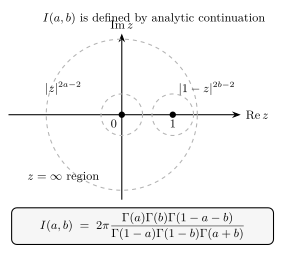
The map , separates a positive scale from a ratio, with absolute Jacobian . The marked point maps to . Its Gaussian is centered at . All plotted parameter values are dimensionless; the two panels show different coordinate systems, not a scale-preserving map. The derivation applies in the absolute-convergence domain before analytic continuation.
The gamma amplitude and its complete residues
Section titled “The gamma amplitude and its complete residues”Substituting the kinematics gives the Virasoro–Shapiro amplitude:
The three invariants are constrained, so this is a meromorphic function of two independent variables. Its symmetry under permutations of agrees with the changes of modulus on page 20. The coupling power remains for canonically normalized external states; the calculation has not fixed the numerical constant or overall phase in .
Pole locations at generic fixed momentum transfer
Section titled “Pole locations at generic fixed momentum transfer”Hold fixed and let vary with . A numerator gamma function has poles when
These are the masses squared of closed strings with equal left and right levels . The tachyon is at , the massless level at , and massive levels begin at . The amplitude detects a state through its coupling to the external tachyons; a list of mass levels does not imply that every polarization at a level has a nonzero coupling.
It is also essential to inspect the denominator. A pole at generic can have zero residue at a special . At intersections of singular loci, one must analyze the full constrained gamma ratio instead of counting numerator poles independently.
The residue is a squared polynomial
Section titled “The residue is a squared polynomial”Introduce dimensionless variables only for this calculation,
The integral becomes
Near , the first gamma function has the expansion
Evaluate the other factors at that pole. The recurrence of the gamma function gives
Since , the full residue of the integral is
Here , with . The first examples are
The amplitude residue includes the additional factor . The minus sign displayed for is fixed by the variable change from the gamma argument to . It is not a negative-norm diagnosis: the overall S-matrix phase, propagator convention and state normalization must also be included in a unitarity test.
At real , the normalized polynomial is nonnegative. Its degree is , consistent with the maximum spin at that level, as discussed in Tong, section 6.2.3. More information requires expansion in physical partial waves; a polynomial degree alone does not count all states or their multiplicities.
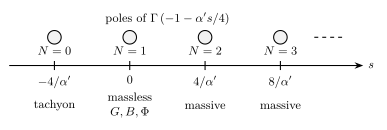
The plotted quantities are for , with the dimensionless axis . The residue of is . These polynomials describe a generic -channel pole and its possible vanishing residue at special momentum transfer; positivity of a plotted function alone is not an all-state unitarity proof.
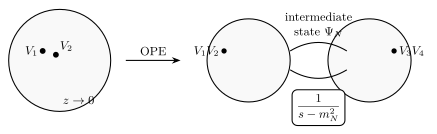
Recovering the residues from a local OPE
Section titled “Recovering the residues from a local OPE”The same coefficient can be obtained without evaluating the entire sphere integral. In a disk around the -channel collision, choose the analytic branches of and that vanish at the origin. Then
For analytically continued complex , the two exponents are still the same , not complex conjugates. Their product agrees with the full scalar power defined through .
With , integration over the angle gives
The twist angle therefore projects onto level-matched intermediate states. Using the full doubled area, the local contribution of a matched term is
Initially this radial integral requires a positive real part of its denominator exponent. Its continuation has
At the pole the exponent of vanishes, so the residue is independent of the arbitrary small disk. The rest of moduli space changes regular terms in this local calculation, provided the other channel singularities are avoided. This is the exact match with the gamma-function residue.
From a collision disk to a long cylinder
Section titled “From a collision disk to a long cylinder”Set . Approaching the puncture means . For an intermediate matter operator with momentum and levels ,
The local integration has the form
The angular integral imposes , while the length integral produces . For matched level , this denominator equals . A short coordinate separation is thus a long propagation region in the sewn worldsheet geometry. Polchinski, section 2.8 explains the corresponding plumbing and intermediate-state interpretation.
The exact coordinate relation is : counterclockwise angular motion increases , and motion toward the puncture increases . The drawn annulus has radii and , corresponding to ; the rectangle uses different horizontal and vertical scales, with its angular edges identified. The twist integral projects . Extending the cylinder to infinite length produces the denominator , whose zero is the matched on-shell condition.
Which physical states propagate?
Section titled “Which physical states propagate?”The local matter OPE contains oscillator descendants and states that do not themselves represent independent physical particles. To obtain physical factorization one combines sewing with the ghost insertions and BRST constraints. In a critical, anomaly-free theory, exact representatives decouple under the usual consistent treatment of moduli-space boundaries, leaving a sum over physical BRST classes. This is an additional structural statement of the string construction; the scalar integral by itself does not prove the decoupling theorem at every level.
To display what the statement means, choose physical intermediate states and their dual states at , after quotienting null directions. Let be their nondegenerate two-point pairing and its inverse. Inserting their resolution of the identity gives, schematically,
The constant fixes the propagator normalization relative to the chosen two- and three-point normalizations. It is fixed once those choices and are matched, not an arbitrary function of the kinematics. An orthonormal physical basis reduces to a Kronecker delta. In a nonorthonormal basis, omitting the inverse pairing would make the answer basis dependent.
All amplitudes in this formula are momentum-delta-stripped. Before stripping, the internal-momentum integral joins the two three-point conservation laws into the single four-point conservation law. Multiplying two full delta-containing amplitudes without that integral is not the factorization formula. The no-ghost result of page 7 and the BRST construction on page 19 provide the appropriate physical-state setting; exceptional zero-momentum cohomology and a proof of the general boundary-decoupling statement are outside this calculation.
The massless pole exchanges gravitons and dilatons
Section titled “The massless pole exchanges gravitons and dilatons”A midpoint expansion makes the selection rule visible. Put , , and . Away from other insertions, the free equation of motion removes the mixed derivative of . The exponential product can be written as
where the first terms of the normal-ordered expansion are
The displayed mixed term is at level . Equal external masses imply . At the massless pole , and
The tensor is symmetric, so its contraction with an antisymmetric polarization vanishes. Its physical transverse symmetric-traceless component couples to the graviton, and its nonzero transverse trace couples to the dilaton. The antisymmetric tensor belongs to the massless spectrum, but it has no two-tachyon coupling. This distinction is also stated explicitly by Polchinski, section 2.8. The general massless-vertex analysis is developed on the next page.
Regge asymptotics and its domain
Section titled “Regge asymptotics and its domain”The leading closed-string trajectory has slope and intercept two. To recover it from the amplitude, take large at fixed generic , rather than at fixed scattering angle. Continue into a complex sector first, so the infinite real-axis pole sequence does not obstruct the asymptotic expansion.
The gamma-ratio formula
holds for fixed shifts as in a closed sector ; see NIST DLMF, equation 5.11.12. In the present calculation the shifts in this generic formula are not Mandelstam variables.
Regroup the exact amplitude into two large-argument ratios:
If both and stay away from their negative real rays, the ratio formula yields
For a fixed upper-half-plane sector , principal logarithms satisfy . Therefore
In the corresponding lower-half-plane sector the phase is . Fixed exceptional values at poles or zeros of the prefactor require a separate limiting analysis. The exponent identifies
It agrees with and on the leading trajectory. The trajectory’s slope is half the open-string slope, as found from the spectrum and rotating strings.
Why the real axis is not a uniform power-law limit
Section titled “Why the real axis is not a uniform power-law limit”Euler reflection gives an exact complementary expression,
It follows by applying to the first large-argument ratio. On a real sequence of increasing , the sine quotient generally continues to oscillate and diverges near uncanceled poles. It cannot uniformly be replaced by a constant phase. A fixed small imaginary part does not eliminate this dependence on the fractional part of .
The controlled sector limit explains the Regge trajectory and its phase. A physical real-energy average, an order of limits approaching the real axis, or interaction-induced resonance widths requires a further prescription. None is silently built into the tree gamma formula. Fixed-angle high-energy suppression is a different limit, where grows with ; it is not established by the fixed- calculation above.
Exercises
Section titled “Exercises”Exercise 1. A recurrence without a common integral domain
Section titled “Exercise 1. A recurrence without a common integral domain”Use the gamma expression to derive in terms of . Determine whether both unregulated plane integrals can converge absolutely for the same . Explain what the recurrence means when the shifted integral is divergent.
Solution
Under , the third parameter changes from to . The four changing gamma factors give
This is an identity of meromorphic functions, away from special points when written as a ratio; the cross-multiplied identity continues across such points.
Absolute convergence of the first integral requires , and . The shifted integral additionally requires . That contradicts the first two inequalities. Thus there is no common domain for the two original, unregulated integral representations.
For example, gives after continuation, but the shifted plane integrand diverges at infinity. The recurrence assigns its meromorphic continuation, not the value of a convergent positive integral. Deriving it by integration by parts directly on the plane would require a regulator and the associated boundary terms or subtractions.
Exercise 2. Residues, spin and a partial-wave check
Section titled “Exercise 2. Residues, spin and a partial-wave check”Compute the complete residues of for . At the first massive pole , express in terms of in center-of-mass kinematics. Expand the resulting polynomial in the even Gegenbauer polynomials appropriate to scalar scattering in .
Solution
The first three residues are
Their degrees are zero, two and four. At , the external tachyon spatial momentum obeys . Therefore
In spacetime dimensions the scalar partial-wave index is , hence here. For direct coefficient matching,
Matching the , and constant terms gives
Thus this residue contains spins zero, two and four with positive coefficients after removing the common normalization of the residue. Odd spins are absent, as required by interchange of the identical external scalars. This checks one massive level; it neither determines state multiplicities nor proves positivity at every level. The overall minus sign of the analytic residue must still be translated into the chosen physical propagator and S-matrix conventions.
Exercise 3. Two intersecting channel poles
Section titled “Exercise 3. Two intersecting channel poles”Take and , where are nonnegative integers. Find the leading singular behavior of as both small parameters tend to zero with a generic finite nonzero ratio. Explain why multiplying the two numerator poles overestimates the singularity.
Solution
The numerator factors behave as
The first two denominator factors tend to . The last denominator is singular itself, so its reciprocal has a zero:
Combining these gives
There is no generic double pole. Two channel poles meet, but their product is canceled by the reciprocal gamma zero. For , the coefficient is ; for , it is .
Special paths such as cancel the displayed leading expression and must be analyzed using the exact function. In fact, at generic nonzero on that path, is the fixed negative integer , while the numerator is finite, so . Other approach directions diverge. This is a several-variable meromorphic singularity, not a point with a unique path-independent numerical value.
Exercise 4. A regulated annulus and its cylinder
Section titled “Exercise 4. A regulated annulus and its cylinder”For integers , integrate
Recover the same answer from . Identify the order of limits that gives a propagator pole, and explain why a finite annulus has no pole.
Solution
Angular integration sets . Writing , the result is
At finite cutoffs the apparent zero denominator is removable. In cylinder coordinates, runs from to . The matched integral becomes
which gives the same expression, including the logarithm at .
First take where . The result is . Then continue this function to . Since , its residue in is . Reversing the operations at finite cutoffs would instead leave a finite cylinder length. The pole comes from the possibility of arbitrarily long propagation, not from a singular finite-length integral.
Exercise 5. A nonzero null exchange momentum
Section titled “Exercise 5. A nonzero null exchange momentum”Take with and a vector orthogonal to it with . Set and . Show that these are on-shell tachyon momenta. Decompose the intermediate tensor into its physical massless polarization components and determine which components can couple.
Solution
An explicit choice is . Then , and
Choose a second null vector with , and define the rank- transverse projector
For the displayed , one may take . Let . Since , subtracting the component along does not change , so .
The physical tensor decomposes as
The first term is transverse symmetric-traceless and couples to the graviton. The second couples to the dilaton; contraction with the unit transverse trace polarization gives . The antisymmetric contraction vanishes identically. Changes of the auxiliary null vector alter the covariant representatives by gauge terms, not these physical conclusions.
Using is essential for this projector construction. A zero-momentum exception cannot be handled by choosing with .
Exercise 6. Complex Regge phases and real sequences
Section titled “Exercise 6. Complex Regge phases and real sequences”For fixed noninteger away from the exceptional gamma values, compare the normalized amplitude
along upper and lower complex rays. Then consider real sequences with . Determine their limiting ratios and explain why there is no single uniform real-axis Regge phase.
Solution
On an upper ray with fixed , , so the limit is . On a lower ray it is . These statements follow from the two gamma ratios in sectors where both admit their asymptotic expansions.
On the real sequences, the exact reflected form instead gives
The gamma ratio contributes its power with relative corrections of order , but the sine quotient retains the offset . For example, at it becomes , which is at , zero at , and at . It becomes arbitrarily large near an uncanceled pole as .
Thus the complex-sector phases and the real-sequence limits are different orders of limits. The power still identifies the leading trajectory, but a physical real-axis approximation needs a specified averaging or continuation prescription. This calculation says nothing by itself about the distinct fixed-angle limit or the loop-induced widths of resonances.
References
Section titled “References”- National Institute of Standards and Technology, Digital Library of Mathematical Functions, section 5.11(iii), “Ratios”, especially equations 5.11.12–5.11.13. The sector condition is part of the gamma-ratio asymptotic formula.
- Joseph Polchinski, What Is String Theory? (1994), lectures at the Les Houches Summer School “Fluctuating Geometries in Statistical Mechanics and Field Theory,” report NSF-ITP-94-97. arXiv:hep-th/9411028. Section 2.8 discusses the sphere amplitude, massless exchange and degeneration factorization.
- David Tong, Lectures on String Theory (2009), arXiv:0908.0333. Sections 6.2.3 and 6.5 discuss residues and derive the complex beta integral. The fixed-angle discussion in section 6.2.3 is distinct from the fixed-transfer Regge limit used here.