
Minimal Models, Ward Identities, and Correlators
Virasoro symmetry fixes the descendants of each primary, but a CFT also needs a spectrum and OPE coefficients. Minimal models provide an especially concrete setting in which to see these ingredients work together. Their finite sets of irreducible Virasoro representations contain null relations, and those relations constrain correlation functions by differential equations.
We will carry out one complete example: the four-spin correlator of the critical Ising CFT. Starting from a null relation, we will derive and solve an ordinary differential equation, distinguish its holomorphic blocks from a local correlator, impose single-valuedness and crossing, and extract a normalized OPE coefficient.
The shared conventions, conformal Ward identities, and representation theory on page 14 supply the background. In particular, a formal singular vector is set to zero only in the appropriate quotient representation.
The unitary minimal series and its local fields
Section titled “The unitary minimal series and its local fields”The nontrivial unitary Virasoro minimal series has
with allowed irreducible highest weights
The labels and specify the same weight and representation. This reflection has no fixed label: a fixed point would require both and to be even. There are therefore inequivalent chiral representations. The trivial endpoint was discussed on page 14.
To specify a local two-dimensional theory, one must also pair holomorphic and antiholomorphic representations. We focus on the diagonal unitary minimal models, with state space
Each summand supplies one local scalar primary of weights , dimension and spin zero. Its descendants need not have spin zero. The number above counts these diagonal primaries; it is not a universal count for every local theory with the same central charge.
For example, gives critical Ising and gives tricritical Ising. At , admits both the diagonal model and the three-state Potts realization, which uses a different pairing and an extended chiral algebra. They must not be identified merely because they have the same . This distinction is explained in Ginsparg, §§4.4 and 9.7.
For Ising, and
The three diagonal fields are
Here is the spin field and is the energy field. Their full scaling dimensions differ from their holomorphic weights. We choose their two-point normalizations to be
These normalizations will be needed when interpreting an OPE coefficient. The disorder field has the same weights as the spin field, but order and disorder insertions are mutually nonlocal. They are alternative local descriptions, not an extra independent entry in this diagonal Kac table.
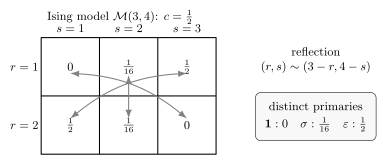
The Kac table describes holomorphic weights. Pairing each representation with the same antiholomorphic representation gives the three local diagonal Ising fields, with dimension and spin . The label reflection removes duplication; it does not identify the spin and energy fields.
The minimal-model representation classification is an all-level theorem, not a consequence proved by computing this small table. In the following calculation, we use the Ising spectrum and its quotient relations as inputs and derive a nontrivial correlator from them.
Ward identities separate kinematics from dynamics
Section titled “Ward identities separate kinematics from dynamics”For separated primary insertions in the plane vacuum, write
The stress-tensor Ward identity is
The OPE fixes the principal parts on the right. The vacuum behavior at infinity, in this correlator, removes the possible entire remainder. Expanding at large and setting the terms to zero gives
These are translation, dilation and special-conformal covariance. There is an analogous barred system. The assumptions about the vacuum and infinity matter: on a torus, in an excited state, or with boundaries, additional terms or data generally enter.
For two fields, translation leaves only the separation , and dilation fixes its holomorphic power to . The special-conformal equation then requires for a nonzero correlator; the barred equations similarly require . For equal weights , the result is
where is the constant two-point pairing within that weight sector. Unequal-weight sectors have zero pairing. For three fields, the equations fix the coordinate dependence to
where
and the barred exponents follow similarly. The special-conformal equation is essential; translation and dilation alone do not determine all three exponents.
The constants become OPE coefficients after accounting for the two-point pairing. If that pairing is , then
For unit-normalized, mutually orthogonal Hermitian fields, this distinction reduces to the usual identification. Symmetry fixes the coordinate dependence, while these constants are dynamical data.
Four points and the cross-ratio
Section titled “Four points and the cross-ratio”A Möbius transformation can fix three distinct points on the sphere. The map
sends to and sends to
The faithful transformation group is . The remaining parameter is generally complex. It cannot be removed by another map that leaves fixed.
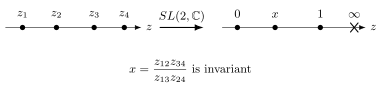
The map fixes three marked points and leaves one complex cross-ratio. Infinity is a point of the sphere, represented by the second coordinate chart. The displayed point configuration illustrates a complex value of ; the drawing is not a claim that all four points can be moved to the real axis.
An insertion at infinity includes a conformal factor. For the scalar spin field, define
The fixed-position four-spin function is
It still contains dynamics. If instead the full four-point function is written as
then . These are two choices of prefactor, not two different correlators.
A holomorphic conformal block organizes the contribution of an exchanged primary and all its Virasoro descendants. It is not generally single-valued by itself. The local correlator combines holomorphic and antiholomorphic blocks with coefficients determined by the spectrum and OPE data. We will determine that combination explicitly.
From the Ising null relation to an ordinary differential equation
Section titled “From the Ising null relation to an ordinary differential equation”The spin representation contains the level-two relation
in its irreducible quotient. The coefficient follows from , as derived on page 14. The local descendant is defined by
Deforming this counterclockwise contour onto the other insertions, with the minus from removing the contour around , gives
Thus the correlator satisfies the differential equation introduced by Belavin, Polyakov, and Zamolodchikov, usually called the BPZ equation
The radical relation actually decouples in the unitary Ising quotient. Merely finding an isotropic vector in an indefinite module would not justify this field equation.
To reduce the equation, first keep four positions finite and apply the global Ward identities. Only then take the fourth insertion to infinity and evaluate the others at . Consider the holomorphic part, with infinity factor and . Denote a resulting holomorphic solution by and the still-defined derivatives at the first and third insertions by . Translation and dilation give
In the second equation, the finite four-point dilation weight combines with to leave . Consequently,
These derivatives are not zero simply because the insertion coordinates have been fixed. Setting them to zero would discard the global covariance that compensates their motion.
The descendant insertion becomes
The fourth insertion’s contribution vanishes in the normalized infinity limit. The BPZ equation is therefore
Its regular singular points are the three collision limits of the four-punctured sphere. Near , the indicial roots are and , corresponding to exchanged weights and . Here we need the complete solutions, not only those local powers.
Solve and normalize the two blocks
Section titled “Solve and normalize the two blocks”Extract a symmetric prefactor,
Substitution gives
This is a hypergeometric equation, but its solutions can be obtained directly. On , put , with . The differential operator becomes
The equation is , so a convenient basis is
Choose these functions real and positive on . They define analytic germs there, which can then be continued along paths in the punctured plane. Equivalently, the displayed principal branches give a convenient initial domain cut along and . Analytic continuation along a loop must track those branches; reevaluating a principal square root independently at each point would erase the monodromy.
Their small- expansions are
Thus has unit leading coefficient in the identity channel, while has leading coefficient in the energy channel. The blocks with unit leading OPE coefficients are
Both bases are useful, but their coefficient matrices differ. A numerical coefficient multiplying a block has no invariant meaning until the normalization of that block has been specified.
The missing linear term in has a physical explanation: the identity module has no level-one descendant. Its level-two term also checks the normalization. The identity-channel OPE contains , and the stress insertion between the other two primaries contributes another factor . The block coefficient is therefore , exactly as above.
Monodromy determines the local pairing
Section titled “Monodromy determines the local pairing”Set . Choose a basepoint on and positively oriented loops around and , enclosing only their named puncture. A loop around multiplies the two leading powers by their respective phases:
The two local solutions have distinct exponents modulo integers, so this monodromy is diagonal in the chosen basis.
For , the half-angle formulas also give the exact connection relation
For example, replacing by replaces by . Expanding the new sine and cosine immediately gives . The identity extends by analytic continuation wherever the branches are connected to this interval.
A positive loop around is described in the local basis by the same phase matrix as a loop around zero. Returning to the basis gives
This loop mixes the two channels. A channel label is tied to an OPE region; it need not remain diagonal under continuation around another collision.
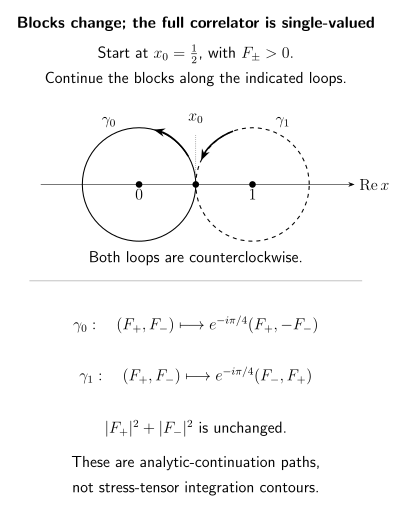
These are analytic-continuation paths in the cross-ratio plane, not stress-tensor integration contours. The basis is , with the energy-channel leading coefficient . Positive loops based on act by and and preserve . The paths are schematic and avoid both punctures.
The antiholomorphic equation has the conjugate solution space. A local scalar correlator can therefore be written, on the Euclidean slice , as
with a constant Hermitian matrix . Reality gives Hermiticity; the diagonal unitary spectrum gives a positive pairing. Single-valuedness requires
The first condition sets the off-diagonal entries to zero, because the two phases differ by a minus sign. The second sets the two diagonal entries equal. Hence . The leading identity OPE, fixed by , requires .
The resulting local correlator is
Although the individual blocks are multivalued, their combination is single-valued. The monodromies around and generate continuation around the punctures, so checking both is stronger than checking only the real interval. These results agree with the direct CFT derivation in Ginsparg, §5.2.
Crossing and the normalized OPE coefficient
Section titled “Crossing and the normalized OPE coefficient”The connection matrix is orthogonal, so
This is crossing between the and pairings of identical spins. It is an equality of full correlators, obtained by mixing their chiral blocks. Other permutations can change the fixed-position prefactor. In particular,
The factor follows from dilating the finite positions by and transforming the insertion at infinity. It also follows directly from the explicit correlator. Thus crossing does not mean that every arbitrarily prefactored function is invariant under every cross-ratio transformation.
In the unit-leading block basis,
The coefficient of the energy channel is , because the two-point functions are normalized to one. Consequently,
Choosing the sign of so that this coefficient is positive gives the leading local OPE
The first correction in the energy block, , is also consistent with the level-one descendant coefficient for two equal external weights. The two independent channel limits therefore check both the null equation and the normalization used to reconstruct the correlator.
Several assumptions entered this result: the diagonal local Ising spectrum, its decoupled null relation, vacuum Ward identities, the specified two-point normalizations, and locality under analytic continuation. A general minimal-model null equation can restrict possible blocks without determining all of these data on its own.
Exercises
Section titled “Exercises”1. Count the tricritical scalar fields
Section titled “1. Count the tricritical scalar fields”For , compute all inequivalent Kac weights, verify the reflection count, and determine which nonidentity diagonal scalar primaries are relevant perturbations in two dimensions.
Solution
Here and . The full table is
The twelve labels fall into six reflection pairs. No label is fixed because would not be an integer. The distinct weights are
A diagonal scalar has dimension . A coupling to its integral has mass dimension , so a nonidentity scalar is relevant when . The four relevant weights are . The field with has dimension three and is irrelevant. This counts relevance by dimension; additional symmetries can forbid particular perturbations.
2. Find the missing symmetry in a three-point function
Section titled “2. Find the missing symmetry in a three-point function”Show explicitly why translation and common dilation do not determine a three-point function. Then derive the exponents by imposing the special-conformal Ward identity on a product of powers.
Solution
Let . The function
is translation covariant and has the required common scaling for any function . Those two symmetries therefore leave functional freedom.
Now take . Applying the special-conformal generator and dividing by gives
The expression must vanish for arbitrary distinct points. Therefore
whose solution is the three-point form in the main text. Their sum also implies , as required by dilation. No independent rescaling of one insertion has been assumed.
3. Check a higher-descendant Ward insertion
Section titled “3. Check a higher-descendant Ward insertion”Derive the Ward operator for with . Apply it at to a holomorphic two-point function and check the result by expanding the stress insertion near .
Solution
The defining local contour has kernel . Removing the contour around introduces a minus sign. At another primary insertion, the double-pole residue differentiates that kernel. Thus
The vacuum condition makes the contour at infinity vanish. For a single other insertion and , let . Then , so
To check it, use the full Ward identity and set . The terms singular at give only and . The other insertion gives
The coefficient of is precisely the descendant insertion. Its sign would be wrong if the minus from contour deformation were omitted.
4. Map a genuinely complex configuration
Section titled “4. Map a genuinely complex configuration”Take . Find the map fixing the first, third and fourth points at and calculate . Determine how exchanging labels and transforms the cross-ratio.
Solution
The required map is
Its matrix has nonzero determinant two and can be rescaled to determinant one without changing the map. The remaining point is
Thus the canonical fourth-point geometry need not lie on a real line. Substituting the exchanged labels into the ratio gives
Together, permutations generate the six possible values
These are equivalent descriptions of the same unordered punctures, but a correlator with labeled fields must also transform its field labels and conformal prefactors. They are not six independent complex moduli.
5. Change block normalization without changing the correlator
Section titled “5. Change block normalization without changing the correlator”Use the unit-leading basis . Find its crossing matrix and the matrix of its local pairing. Verify crossing invariance and explain why assigning equal coefficients to and would fail.
Solution
Since with , its crossing matrix is
The same scalar correlator has pairing
Direct multiplication gives . The crossing matrix is not orthogonal with respect to the ordinary identity matrix in this normalization. Indeed,
Equal coefficients in the unit-leading basis would therefore violate crossing. The coefficient is required, and with unit-normalized external and exchanged fields it is . Rescaling a block changes this matrix, while rescaling the local field changes its two-point normalization as well. These two operations must not be conflated.
6. Complete the Ising fusion rules
Section titled “6. Complete the Ising fusion rules”Use the level-two null relation for the energy field, with and coefficient , to find the candidate weights in . Then use the spin null relation to find the candidates in . Impose the Ising spectrum and identify which coefficients are known to be nonzero.
Solution
If a degenerate field at approaches a field of weight at , write . Holding fixed when differentiating gives the indicial equation
For two energy fields, , so
The candidate exchanged weights are . Only zero occurs in the Ising table. The identity coefficient is nonzero because the energy two-point function is normalized and nonzero. Hence .
For the spin null relation colliding with an energy field, . It gives , corresponding to
Only the spin representation is allowed. The coefficient of this channel is nonzero because the four-spin calculation found ; the same normalized three-point function pairs with . Together with the two nonzero channels already obtained from the four-spin function,
These are statements about entire Virasoro families. The null equations supplied candidate weights, the chosen spectrum excluded the others, and normalized correlation functions established the nonzero coefficients. No one of these steps alone gives the full conclusion.
References
Section titled “References”- Belavin, Alexander A.; Polyakov, Alexander M.; and Zamolodchikov, Alexander B. “Infinite Conformal Symmetry in Two-Dimensional Quantum Field Theory.” Nuclear Physics B 241 (1984), 333–380. doi:10.1016/0550-3213(84)90052-X. Null-field equations and the conformal-block approach to minimal models.
- Ginsparg, Paul. “Applied Conformal Field Theory.” In Fields, Strings and Critical Phenomena, Les Houches Session XLIX (1988), edited by Édouard Brézin and Jean Zinn-Justin, North-Holland (1989), pp. 1–168. arXiv:hep-th/9108028, §§4.4–4.5, 5.1–5.3 and 9.7. Minimal-model realizations, the explicit Ising four-spin calculation, fusion rules, and the distinction between the diagonal and Potts theories at .