
NSR Vertex Operators and Picture Changing
A physical vertex operator combines a spacetime polarization with a worldsheet matter operator and the ghosts needed to impose the string constraints. In the RNS superstring, the superghost representation also has a picture. This extra label makes scattering calculations manageable, but it introduces two operations that must be distinguished: picture changing changes the superghost representation, while descent converts a fixed insertion into an integrated density.
We derive the massless vertices and use them to compute the open-string fermion–gauge-boson and three-vector couplings. The setting is flat, critical ten-dimensional string theory, initially with Neumann boundary conditions in all ten directions. The shared matter definitions, ghost and picture charges, and spacetime spinor definitions apply throughout. The previous page supplies the spin fields and their cocycles. Overall disk couplings, external-state normalization constants, and consistent overall cocycle phases will be suppressed; relative coefficients inside each vertex will be retained.
Boundary operators and the NS supermultiplet
Section titled “Boundary operators and the NS supermultiplet”Doubling fixes the momentum coefficients
Section titled “Doubling fixes the momentum coefficients”Write the bulk coordinate as . A Neumann boundary at real identifies , so the physical boundary coordinate and its plane wave are
Using the shared chiral propagator gives
The factor of two in the exponential is essential: is physical spacetime momentum. The boundary fermion below is the canonical doubled chiral field, whose OPE is still ; it is not doubled a second time.
For the NS vector, start with the fermionic matter operator
The weights are , , and . A weight-one density, or equivalently a weight-zero unintegrated vertex, requires . This weight condition does not yet test the polarization.
The supercurrent gives the second constraint and the descendant
Section titled “The supercurrent gives the second constraint and the descendant”Contract with . There are three contributions. Contracting both the fermion and the derivative gives a double pole. Contracting only the fermion leaves . Contracting only the derivative leaves the ordered bilinear . The result is
Thus makes a superconformal primary of weight , and has weight one. The same formula in terms of the boundary coordinate is
Every term in the brackets has dimensions of length when is dimensionless. In particular, changing from to changes the derivative coefficient relative to the fermion term. An overall vertex normalization cannot repair an incorrect relative coefficient.
As a comparison, the unprojected NS ground-state density is . Its weight-one condition is , or . This is the tachyon removed by the supersymmetric GSO projection. The weight calculation identifies the state; the GSO projection is a separate selection.
BRST completion and descent
Section titled “BRST completion and descent”A weight-one matter descendant is an integrated density, but multiplying it by does not always give the complete unintegrated vertex. Here the missing term can be found directly from BRST closure.
The BRST charge construction gives, on the physical supermultiplet,
The bracket is graded: is odd, and are odd, and and are even. Applying the graded product rule gives
Every term cancels in the sum. The complete zero-picture vertex is therefore
The term is essential to the operator equation. Its contribution can vanish in a particular correlator, but that requires a separate ghost-saturation argument. This completion is explicit in Berkovits, section 2, after translating his supercurrent phase to the shared definitions.
Integrating an insertion removes a reparametrization ghost
Section titled “Integrating an insertion removes a reparametrization ghost”Descent uses the residue of the antighost . Since has a simple pole with and is regular with the other displayed factors,
The identity implies for either density. Its integral is BRST invariant up to endpoint or moduli-boundary terms. Descent lowers ghost number by one, raises conformal weight by one, and preserves picture.
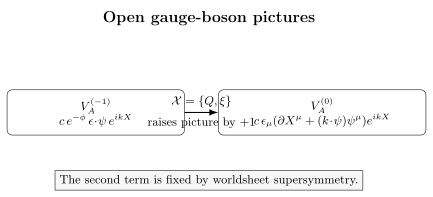
For the on-shell NS vector, phase-adjusted horizontal arrows preserve ghost number and change picture; vertical arrows are antighost residues and preserve picture. Each box gives the operator and its weight and ghost number . Horizontal arrows refer to the corresponding physical classes with the appropriate finite-product and descent prescription, not to unrestricted multiplication of local fields. The diagram has no geometric scale.
Longitudinal polarization is a gauge direction
Section titled “Longitudinal polarization is a gauge direction”Set . The fermion bilinear vanishes, and . Consequently,
The second identity follows from at . It makes the gauge identification explicit. At a fixed nonzero null momentum, transversality leaves nine components and this quotient leaves eight physical vector polarizations.
Picture changing in the small Hilbert space
Section titled “Picture changing in the small Hilbert space”The previous page explains why the physical state space omits the zero mode . Nevertheless, is a useful auxiliary field for constructing the picture-changing operator
The terms follow from the BRST current as follows: produces ; produces ; and the contraction of with gives the last two terms. A derivative contraction gives a double pole, whose residue differentiates the remaining product. These signs use the ordered ghost products fixed in the overview.
Each term has weight zero, ghost number zero, and picture . For example, has picture despite containing no exponential. The full picture current, rather than the exponential alone, supplies this grading.
Nilpotence and the graded Jacobi identity give . The state map at fixed is
It is not a gauge transformation inside a single fixed-picture complex. For a closed small-space state , the apparent primitive is inadmissible because . Thus writing the map as a BRST commutator in the large space does not make it trivial in the small space.
At fixed nonzero momentum, the chiral relative cohomologies defined using are picture-isomorphic in both NS and R sectors; the corresponding closed-string statement preserves . For BRST-closed relative states, also imposes . No additional restriction is included in this particular theorem. Its proof and its zero-momentum limits are discussed on page 31 and by Berkovits and Zwiebach, section 2.
For local operators, one instead specifies a finite OPE product. The factor cancels the simple pole in . Moving the odd past the odd supplies a minus sign. With the ordering used above, the full calculation gives
The matter contribution to the first line is . Expanding the differentiated ghost term in , the finite contractions of and give and respectively; the remaining terms vanish in this finite product. Thus the relative plus sign inside is preserved. We have chosen its common overall phase so that its matter descendant is .
The density map needs a correction:
Indeed, cancels the extra term. Equivalently, the local antighost residue obeys , so picture changing and descent do not commute as bare local products. The general corrected density prescription is derived by Fuchs and Kroyter, equations (8.25)–(8.27). The phase-adjusted horizontal maps in the figure include this prescription.
Moving an insertion is a local statement
Section titled “Moving an insertion is a local statement”Away from singularities,
For a fixed surface with BRST-closed external states, this gives the usual local argument for independence of the PCO position. With moduli integration, moving the BRST contour through an antighost insertion uses and produces a derivative on moduli space. Such derivatives can have boundary contributions.
PCO collisions, spurious singularities, and the joining of local prescriptions therefore require care. Sen and Witten explain how correction terms join prescriptions on different moduli patches; degeneration limits require additional conditions. Elementary separated tree insertions provide useful calculations, but tree topology alone does not justify every collision or contour deformation.
Ramond vertices and spacetime supersymmetry
Section titled “Ramond vertices and spacetime supersymmetry”Let create the spinor basis state , so a polarization column gives . The canonical open Ramond vertex is
The weights cancel , leaving the mass-shell condition . The supercurrent supplies the spinor constraint. From the canonical spin-field OPE,
and the derivative contraction with ,
Here . Multiplication by in the BRST current supplies a factor from the ghost exponential, leaving a simple pole. BRST closure therefore requires
The GSO projection chooses a Weyl subspace of dimension 16. At nonzero null momentum its Dirac kernel has dimension eight. These are eight complex polarization amplitudes at fixed momentum; the reality of a spacetime Majorana field relates conjugate Fourier modes and does not halve the count again. In this canonical picture there is no further quotient by .
Spin currents generate spacetime supersymmetry
Section titled “Spin currents generate spacetime supersymmetry”At , the dressed spin field is a dimension-one current,
For the mutually local GSO-selected fields, this odd charge changes NS states into R states and conversely. The vector term in the spin-field product has power ; the ghost product adds . Together they give a simple pole,
With a consistent spin-field two-point normalization encoded by , contour integration gives an anticommutator proportional to the picture-minus-one translation current. It remains to identify the ordinary translation generator.
This last step can be done directly, without applying a nonzero-momentum theorem at . Put and . Its descended picture change is
In the first line, and integration by parts have been used. The finite product contains ; it cancels . The matter pole supplies the second line. Acting on , the resulting charge gives , so it is proportional to spacetime momentum. Constant rescaling of the supercharges and momentum gives the usual supersymmetry algebra. The RNS representatives close up to picture changing, as emphasized by Friedan, Martinec, and Shenker, section 6, and Berkovits.
Tree insertions and the two ghost requirements
Section titled “Tree insertions and the two ghost requirements”A scattering prescription must satisfy both the reparametrization-ghost zero modes and the superghost picture condition. These are independent requirements.
On the disk, fixes three real boundary positions. Three unintegrated open vertices supply the three insertions; each remaining boundary position is integrated using its descended density. The doubled chiral ghost system requires total picture . On the closed sphere, three complex positions are fixed, giving three and three insertions, and the pictures sum to separately on the two sides. The background-charge derivation is on the previous page.
For an ordered four-vector disk amplitude, one valid choice is
The pictures are and ghost numbers . The part of the last vertex would leave only two insertions, so its correlator vanishes here. It remains part of the BRST-complete operator.
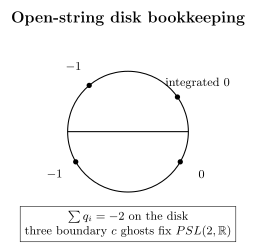
A four-vector disk amplitude has one real modulus . The three fixed punctures carry ghosts; the moving puncture carries a descended density. The indicated pictures sum to . The real boundary is shown in an upper-half-plane coordinate; infinity is the added point that compactifies the real boundary, drawn at the right edge. Distances are schematic.
For NS and Ramond open insertions initially in canonical pictures, the total is . If these are raised using PCOs, the required number is
This count assumes an allowed spin structure and picture assignment; in particular ordinary amplitudes with open spacetime fermions have even . It does not specify safe PCO locations. The two-fermion, one-vector amplitude has , , so canonical pictures already satisfy the rule.
Two fermions and one gauge boson
Section titled “Two fermions and one gauge boson”Consider three distinct finite boundary points in a fixed cyclic order, with incoming momenta satisfying
The last equations follow by squaring the sum of each pair. Nonzero three-point couplings are understood by analytic continuation: real Lorentzian massless three-point momenta are collinear and give degenerate scattering kinematics.
Insert two Ramond vertices in picture and a vector in picture . Suppressing the overall normalization and momentum delta function, the ordered correlator is
Write , with branches chosen consistently for the fixed boundary ordering. The exponential correlator is
The momentum zero mode still supplies the omitted delta function. The nontrivial position dependence comes from the spin fields and ghosts.
The spin-field tensor and its powers
Section titled “The spin-field tensor and its powers”Conformal covariance fixes a three-point function of weights to have pair powers , , and . Substituting gives
up to the consistent overall ordering phase already suppressed. The tensor coefficient follows by taking the OPE and using the spin-field two-point pairing. The is required by the canonical Clifford normalization. Powers alone would not determine either the matrix coefficient or the cocycle phases.
The bosonized charges also explain the chirality selection. If the vector fermion carries charge , neutrality requires . The spin charges are equal in component and opposite in the other four components, so . The two open fermions have the same ten-dimensional chirality, as required for the gauge multiplet. Exercise 3 makes this selection and the charge count explicit. The spin correlator is derived in Friedan, Martinec, and Shenker, section 5.4.
All separation powers cancel
Section titled “All separation powers cancel”The ghost factors are
Multiplying them by the spin correlator cancels each separation independently. The result is
The spinor contraction is bilinear in polarization coordinates; no complex conjugation is inserted into this analytic amplitude.
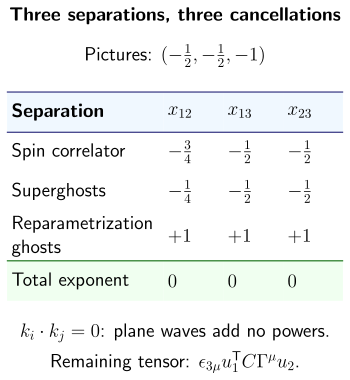
At massless three-point kinematics, the plane-wave powers vanish. The displayed exponents therefore account for every position power in the ordered correlator with pictures . Their column sums are zero; the remaining amplitude is the spinor–vector tensor contraction and its color factor. The table gives exact exponents, not a geometric scale.
Gauge invariance now follows from the two Dirac equations. Replacing by gives
The transpose identity for is essential to the first term. The second term vanishes directly on .
For an oriented stack with Chan–Paton matrices, the fixed order gives the displayed trace. Combining the appropriate orderings and fermion exchange signs produces the adjoint color coupling associated with . Together with the three-vector calculation in Exercise 4, this identifies the cubic interactions of ten-dimensional super Yang–Mills theory. Determining the absolute relation between and also requires the disk and external-state normalizations.
Closed-string products and independent pictures
Section titled “Closed-string products and independent pictures”A bulk plane wave is
It uses , not the boundary factor , in each chiral exponential. The canonical NSNS vertex is
Each side separately imposes the massless condition and transversality,
with gauge shifts , where . On the physical transverse space, the symmetric traceless, antisymmetric, and trace parts give the graviton, two-form, and dilaton. Exercise 5 constructs that transverse trace explicitly.
The left zero-picture matter factor, with its plane wave understood, is
Its right counterpart is obtained by tilding the fields. The integrated matter density is . Complete unintegrated factors contain the corresponding completions as well. The fermion coefficient is half the open-string coefficient because has half the boundary contraction.
Holomorphic and antiholomorphic picture maps change their own slots:
Both are needed to reach . For example, two fixed NSNS vertices in , a third fixed vertex in , and any further integrated densities satisfy the sphere picture and requirements.
For the canonical R–R state, use the bispinor polarization in the state basis of page 30:
The form-valued Clifford matrix is . Its two constraints encode the free Bianchi identities and field equations at nonzero null momentum. The symmetric-picture vertex therefore describes field strengths. IIA has independent degrees two and four; IIB has degrees one, three, and a self-dual five-form, with the dual degrees determined accordingly. The form decomposition, chirality signs, and physical counts are derived on page 30. Potential representatives in other pictures require their own cohomological analysis.
Common pitfalls
Section titled “Common pitfalls”Dropping a ghost term before choosing an amplitude. The complete vector is . A three- saturation argument may remove the second term from a specified correlator; it does not remove it from the BRST operator equation.
Identifying picture changing with descent. Picture changing preserves ghost number. Descent removes through an antighost residue and turns a fixed insertion into a density to be integrated.
Using charge balance as the entire amplitude prescription. Picture balance does not fix the zero modes, integration region, cocycle phases, or allowed PCO locations. The explicit three-point calculation works because all of these ingredients have been specified.
Exercises
Section titled “Exercises”Exercise 1: the boundary superspace interaction
Section titled “Exercise 1: the boundary superspace interaction”Let , , and . Using left odd derivatives, evaluate
Show that it gives , and rewrite its fermion term using . Also evaluate the top component of and identify the mass shell of the associated unprojected tachyon.
Solution
The boundary superfield is twice the chiral superfield, which explains . Expanding with on the left,
In the product, moving past gives one minus sign, and exchanging with gives another. Thus
Berezin integration and multiplication by give exactly the boundary expression for . Since
one can also write
The superspace integral has combined the gauge-potential coupling and its required fermionic partner. A longitudinal polarization has and gives a total derivative.
For the tachyon superfield, the top component is . Up to a constant sign it is . Its weight is , so an integrated weight-one interaction requires . Equivalently, has weight one on this mass shell. The state is removed in the supersymmetric GSO projection; worldsheet superspace by itself does not remove it.
Exercise 2: solve for the ghost completion
Section titled “Exercise 2: solve for the ghost completion”Start with , with constant . Determine from the BRST transformations in the text. Derive both the descent equation and the explicit longitudinal gauge parameter, then explain why neither derivation requires an inverse picture-changing operator.
Solution
The two variations displayed above give
The independent ghost structures force for a general physical matter multiplet. Merely checking conformal weight would not fix this coefficient: both candidate terms already have weight zero and ghost number one.
The residue is . Direct differentiation gives
This is the descent equation. Under , the gauge parameter is the small-space ghost-number-zero, picture-zero operator
All identities follow from the BRST differential and the antighost residue within a fixed picture. They neither identify different-picture complexes by a gauge transformation nor assume a local inverse for .
For an integrated insertion on an interval, is an endpoint term. In a scattering prescription those endpoints can be collision or factorization limits, so its cancellation is a statement about the full amplitude rather than an automatic property of one interval.
Exercise 3: enumerate the spin-field coupling
Section titled “Exercise 3: enumerate the spin-field coupling”Take spin weights and a vector weight . Count the ordered neutral triples . Determine the chirality of the two spin fields, derive all separation powers from bosonization, and find how many triples involve each chosen Weyl chirality. Explain what this count does not fix about the amplitude.
Solution
For a fixed and sign of , neutrality fixes
The remaining four are free, giving pairs. There are ten vector weights, hence ordered triples. Eight pairs for each vector weight have each chirality, so each Weyl sector contributes 80 triples.
The chirality product changes sign in four places:
Thus the two spin fields have the same chirality. In the fixed pairing used on page 31, their absolute chirality is ; the present argument needs only its equality for and .
Free-boson contraction gives the three powers
The ghost charges give powers . Adding the -ghost power in each pair gives zero. This independently reproduces the conformal-weight calculation in the text.
The count enumerates nonzero weight-basis components before imposing momentum-dependent Dirac polarizations; it is not a count of physical scattering states. It also does not fix cocycle phases, the Clifford normalization, color ordering, or the disk coupling. Those require the normalized operator construction and amplitude prescription.
Exercise 4: derive the complete three-vector coupling
Section titled “Exercise 4: derive the complete three-vector coupling”At three distinct finite boundary points, compute the ordered disk amplitude in pictures . Verify position independence and all three gauge Ward identities. Explain why the bosonic-string cubic-momentum structure associated with is absent from this superstring three-point amplitude.
Solution
Three fixed vertices supply the three zero modes, so only the part of contributes. With ,
All pairwise vanish at massless three-point kinematics, so the plane-wave factor is one. Put . The derivative part of gives
Momentum conservation and imply . The expression in positions then reduces to , giving
For the other term, preserve the ordering . The normal-ordered fields at point 3 do not contract with each other. The four-fermion Wick contraction is
Its denominator cancels the remaining ghost factor. Combining the two contributions and using transversality gives
There are no remaining positions. Up to the common normalization, this is the color-ordered Yang–Mills cubic vertex. For , its middle term vanishes and the other two sum to
Cyclic symmetry proves the other Ward identities. Reversing the relative sign of the fermion term in would spoil this cancellation.
Every contribution here contains exactly one momentum. In the bosonic string, three derivative vertices also allow all three derivatives to contract with exponentials, producing a cubic-momentum term proportional to and the corresponding interaction. The present superstring correlator has no such term: two vertices contain only and the third contains either one derivative or one momentum-weighted bilinear. The exact three-point result therefore has no on-shell coupling. This does not exclude higher-derivative interactions first visible at four points, such as terms.
For real Lorentzian three-point momenta, collinearity makes vanish. Complex momenta or analytic continuation retain the nontrivial cubic tensor that determines factorization and the local interaction.
Exercise 5: the physical dilaton and the two picture slots
Section titled “Exercise 5: the physical dilaton and the two picture slots”For nonzero null , choose null with . Construct a rank-eight projector orthogonal to both. Use it to normalize the dilaton polarization, show that changing changes only a gauge representative, and count the graviton, two-form, and scalar polarizations. Finally determine the result of applying only the holomorphic picture map to the canonical NSNS vertex.
Solution
Define
The null conditions and give , , and . Hence
If is replaced by another admissible , then and
This is precisely an allowed NSNS gauge shift. By contrast, alone is not transverse and is not a physical scalar polarization at nonzero .
The physical tensor space is . Its symmetric traceless part has components, its antisymmetric part has , and its trace has one. Their sum is 64. These counts apply after the gauge quotient, not to an arbitrary unconstrained ten-dimensional tensor.
The holomorphic map raises only the first picture slot. The result is a representative: its left factor contains the complete zero-picture combination , while its right factor remains , all multiplying in the chosen ordering. An antiholomorphic map is still required to reach .
Exercise 6: one closed NSNS state and two open fermions
Section titled “Exercise 6: one closed NSNS state and two open fermions”For a disk with one bulk NSNS puncture and two boundary Ramond punctures, count the real moduli and the required insertions after doubling. Starting from canonical pictures, determine the number of PCOs. Give one consistent fixed/integrated prescription and explain why it is not yet a calculation of the amplitude.
Solution
The bulk puncture has two real coordinates and the two boundary punctures have one each. Dividing by the three-dimensional group leaves
real modulus. Locally, one may fix the bulk puncture at and one boundary puncture at , leaving the other boundary position to be integrated over the appropriate ordered domain.
The fixed bulk vertex supplies , which after doubling is a pair of insertions in the same chiral system. The fixed boundary vertex supplies the third . The moving Ramond puncture uses its descended density , with no . Thus the reparametrization-ghost requirement is satisfied.
Canonical pictures give from the two closed factors and from the open factors, totaling after doubling. One picture-raising operation is required. For example, choose the closed vertex in and both open fermions in :
The fixed/integrated assignment and the picture assignment solve different constraints. One may represent the picture shift by a separated PCO before choosing a valid finite-product prescription at a puncture. This count does not determine safe placement over the entire modulus interval, collision contributions, reflection matrices for other boundary conditions, spinor contractions, the integration domain’s factorization limits, or the disk normalization. Those are ingredients of the amplitude still to be worked out.
References
Section titled “References”- Berkovits, Nathan. “Manifest Spacetime Supersymmetry and the Superstring.” Journal of High Energy Physics 2021, no. 10 (2021), 162. doi:10.1007/JHEP10(2021)162, arXiv:2106.04448. Section 2 displays the complete RNS vector and the role of picture changing in the supersymmetry algebra.
- Berkovits, Nathan, and Barton Zwiebach. “On the Picture Dependence of Ramond–Ramond Cohomology.” Nuclear Physics B 523 (1998), 311–343. doi:10.1016/S0550-3213(98)00132-1, arXiv:hep-th/9711087. Section 2 establishes the nonzero-momentum picture isomorphisms with specified cohomological restrictions.
- Friedan, Daniel, Emil Martinec, and Stephen Shenker. “Conformal Invariance, Supersymmetry, and String Theory.” Nuclear Physics B 271 (1986), 93–165. doi:10.1016/0550-3213(86)90356-1, author-hosted article. Sections 5–6 develop the covariant vertices, spin-field correlators, and spacetime supersymmetry currents.
- Fuchs, Ehud, and Michael Kroyter. “Analytical Solutions of Open String Field Theory.” Physics Reports 502 (2011), 89–149. arXiv:0807.4722, published article. Section 8.1 fixes the ordered ghost products and the descent correction to picture changing an integrated density.
- Sen, Ashoke, and Edward Witten. “Filling the Gaps With PCO’s.” Journal of High Energy Physics 2015, no. 9 (2015), 004. doi:10.1007/JHEP09(2015)004, arXiv:1504.00609. The introduction and section 2 explain why local PCO prescriptions need compatible gluing and separate control of degeneration limits.