
Mode Expansions and Canonical Quantization
A free string has infinitely many normal modes. Quantizing these modes gives the oscillator algebra from which string states are built. The boundary conditions determine whether there are two independent families of traveling waves or one family of standing waves; the worldsheet constraints determine which combinations can describe physical states.
This page develops the canonical quantization of the embedding fields in flat spacetime. It builds on conformal gauge and boundary conditions and uses the global conventions. The Fock space constructed here includes negative-norm states. Selecting the physical space is a further step, developed in Virasoro constraints and the spectrum.
Closed-string waves and their zero modes
Section titled “Closed-string waves and their zero modes”The conformal-gauge action and its canonical momentum density are
The equation of motion is . On a closed string, its solutions separate into waves of the two null coordinates:
A fixed phase of a function of moves toward decreasing ; a fixed phase of a function of moves toward increasing . These descriptions concern propagation along the string, not motion in target space.
For a noncompact target coordinate, periodicity forbids a net term linear in . The expansion is
The label belongs to , and belongs to . The zero modes can be split as
Assigning half of to each expression is convenient; it does not introduce two independent center-of-mass positions. Likewise, the noncompact left and right zero-mode momenta are equal. Compact directions admit winding and require a different zero-mode split, worked out in Exercise 3.
The total target-space momentum checks the coefficient of :
Reality of the classical field, or Hermiticity after quantization, requires
It is useful to include the momentum in the oscillator notation:
All are dimensionless. The two nonzero-mode families are independent before the physical constraints are imposed.
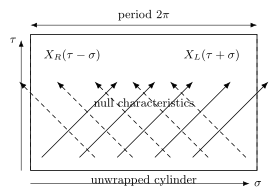
Constant-phase characteristics on a local unwrapped-cylinder patch. Future worldsheet time points upward. The left-moving family depends on , whereas the right-moving family depends on . The Wick-rotation dictionary shown below the diagram is derived in the cylinder-to-plane discussion. The worldsheet drawing is schematic.
Deriving the closed-string oscillator algebra
Section titled “Deriving the closed-string oscillator algebra”Canonical quantization begins with the equal-time relations
where the periodic delta distribution is
To derive the oscillator normalization rather than guess it, take Fourier coefficients at :
The different prefactors ensure
In particular, and , so . The Kronecker delta involves because both Fourier transforms used the same sign in the exponential.
For , the field expansion gives
Solving these two equations gives the inverse transformation:
Only the cross commutators between and contribute. For example,
The same calculation for the other family, and cancellation between its mixed terms, yield
The nonzero oscillators commute with and . The appearance of follows from raising the momentum index with the target metric; replacing it by a positive Euclidean metric would change the theory.
Oscillator levels and the indefinite Fock space
Section titled “Oscillator levels and the indefinite Fock space”For each , define . Then
The oscillator vacuum at momentum obeys
Products of negative-index oscillators generate the matter Fock space. For a spacelike coordinate this is the familiar harmonic-oscillator construction. For the timelike coordinate, however,
Here one may use wave packets to remove the delta-function normalization of momentum eigenstates. This negative norm is a feature of the covariant, unconstrained state space. Quantizing free fields has not yet established a unitary physical string theory.
The level operators are
They are weighted occupation operators, not simply the number of creation operators. Indeed,
For spacelike oscillators, . The covariant operator continues to grade every creation operator by its mode number, even though the inner product is indefinite. Thus and both have level two.
Neumann open strings and the interval delta function
Section titled “Neumann open strings and the interval delta function”An open string with Neumann conditions at both ends has standing waves. The chiral derivative matching derived on the previous boundary-condition page leaves one periodic oscillator family, giving
The cosine modes make at . The shorter integration interval explains the factor two in the zero mode:
The canonical delta function must now reproduce functions on the interval. The orthonormal Neumann eigenfunctions are
Consequently,
The equality is distributional: integration against a suitable Neumann mode expansion reproduces that function. The spectral definition fixes the endpoint prescription, with no extra factor of one-half inserted by hand. Exercise 2 relates this kernel to reflection across the ends of the interval.
Define canonical mode coordinates and momenta at by
Orthonormality gives . Here denotes a mode momentum; the total target momentum is without a mode index. In particular, and .
For , direct projection of the open-string expansion gives
Thus
and the canonical brackets imply
The full open-string oscillator algebra therefore has the same form as one closed-string chiral algebra. Its zero-mode normalization is different, and there is no independent tilde family.
From local constraints to Virasoro modes
Section titled “From local constraints to Virasoro modes”The oscillator expansion turns the local conditions into algebraic conditions on infinitely many Fourier coefficients. For the closed string,
Squaring the series defines the classical generators:
The have dimensions of length squared in these dimensionless worldsheet coordinates; are dimensionless. Fourier inversion, including the tension, reads
For the open string, differentiation of the cosine expansion gives the same two derivative formulas with a single family and the open-string value of . Both components of the constraint therefore involve the same . A correct interval inversion combines both halves of the doubled string:
One chiral integral over half the circle would not isolate an arbitrary integer Fourier mode. Classically all these constraint modes vanish.
Normal ordering and the central term
Section titled “Normal ordering and the central term”The quantum products require normal ordering. Moving positive-index oscillators to the right gives the plane-vacuum prescription for this free theory:
In particular, the two halves of the nonzero-mode sum combine into , so
| String sector | Zero mode | Plane generator |
|---|---|---|
| Closed, holomorphic | ||
| Closed, antiholomorphic | ||
| Open, Neumann |
No intercept has been subtracted in these definitions. The oscillator algebra gives
as derived in Exercise 4. Applying this relation twice shows that commutes with every oscillator. Its possible vacuum contribution is the central term.
For , evaluate the commutator in the formal oscillator vacuum. The only terms in contain two creation operators, with mode numbers and . Contracting these with gives
with unit oscillator-vacuum normalization. The double target-index contraction is : the timelike boson contributes to the central charge despite its negative-norm excitations. The result is
Closed strings have a commuting tilde copy. Open strings have one copy. This is the matter Virasoro algebra, with . It already shows why one cannot require every , positive and negative, to annihilate every physical state: the central term obstructs that prescription. Constraints must be imposed with the quantum state-space construction taken into account.
The Euclidean cylinder and the complex plane
Section titled “The Euclidean cylinder and the complex plane”The chirality labels are tied to the analytic continuation. Under
we have the exact mode and derivative dictionary
Thus are holomorphic and antiholomorphic. Choosing the opposite Lorentzian assignment without changing the complex coordinate would exchange these labels inconsistently.
The cylinder is mapped to the punctured plane. A constant- circle has radius , and increasing runs counterclockwise. The infinite past maps to the origin; the infinite future maps to infinity. This turns Euclidean time ordering into radial ordering.
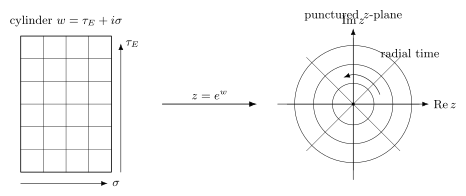
The map sends closed-string spatial circles to concentric circles with . The three labeled radii are exact; the cylinder drawing is schematic. The origin is a limiting puncture at , not a finite-time point on the cylinder.
The continued closed-string field becomes
Differentiating, including the momentum as the term, yields
Substitution in the normalized plane stress tensor reproduces precisely the oscillator generators:
The contour is counterclockwise. The factor of in is necessary: its square cancels the minus sign in . Before quantum normal ordering, the Lorentzian quantity continues to . The quantum stress tensor on the cylinder also contains a vacuum shift, discussed below.
For the open string, the same exponential maps the strip to the upper half-plane. Its two edges map to the positive and negative real axes. Neumann reflection extends the holomorphic derivative through the boundary, so the doubled description has one chiral oscillator family. This is a relation between derivatives; it does not equate open- and closed-string center-of-mass normalizations.
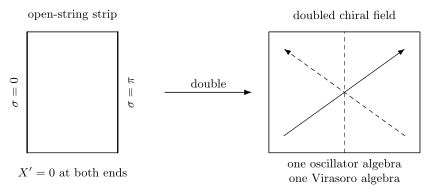
Under , a constant-time open-string slice becomes an upper semicircle. The dashed lower semicircle is its reflected continuation, not an additional physical string. Neumann derivative gluing leaves one family and one Virasoro algebra. The geometry is schematic and the open zero-mode coefficient remains .
Plane ordering, cylinder energy, and the physical intercept
Section titled “Plane ordering, cylinder energy, and the physical intercept”Three quantities that can contain constant shifts must be distinguished. First, the plane generator defined above has in a closed-string chiral sector. Its oscillator vacuum has .
Second, the cylinder stress tensor transforms with the Schwarzian derivative:
For , , and hence
The matter contribution to the dimensionless worldsheet-time translation generator is therefore
These are worldsheet generators, not the target-space energy . The negative constant is the matter Casimir energy in these coordinate units. The anomalous transformation and its relation to vacuum energy are developed in Tong, Section 4.4.1; Exercise 6 evaluates the shift directly for our complex coordinate.
Third, the physical intercept appears when imposing the quantum string constraints, conventionally written
with another set for closed strings. For the critical bosonic string, consistency gives and . One cannot infer this by setting : at , that matter-cylinder shift is , not . The physical construction removes longitudinal excitations and includes the gauge constraints; in light-cone quantization the corresponding transverse zero-point sum gives . Deriving why these constructions agree belongs to the subsequent treatment of physical states and the critical dimension, not to the canonical brackets alone.
The early operator approach is developed in the original analysis of Goddard, Goldstone, Rebbi, and Thorn. Tong, Sections 1.4 and 2.1, provides a complementary account of the mode expansion and the covariant oscillator construction.
Exercises
Section titled “Exercises”1. Recover traveling waves from initial data
Section titled “1. Recover traveling waves from initial data”For one nonzero integer , suppose the classical closed-string initial data are
Here are real target-space vectors with dimensions of length. Determine and . Find the condition for a purely left-moving nonzero-mode wave and check it directly in the initial data. No Virasoro constraint is assumed in this exercise.
Solution
The positive-index Fourier coefficients are
The second formula follows from and . Inserting these coefficients into the canonical inverse transformation gives
The negative-index coefficients are the complex conjugates. A purely left-moving wave has , requiring
At these relations give
This is the correct relation for a function of . A purely right-moving wave instead has , , so . These are solutions of the wave equation; generic choices still need not satisfy .
2. Derive the reflection kernels
Section titled “2. Derive the reflection kernels”Show that the Neumann interval kernel can be written as
Find the corresponding Dirichlet kernel using an odd reflection. Check Neumann reproduction at both endpoints for .
Solution
Adding the two periodic Fourier expansions and using
gives
This is the even-reflection kernel. Subtracting instead yields the odd-reflection kernel
It reproduces the Dirichlet sine expansion and has no constant mode. It vanishes when either argument is an endpoint, as appropriate for fields whose endpoint values are fixed.
For the specified Neumann function, orthogonality on gives
The endpoint values are and , with their full coefficients. In the image representation, the two coincident image contributions at a boundary implement this same spectral prescription. One must not apply another ad hoc endpoint factor after using the cosine completeness relation.
3. Include a compact direction and winding
Section titled “3. Include a compact direction and winding”Let a spatial target coordinate satisfy , with integer momentum quantum number and winding number . Derive its left and right zero-mode momenta, and find the level-matching condition when the left and right physical intercepts are equal.
Solution
A center-of-mass wavefunction must be periodic under . Thus is single-valued only if , with . Winding means
The zero-mode solution is therefore
Matching the coefficients of and gives
Consequently and . The remaining noncompact momenta cancel from the difference of the two generators:
Equal physical intercepts require this difference to vanish, giving
For example, requires . The sign follows from associating with and from the stated positive winding orientation. Reversing either naming convention changes the displayed sign but not the physical matching condition. When , the ordinary equality is recovered.
4. Show how Virasoro generators act on oscillators
Section titled “4. Show how Virasoro generators act on oscillators”Derive . Use it to compute the eigenvalue of the closed-string chiral state . Explain why this is a level statement rather than a physical-state test.
Solution
Normal-ordering subtractions are constants and do not affect a commutator with a single oscillator. Thus
The first term survives at and contributes . The second survives at and contributes the same amount. Therefore
For and negative oscillator indices,
Since , the state has eigenvalue
It contains two creation operators but has level three. It need not satisfy the positive-mode Virasoro conditions, a mass-shell condition, or closed-string level matching with an antiholomorphic sector. Those are additional requirements on physical states.
5. Express the rotating string in oscillator variables
Section titled “5. Express the rotating string in oscillator variables”For the classical rotating open string
with , find the nonzero oscillators. Check all classical Virasoro constraints and relate to the angular momentum found on the rotating-string page.
Solution
The zero modes are and , so
Matching the coefficients of gives
The coefficients are their conjugates; all coefficients vanish. Therefore
The zero-mode constraint is
The remaining possible nonzero constraints are
The last equality uses the relative factor of between the two spatial oscillators: their squares cancel. Higher modes vanish because no pair of nonzero oscillator indices can sum to them. Thus all vanish.
The classical angular momentum is , so . This is a relation among classical amplitudes. It does not assert that the solution is an exact oscillator-number eigenstate or add a quantum intercept to the classical trajectory.
6. Compute the cylinder vacuum shift
Section titled “6. Compute the cylinder vacuum shift”Evaluate the Schwarzian derivative for . Determine the matter vacuum value of the chiral cylinder generator and the change produced by . Explain why setting does not identify the matter-cylinder shift with the bosonic physical intercept.
Solution
All derivatives of equal , so
Consequently the chiral cylinder zero mode is . In the plane oscillator vacuum with , its value is ; adding changes it to . The excitation gap is still two. For a closed string with both sectors in their oscillator vacuum, the combined constant is . A single chiral excitation by itself is only a kinematic example and need not satisfy closed-string matching.
One can check the constant without invoking the transformation law. Point-split one free boson by a small separation in . Transforming the plane two-point function gives
Subtract its local singular part and multiply by from the stress tensor. Since
the finite expectation value is per boson. A target-index contraction gives for the covariant matter system.
At , this number is . The physical condition involves with , obtained after treating the worldsheet gauge constraints consistently. Matter-cylinder vacuum energy, plane ordering, and the physical intercept answer different questions and must not be substituted for one another.
References
Section titled “References”- Goddard, Peter; Goldstone, Jeffrey; Rebbi, Claudio; and Thorn, Charles B. “Quantum Dynamics of a Massless Relativistic String.” Nuclear Physics B 56 (1973), 109–135. doi:10.1016/0550-3213(73)90223-X. The original systematic operator treatment of the relativistic string and its consistency conditions.
- Tong, David. String Theory. University of Cambridge Part III Mathematical Tripos lecture notes (2009), arXiv:0908.0333, version 3 (23 February 2012). Full text. Sections 1.4 and 2.1 cover mode expansions and covariant quantization; Section 4.4.1 explains the cylinder Casimir shift, and Sections 4.5.1–4.5.2 develop radial quantization and the Virasoro algebra. Complex-coordinate and chiral-label choices must be translated when comparing formulas.