
Near-Extremal D3-Branes and Entropy
How many thermal states are associated with a stack of D3-branes? At weak coupling we can count the physical gauge, scalar, and fermion modes. At strong coupling the same question becomes a horizon-area calculation. In the planar limit, at the same temperature and spatial volume, the two calculations give
This page derives the gravitational answer, explains what is held fixed in the comparison, and computes the leading correction at large ‘t Hooft coupling. The difference between the coefficients is a physical interaction effect: ordinary thermal entropy is not protected by supersymmetry. The calculation uses the shared Einstein-frame normalization, RR fields and source signs, and D3 gauge-coupling dictionary. The extremal geometry and its flux normalization were derived on the supergravity brane page.
The charged black D3-brane geometry
Section titled “The charged black D3-brane geometry”An extremal D3-brane has a mass fixed by its RR charge. Heating it means adding energy at fixed charge. The exact asymptotically flat black-brane family is useful because it distinguishes this operation from changing the number of branes.
Let locate the horizon and let be a dimensionless charge parameter. Introduce the derived quantities
Here is the radius fixed by the extremal D3 charge, so . At fixed , , and , it is that stays fixed. The relation between the harmonic coefficient and this charge is
Thus only at extremality. The metric is
The shifted dilaton is , so the asymptotically normalized Einstein metric here equals the string metric. The worldvolume time and spatial coordinates are normalized by the flat metric at infinity. Densities below are per coordinate volume .
The flux measures q, not h
Section titled “The flux measures q, not h”With all other form fields vanishing, a local electric potential that vanishes at infinity is
The magnetic flux requires additional potential patches; the displayed supplies the electric part. In a Euclidean calculation a gauge regular at the horizon instead sets the electric potential there to zero. This additive change does not change .
The Hodge dual contains a factor , while the factors of cancel between the time and radial metric components. Consequently, the coefficient of the outward unit-sphere volume form is
Using the shared orientation and positive D3 source coupling, this gives
The negative sign is the consequence of the specified Lorentzian Hodge star and outward normal orientation, not a negative value of . Both the and in the potential are required. Replacing by while keeping arbitrary would change the exact physical charge to .
The IIB five-form is self-dual. One varies its pseudo-action with the half-strength kinetic coefficient and then imposes ; substituting self-duality into the action before variation loses its stress tensor. On this background its Einstein equation is
The electric and magnetic parts both contribute even though . This is also why the thermal free energy should be computed using a consistent reduced action, rather than an unconstrained electric five-form action with a guessed extra factor.
Temperature, area, and energy at fixed charge
Section titled “Temperature, area, and energy at fixed charge”Smoothness of the Euclidean horizon
Section titled “Smoothness of the Euclidean horizon”Write and . Since , the Euclidean time–radial metric becomes
The proper radial coordinate puts this in polar form,
Absence of a conical singularity fixes the angular period to . Therefore
The horizon alone does not set a temperature until the normalization of the time coordinate has also been specified.
The full horizon determinant
Section titled “The full horizon determinant”At fixed time, the horizon is . Its worldvolume volume element contributes , and its sphere contributes , where . The powers combine to give
Keeping only a sphere area would miss the redshift of the three worldvolume directions. The area and must refer to the same Einstein metric.
ADM energy and the extremal subtraction
Section titled “ADM energy and the extremal subtraction”The energy above extremality must be determined in the same fixed-charge family. To see its normalization directly, use transverse Cartesian coordinates , with and . The asymptotic spatial perturbations are
Here run over the three brane directions and over the six normal directions. If is summed over all nine spatial directions, the ADM surface integrand is
The sphere integral then gives, with the local abbreviation ,
Subtracting at the same yields
These expressions reproduce the fixed-charge thermodynamics of Gubser, Klebanov, and Peet, after translating their radial coordinate. They satisfy at fixed ; Exercise 1 verifies this and examines the heat capacity.
Temperature in the full asymptotically flat family at fixed . Both axes are dimensionless and linear: and . The dashed line is the near-extremal approximation , valid for . The exact maximum at belongs to the asymptotically flat family outside this approximation; it is not a Hawking–Page transition of the planar CFT.
Isolating the thermal D3 throat
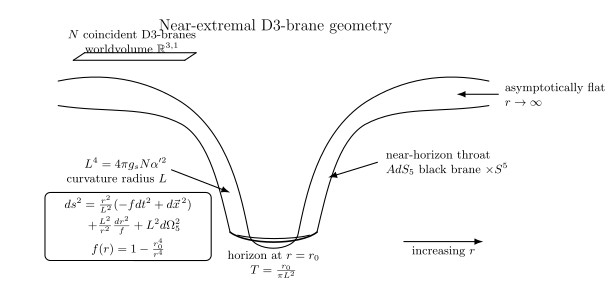
Section titled “Isolating the thermal D3 throat”There are two related but distinct limits. At finite , a near-extremal horizon lies deep in the throat:
For example,
The additional near-horizon approximation drops the constant in . Together these give the planar AdS black brane times a sphere,
At finite this metric approximates the interior of the full geometry. A decoupling limit instead makes the throat a separate spacetime. Send with
In particular, must be held fixed to retain a finite temperature. Then , while
The limiting geometry has its own AdS boundary at . This does not assert that holds out to infinity in the original asymptotically flat geometry: the limit was taken first. Removing the common conformal factor at the boundary gives , identifying the temperature and volume used by the gauge theory. The full decoupling argument and the source dictionary are developed on page 31.
Entropy and the three-quarters comparison
Section titled “Entropy and the three-quarters comparison”In the throat, the internal sphere has radius . Dimensional reduction of the Einstein term gives
This is the same area calculation in five dimensions: the internal sphere has been absorbed into Newton’s constant. Inserting and the shared charge/gravitational normalizations gives
The temperature power follows from conformal invariance in three spatial dimensions. The factor follows here from ; weakly coupled adjoint counting gives the same leading power. Neither argument makes the thermal coefficient a supersymmetric nonrenormalization theorem.
Physical degrees of freedom in the free gas
Section titled “Physical degrees of freedom in the free gas”For each adjoint color, the massless multiplet has two transverse gluon polarizations, six real scalar modes, and eight fermionic helicity states. Thus and . The momentum integral for one bosonic or fermionic degree of freedom is
The upper minus sign is bosonic. Expanding the occupation factor into exponentials gives and a fermionic integral as large. Since , the result for color multiplicity is
For , ; adds one free, decoupled Abelian multiplet. Classical gravity determines the leading large- term. It does not establish an exact finite- ratio by combining its leading answer with the exact free color count.
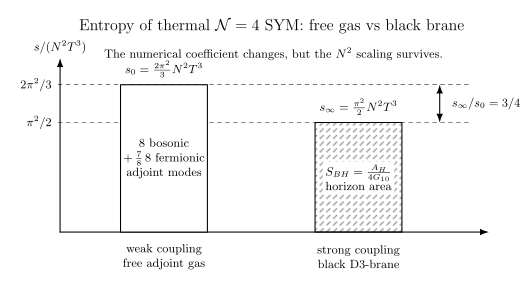
Entropy per at leading large , plotted on a common linear scale at the same temperature. The free bar separates eight bosonic polarizations from eight fermionic helicity states with their thermal weight. The black-brane value is three quarters of their sum. This is a canonical comparison; at the same energy above extremality the entropy ratio is instead.
Energy, free energy, and the ensemble
Section titled “Energy, free energy, and the ensemble”Subtract the zero-temperature energy at the same charge. With this reference, integrating gives
The last expression also follows from the leading term in the exact ADM energy. The subscript denotes the classical gravity approximation, not zero temperature. Exercise 4 obtains the same free energy from the regulated Euclidean gravitational action, with the boundary time circles matched before subtraction.
More generally, if , then and . At equal and , an entropy ratio is a ratio of ‘s. At equal and , eliminating temperature instead gives
These comparisons concern the ordinary thermal trace , whose Euclidean fermions are antiperiodic. They are not supersymmetric indices with an insertion of .
For an uncompactified planar boundary, is negative for every relative to thermal Poincaré AdS with the same flat boundary data. There is no finite-temperature Hawking–Page crossing between these two saddles. A spherical boundary introduces its curvature radius as another scale and requires a different comparison. A turning point of the full asymptotically flat D3 temperature is a third, distinct question.
The leading strong-coupling correction
Section titled “The leading strong-coupling correction”Write the planar free energy as
The free and classical-gravity limits are and . The leading large- correction was calculated by Gubser, Klebanov, and Tseytlin, using the tree-level term of the IIB effective action. A useful way to understand the coefficient is to separate its string-theory input from its gravitational evaluation.
In the field-redefinition scheme used for that calculation, the relevant first-order Euclidean action contribution on this background is
Here is the specified quartic Weyl contraction, not an arbitrary scalar called “.” On the unperturbed black brane its value and measure are
These are the action and invariant inputs; Exercise 5 displays the contraction and checks how it enters the thermodynamics. The radial integral is finite and elementary:
Why is it legitimate to use the unperturbed geometry? At fixed boundary temperature and charge, the zeroth-order action, including its boundary terms, is stationary. In an expansion , the first-order variation of vanishes for variations satisfying that boundary problem. Thus the first correction comes from . One must hold the physical temperature fixed, rather than keep a corrected solution’s horizon parameter fixed and identify that with an unchanged temperature.
Dividing by and comparing with gives
The positive correction makes more negative and increases the entropy at the same . The cited paper uses ; its combination is the used here. This translation is essential to the numerical coefficient.
This calculation uses a known term of the string effective action and its applicable reduction. It is not a derivation of the complete higher-derivative IIB action or of every corrected field. At higher derivative order the entropy is determined by the action’s entropy prescription, such as the Wald construction when applicable, rather than the corrected area alone. In particular, the sphere-radius mode of a corrected ten-dimensional ansatz should not be discarded merely because the leading product geometry has a constant sphere.
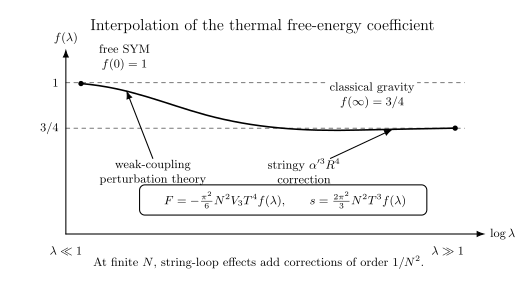
The leading strong-coupling asymptotic expression , for . The horizontal axis is logarithmic and the vertical axis is linear with a displayed restricted range. Every plotted value lies above . The range illustrates the leading correction; it is not an error bound on omitted terms, and the curve does not determine an interpolation to weak coupling.
When the calculation is controlled
Section titled “When the calculation is controlled”Small curvature requires . The simplest string perturbation regime also has . A sufficient parametric window is therefore , with large total entropy . One can equivalently take the planar limit first at fixed , then study large . The infinite-volume result assumes uncompactified spatial directions, or a large-volume regime in which finite-size effects are negligible. Neither the two endpoint values of nor the one-term correction fixes its behavior at all couplings.
What changes for M2- and M5-branes
Section titled “What changes for M2- and M5-branes”The same area reasoning applies to the M-brane throats. Let a planar black brane have radius , radial coordinate , and blackening factor . Euclidean regularity and the area law give
Reducing over the internal sphere means . It is crucial that the AdS and sphere radii are different: for M2-branes and for M5-branes. With the flux-quantized radii already derived on page 27, the result is
Exercise 6 works out the sphere volumes and numerical factors. The different powers of are gravitational predictions for strongly coupled worldvolume theories, not counts of independent free matrix species. These near-extremal entropy scalings were established by Klebanov and Tseytlin. A separate dynamical test of the D3 description is the absorption calculation on page 30.
A comparison: the D1–D5 throat
Section titled “A comparison: the D1–D5 throat”Intersecting branes give another AdS throat. Take D1-branes along and D5-branes along , with positive charges and no momentum excitation along . The D1–D5 intersection has four mixed boundary-condition directions. Here use the extremal, translationally invariant solution on the torus: retaining its zero modes smears the D1 charge over .
Let the asymptotic string-frame torus metric have volume
The charge radii and harmonic functions are
The ten-dimensional string-frame geometry and total dilaton are
This is the zero-momentum extremal limit of the solution of Horowitz, Maldacena, and Strominger, converted using the shared Einstein/string-frame relation.
In the region , drop the constant terms in both harmonic functions. Define . Then and . Substituting these factors and setting gives
Thus the local product is : the AdS and sphere radii are equal in this frame, while the torus metric and dilaton become constant. The torus volume approaches . This is the near-throat geometry in Maldacena’s D1–D5 example, section 4. If is periodic, its identification remains; the three-dimensional space is locally AdS, with a quotient rather than unquotiented global AdS geometry.
Small string-scale curvature requires , and a weak local string coupling requires . A ten-dimensional supergravity treatment must also account for the individual torus cycle sizes and any light winding modes. The geometry comparison does not identify this two-charge extremal configuration with the thermal D3 state considered above.
Common pitfalls
Section titled “Common pitfalls”Keeping the harmonic coefficient fixed. In the exact charged black-brane family, . Holding fixed as the horizon grows changes the physical charge; it does not describe heating the same stack.
Mixing frames or ensembles. A radius, horizon area, and Newton constant must use compatible metric normalization. Likewise, the three-quarters entropy ratio compares equal temperatures; equal energies give a different ratio.
Treating a thermal coefficient as protected. The large- scaling and conformal temperature dependence do not fix the coefficient. Ordinary thermal boundary conditions do not compute a supersymmetric index.
Extrapolating an asymptotic curve. The positive leading correction establishes the local approach to at large coupling. It neither proves monotonicity at every coupling nor demonstrates a finite-temperature planar phase transition.
Exercises
Section titled “Exercises”1. Exact charge, heat capacity, and a wrong fixed parameter
Section titled “1. Exact charge, heat capacity, and a wrong fixed parameter”At fixed , derive the ADM integrand from the asymptotic perturbations above, verify the first law, and find where the fixed-charge heat capacity changes sign. Compare with the family obtained by holding while varying . Does that family have the same charge?
Solution
The full spatial trace is . In six normal dimensions,
Thus , while the derivative of the trace is . Their difference is . The ADM coefficient is , and the in the integration measure cancels, giving .
Write and . Then
It follows that
In contrast,
Since , the sign of is the sign of . It is positive for and negative for larger , diverging at the maximum of . Explicitly,
The near-extremal branch has , so it lies safely on the positive branch. The turnover at is outside the near-extremal CFT approximation.
Now falsely impose as an exact relation. Its electric coefficient must satisfy , so its physical charge length is , not . If one nevertheless subtracts as a fixed BPS energy, one obtains , whereas its temperature and area give
This residual is the missed charge-work contribution. The metric with fixed is a member of a legitimate varying-charge family when accompanied by the corresponding flux. The error is interpreting it as fixed charge. Omitting would instead make the flux proportional to , which is not the field supporting this nonextremal metric.
2. Decoupling, boundary units, and frame consistency
Section titled “2. Decoupling, boundary units, and frame consistency”Carry out the thermal decoupling limit keeping both and fixed. Explain why keeping fixed would fail. Verify the entropy reduction to five dimensions and its behavior under an AdS dilation. Finally, show how using the unshifted Einstein-frame area with the original gives a spurious power of .
Solution
With , , and , one has
Substitution in each block of the metric produces the finite displayed above. The Euclidean near-tip calculation then gives . Keeping fixed instead would send and remove the horizon from the finite- throat. That is not the thermal decoupling limit of a near-extremal stack.
The boundary representative is obtained by multiplying the limiting five-dimensional metric by . It is , so its time period is precisely the thermal , not the proper period at a finite radial cutoff.
For the product with , integrating the ten-dimensional Einstein term gives . Multiplying the five-dimensional horizon area density by the same internal volume reproduces the ten-dimensional area. Thus the reduction does not introduce an independent entropy normalization.
The AdS dilation , , preserves the throat metric’s form and sends . Consequently , , and . Both and are invariant. This checks that the temperature coefficient is expressed in boundary units consistently.
For a constant metric rescaling , an eight-dimensional horizon area scales as . Expressing the Einstein action in the rescaled metric also changes the Newton coefficient to . Hence . For the unshifted Einstein metric, , so using with the old would multiply the entropy by the incorrect factor .
3. Occupation integrals and microcanonical entropy
Section titled “3. Occupation integrals and microcanonical entropy”Evaluate the Bose and Fermi energy integrals by expanding the occupation factors, and obtain the free pressure and entropy for the physical multiplet. At fixed energy and volume, derive both the ratio of temperatures and the ratio of entropies between the free and strongly coupled theories. State how the and counts differ.
Solution
Use . The positive Bose series permits termwise integration; the integrated absolute values of the Fermi series also sum to a finite value. Therefore
The factor is a thermal occupation effect, not a reduced number of fermionic states. Eight bosonic and eight fermionic states per adjoint color give
For example, four Weyl fields contribute two physical particle/antiparticle helicity states each. The gluon contributes two polarizations rather than four gauge-potential components. Here for , and for , including the decoupled multiplet.
At leading large , write . From at the same and ,
The strongly coupled system is hotter at the same energy, which partly compensates its smaller fixed-temperature entropy coefficient. The equal-temperature ratio remains . Neither comparison is protected by supersymmetry: the ordinary trace has antiperiodic thermal fermions, whereas an index uses different boundary conditions and weights.
4. Free energy from a matched gravitational subtraction
Section titled “4. Free energy from a matched gravitational subtraction”Use the five-dimensional Euclidean Einstein action and Gibbons–Hawking term,
Cut off the black brane and thermal Poincaré AdS at . Match their induced metrics, compute bulk and boundary contributions separately, and take . What goes wrong if their coordinate time periods are set equal before matching?
Solution
The black-brane metric has , , and . Both solutions have . Their radial ranges are and , respectively. The horizon is a smooth interior point, not an extra boundary.
At , the proper time circles agree only if
The spatial induced metrics already agree. The subtracted bulk action is
For the outward unit normal , the extrinsic curvature follows from :
Thus
Adding gives
In the last step, . Inserting and the D3 dictionary gives .
If instead , the unmatched bulk difference is and the unmatched boundary difference is . Their sum is positive and equals : it is comparing different boundary temperatures. The boundary mismatch tends to zero at large cutoff, but its product with the divergent volume leaves a finite error.
With matched periods, the subtracted Gibbons–Hawking contribution tends to zero in this particular comparison. It is still required for the finite-cutoff variational problem; omitting it cannot be diagnosed solely by this limiting number. The negative matched free energy for all rules out a crossing between these planar saddles. It makes no claim about a global boundary or spatial compactifications. This calculation uses the fixed-flux reduced theory, which has already incorporated the five-form consistently.
5. The curvature correction and its range of validity
Section titled “5. The curvature correction and its range of validity”Given the action input above, use the Euclidean Weyl contraction
and its value , , to determine the leading entropy and energy corrections at fixed . Estimate the plotted correction at , and calculate the errors from a reversed correction sign or an untranslated factor of two in the gauge coupling. Explain the limitation of using an area formula alone.
Solution
The Weyl tensor is traceless; in an orthonormal Euclidean frame split into and , its independent sectional components are
The remaining entries follow from the curvature symmetries. The first contraction is , and the second contraction before its factor of is . Their sum is . The choice of contraction and its string coefficient are physical input; replacing it by a different quartic invariant would not preserve the result.
The radial measure makes the integral proportional to . Hence the first-order free energy is
At fixed coupling is independent of , so ordinary thermodynamic differentiation gives
Thus conformal scaling remains intact. At the shift of the normalized coefficient is
A reversed sign would predict , below the infinite-coupling limit, and contradict the action input. If the original paper’s coupling were substituted for without the corresponding factor of two, the correction would be too large by ; at this point the wrong shift would be about .
The expansion parameter is , and this correction first occurs at its third power. String loops require separate control, for example with large . No error estimate for all omitted terms follows from a single retained term, even when it is small.
Finally, a higher-derivative action modifies both the geometry and the relation between its horizon data and thermodynamic entropy. The corrected horizon area alone is therefore insufficient. The fixed-temperature action calculation above determines the first correction without needing the complete corrected ten-dimensional metric; it does not justify neglecting other fields in a proposed full corrected solution.
6. M-brane entropy coefficients from their two radii
Section titled “6. M-brane entropy coefficients from their two radii”Derive the general planar AdS entropy formula used above, then evaluate the M2 and M5 coefficients using the flux-quantized sphere radii from page 27. Track the factor of two between each sphere radius and its AdS radius. What error results from setting those radii equal?
Solution
For
one has . The Euclidean near-tip metric gives , and the horizon determinant per boundary volume is . Their combination yields
The unit-sphere formula gives and . The shared eleven-dimensional coupling implies .
For M2-branes, , , and . Therefore
The standard AdS radial coordinate is in the throat metric inherited from the M2 solution; it gives exactly without changing the worldvolume time normalization.
For M5-branes, , , and . Hence
Here the standard AdS coordinate is , which fixes the radial and worldvolume blocks with .
At fixed sphere radius and Newton constant, the entropy scales as . Replacing by would give four times the correct M2 entropy; replacing by would give of the M5 result. These are substantial normalization errors even though the powers of and remain unchanged.
Large makes the curvature radii large compared with . The displayed densities describe uncompactified branes, or sufficiently large worldvolume directions in the homogeneous black-brane regime. They do not by themselves settle finite-size phases or supply a free-particle interpretation of the fractional power.
References
Section titled “References”- Gubser, Steven S., Igor R. Klebanov, and Amanda W. Peet. “Entropy and Temperature of Black 3-Branes.” Physical Review D 54 (1996), 3915–3919. doi:10.1103/PhysRevD.54.3915; arXiv:hep-th/9602135.
- Gubser, Steven S., Igor R. Klebanov, and Arkady A. Tseytlin. “Coupling Constant Dependence in the Thermodynamics of N=4 Supersymmetric Yang-Mills Theory.” Nuclear Physics B 534 (1998), 202–222. doi:10.1016/S0550-3213(98)00514-8; arXiv:hep-th/9805156. Sections 2–3 and the Note Added discuss the leading action correction and the scope of the corrected geometry.
- Horowitz, Gary T., Juan M. Maldacena, and Andrew Strominger. “Nonextremal Black Hole Microstates and U-duality.” Physics Letters B 383 (1996), 151–159. doi:10.1016/0370-2693(96)00738-1; arXiv:hep-th/9603109. Section 2.1 gives the ten-dimensional metric and charge normalization.
- Klebanov, Igor R., and Arkady A. Tseytlin. “Entropy of Near-Extremal Black p-Branes.” Nuclear Physics B 475 (1996), 164–178. doi:10.1016/0550-3213(96)00295-7; arXiv:hep-th/9604089.
- Maldacena, Juan M. “The Large N Limit of Superconformal Field Theories and Supergravity.” Advances in Theoretical and Mathematical Physics 2 (1998), 231–252. arXiv:hep-th/9711200. Section 4, equations (4.1)–(4.3), derives the D1–D5 throat limit.