
Open-String T-Duality and D-Branes
T-duality turns a compact direction in which an open-string endpoint can move into a direction in which its position is fixed. The allowed endpoint positions define D-branes. A flat gauge connection becomes the positions of these branes, and a shifted momentum becomes the energy needed to stretch a string between them.
The central equality is : the momentum before duality determines an oriented endpoint separation afterward. We will derive this relation, the resulting mass spectrum, and the gauge and displacement fields carried by the brane. The worldsheet derivation begins with the bosonic string; the corresponding GSO-projected Type II spectrum will be identified separately. The metric, string tension and Hermitian gauge fields follow the shared definitions.
Neumann and Dirichlet endpoints
Section titled “Neumann and Dirichlet endpoints”Let be a spatial circle and the open-string interval. Varying the conformal-gauge action produces, besides the wave equation, the boundary term
There are two elementary ways to make this vanish. At a Neumann endpoint, is arbitrary and . At a Dirichlet endpoint, is prescribed and . For a static Dirichlet position, at the endpoint. These conditions refer to the boundary of the worldsheet; the prescribed position lies in target space.
For Neumann conditions at both ends, write
With trivial holonomy, , . There is no conserved open-string winding in this Neumann direction: the endpoints can move and unwind the string.
The wave equation gives . Define the dual coordinate by . Differentiating fixes both signs:
Consequently, a Neumann endpoint of is a static Dirichlet endpoint of . Conversely, a Dirichlet endpoint becomes Neumann. The coordinate Hamiltonian density, proportional to , is unchanged. This is the canonical transformation explained on the closed-string T-duality page; substituting the derivative swap into the Lorentzian Lagrangian is not an equality of Lagrangian densities.
Subtracting the two chiral pieces gives the dual expansion
The sine term has no extra : the difference of the two complex exponentials supplies it. Pairing with , using , makes the Hermiticity of the expansion explicit. All oscillator terms vanish at the endpoints, so
For and , the endpoints differ by . On the dual circle they are the same point; on its universal cover they are different images of that point. The integer now labels the lifted endpoint sector. It does not place the two endpoints at arbitrary distinct points of the circle.
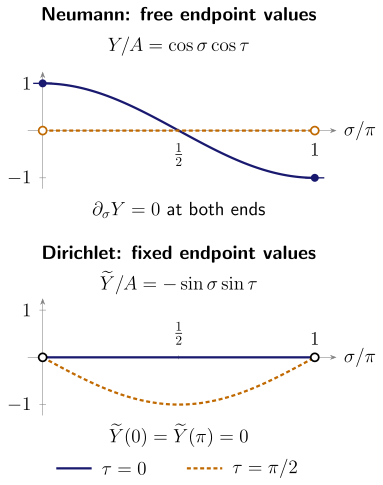
A single real mode with : and , with the additive constants set to zero. Both panels have the same dimensionless scales and show and . Neumann endpoint slopes vanish; dual endpoint values stay fixed. This isolates the oscillator map. Nonzero momentum adds the dual linear term and separates endpoint images.
Stretched strings and the mass shell
Section titled “Stretched strings and the mass shell”A Dp-brane has spatial worldvolume directions and one time direction. An open string ending on it has Neumann conditions along that worldvolume and Dirichlet conditions in its transverse directions. A brane is a hypersurface only when this codimension is one.
T-dualizing a compact tangent direction changes a Dp-brane into a D-brane; dualizing a transverse direction changes it into a D-brane. The bosonic space-filling starting point is a D25-brane. For identical BPS branes in Type II theory, even belongs to IIA and odd to IIB. In particular, a supersymmetric space-filling Type II D9-brane belongs to IIB. A spatial T-duality exchanges IIA and IIB, consistently with the Ramond-sector chirality analysis.
Now take two parallel branes with transverse separation vector . The Dirichlet zero mode is
Its contribution to the left derivative is half the gradient. Matching the usual oscillator normalization gives
This term replaces the transverse momentum contribution. There is no freely variable transverse center-of-mass momentum for a string whose endpoints obey these Dirichlet conditions.
Let be the momentum along the remaining noncompact brane directions and . The oscillator mass-shell constraint is
Thus the exact free-string spectrum in this flat background is
These are oscillator intercepts, not a redefinition of the plane Ramond vacuum weight; the open-superstring spectrum explains that distinction and the GSO projection. Open strings have one oscillator constraint rather than the two independent closed-string conditions that lead to level matching.
On the vector branch, , the mass is
The right side is the tension times the shortest length in the specified image sector. Minimizing over image sectors is a separate operation. Excited states also carry oscillator energy.
The bosonic ground state instead has . It remains tachyonic for and is massless at the threshold. Statements below about massless vectors and gauge enhancement therefore concern the vector branch. The boundary-condition argument itself does not remove the bosonic tachyon.
Wilson lines become brane positions
Section titled “Wilson lines become brane positions”Consider Chan–Paton labels and a flat constant connection on the original circle. A constant unitary transformation diagonalizes it:
The Wilson loop is physical even though the field strength vanishes. The angles are eigenphases modulo , with permutations identifying the same collection of eigenvalues.
Keep the endpoint label at and at . An adjoint component proportional to the matrix unit has a periodic Fourier factor . The global Hermitian covariant derivative acts as
The kinetic momentum is the eigenvalue of :
The order of the two phases follows from the specified derivative and endpoint labels. It should not be changed while retaining the same labels.
Removing the connection locally
Section titled “Removing the connection locally”The same shift can be obtained without a covariant derivative. With , the connection transforms as
Choose . This gives , but generally . Therefore the originally periodic matrix field now satisfies
Allowed plane waves have exactly the momenta found above. A flat connection can be traded for a twist in the boundary condition; a nonperiodic transformation does not erase its holonomy. This derivation also explains the inverse holonomy in the left factor. See Polchinski, sections 2.3–2.4 for the connection between this twist and D-brane positions.
The oriented endpoint displacement
Section titled “The oriented endpoint displacement”Apply the duality relation to each sector. It is satisfied by
The common shift of all is the overall brane position; phase differences determine the stretching. An endpoint on brane may be represented by any image on the covering line. The displacement can be negative, while the physical length is .
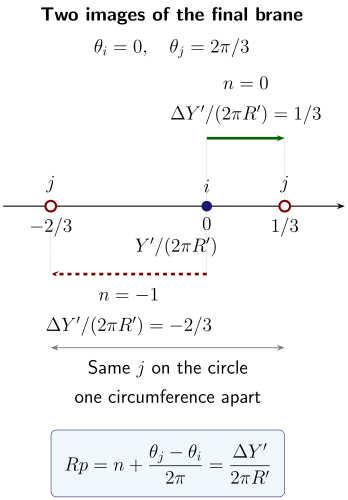
The universal cover is drawn in units of . For and , the and sectors end at two images of the same physical brane . The arrows show signed displacement from to , and . Their lengths are and , respectively. The positions and spacings are quantitative; the vertical offsets only separate the arrows.
Changing a chosen lift of a phase is a large gauge transformation. The simultaneous relabeling
leaves both and invariant. Likewise, reversing the string sends to and reverses the momentum and displacement. The mass is unchanged. Hermiticity pairs the Fourier coefficients as .
Coincident branes and unbroken gauge symmetry
Section titled “Coincident branes and unbroken gauge symmetry”For the vector branch, one compact direction contributes
A vector is massless when the endpoints coincide modulo the dual circle, even if the chosen lifts differ. At a generic set of distinct eigenphases, only the diagonal components survive as massless gauge fields. If the eigenvalues of have multiplicities , the unbroken group is
Why does the holonomy, rather than a selected numerical logarithm , determine the answer? An infinitesimal unbroken gauge transformation is covariantly constant around the circle:
Periodicity requires . Thus the unbroken Lie algebra is the centralizer of . Within each equal-eigenphase block, all Hermitian matrices are allowed, giving . Two unequal numerical entries of can differ by an integer multiple of ; the associated covariantly constant field then has a nonzero Fourier label. Requiring would miss it.
Each off-diagonal complex entry and its conjugate describe two real generators. This is the same counting as the two orientations of a string connecting a pair of branes; they are not two unrelated Hermitian matrix fields.
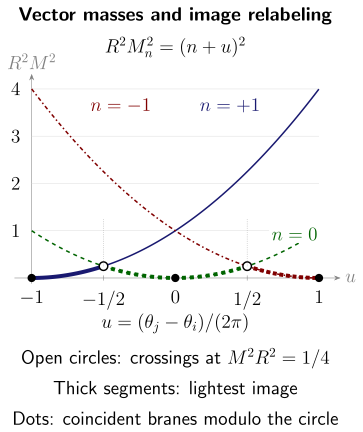
For the vector branch, with . The plotted sectors are and the thicker segments give the smallest mass on . Integer gives coincident branes modulo the circle and a massless vector. Crossings at instead have . Both axes are dimensionless. Large gauge transformations permute the smooth sector curves; the bosonic ground-state branch is not shown.
For example, phases give two coincident pairs and , although the displayed connection has four distinct diagonal entries. Exercise 2 constructs all eight generators. Such enhancement can occur at any circle radius. It is distinct from the extra closed-string gauge bosons at the bosonic self-dual radius on the previous page.
Gauge fields and transverse displacement fields
Section titled “Gauge fields and transverse displacement fields”At coincidence, a bosonic level-one state is . Split its polarization into directions tangent to the brane and transverse directions . To identify the corresponding local boundary operators, use the upper half-plane with and inward normal coordinate .
Neumann and Dirichlet doubling respectively give
On the boundary,
The normal derivative is essential: a tangential derivative of the fixed Dirichlet value would vanish. A normalized matter vertex is
In the doubled chiral description this becomes
Both the tangential and normal currents have the same unit two-point normalization. The relative in the first expression follows from Euclidean doubling, not from changing the earlier Lorentzian duality signs.
The physical-state conditions
Section titled “The physical-state conditions”Let . Its boundary dimension is . Using the free-boson OPE and gives
The cubic pole arises when one derivative in contracts with the derivative in and the other with the exponential. Vanishing of this pole and weight one require
There is also the longitudinal equivalence . Indeed, its matter vertex is . The integrated insertion is a total derivative, while the unintegrated vertex is BRST exact because a weight-zero scalar satisfies . This is the physical quotient derived earlier, now with momentum restricted to the worldvolume.
For nonzero null and , the tangent vector has physical polarizations. None of the transverse polarizations is removed by this longitudinal quotient. Therefore
They are a worldvolume gauge field and transverse scalars . For the GSO-projected Type II string, the analogous NS state uses and gives eight bosonic polarizations; its R partner gives eight fermionic polarizations. The superstring vertex also needs the fermion and ghost terms explained on the NSR vertex page. The bosonic expression above is not its complete zero-picture representative.
A D0-brane requires a different interpretation: its worldvolume is quantum mechanics, is a nondynamical gauge field, and the transverse scalars are matrix coordinates. There is no nonzero null momentum in a one-dimensional worldvolume to which the preceding polarization count could be applied. Similarly, the displayed local plane-wave operators describe coincident parallel boundaries; a general operator changing one separated boundary condition into another requires additional construction.
Why the scalar measures position
Section titled “Why the scalar measures position”The constant Wilson-line relation already fixes the normalization of the position field. After duality, a slowly varying transverse matrix field enters as
Thus , while is a target-space length. A normal boundary derivative couples to a displacement of the prescribed endpoint position. The massless transverse oscillator therefore describes a dynamical displacement of the brane, even though a given worldsheet calculation starts with fixed background positions.
For commuting Hermitian , simultaneous diagonalization identifies their eigenvalues with individual brane positions divided by . Permuting identical branes gives the same configuration. Noncommuting matrices need not have simultaneous ordinary positions. The normalization and this geometric interpretation are developed in Tong, section 7.7.
The gauge-theory description of stretching
Section titled “The gauge-theory description of stretching”The leading two-derivative gauge/scalar action follows from dimensional reduction. For the BPS Type II stack it is the bosonic part of reduced ten-dimensional super Yang–Mills theory; the bosonic string has an analogous gauge sector alongside its unstable tachyon. Decompose the higher-dimensional field strength as
With the fundamental matrix trace and , the action is
The mixed components occur twice in the higher-dimensional contraction. The rest energy and fermions are omitted. The same matrix normalization is used in the String II brane definitions; the value of the coupling is derived from the brane action there.
The scalar potential is
A commutator of Hermitian matrices is anti-Hermitian, so the minus sign is required for nonnegative energy. The minima of this gauge-sector potential are commuting matrices. This statement does not establish stability of the full bosonic string background.
For two diagonal branes, set . The off-diagonal vector obtains its mass from , and canonical normalization gives
This agrees with the free-string vector branch. For and nonzero separation, one off-diagonal scalar becomes the longitudinal polarization of the massive vector. Exercise 5 derives both the vector mass and the remaining scalar mass matrix, including their normalization.
This gauge theory retains energies and derivatives well below . A very long stretched string obeys the free-string mass formula but is too heavy to keep in that low-energy truncation. The dual string coupling also changes as ; a small original radius need not give weakly coupled dual branes. Nonlinear brane dynamics, tachyon condensation and RR charges are the subject of the next page.
Common pitfalls
Section titled “Common pitfalls”Changing endpoint labels halfway through a calculation. With the inherited derivative and Fourier factor, the momentum contains . Reversing orientation also reverses the image label. A mass squared can hide a sign error that an oriented displacement exposes.
Using a connection eigenvalue instead of its holonomy. Equal eigenphases modulo give coincident dual branes. The missing generator may have nonzero Fourier label in a gauge where the displayed connection eigenvalues differ.
Identifying all massless states with gauge enhancement. The vector branch gives gauge generators at coincidence. A bosonic ground-state threshold can instead give a massless scalar at finite separation, and the bosonic vacuum remains unstable.
Exercises
Section titled “Exercises”1. Two oscillator phases and the worldsheet Hamiltonian
Section titled “1. Two oscillator phases and the worldsheet Hamiltonian”For real , and , dualize
Verify the endpoint conditions and compute the contribution of this coordinate to the worldsheet Hamiltonian. Explain why it is not by itself the target-space energy of a physical string.
Solution
Integrating the two derivative relations gives, up to an additive constant,
For example, . Its spatial derivative is . Both oscillators have zero Neumann slope at , and both dual oscillators vanish there. The dual endpoint displacement is .
The coordinate Hamiltonian is
Orthogonality removes cross terms between the constant, the first harmonic and the second harmonic. Each squared sine or cosine integrates to . For a real mode , the remaining sum of squared time factors is one and the contribution is . Hence
Duality swaps the two derivatives pointwise, so the original and dual Hamiltonian densities agree before integration. The momentum contribution becomes the gradient contribution .
This is one spatial coordinate’s contribution to the generator of worldsheet time. A physical embedding must also satisfy the constraints involving target time and the other coordinates. Target-space energy is the momentum conjugate to ; it is not for this isolated coordinate.
2. Gauge generators hidden by a logarithm
Section titled “2. Gauge generators hidden by a logarithm”Take . Find every massless vector sector and the unbroken group. Construct its covariantly constant generators and explain how a large gauge transformation makes them ordinary zero modes.
Solution
Write . The massless condition is . The sectors are
For each pair, the covariantly constant matrix is
It solves and is periodic precisely for the listed pairs. The conjugate entries pair into two Hermitian generators, and . Along with the four diagonal generators, there are eight real generators. The equal-holonomy blocks are and , giving .
Choose the integer phase shifts . The new phases are . Under , all eight listed generators have . The corresponding periodic gauge transformation is ; it shifts by and multiplies an adjoint component by .
Before this transformation, the four numerical eigenvalues of were distinct. Its constant-matrix commutant was only , which missed the covariantly constant Fourier modes. The centralizer of gives the same correct answer in either description. Reversal pairs with , not with a sector of the same Fourier label.
3. Two Wilson lines require simultaneous coincidence
Section titled “3. Two Wilson lines require simultaneous coincidence”On a rectangular two-torus of radii , take commuting flat holonomies with phase vectors
Determine the vector mass formula and unbroken gauge group after dualizing both circles. Each holonomy separately has a centralizer. Why is their union not the answer?
Solution
Commuting unitary holonomies can be simultaneously diagonalized. Their two momenta and dual displacements are
Here and . On the vector branch,
Every term is nonnegative. Masslessness requires coincidence in both circles. The first holonomy groups and ; the second groups and . Their joint ordered eigenphase pairs are all distinct, so only remains and the group is .
The unbroken Lie algebra is the intersection of the two centralizers. A mode massless in only one circle still receives a positive mass from the other. This is why the union overcounts. The assumption of commuting flat holonomies is essential to this simultaneous-position description; no conclusion about noncommuting flux backgrounds follows from it.
4. A tilted brane and its normal scalar
Section titled “4. A tilted brane and its normal scalar”Let be a unit spatial normal to a flat codimension-one brane. Construct the normal and tangent projectors and the reflection matrix . Show that the boundary gluing preserves the stress tensor. Derive the normal scalar and tangent vector operators without rotating the brane onto a coordinate axis.
Solution
In the spatial subspace, set
The projectors are orthogonal and sum to the identity. Consequently and . Extend to leave target time invariant; then . The gluing gives
Thus there is no stress-energy flux through the boundary. At , the derivatives become
In particular . For tangent and normal , the normalized currents are
Both equal in their projected subspaces. Since , either current has two-point coefficient . The mixed coefficient vanishes by projector orthogonality. Omitting the normal derivative’s Euclidean would give the wrong sign.
Multiply by with . The same cubic stress-tensor pole imposes , and is the longitudinal quotient. The normal polarization is unaffected. Thus tilting the brane changes neither the physical count nor the interpretation of the scalar. The nonzero-null-momentum count still requires ; it is not a worldline polarization formula for D0-branes.
5. The scalar eaten by a stretched vector
Section titled “5. The scalar eaten by a stretched vector”For , expand the leading gauge theory around two diagonal branes with . Keep an off-diagonal vector and scalar , together with their Hermitian conjugates. Derive the canonically normalized vector and scalar masses, identify the Goldstone direction, and compare with the stretched-string mass.
Solution
Write the off-diagonal fields as
With , the scalar covariant derivative has upper-right entry . The trace includes both conjugate entries, so its quadratic Lagrangian is . If , the vector kinetic term is .
For the potential, the linearized commutator has upper-right entry and lower-left entry . Therefore
The second factor of two comes from the ordered sum over transverse indices. Thus
Use and . These give the usual complex-vector kinetic term and complex-scalar term . The mass terms then yield
A gauge parameter with upper-right entry acts at this order as and . Hence is gauge invariant. The scalar along lies in the kernel of the potential matrix and can be removed by a gauge choice; its degree of freedom becomes the longitudinal polarization of the massive vector. Scalars orthogonal to have mass squared .
Since , the vector mass is exactly . For , a massless vector’s polarizations plus the eaten scalar become a massive vector’s polarizations. The total physical count is unchanged. For D0-branes, enforces a gauge constraint instead; it does not become a propagating massive vector by this count.
The action is a low-energy truncation. Keeping these off-diagonal fields requires and small derivative scales. The free-string mass formula extends to larger separation, but this does not make the truncated action an exact non-Abelian DBI theory or remove the bosonic tachyon.
6. Uniform branes and a resummed lattice factor
Section titled “6. Uniform branes and a resummed lattice factor”Let , , and . Evaluate the compact Gaussian sum
Derive it by reindexing and by Poisson summation. Explain the multiplicities and the role of . State what part of an annulus calculation has, and has not, been obtained.
Solution
Set . For each integer and each choice of , there is exactly one satisfying , and then one integer . Hence each occurs times:
Poisson summation of this Gaussian gives
Alternatively, apply the shifted Gaussian identity before summing endpoints:
For , the endpoint sum of its phase is
Uniform phases form the th roots of unity. Their geometric series gives when divides and zero otherwise. Inserting this result restricts and reproduces the previous answer, including the factor .
The winding-language expression makes interference between the brane phases explicit. It is a transformation of the compact lattice factor only. Oscillator determinants, ghosts, the proper modular measure and the rest of the spacetime directions have not been included. No complete annulus amplitude, tadpole cancellation condition or stable bosonic vacuum follows from this Gaussian identity.
References
Section titled “References”- Joseph Polchinski, “TASI Lectures on D-Branes,” in Fields, Strings and Duality, TASI 1996, edited by C. Efthimiou and B. Greene (World Scientific, 1997), pp. 293–356, arXiv:hep-th/9611050, especially sections 2.3–2.4 on open-string duality, Wilson lines and brane fluctuations.
- David Tong, String Theory, University of Cambridge Part III lecture notes (2009; revised 2012), arXiv:0908.0333, sections 7.7 and 8.3.2–8.3.3 on matrix-valued brane fields, stretched strings and Type II D-branes.