
Hagedorn Growth and String Thermodynamics
A highly excited string has enormously many ways to distribute its energy among oscillators. For the critical bosonic string, the number of states at level grows exponentially in . Since the rest mass also grows as , the density of masses grows exponentially in mass. The resulting thermal scale is
We will derive the exponential and its algebraic prefactor. The latter matters: exactly at , it decides whether a particular high-energy thermal integral converges. The calculation concerns the free critical bosonic spectrum in flat, uncompactified spacetime. Its tachyon prevents interpreting the result as the thermodynamics of a stable vacuum.
We use the global conventions and the physical oscillator Hilbert space constructed in light-cone quantization. The dimensionless parameter below weights oscillator level; the dimensionful inverse temperature weights target-space energy.
Oscillator states and colored partitions
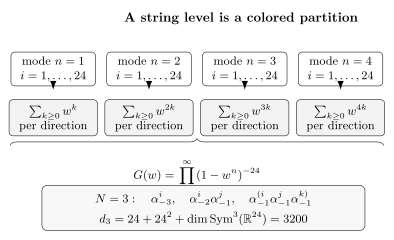
Section titled “Oscillator states and colored partitions”There are physical transverse creation operators at every positive integer mode number . If is the occupation number of the normalized oscillator , then
Let count oscillator states at this level, for one open-string sector without extra endpoint multiplicities. Center-of-mass momentum is held fixed and is not included in . The positive transverse Fock space already implements the physical-state reduction; we must not count all covariant oscillators and then call every state physical.
A state of level is a partition of into positive integers, with possible transverse labels, or colors, on each part. Repeated oscillators of the same mode commute. Thus at level two,
The second term counts a symmetric tensor, not ordered choices. At level three the partitions , , and give
For one pair , the sum over occupations is a geometric series. Consequently the generating function is
Its first coefficients are
An exact way to continue the list follows by logarithmic differentiation. Expanding each denominator in a geometric series gives
where is the sum of the positive divisors of . Equating coefficients after multiplying by yields
This recurrence determines integer degeneracies without using any large-level approximation. It will also let us assess the accuracy of the saddle estimate.
The eta function and the coefficient contour
Section titled “The eta function and the coefficient contour”Retaining the vacuum shift
Section titled “Retaining the vacuum shift”The Dedekind eta function is defined by
Set with , so . It follows exactly, including the prefactor , that
The eta transformation , with the continuous principal square root in the upper half-plane, is the mathematical input. See the NIST transformation formula. Applying it gives
For small positive , the last argument is exponentially small and its product tends to one:
The is easy to discard at leading order, but retaining it organizes the answer in terms of , precisely the open-string mass level. It arises from the eta definition; we have not inserted an extra intercept into the counting trace .
Which path passes through the saddle?
Section titled “Which path passes through the saddle?”Cauchy’s formula extracts a coefficient on any counterclockwise circle :
On , , the logarithmic variable is . It runs downward. Since , reversing the transformed limits gives the exact upward integral
This orientation and integration direction are essential. An integral of the approximate exponential along the positive real axis would diverge at both ends and would not extract a coefficient.
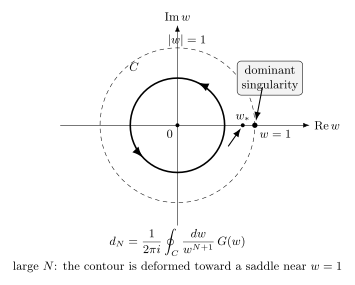
The coefficient contour has . Under , its downward traversal is reversed by . The resulting path passes upward through , where the exponent has a real-axis minimum but decays in the imaginary direction. The diagrams are schematic; tends to zero as the level grows.
The unit circle contains other singular points, including every root of unity. Therefore is not the unique singularity nearest the origin. Its modular cusp gives the dominant exponential. Near a root of unity of denominator , the corresponding modular estimate gives the smaller exponential scale . Controlling all these arcs is the circle-method step in a rigorous coefficient asymptotic. We calculate the dominant saddle and its fluctuations below; we do not reproduce that uniform remainder proof. The role of modular transformations in partition asymptotics is reviewed in NIST DLMF, §27.14.
The exponential and its Gaussian prefactor
Section titled “The exponential and its Gaussian prefactor”Write
Choose the coefficient circle so that , where
Locally put . Taylor expansion then gives
The contributing width is , narrower than . Thus the factor varies slowly over the Gaussian region. At leading order it can be evaluated at the saddle:
The modular power contributes and the Gaussian determinant contributes . Together,
Here means that the ratio approaches one. If we suppress the power, the accurate statement is instead
The distinction is crucial when two exponentials cancel in a thermal integral. The leading entropy alone cannot determine the remaining power.
The first correction, derived in Exercise 3, is
Its large coefficient makes convergence rather slow: the exact count is about of the leading estimate at , at , and at .
Points are exact integer counts from the divisor-sum recurrence, divided by with . The horizontal value one is the leading prediction; the correction curve is for . The level axis is logarithmic. The comparison measures a finite-level error, not a change in the asymptotic exponential.
The same exponent can be written with chiral central charge . This is the free-boson realization of the Cardy asymptotic mechanism: a modular transformation converts a low-energy vacuum contribution into high-level growth. Our fixed-momentum chiral oscillator product is not by itself a modular-invariant full torus partition function. Its eta modular weight is also responsible for the algebraic factor that a leading-entropy statement omits.
From levels to a density of rest masses
Section titled “From levels to a density of rest masses”Open strings: include the change of variable
Section titled “Open strings: include the change of variable”For massive open-string levels, . The exact density is a sum of delta functions,
A smooth density replaces this distribution only after averaging over a mass bin larger than the level spacing . The bin can still be much smaller than the string mass scale at large . Since , the Jacobian gives
With the dimensionless mass , this is conveniently written
A density per unit mass has dimension , or length; the explicit factor supplies it. The level degeneracy itself is dimensionless. Omitting the Jacobian would give both the wrong power and the wrong interpretation.
Closed strings: impose level matching first
Section titled “Closed strings: impose level matching first”For an ordinary oriented closed bosonic string without additional projections, the two transverse oscillator spaces are independent. Physical states obey . At a specified matched level, the exact degeneracy is therefore
There is no extra factor from exchanging the two sectors: left and right are distinct oscillator spaces in this oriented theory. A phase integral projects onto their equal levels, as shown in Exercise 4.
The closed-string normalization gives
Hence
The closed string has twice the oscillator entropy at fixed , while its mass is twice the open-string mass at that level. These two effects give the same . Level matching pairs the two sectors; it does not itself create the factor four in the closed mass formula. The different powers of will give different endpoint behavior.
What the Hagedorn threshold says about temperature
Section titled “What the Hagedorn threshold says about temperature”Exponential competition and the endpoint
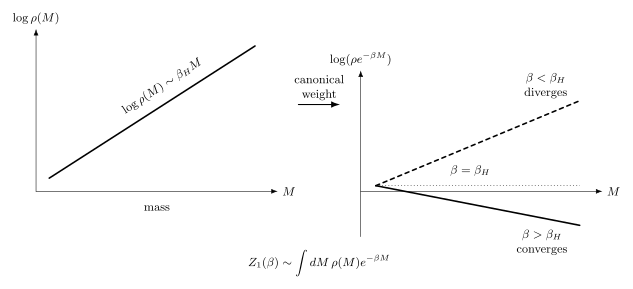
Section titled “Exponential competition and the endpoint”To isolate the high-mass question, choose a lower cutoff . At fixed zero center-of-mass momentum the one-string tail is approximated by
The exponential part is . It ensures convergence for and divergence for , whatever the fixed algebraic power. At equality the exponentials cancel, so that power decides the answer. Both rest-mass tails above converge at equality, because and .
A thermal gas also sums over center-of-mass momenta. In the noncompact volume limit its one-string Boltzmann trace per spatial volume is
Here denotes the number of integrated noncompact spatial directions; our uncompactified string background has . At fixed positive and large , put . Then
Integrating the Gaussian yields
Although grows with , the ratio is small in this region. This is a controlled large-mass expansion of the relativistic trace, not an assumption that all thermally occupied strings are nonrelativistic at every mass.
At with , the resulting powers are
| High-mass integrand, up to positive constants | Open string | Closed string |
|---|---|---|
| Center-of-mass momentum fixed to zero | ||
| All 25 noncompact momenta integrated | ||
| Endpoint convergence after momentum integration | Diverges | Converges |
At , the exponential density and Boltzmann factor cancel. The displayed powers refer to the remaining integrand in , for one free string and the high-mass tail. Rest-mass counting and the trace per volume in 25 noncompact spatial dimensions answer different questions. No low-energy stability conclusion follows from this endpoint test.
Thus a partition function can remain finite at a Hagedorn boundary while failing to be analytic there. For the closed noncompact tail, taking derivatives with respect to inserts a leading factor . The integral behaves as : derivatives through order remain finite, while the thirteenth diverges. For the open noncompact tail, the leading divergence on approach from is proportional to . These are statements about the specified idealized tails, not universal critical exponents for every string background.
The importance of spatial geometry is discussed in Barbón and Rabinovici, §3.1. Compactification requires recounting momentum and winding sectors. In particular, taking the high-energy limit at fixed compact radii need not agree with taking the noncompact volume limit first. One cannot change in the Gaussian factor while leaving all compact-string state counting unchanged and infer a general compactification result.
One string, a free gas, and interactions
Section titled “One string, a free gas, and interactions”is a trace over the states of one string with Boltzmann weight. For a formal free gas of bosonic string states at zero chemical potential, expanding each Bose factor gives
Near , the high-energy singularity comes from ; have stronger exponential suppression. Low-energy divergences, if present, are a separate issue.
The critical bosonic vacuum already has a tachyon at zero temperature. Restricting the calculation to diagnoses the high-level spectrum; it does not remove that instability from the full theory. Tachyon-free string theories also exhibit exponential oscillator growth, but their worldsheet degrees of freedom and projections change the value of the Hagedorn scale.
Finally, the free-spectrum calculation does not determine the interacting phase above this scale or prove an absolute maximum temperature. When the leading entropy is proportional to energy, adding energy can excite a vastly larger set of internal string configurations. Interactions, gravity, spatial geometry, and the choice of ensemble are needed to decide the resulting thermodynamics.
A preview: winding around Euclidean time
Section titled “A preview: winding around Euclidean time”There is a useful later interpretation of the same number. At temperature , Euclidean target time is periodic with circumference . Write its radius as . The compact closed-string mass formula, developed in T-duality and compactification, assigns a state with zero momentum around that circle, winding , and the spatial effective mass squared
It becomes massless at , the same found by counting. This radius differs from the self-dual radius . Below its mass squared is negative.
This thermal winding mode is a mode of the Euclidean thermal description, not a Lorentzian particle winding around physical time. It is also distinct from the pre-existing zero-winding bosonic tachyon. A worldsheet modular transformation relates the highly excited string sum to this winding description; deriving that relation requires the thermal worldsheet amplitude, beyond the oscillator trace used here. Kruczenski and Lawrence develop that connection. The threshold agreement is a useful check, not by itself a derivation of the subsequent interacting phase.
Exercises
Section titled “Exercises”Exercise 1. An exact count and an integer recurrence
Section titled “Exercise 1. An exact count and an integer recurrence”Count the states directly by partitions. Derive the divisor-sum recurrence from and use it to determine . Explain why oscillators with equal mode number require a different count from oscillators with different mode numbers.
Solution
The partitions , , , , and give
Equal-mode creation operators commute and span a symmetric power: occupations of a mode have color states. Different modes belong to distinct oscillator spaces, so their color counts multiply.
From ,
The coefficient of is . Since are ,
The recurrence and occupation counting compute the same integer by different organizations of the states.
Exercise 2. A formal model with any number of colors
Section titled “Exercise 2. A formal model with any number of colors”For a positive integer , consider . Derive its modular approximation, retain the shift , and obtain the complete leading saddle prefactor. Check and . What additional claim about string theory would this counting exercise fail to establish?
Solution
The eta definition and transformation give, for small positive ,
In the coefficient integral the exponent is , so
The upward vertical Gaussian supplies . Combining it with the amplitude gives
where
For , and the power is , reproducing the leading ordinary-partition asymptotic. For , and the power is .
These are mathematical colored-partition models. They do not establish that an ordinary flat bosonic string with has a consistent Lorentz algebra for arbitrary . That is a separate dynamical and quantum-consistency question, resolved for the usual critical theory in the preceding page. Nor does the counting variable become a target temperature without specifying a relation between level and energy.
Exercise 3. Why the leading saddle overestimates the count
Section titled “Exercise 3. Why the leading saddle overestimates the count”Derive the first relative correction . Use and parametrize the vertical saddle by . Expand the exponent and the factor through order . Explain why no relative correction of order survives.
Solution
Put . Since ,
At fixed , the amplitude and the non-Gaussian exponential expand as
Every term of order is odd in and integrates to zero on the symmetric Gaussian path. At order the product contributes
With normalized Gaussian average
we have , , and . Thus the relative correction is
The negative sign explains the leading overestimate at large finite . At moderately small this correction itself is not small, so it should not be treated as an accurate replacement for exact counting. Higher even orders give the subsequent algebraic corrections; the other modular cusps are exponentially smaller in the asymptotic regime.
Exercise 4. Projecting the closed-string Hilbert space
Section titled “Exercise 4. Projecting the closed-string Hilbert space”Show that the level-matched oscillator generating function can be written
Find its coefficient at and its first two coefficients. Derive the smooth closed rest-mass density, including its normalization and units.
Solution
Expand the product before integrating:
The phase integral vanishes unless . Therefore
The constant term counts the closed tachyonic oscillator vacuum; the term counts the massless polarizations. Neither is part of the large positive-mass density used for the thermal-tail test.
Squaring the asymptotic count and differentiating gives
Collecting powers yields with . Its dimension is length, so is dimensionless. Level projection restricts which products occur; no additional division by two is appropriate for this oriented theory.
Exercise 5. A finite partition function with divergent derivatives
Section titled “Exercise 5. A finite partition function with divergent derivatives”Suppose a smooth rest density has the tail . Derive the endpoint criterion after integrating continuous momenta. Apply it to the two densities in this page with . Determine the first divergent derivative of the closed-string one-string trace. Also derive the Bose-gas relation to .
Solution
The large-mass momentum integral is Gaussian and contributes . Thus, up to a smooth positive coefficient, the tail is
For it converges, and for it diverges. At it converges exactly when . Each derivative in inserts one leading factor of ; derivatives of the smooth prefactor are less singular. The derivative of order therefore converges when .
For open strings, and , so . In fact,
For closed strings, gives . The endpoint trace and its first twelve derivatives are finite, while the thirteenth has a large-mass integrand proportional to and diverges. Finite value does not imply analyticity. If momenta were instead held at zero, , and both original endpoint integrals would converge. This is a comparison of different traces, not a contradiction.
For a stable free bosonic one-particle spectrum, each mode of energy has a geometric occupation sum. Formally applying the same construction to the high-energy string spectrum gives
Only reaches the high-energy threshold at . A bosonic-string tachyon and gravitational interactions prevent this formal identity from establishing a stable full ensemble here.
Exercise 6. The thermal winding threshold
Section titled “Exercise 6. The thermal winding threshold”Take the compact closed-string formula
where and are momentum and winding integers. Interpret the circle as Euclidean target time with . For , , and , find the threshold and compare it with the counting result and the self-dual radius. What does this calculation leave unresolved?
Solution
Level matching is satisfied because both sides vanish. The remaining two terms are the winding energy squared and the closed vacuum intercept:
Both have dimension length. The zero occurs at , hence . This agrees with the spectral Hagedorn scale. The corresponding radius is , not the self-dual radius .
For the Euclidean winding mode has negative mass squared. The zero-winding state with the same oscillator levels already has at every radius; these are separate modes and separate statements. The calculation identifies a thermal threshold, but does not derive the modular equivalence of thermal amplitudes, show that the bosonic vacuum is stable below it, or determine the interacting phase beyond it.
References
Section titled “References”- J. L. F. Barbón and E. Rabinovici, Touring the Hagedorn Ridge, review contributed to the I. I. Kogan memorial volume (2004), arXiv:hep-th/0407236, DOI:10.1142/9789812775344_0048. Section 3.1 discusses how spatial geometry changes the open- and closed-string high-energy density.
- John L. Cardy, “Operator Content of Two-Dimensional Conformally Invariant Theories,” Nuclear Physics B 270 (1986), 186–204, DOI:10.1016/0550-3213(86)90552-3. The modular origin of high-energy state counting.
- Martin Kruczenski and Albion Lawrence, “Random Walks and the Hagedorn Transition,” Journal of High Energy Physics 07 (2006), 031, arXiv:hep-th/0508148, DOI:10.1088/1126-6708/2006/07/031. The relation between the single-string thermal sum and Euclidean winding modes.
- National Institute of Standards and Technology, Digital Library of Mathematical Functions, §23.18, “Modular Transformations”, especially equation (23.18.5), and §27.14, “Unrestricted Partitions”. Eta transformations and the mathematical background to partition asymptotics.