
ER=EPR, Wormholes, and Black Hole Interiors
The previous pages explained how the Page curve can be reproduced by quantum extremal surfaces, islands, and replica wormholes. This page turns to a closely related but logically distinct question:
What is the quantum-information meaning of the black-hole interior?
A black-hole exterior is comparatively easy to discuss in AdS/CFT: boundary observables reconstruct exterior bulk fields by HKLL reconstruction, entanglement wedge reconstruction, or their quantum-corrected versions. The interior is subtler. It is hidden behind a horizon, it is sensitive to the state of the black hole, and its boundary representation is generally highly nonlocal.
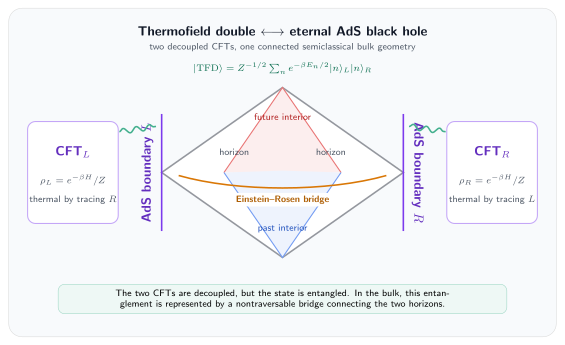
The slogan ER=EPR says that entanglement and spacetime connectivity are not separate phenomena in quantum gravity. The cleanest example is the thermofield-double state of two CFTs, which is dual to the eternal two-sided AdS black hole. The two CFTs are not coupled, but the bulk geometry contains an Einstein-Rosen bridge connecting the two exterior regions.
The guiding slogan of this page is
The phrase “as if” is doing real work. ER=EPR is not the claim that every entangled pair of spins is connected by a smooth classical wormhole. A smooth semiclassical bridge requires special large-, strongly coupled, highly entangled states. The thermofield double is the canonical example.
The thermofield double state
Section titled “The thermofield double state”Let a CFT have Hamiltonian and energy eigenstates . The thermofield-double state of two identical copies of the CFT is
where
The left and right CFTs are independent systems with Hilbert space
There is no interaction term coupling the two sides:
Nevertheless, the state is highly entangled. If we trace out the left CFT, the right CFT is thermal:
Similarly, tracing out the right CFT gives a thermal state on the left.
This is the first key lesson. A thermal density matrix can arise in two different ways:
- as a genuinely mixed state of a single system, or
- as the reduced state of a larger pure entangled system.
In the TFD state, the total two-CFT system is pure, but each side separately looks thermal. Holographically, each side separately describes one exterior of an AdS black hole, while the two sides together describe the maximally extended two-sided geometry.
The TFD state obeys
assuming the two copies have the same spectrum and the energy eigenstates are paired as above. Therefore the state is invariant under the boost-like evolution generated by . In the bulk, this corresponds to the time-translation Killing symmetry of the eternal black hole, which runs forward in time on one exterior and backward in time on the other.
By contrast, evolution by changes the two-sided slice through the wormhole and is associated with growth of the Einstein-Rosen bridge. This is one reason black-hole interiors are naturally connected to holographic complexity, which is the subject of the next page.
The eternal AdS black hole
Section titled “The eternal AdS black hole”The maximally extended AdS-Schwarzschild geometry has two asymptotic AdS boundaries. In bulk dimensions, a standard form of the metric outside either horizon is
with
for a spherical black hole. The horizon radius satisfies . The Hawking temperature is
The Lorentzian extension contains a right exterior, a left exterior, a future interior ending at a future singularity, and a past interior emerging from a past singularity. The two exterior regions are connected through a nontraversable Einstein-Rosen bridge. On a spatial slice at , the bridge is shortest. As the two-sided state evolves under , the bridge grows longer behind the horizons even though the exterior thermal state on each side remains essentially unchanged.
This gives a simple but deep lesson:
The horizon area is fixed in the eternal black hole, but the interior volume can grow for a very long time.
Nontraversability
Section titled “Nontraversability”The Einstein-Rosen bridge in the eternal black hole is not a shortcut through spacetime. A signal sent from the left boundary into the black hole cannot emerge at the right boundary. It hits the future singularity.
This is visible in the Penrose diagram. A causal curve entering from one boundary crosses the horizon and then is forced toward the singularity. The right exterior is outside its future light cone.
In the boundary description, this must be true because the two CFTs are decoupled. If
then an operation performed on the left CFT cannot send information to the right CFT. The reduced state on the right obeys autonomous unitary evolution under .
This is a beautiful consistency check:
The wormhole is present in the geometry, but it is not usable for communication.
ER=EPR
Section titled “ER=EPR”Maldacena and Susskind proposed the slogan ER=EPR:
The sharp statement is not that every entangled pair has a smooth wormhole. The more careful statement is that in quantum gravity, certain highly entangled states have a dual description in terms of connected spacetime geometry.
The TFD state is the prototype:
A pair of ordinary qubits in a Bell state,
is also entangled, but it does not have enough degrees of freedom to support a classical spacetime throat. If one insists on an ER=EPR interpretation, any associated “bridge” is Planckian and non-geometric. It is not described by classical general relativity.
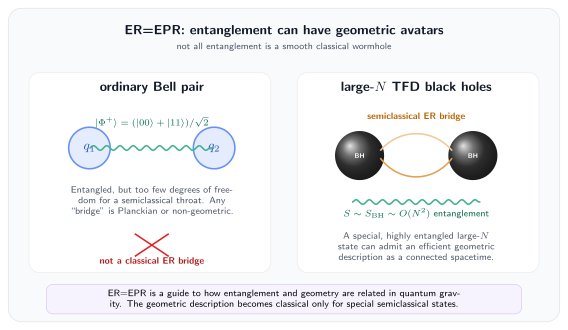
The safest formulation is:
This formulation connects ER=EPR to the broader lessons of holography. RT/HRT surfaces relate entanglement entropy to areas. Entanglement wedge reconstruction relates boundary subregions to bulk regions. Islands say that the entanglement wedge of the Hawking radiation can include part of the black-hole interior. ER=EPR says that entanglement can sometimes be represented geometrically as a bridge.
These are not identical statements, but they rhyme.
Mutual information and connectivity
Section titled “Mutual information and connectivity”A useful diagnostic of whether two boundary regions are geometrically connected is the mutual information
In holography, large- mutual information is controlled by competing extremal surfaces. When the dominant surface for is disconnected, the leading classical mutual information vanishes:
When the connected surface dominates, the mutual information can be order in a large- gauge theory:
This is not the same as saying that mutual information literally equals a wormhole. But it gives a practical lesson: robust semiclassical connectivity is associated with large, structured correlations. Tiny entanglement is not enough.
For the full left and right CFTs in the TFD state, the entanglement entropy of one side is the thermal entropy:
Since the total state is pure,
so
This large mutual information is one reason the two-sided black hole has a classical connected dual.
Traversable wormholes from a double-trace coupling
Section titled “Traversable wormholes from a double-trace coupling”The eternal wormhole is nontraversable when the two boundaries are decoupled. Gao, Jafferis, and Wall showed that a suitable interaction between the two boundaries can make the wormhole traversable.
The boundary interaction is often written schematically as a double-trace deformation,
or, with spatial dependence,
This is no longer a pair of decoupled CFTs. The interaction allows information transfer between the two sides. In the bulk, the same operation produces a negative averaged null energy shock near the horizon:
This negative energy creates a time advance for a signal that would otherwise fall into the singularity. With the right timing, a signal injected from the left can emerge on the right.
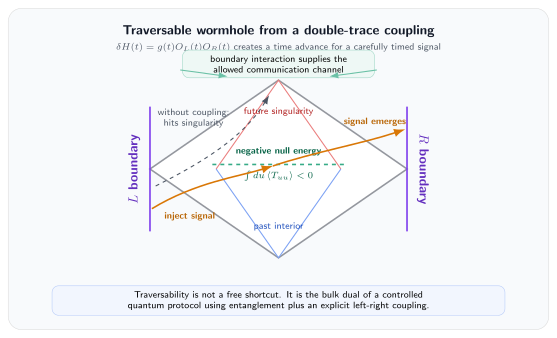
The traversable wormhole is therefore not magic. It is the gravitational description of a quantum-information protocol performed on two entangled systems with an allowed communication channel.
The dictionary is:
The statement that negative energy is needed is not accidental. Classical general relativity with ordinary energy conditions forbids traversable wormholes. Quantum effects can violate averaged energy conditions in controlled ways, but the amount and timing are constrained. In holography, these constraints are reflected in the boundary protocol.
Traversability as teleportation
Section titled “Traversability as teleportation”The traversable wormhole protocol has a teleportation interpretation. Ordinary quantum teleportation uses shared entanglement, a local operation and measurement, a classical communication channel, and a final decoding operation. The classical message does not itself carry the quantum state. It only tells the receiver how to decode the state from the entanglement resource.
The traversable wormhole is similar. The TFD state provides the shared entanglement. The double-trace coupling plays the role of a communication channel and decoding operation. The signal emerges from the other side, but the protocol does not allow faster-than-light communication because the two boundary systems have been coupled.
A compact way to say this is:
This viewpoint demystifies ER=EPR. The wormhole is not an independent channel in addition to quantum mechanics. It is the bulk description of a quantum protocol that uses entanglement and communication.
It also explains why traversability is delicate. A generic perturbation does not open the wormhole. The interaction must have the correct sign and timing so that the gravitational backreaction gives a time advance rather than a time delay.
Interior operators and precursors
Section titled “Interior operators and precursors”So far we have discussed the two-sided black hole. What about a one-sided black hole formed by collapse?
In AdS/CFT, a one-sided black hole is described by a pure state in a single CFT. The exterior is reconstructed by boundary operators in a relatively direct way. For a free bulk scalar field outside the horizon, the leading large- reconstruction has the schematic HKLL form
where labels boundary spacetime points and is a smearing kernel.
Behind the horizon, reconstruction becomes much more subtle. One reason is causal: no local signal from behind the horizon can reach the boundary. Another reason is algebraic: a naive state-independent operator representing the interior and commuting with all exterior operators is difficult to reconcile with finite-dimensional black-hole Hilbert space and unitarity.
Boundary descriptions of interior operators are usually precursors: operators that look simple at an early time but become highly complex when rewritten at a later boundary time. Schematically,
For times of order the scrambling time,
a simple operator evolves into an operator with support on many microscopic degrees of freedom. In the bulk, this complexity is related to the fact that the perturbation has fallen deep into the black-hole interior.
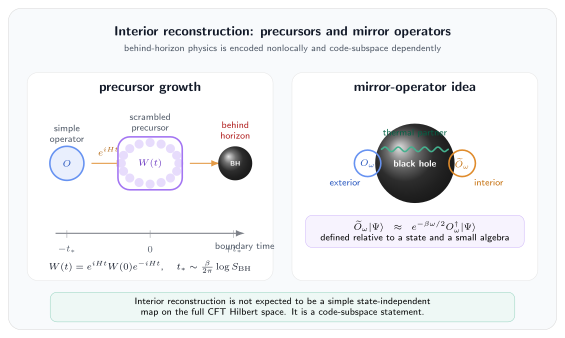
This is one operational meaning of the statement that the black-hole interior is encoded nonlocally in the boundary theory.
Mirror operators and state dependence
Section titled “Mirror operators and state dependence”For an eternal two-sided black hole, an interior mode can often be described using operators from both CFTs. Roughly, the left CFT supplies the degrees of freedom that purify the thermal right CFT. This makes the two-sided interior relatively tractable.
For a one-sided black hole, the purifier is not a second explicit CFT. It is hidden inside the same CFT state. Papadodimas and Raju proposed that interior operators can be reconstructed by mirror operators defined relative to a particular equilibrium state and a chosen small algebra of exterior observables.
A useful schematic relation is
where is an exterior mode of frequency , is its mirror partner, and is a black-hole microstate or code-subspace reference state. This is reminiscent of the thermofield-double relation
with thermal factors determined by the KMS condition.
The important point is not the exact formula, which depends on the setup. The important point is conceptual:
This state dependence is controversial, but it is not arbitrary. In quantum error correction, logical operators are defined by their action on a code subspace, not necessarily on the full physical Hilbert space. The black-hole interior may similarly be meaningful only within a semiclassical code subspace.
This is the same philosophy encountered in entanglement wedge reconstruction:
The interior is not expected to be represented by a simple, universal, state-independent boundary operator that works on all CFT states.
Relation to the firewall paradox
Section titled “Relation to the firewall paradox”The AMPS firewall argument involved a tension between smooth horizon effective field theory, unitarity of Hawking radiation, and monogamy of entanglement. In the two-sided eternal black hole, smoothness of the horizon is associated with entanglement between left and right modes. In a one-sided evaporating black hole, the late Hawking mode is correlated with both its interior partner and the early radiation if one uses naive semiclassical reasoning. That is the monogamy problem.
ER=EPR suggests a geometric way to think about the purifier of the black hole. If the black hole is highly entangled with another system, then that system may participate in the interior description. For an old evaporating black hole, the purifier is the early radiation. This gives a qualitative bridge to the island story:
In the island formula, this statement becomes precise. After the Page transition, the entanglement wedge of the radiation includes an island behind the horizon:
Thus interior degrees of freedom can be reconstructable from the radiation. ER=EPR provides intuition for why such a statement might be geometrically natural. The island formula and entanglement wedge reconstruction provide the sharper technical framework.
Two-sided versus one-sided interiors
Section titled “Two-sided versus one-sided interiors”It is useful to separate three cases.
Eternal two-sided black hole
Section titled “Eternal two-sided black hole”The state is on . The interior is shared between two explicit boundary theories. Correlators between the two sides diagnose the bridge. Traversable wormhole protocols can be implemented by explicitly coupling the boundaries.
One-sided black hole in a pure CFT state
Section titled “One-sided black hole in a pure CFT state”The state lies in one Hilbert space . There is no explicit second boundary. The black hole may still have a smooth interior for typical equilibrium microstates, but the encoding of interior operators is subtle and may require state-dependent or code-subspace-dependent reconstruction.
Evaporating old black hole plus radiation
Section titled “Evaporating old black hole plus radiation”The black hole is entangled with radiation. The radiation may be nongravitating, as in many island models, or it may be part of a larger holographic system. After the Page time, the fine-grained entropy calculation says that the radiation entanglement wedge includes an island. Operationally, sufficiently complete access to the radiation can reconstruct certain interior degrees of freedom.
These cases are related, but not identical. Much confusion comes from importing intuitions from one case into another without keeping track of the Hilbert space and the accessible algebra.
The role of complexity
Section titled “The role of complexity”Even if an interior operator is encoded in the boundary theory, it may be computationally inaccessible.
This is crucial for black-hole information. Unitarity says that the information is present in the Hawking radiation. It does not say that the information is easy to decode. In many models, decoding requires operations of enormous complexity.
The same is true for interior reconstruction. A boundary representation of a deep interior excitation may be a highly scrambled precursor. It may require a circuit whose size grows exponentially in natural parameters, or at least grows rapidly with the time depth of the interior excitation.
This gives a useful distinction:
The next page develops this point through holographic complexity proposals.
Common pitfalls
Section titled “Common pitfalls”“ER=EPR means every entangled pair is a classical wormhole.”
Section titled ““ER=EPR means every entangled pair is a classical wormhole.””No. A Bell pair is entangled, but it does not have a smooth semiclassical gravitational dual. A classical Einstein-Rosen bridge requires a large number of degrees of freedom and a very special pattern of entanglement.
“The eternal wormhole lets the two CFTs communicate.”
Section titled ““The eternal wormhole lets the two CFTs communicate.””No. The ordinary eternal AdS wormhole is nontraversable. This matches the fact that the two CFTs are decoupled.
“Traversable wormholes violate causality.”
Section titled ““Traversable wormholes violate causality.””No. In the holographic construction, the two boundaries are explicitly coupled. The bulk traversability is the geometric description of an allowed boundary communication protocol.
“Teleportation through a wormhole means science-fiction teleportation.”
Section titled ““Teleportation through a wormhole means science-fiction teleportation.””No. It is quantum teleportation: transfer of a quantum state using shared entanglement plus a communication channel. The classical message or coupling does not by itself carry the quantum state.
“The island formula is just ER=EPR.”
Section titled ““The island formula is just ER=EPR.””No. ER=EPR is a broad geometric intuition about entanglement and connectivity. The island formula is a concrete prescription for fine-grained entropy using quantum extremal surfaces. The two ideas are compatible, but not interchangeable.
“Interior operators must be simple boundary operators.”
Section titled ““Interior operators must be simple boundary operators.””No. They are generally highly nonlocal and code-subspace dependent. In old black holes, reconstruction from radiation may be possible in principle but extremely complex in practice.
Summary
Section titled “Summary”The thermofield double gives the cleanest holographic realization of the relation between entanglement and geometry:
The two CFTs are decoupled, so the Einstein-Rosen bridge is nontraversable. If we add a suitable double-trace coupling, the wormhole can become traversable, and the resulting process has the interpretation of a teleportation protocol with a geometric dual.
For one-sided and evaporating black holes, the interior is encoded in a more subtle way. It may require precursors, state-dependent mirror operators, or entanglement wedge reconstruction from radiation after the Page time. This is why black-hole interiors sit at the intersection of ER=EPR, quantum error correction, islands, and complexity.
Exercises
Section titled “Exercises”Exercise 1: tracing the thermofield double
Section titled “Exercise 1: tracing the thermofield double”Starting from
show that tracing over the left CFT gives
Solution
The pure-state density matrix is
Tracing over the left Hilbert space uses
Therefore
Thus each side of the TFD is thermal even though the full two-sided state is pure.
Exercise 2: the boost symmetry of the TFD
Section titled “Exercise 2: the boost symmetry of the TFD”Assume the two CFTs have identical spectra and that the TFD pairs the same energy level on the two sides. Show that
Explain the corresponding bulk symmetry.
Solution
Acting on a basis element gives
Since every term in the TFD sum is annihilated by , the whole state is annihilated:
In the bulk, this corresponds to the Killing time of the eternal black hole. The Killing flow runs forward on one exterior and backward on the other. This is different from the evolution generated by , which changes the two-sided slice and is associated with growth of the Einstein-Rosen bridge.
Exercise 3: why the ordinary ER bridge is nontraversable
Section titled “Exercise 3: why the ordinary ER bridge is nontraversable”Give both the bulk and boundary explanations for why a signal sent from the left exterior of the eternal AdS black hole cannot emerge at the right boundary.
Solution
In the bulk Penrose diagram, a future-directed causal curve sent from the left boundary through the horizon is forced toward the future singularity. The right exterior is not in its causal future. The Einstein-Rosen bridge is therefore nontraversable.
In the boundary theory, the two CFTs are decoupled:
A left operation changes the left state but cannot causally influence the right system. If the wormhole were traversable without a coupling, the right CFT could receive a message from the left despite the absence of any interaction, contradicting the boundary description. Thus decoupling of the CFTs and nontraversability of the bridge are the same statement in two languages.
Exercise 4: mutual information of the full TFD
Section titled “Exercise 4: mutual information of the full TFD”For the TFD state, compute in terms of the thermal entropy of one side.
Solution
The mutual information is
The full TFD state is pure, so
Each side is thermal with entropy
Therefore
For a large AdS black hole, is approximately the Bekenstein-Hawking entropy , so
This large mutual information is consistent with the existence of a smooth semiclassical bridge in the dual geometry.
Exercise 5: traversability and boundary coupling
Section titled “Exercise 5: traversability and boundary coupling”Why does making the wormhole traversable not violate causality in the boundary theory?
Solution
The traversable-wormhole construction adds an explicit interaction between the two boundary theories, for example
After this deformation, the two boundary systems are no longer decoupled. Information transfer from left to right is allowed because the Hamiltonian contains a communication channel. The bulk statement that a signal passes through the wormhole is the gravitational dual of this boundary communication protocol.
There is no causality violation because the signal does not travel between two independent systems without an interaction. The coupling is precisely what permits the transfer.
Exercise 6: mirror-operator intuition
Section titled “Exercise 6: mirror-operator intuition”Suppose an exterior mode has frequency in a thermal equilibrium state. Explain why a mirror operator satisfying
is reminiscent of the TFD relation between left and right operators.
Solution
In the TFD state, operators on one side can be related to operators on the other side when acting on , with thermal factors determined by the Boltzmann weights in the state. Schematically,
up to frequency-dependent thermal factors. The left degrees of freedom purify the thermal state of the right CFT.
For a one-sided equilibrium black hole, there is no explicit left CFT. The mirror-operator idea is that the purifier of the exterior thermal algebra is encoded within the same CFT state and can be represented relative to a code subspace. The relation
therefore plays a role analogous to the TFD left-right relation, but in a state-dependent one-sided setting.
Further reading
Section titled “Further reading”- Juan Maldacena, “Eternal Black Holes in Anti-de-Sitter”. The basic two-CFT/eternal-black-hole dictionary.
- Juan Maldacena and Leonard Susskind, “Cool Horizons for Entangled Black Holes”. The original ER=EPR proposal.
- Ping Gao, Daniel L. Jafferis, and Aron C. Wall, “Traversable Wormholes via a Double Trace Deformation”. The canonical holographic traversable-wormhole construction.
- Juan Maldacena, Douglas Stanford, and Zhenbin Yang, “Diving into Traversable Wormholes”. Traversability, nearly-AdS dynamics, and the teleportation interpretation.
- Leonard Susskind and Ying Zhao, “Teleportation Through the Wormhole”. A direct discussion of quantum teleportation through ER=EPR.
- Kyriakos Papadodimas and Suvrat Raju, “State-Dependent Bulk-Boundary Maps and Black Hole Complementarity”. Mirror operators and state-dependent interior reconstruction.
- Ahmed Almheiri, Xi Dong, and Daniel Harlow, “Bulk Locality and Quantum Error Correction in AdS/CFT”. The quantum-error-correction viewpoint on bulk locality.
- Daniel Harlow, “Jerusalem Lectures on Black Holes and Quantum Information”. A broad pedagogical review of the information paradox, complementarity, and holography.