
The GSO Projection and Open-String Supersymmetry
The Gliozzi–Scherk–Olive (GSO) projection removes the open NS tachyon and correlates Ramond chirality with fermion-oscillator occupation. Its massless states are a vector and a Majorana–Weyl spinor, with eight physical polarizations each. More surprisingly, the bosonic and fermionic degeneracies agree at every mass level. We will derive the projectors, explain why they act consistently on physical states, and prove that equality using oscillator products and a theta-function identity.
The setting is a free critical RNS string in flat ten-dimensional spacetime, with Neumann conditions in all directions and nonzero momentum. Counts below are for one Chan–Paton endpoint pair and omit additional endpoint multiplicities. The open-string spectrum supplies the constraints and mass formulas; Ramond ground-state spinors supplies the Clifford algebra and physical spinor space. The shared worldsheet normalization and spacetime spinor definitions apply throughout. The historical construction is due to Gliozzi, Scherk and Olive (1976, 1977).
Fermion parity and the NS projection
Section titled “Fermion parity and the NS projection”Let count nonzero fermion creation operators modulo two. Bosonic oscillators do not change this parity. In the NS sector, the projection of interest is
It retains odd fermion occupation. Equivalently, define the matter grading ; retained states have . This minus sign assigns the NS oscillator vacuum negative matter parity. The gradings and both square to one, so .
The NS vacuum has no fermion excitations and mass , so it is removed. The one-fermion vector survives:
Every NS fermion contributes a half-integer level, while each boson contributes an integer. Thus
Odd occupation leaves with , hence
The intermediate unprojected levels with integer disappear. This is a statement about oscillator occupation, not spacetime statistics: retained NS states are spacetime bosons even though their worldsheet-fermion occupation is odd. The three notions—oscillator parity, the matter grading , and spacetime Bose/Fermi statistics—must be kept distinct.
Why the physical constraints survive
Section titled “Why the physical constraints survive”The matter stress tensor is even in fermions, whereas the supercurrent contains one fermion. Their modes therefore obey
Here is the appropriate matter grading in either sector. If , then . Commutation with is unnecessary: anticommutation also preserves its kernel. The same argument includes the Ramond constraint and, together with , preserves the mass shell and all positive-mode constraints.
In the NS sector there is also a quotient to respect. Let be its constrained covariant state space and let be its radical: states orthogonal to every state of . The NS parity transformation is invertible and preserves the oscillator inner product. Since it preserves , it also preserves :
Consequently the projector acts on . This is stronger and more precise than merely observing that a particular null state has zero norm. A descendant has the opposite parity to its parent, so a projected-out parent can still produce a retained gauge direction; exercise 1 checks the photon example. In either sector, the same commutation relations also preserve the subspace generated by constraint descendants: and . Their intersection with the physical kernel is therefore invariant as well. Ramond counting below uses the positive transverse state space, without assuming that the covariant Ramond pairing is the NS oscillator pairing.
Ramond parity includes the excited oscillators
Section titled “Ramond parity includes the excited oscillators”The Ramond zero modes are on the zero-mode spinor module. To reverse every fermion mode, including these zero modes, the grading must contain both chirality and nonzero-mode parity:
Here acts on the zero-mode factor. It is the globally fixed chirality operator, not a freely adjustable sign. The two choices of retained eigenvalue give parity-conjugate spectra. When an absolute choice is needed, agrees with the shared polarization chirality; writing keeps both choices visible.
On a state with oscillator parity , the coefficient spinor must have
At level zero this is a single chirality. One bosonic oscillator leaves it unchanged, while one nonzero fermion oscillator requires the opposite coefficient chirality. Thus the ground-state rule cannot be applied unchanged to every excited coefficient.
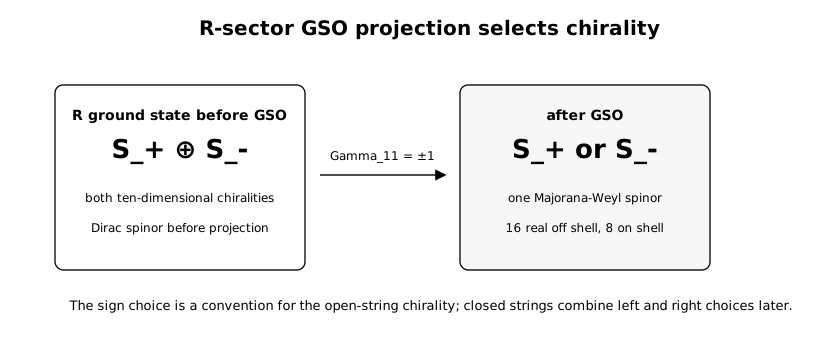
The retained eigenvalue is . The chirality labels belong to the zero-mode coefficient spinors; excited coefficients at a massive momentum are not independently physical massless ground states. In the transverse description, the two zero-mode modules are the opposite spinors and . This is a schematic parity diagram, with no spacetime scale.
A useful explicit check uses an ordinary tensor product with the grading inserted. If acts on the nonzero-mode Fock space, represent the fermions by
Then , because . The full parity is and anticommutes with both kinds of mode. Replacing by would make zero and nonzero modes commute, which is the wrong algebra. Exercise 2 follows the chirality correlation through an excited constraint.
The massless vector and gaugino
Section titled “The massless vector and gaugino”For the retained NS vector, the constrained polarization space is
At a nonzero null momentum, the transverse condition leaves nine components and the gauge equivalence removes one. These eight polarizations form the vector of .
For the retained R ground state, the conditions are
The previous page constructed this chiral Dirac kernel and found complex dimension eight. It carries one of the two spinor representations of ; the null-translation part of the massless stabilizer acts trivially. A Majorana–Weyl field has sixteen real components before its equation of motion, but the reality condition pairs opposite Fourier momenta. It does not impose a second halving on the eight complex positive-frequency polarization amplitudes.
The result is the on-shell field content of a ten-dimensional vector multiplet, and a Majorana–Weyl gaugino . Equal dimensions do not identify with or as rotation representations. Supersymmetry relates different representations; it does not turn a vector into a spinor by an ordinary rotation.
The first massive multiplet
Section titled “The first massive multiplet”We now count physical transverse oscillators, using the critical light-cone description of the covariant physical quotient. There are eight bosonic and eight fermionic transverse directions. This description assumes the usual critical-string equivalence and nonzero momentum; counting all ten covariant oscillator labels without constraints would give the wrong answer.
At , the NS level is . Its three types of state are
where . The last coefficients are antisymmetric because the fermion modes anticommute. Therefore
To interpret the result under the massive little group , decompose the into . Splitting a nine-dimensional index into eight directions and the ninth gives
Here is a symmetric traceless tensor and is a three-form. Their restrictions account for precisely the NS oscillators above.
At the same mass, the R level is . Its transverse zero-mode space before projection is . The and excitations retain opposite zero-mode modules, so the R content is
This is the restriction of the gamma-traceless vector-spinor of . Indeed, if is a vector-spinor with , its gamma trace is . The trace map is onto: any spinor is the trace of . Its kernel therefore has dimension
These branchings identify the physical first massive content as , using critical Lorentz covariance. They do not replace a full elimination of covariant massive constraints and null states. Exercise 3 derives the branchings directly and explains the gamma-trace restriction.
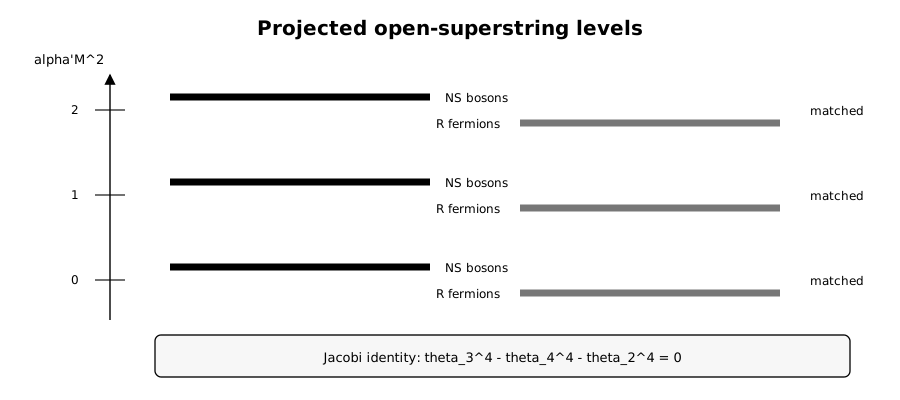
Both columns use the same dimensionless mass coordinate and the same physical degeneracies . Their horizontal separation distinguishes statistics; line lengths do not encode degeneracy. The unprojected NS tachyon at is shown separately as removed. Chan–Paton multiplicities are omitted. The axis is linear; the spectrum continues beyond the displayed levels.
Count every level with oscillator products
Section titled “Count every level with oscillator products”Introduce a formal variable which counts the dimensionless mass squared:
These are ordinary positive state counts. The spacetime supertrace is their difference, not either function separately. A bosonic mode of frequency can occur any number of times, giving . The eight transverse bosons contribute
Each fermionic oscillator is occupied zero or one times. Let
counts every NS occupation; weights it by . Their half-difference selects odd occupation, and the NS intercept shifts level to mass. Hence
The leading difference is , so the apparent negative power cancels and starts with eight massless states.
In the R sector the nonzero fermions have integer frequencies. For each occupation configuration, the full projection retains eight of the sixteen transverse zero-mode states: it selects one chirality for even occupation and the other for odd occupation. Consequently
Equivalently, the trace with vanishes on the zero-mode space because the two chiralities have equal dimension. Inserting halves its dimension from sixteen to eight. There is no additional factor of two to remove.
Direct expansion gives, independently in the two sectors,
The first massive calculation checked the coefficient. Exercise 4 obtains the coefficient without presupposing equality. A finite list of matching coefficients is suggestive; the following identity proves equality to every order.
Jacobi’s identity from two integer lattices
Section titled “Jacobi’s identity from two integer lattices”For the analytic calculation take with , and write . The theta constants and Dedekind eta function are
Fractional powers here mean , so their phases are fixed. The product identities in DLMF §20.5, translated from its nome , give
Raising the products to fourth powers and using yields
The factor in , followed by division by two, reproduces the eight Ramond zero-mode states. The powers of reproduce the NS intercept and its absence in R. Confusing the two nomes would double the oscillator spacing and spoil this comparison.
Same-parity pairs give the first two duplication formulas
Section titled “Same-parity pairs give the first two duplication formulas”In the absolutely convergent double sum for , set
The image consists exactly of integer pairs with : the inverse is , . Split it into even/even and odd/odd pairs. With , the weight becomes ; with , it becomes . Therefore
For the extra sign is . It is positive on the even/even branch and negative on the odd/odd branch, giving
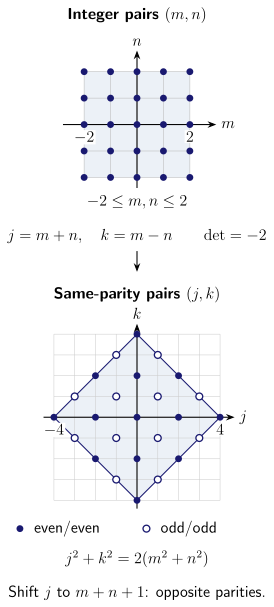
The displayed window is . Its image contains 25 points in a diamond; filled markers are even/even and open markers odd/odd. Within each coordinate plane, the horizontal and vertical scales are equal. The map has determinant , so the image occupies an index-two sublattice, and . The finite window illustrates the infinite bijection used in the proof; it is not a finite approximation asserted to satisfy the theta identity exactly.
Shifted pairs give the third formula
Section titled “Shifted pairs give the third formula”For , set instead , . Now is odd, so the image has opposite parities. The inverse is , , and
The even/odd and odd/even branches contribute equally, producing
Write and . The three duplication formulas now imply
This is Jacobi’s theta-constant identity, DLMF 20.7.5, often called the abstruse identity in string theory. Absolute convergence justifies the rearrangements for . Substitution into the character formulas proves ; uniqueness of their power-series coefficients establishes at every mass. The eight transverse fermions matter: their product powers become fourth powers of theta functions, precisely the powers in this identity.
What the matching establishes about supersymmetry
Section titled “What the matching establishes about supersymmetry”Equal degeneracies are a necessary spectral feature of unbroken supersymmetry. To see more than a count, examine the massless polarization maps. Let have the same ten-dimensional chirality as , using the shared transpose pairing . The possible on-shell structures include
The proportionality symbols leave the field normalization and phase unspecified. Nevertheless, their kinematic properties follow exactly:
Two gamma matrices preserve chirality, so has the required chirality. Using transversality to remove the symmetric Clifford product gives
This explains the field-strength structure in the gaugino transformation. It does not say that every fixed gives an invertible map: if , then for transverse .
A full supersymmetry argument constructs the sixteen real spacetime charges, fixes their normalization, and checks their action and anticommutators. In RNS language the charge current involves a spin field dressed by the superghost, , whose weights add to . Mutual locality with this current selects the appropriate spectrum. The required spin fields, ghost pictures and charge OPEs are developed in bosonization, spin fields and superghosts, NSR vertex operators and picture changing, and the more detailed String II supersymmetry construction. Matter parity alone should not be confused with a picture-dependent ghost-dressed grading.
The GSO choice studied here is the supersymmetric open-sector choice. As discussed by Weigand, §§6.5 and 6.7, consistent sector choices also require locality and, for a complete closed theory, modular consistency; not every such choice is supersymmetric. Type 0 closed strings supply a counterexample. In an open-string theory one must additionally specify the closed sector, boundary conditions and Chan–Paton data and check the relevant tadpole and anomaly constraints. The vanishing oscillator supertrace derived here does not perform those checks or evaluate a complete one-loop amplitude.
With suitable coincident D-branes and Chan–Paton endpoint labels, the massless fields acquire a nonabelian gauge interpretation. Lower-dimensional branes give dimensional reductions of this vector multiplet. The next page combines left and right sectors and distinguishes the type IIA and type IIB spectra.
Common pitfalls
Section titled “Common pitfalls”Applying only a chirality projector at every R level. An odd nonzero-fermion occupation reverses the coefficient chirality required by the full GSO projection. The massive equation mixes coefficients of these opposite chiralities.
Removing a gauge direction because its parent is projected out. reverses matter parity. A retained physical descendant can arise from an excluded parent, as the photon gauge state demonstrates.
Treating equal dimensions as equal representations. , and all have dimension eight, but they have different rotation characters. Likewise, a vanishing unrefined supertrace is not a derivation of the normalized interacting supersymmetry algebra.
Exercises
Section titled “Exercises”1. Follow the photon gauge state through the projection
Section titled “1. Follow the photon gauge state through the projection”At nonzero null momentum, take the NS oscillator vacuum as the parent of . Determine both parities, verify the descendant’s physical constraint and orthogonality, and explain why this parent is not a physical tachyon. Then prove that a parity-preserving physical space has a parity-preserving radical.
Solution
The parent has ; is odd, so the descendant has and is retained. Using the open-string zero mode,
At , the parent has plane matter weight . The descendant has weight , the correct NS physical weight. Since annihilates the parent,
Larger positive modes vanish by level. For any physical photon , its overlap with the descendant is proportional to , so the descendant lies in the radical and implements . Its own norm is proportional to .
The parent is a useful oscillator state at this momentum, but it is not an on-shell NS vacuum: a physical unprojected tachyon would require . Conflating these two momenta would invalidate the null-state argument.
More generally, let be orthogonal to and let . Since is an isometric involution and , . Thus , and either parity projector descends to the quotient. A bare zero-norm condition in an indefinite space would not suffice for this proof.
2. Couple opposite coefficient chiralities at the first R level
Section titled “2. Couple opposite coefficient chiralities at the first R level”Use the graded tensor realization to check the mixed zero/nonzero-mode anticommutator and the full parity. At R level one let
Determine the two coefficient chiralities, solve the equation, and show the failure of a chirality-only projection.
Solution
The mixed anticommutator is . The product anticommutes with because of the Clifford factor and with because of the Fock parity factor. Both factors square to one, so the full projector is idempotent.
Retaining requires
The oscillator algebra gives and . Moving to the right therefore gives
The first equation fixes . Because , the second becomes and is satisfied. Since anticommutes with , the two equations respect precisely the opposite coefficient chiralities found above.
A chirality-only rule assigning both coefficients eigenvalue would make and belong to opposite eigenspaces. Their sum could vanish only if both vanished; invertibility of would then kill too. Likewise, imposing a massless ground-state Dirac equation on each coefficient would kill the entire level. Further positive-mode constraints and null equivalences are still required for the physical massive space; the spectrum page, exercise 6, derives the additional condition.
3. Derive the massive little-group branchings
Section titled “3. Derive the massive little-group branchings”Split the index into and . Derive the restrictions of the symmetric traceless tensor, three-form and gamma-traceless vector-spinor. Explain why the last has the same dimension as the sum of the first two without being the same representation.
Solution
A symmetric tensor has components , and . Write as its eight-dimensional traceless part (35 components) and its trace. The nine-dimensional trace equation determines from that trace, leaving one scalar, while is an eight-vector. Hence .
For a three-form, the independent components are and . They have dimensions and , so . Together these give , exactly the NS content .
The spinor has sixteen components and restricts to . Its vector-spinor gamma-trace equation can be solved as
because . The eight spinors are otherwise unrestricted. This gives the explicit identification and dimension . Equivalently, the trace map has a right inverse , so its rank is sixteen.
Under a rotation, the tensor representations act as , while the vector-spinor acts as . Their equal dimensions cannot make them isomorphic. They can be bosonic and fermionic components of a supersymmetry multiplet because the supercharges themselves transform as spinors.
4. Count the second massive level twice
Section titled “4. Count the second massive level twice”Without using Jacobi’s identity, count projected NS states at by the number of fermionic oscillators, and R states at by nonzero-mode oscillator content. Check the chirality projection configuration by configuration.
Solution
NS occupation must be odd, so there are one-, three- and five-fermion contributions. With one fermion, the possibilities are a mode by itself; a mode together with a boson at level one; or a mode together with bosonic level two. The latter bosonic level has eight modes and two-mode excitations. Thus
For three fermions, either one has frequency and the other two frequency , or all three have frequency and there is a level-one boson. The unequal-frequency mode carries an independent transverse index, so
Five fermions must all have frequency , giving . Altogether .
For R nonzero modes at level two, the purely bosonic possibilities contribute , the purely fermionic possibilities contribute , and mixed contributes . The nonzero-mode count is therefore . More specifically, even occupation has configurations, while odd occupation has . Each configuration retains eight zero-mode states of its required chirality, so
These counts also follow by expanding the individual boson and fermion factors to this order. No equality between the sectors was assumed; the agreement independently checks the projection, intercept and zero-mode factor.
5. Refine the count by a rotation
Section titled “5. Refine the count by a rotation”Let be a rotation through in one transverse two-plane, continuously lifted to . Compute its traces on and on either chiral spinor using their weights. Do the equal massless degeneracies imply equal traces? Explain what happens at and why this does not contradict the unrefined character identity.
Solution
In , six directions are unchanged and the rotated plane has eigenvalues . Therefore
The spinor weights in four transverse two-planes are with , with a fixed parity of minus signs for each chirality. For either chirality, four weights have and four have . Hence
At , both expressions are eight, as required by the unrefined count. At , the vector trace is but both spinor traces are ; the lift is the nontrivial central element above the identity rotation in . Even near zero the two traces differ, starting at .
Thus inserting a rotation in the trace refines the information and need not preserve the unrefined cancellation. A supercharge is itself a spinor and generally does not commute with the inserted rotation. The identity proved in the main text counts dimensions with no angular insertion, so there is no contradiction.
6. Test the polarization maps and a vanishing parameter choice
Section titled “6. Test the polarization maps and a vanishing parameter choice”For a nonzero null , let and , and take and of the retained chirality. Check the two proportional polarization maps in the text, including their behavior under a photon gauge shift. Show that a nonzero can annihilate the vector-to-spinor map for every transverse . State what would still be needed to establish the supersymmetry algebra.
Solution
For , the Dirac equation is . Under , its change is . The product of two gamma matrices commutes with , so has the chirality of .
For , contraction with gives . The transpose pairing is essential to its Lorentz transformation as a vector. These statements hold for complex polarization amplitudes; a compatible spacetime Majorana condition is imposed on the full Fourier field.
There are eight nonzero independent chiral choices in for . For any of them,
Consequently a fixed supersymmetry parameter need not define an isomorphism of the two eight-dimensional polarization spaces. The kinematic maps supply the correct tensor structures; they neither choose their relative normalization nor prove a charge anticommutator. One must construct the ghost-dressed currents, their action on physical vertices, and their OPEs with the correct picture identifications to obtain the spacetime superalgebra. Interactions and open/closed consistency require further checks beyond this free calculation.
The maps exchange NS spacetime bosons and R spacetime fermions. Their matter GSO eigenvalues describe retained sectors, not spacetime statistics; a spacetime supersymmetry transformation is not the worldsheet operation of applying a single descendant.
References
Section titled “References”- Gliozzi, Ferdinando, Joël Scherk, and David Olive. “Supergravity and the Spinor Dual Model.” Physics Letters B 65, 282–286 (1976). doi:10.1016/0370-2693(76)90183-0. Historical introduction of the projection.
- Gliozzi, Ferdinando, Joël Scherk, and David Olive. “Supersymmetry, Supergravity Theories and the Dual Spinor Model.” Nuclear Physics B 122, 253–290 (1977). doi:10.1016/0550-3213(77)90206-1.
- National Institute of Standards and Technology. Digital Library of Mathematical Functions, chapter 20, “Theta Functions,” §§20.5 and 20.7, equations 20.5.2–4 and 20.7.5. Products; theta-constant identity. Its nome is .
- Weigand, Timo. Introduction to String Theory. Heidelberg University, winter term 2011/12, §§6.5 and 6.7, pp. 139–147. Author’s lecture notes.