
Bosonization, Spin Fields, and Spacetime Supersymmetry
A Ramond ground state is a spacetime spinor because its fermion zero modes generate a Clifford algebra. A spin field is the worldsheet operator that creates that state. Bosonization constructs these operators explicitly and makes their branch cuts, conformal weights, and chirality calculable.
The next question is more demanding: can a spin field generate spacetime supersymmetry? The answer requires its superghost dressing, BRST closure, and locality with the chosen spectrum. Tracking these ingredients also explains why the familiar transformation of a gauge boson into a gaugino contains the field strength.
We use the shared worldsheet normalization and spacetime notation, building on NS/R representations and the physical GSO-projected spectrum. Most calculations concern one chiral sector of the flat ten-dimensional theory. The superghost and BRST ingredients introduced near the end will be developed systematically on the next page.
A complex fermion as a bosonic charge operator
Section titled “A complex fermion as a bosonic charge operator”For two positive-norm real fermions, form
Their singular elementary products pair opposite charges: , and the reversed-charge ordering has the same pole. Introduce a chiral boson with and exponential fields
Wick contraction gives a useful calculation rule:
Thus has a simple pole, whereas begins at order . For one species, the local identification is , with phases fixed consistently. Several species will require additional operators called cocycles.
Deriving the current and stress tensor
Section titled “Deriving the current and stress tensor”Point splitting identifies the composite operators rather than guessing them. Put the two insertions symmetrically about , with separation . Then
The constant term is the normal-ordered charge current. The coefficient of is
where the last equality uses fermionic ordering. It is precisely the stress tensor of the two real fermions. We have therefore derived
The current measures the exponent’s charge, and the stress tensor measures its weight:
In particular . The double contraction in is , so , exactly the sum of two real-fermion central charges. These checks establish the local current algebra, stress tensor, and elementary fermion OPEs in the bosonic description.
Charge sectors and the meaning of compactness
Section titled “Charge sectors and the meaning of compactness”The algebra generated by changes charge by integers. Starting from the NS vacuum of charge zero produces states in integer-charge sectors. Ramond states instead belong to sectors with
These are twisted modules: fermion fields act on them, but a half-charge field is not an ordinary single-valued function on the same untwisted charge sector. Saying that is compact encodes a quantized charge lattice. An identification such as , taken alone, does not make an ordinary single-valued function. One must also specify the allowed sectors and their spin structures.
For a full nonchiral theory, the left- and right-moving sectors and their pairings supply further global data. The local bosonization formula does not choose those pairings or prove modular invariance. This distinction will matter when comparing supersymmetric Type II theories with other consistent projections.
Spin fields create Ramond states
Section titled “Spin fields create Ramond states”The two lowest-weight half-charge operators are
Their products with a fermion include
The other two products begin with and create higher-weight fields. Both powers change sign when makes one counterclockwise turn around the insertion. The square-root branch therefore changes the fermion’s boundary condition in radial quantization.
Why a plane branch gives a periodic cylinder fermion
Section titled “Why a plane branch gives a periodic cylinder fermion”Under the shared cylinder map , a field of weight transforms as
A turn changes by a minus sign. Around the untwisted plane vacuum, the fermion itself is single-valued; its cylinder representative is therefore antiperiodic, as required in the NS sector. Around a spin field, the fermion’s plane monodromy is also minus, and the two signs multiply to plus. This is the periodic Ramond sector.
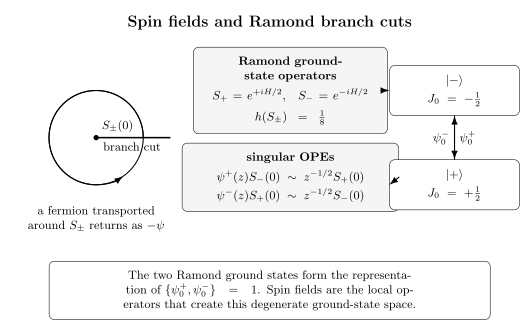
The contour is counterclockwise. A spin field changes the plane fermion’s monodromy; the conformal spin-frame factor supplies a second minus sign under a cylinder turn. The branch cut can be moved by convention and is not a physical boundary. This is a schematic relation between operator sectors, not a metric drawing.
The singular terms above also give the zero-mode action. In the Ramond expansion , the coefficient of is the zero mode. Hence maps to and annihilates , while does the reverse. Their anticommutator is one. Bosonization has recovered the two-state Clifford module directly from local products.
Cocycles and ten-dimensional spinors
Section titled “Cocycles and ten-dimensional spinors”Exponentials involving independent bosons commute, whereas distinct fermions must anticommute. Coordinate powers alone cannot repair this: the missing exchange signs come from operators acting on the charge zero modes.
For two species, let
One useful choice is
Indeed, for ,
Different species therefore anticommute. Within the second species the inverse factors cancel, preserving its unit OPE coefficient. The inverse in matters: need not equal its inverse when is half-integral. For five species the same construction uses .
Spin fields also need consistent cocycle phases. These determine matrix-element signs and the representation of charge conjugation; they do not change the powers of , the weights, or the chirality selection rules derived below. This use of bosonic charges and cocycles is developed in Friedan, Martinec, and Shenker.
Five charge directions, with the timelike component treated explicitly
Section titled “Five charge directions, with the timelike component treated explicitly”To use positive-norm bosons, first continue the tangent-space fermion algebra to a Euclidean basis:
Then . Pair and write
The 32 Ramond ground-state operators are
The simultaneous eigenvalues of the five currents are the five spinor weights . Fermion zero modes change one sign. In a basis of Clifford occupation numbers , choose the vacuum annihilated by . Then
This agrees with the Clifford construction on the previous page: an even or odd number of minus signs gives one of the two 16-dimensional Weyl representations. Undoing the tangent-space continuation restores and the Lorentzian Clifford algebra. It does not impose a Majorana condition. The 32 spin fields span a complex Dirac representation; a spacetime Majorana reality condition is a separate relation between field coefficients. Fixed-momentum polarization amplitudes can remain complex.
The fermion–spin-field OPE and gamma matrices
Section titled “The fermion–spin-field OPE and gamma matrices”With consistent cocycles, the singular product has the covariant form
The coefficient follows from . Each gamma matrix reverses chirality. The singular part acts within the Ramond ground-state space; regular terms include excited twist fields and must not be identified with additional zero-mode actions.
Which spin-field products contain the identity or a vector?
Section titled “Which spin-field products contain the identity or a vector?”For two weights , let be the number of entries with opposite signs and the number with equal signs. Their exponential product begins as
The remaining charge has entries equal to or . Its lowest operator is a product of distinct complex fermions. The relative chirality is , so
| Input chiralities | Allowed values of | Leading channels and powers |
|---|---|---|
| Opposite | Identity: ; two fermions: | |
| Equal | Vector: ; three fermions: |
The identity coefficient is the charge-conjugation pairing between opposite Weyl representations. The vector coefficient for equal chirality is proportional to the corresponding block of . Thus an unqualified formula containing both identity and vector channels hides essential chirality information. The charge calculation establishes both the allowed channels and their singularity powers without choosing explicit gamma matrices.
Dressing spin fields into physical supercharges
Section titled “Dressing spin fields into physical supercharges”A spin field alone has weight , not one. The missing contribution comes from the bosonized superghost. The new scalar is distinct from the five matter bosons : although , its stress tensor has a background-charge term,
Double contraction with gives
In particular . The candidate supercharge current and its counterclockwise contour integral are therefore
Here the superscript denotes the superghost picture, and is an overall normalization to be fixed when comparing spacetime generators. There is no momentum exponential: the charge carries zero spacetime momentum.
Weight one is necessary, but BRST closure also matters
Section titled “Weight one is necessary, but BRST closure also matters”The superghost bosonization introduces fields with . Physical vertices are taken in the small Hilbert space, the subspace annihilated by ; no zero mode is included. The current above belongs to that space.
One can already check its BRST closure using the structure of the standard RNS BRST current. Its conformal part acts on a weight-one primary as a total derivative:
The additional matter term is proportional to . At zero momentum, has at worst a singularity. The superghost product contributes , so their product has no pole. The term proportional to is also regular, because its exponential product contributes . Thus the contour charge is BRST closed. A generic weight-one operator would not pass these extra checks.
To act on physical states, the current must also be mutually local with them and compatible with the worldsheet’s global spin structure and boundary conditions. The construction of a physical supersymmetry generator therefore uses more than the sum . Friedan, Martinec, and Shenker, sections 5–6, establish its BRST and picture interpretation.
Locality selects the supersymmetric projection
Section titled “Locality selects the supersymmetric projection”The fractional coordinate power in the product of with a vertex containing is
The first term comes from matter and the second from superghosts. Integer shifts caused by descendants do not affect a full-turn monodromy. Cocycles implement graded exchange signs, but do not turn a half-integral full-turn exponent into an integral one. A contour charge can be deformed around an allowed vertex without a branch ambiguity when is integral.
NS tachyon and vector
Section titled “NS tachyon and vector”An NS vertex in picture has integer matter charges. Since each is odd,
where is the number of fermion excitations modulo two. Each fermion changes the sum of charges by an odd integer; bosonic oscillators do not.
The tachyon has and hence . The vector term has , equal to or . Therefore the odd-fermion NS states are local with the chosen supercharges, while the tachyon is not. This is the supersymmetric NS projection derived from a complete matter-plus-superghost product.
Ramond chirality depends on picture
Section titled “Ramond chirality depends on picture”For a Ramond ground-state weight , let again count signs different from . At picture ,
Locality requires even : the physical spin fields have the same chirality as the selected supercharge fields. At picture , however,
Now must be odd. The corresponding matter spin field has the opposite chirality. The complete vertex, including its ghost factor, has the same locality property in the two pictures. Changing the picture without changing the matter representative would be an error.
This argument characterizes the projection compatible with these spacetime supercharges. It does not prove that every consistent GSO projection is supersymmetric. For example, Type 0 theories use other left/right pairings and do not retain these spacetime charges; their existence was discussed on the preceding page. Nor does this chiral locality test replace a torus modular-invariance calculation or an open-string channel-consistency calculation.
Supersymmetry transformations with their pictures included
Section titled “Supersymmetry transformations with their pictures included”Consider massless open-string states with Neumann conditions in all ten spacetime directions and a boundary sector preserving the selected supercharges. The polarization below is then a ten-dimensional vector. On a D-brane, dimensional reduction separates tangential gauge components from transverse scalar components. In the doubled description, the boundary coordinate is , so define
This follows from the shared chiral OPE. It fixes the momentum factors in the calculation without changing that OPE’s normalization.
Suppress a common ghost when using unintegrated vertices, as well as coupling and Chan–Paton factors. Representatives for the vector and gaugino are
The vector polarization is identified under , and has the selected Weyl chirality. To make the spinor notation precise, denotes the basis operator creating , and is the state–operator map applied to a polarization column. It is not an invariant contraction of two independently transforming spinor fields. The matrix entries are defined by
thus the gamma matrix acts on the column . The label below denotes the chirality of this basis subspace and its polarization column; similarly labels the chosen linear combination of supercharge components. The matrix will appear explicitly in invariant bilinears such as . This distinction matters because the two complex Weyl representations of are dual to one another.
Below, suppresses the overall charge normalization and consistent cocycle phases, while retaining momentum dependence, chirality, and picture exactly.
A vector first becomes a spinor in picture −3/2
Section titled “A vector first becomes a spinor in picture −3/2”Apply to . The matter product contributes , and
The simple pole produces
The matter spin field has the opposite chirality, as both the gamma matrix and the locality test require. There is no momentum factor yet.
The picture-changing operator raises picture by one. Its matter contribution is proportional to , with . In its product with , the relevant powers are
They yield a finite term proportional to . In fact the displayed matter term alone gives the coefficient with the normalizations above. The complete BRST picture map, including its ghost terms, identifies the physical classes as
Thus the gaugino variation contains a derivative. With ,
The last equality uses transversality. This derives the linearized Yang–Mills form . It also checks the equations of motion and gauge invariance: , while replacing by leaves unchanged.
The reverse transformation already has picture −1
Section titled “The reverse transformation already has picture −1”In , the equal-chirality spin-field product has a vector pole of order . The ghost product supplies . The residue therefore gives
Here denotes the invariant spinor pairing, extended complex-linearly when discussing complex amplitudes. The Dirac equation implies . This is the linearized vector variation .
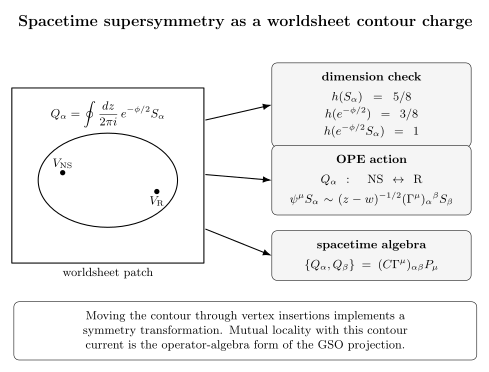
The contour charge carries picture . Pictures add in its operator product, while picture changing raises the result by one and reverses the matter spinor chirality through . The Ramond equivalence shown is for BRST classes at nonzero null momentum in the supersymmetric sector. Overall transformation normalizations are suppressed; the diagram is schematic.
Why nonzero momentum matters
Section titled “Why nonzero momentum matters”The BRST analysis gives the following physical identifications at nonzero null : the coefficient is a Weyl spinor modulo ; the coefficient satisfies . The map identifies their eight-dimensional physical spaces. Exercise 5 proves the resulting linear-algebra isomorphism from the Clifford relations. The assertion that the quotient directions are BRST trivial is input from the BRST analysis, not a consequence of that Clifford calculation alone.
At the momentum map vanishes, so this argument does not give a universal picture isomorphism. The zero-momentum supersymmetry currents require their own operator treatment. Picture changing is a relation between appropriate BRST classes; it is not permission to replace every local operator at every momentum by a superficially similar expression.
The supercharge algebra and its scope
Section titled “The supercharge algebra and its scope”Two supercharge currents of the retained chirality have a simple vector pole:
The tensor is proportional to the equal-chirality block of , with its numerical coefficient set by spin-field and charge normalization. There is no identity pole for equal chirality. Consequently the contour anticommutator first produces a translation current in picture :
Unlike the zero-momentum Ramond map just discussed, picture changing this NS current is nonzero even at zero momentum. The ghost product in supplies , while the contraction supplies its inverse; the remaining field is proportional to . In the open doubled normalization, the physical translation operator is
After fixing the overall normalization of the supercharges and identifying pictures on physical classes, this gives the spacetime supersymmetry algebra proportional to . It is an on-shell statement in the RNS description, not a literal equality of local currents in one fixed picture. The issue is emphasized explicitly in Berkovits.
For a Type II closed-string vacuum, the construction is repeated independently in the antiholomorphic sector, with a positively oriented contour in the plane. Equal left/right Weyl chiralities give Type IIB and opposite chiralities give Type IIA. There are 32 real spacetime supercharges after imposing the appropriate spacetime reality conditions. A supersymmetric D-brane boundary preserves a compatible combination, normally 16 in flat space.
The elementary algebra above concerns the flat perturbative vacuum without winding or brane charges. More general sectors admit additional charges in the supersymmetry algebra; this calculation does not exclude them. Nor does worldsheet supersymmetry by itself guarantee spacetime supersymmetry in an arbitrary compactification or projection.
Common pitfalls
Section titled “Common pitfalls”A branch on the plane does not mean an antiperiodic Ramond cylinder field. The conformal spin-frame factor contributes another minus sign. Both factors are needed.
A matter spin field is not yet a physical supercharge. Its ghost dressing, BRST closure, mutual locality, and global boundary conditions all matter. Weight one is one check among these.
A change of ghost picture can change the matter chirality. In particular, the same physical Ramond state uses opposite matter chiralities in pictures and . Its physical polarization is related by a momentum slash.
Exercises
Section titled “Exercises”Exercise 1: a four-fermion correlator from bosonic charges
Section titled “Exercise 1: a four-fermion correlator from bosonic charges”Compute first by bosonization and then by fermionic Wick contraction. Use the comparison to determine the relative sign of the two nonzero pairings. Derive the current Ward identity in an arbitrary neutral exponential correlator.
Solution
For neutral charges, the free-boson expectation value is
For charges this gives
The equality follows from . Wick’s theorem gives the same two terms: the pairing is positive, and the pairing is also positive in this ordering. The intermediate minus-sign pairing vanishes because it contracts equal-charge fermions. Replacing the second surviving plus sign by a minus would violate the bosonic identity and the expected short-distance residues.
Contracting with each exponential gives
Charge neutrality removes the term at infinity, as required for no net charge insertion there. A contour enclosing a subset of insertions measures the sum of their charges. This verifies the current interpretation beyond a single OPE.
Exercise 2: cocycle signs in a Ramond module
Section titled “Exercise 2: cocycle signs in a Ramond module”Use the two-species cocycles in the text to show that distinct fermions anticommute in both integer- and half-integer-charge modules. Evaluate the cocycle factors on . Explain why assigning the same factor to both and would give the wrong same-species OPE on these states. Recover the zero-mode Clifford algebra.
Solution
The operator relation follows from the unit charge shift, independently of the initial eigenvalue of . Thus it gives the same cross-species minus sign on either charge lattice.
On , the factors in and are and ; on they are and . Their product is always one. Since the second fermion does not change , the factors cancel in its same-species product.
If the same factor were used twice, their product would instead be on the Ramond module. The coefficient of would become , contradicting the canonical OPE. The shorthand must therefore not be treated as a Hermitian involution on half-integral charges.
Taking the zero-mode residues now gives
Define Euclidean gamma matrices by
Their anticommutator is . Consistent phase redefinitions of the basis states conjugate these matrices and do not change the Clifford algebra. The cocycles supply precisely the cross-species signs required for this construction.
Exercise 3: the four charge cosets and their fusion
Section titled “Exercise 3: the four charge cosets and their fusion”Let . Show that the even and odd integer-charge sectors and the two half-integer spinor sectors define four cosets, denoted . Choose and as representatives of and . Determine their addition table, and relate it to the chirality selection rules in spin-field products. Distinguish a fusion channel from a fixed finite-dimensional tensor product.
Solution
The sectors are , , , and . Changing two signs in a half-charge weight adds an integer vector of even total charge, so the ground weights in have an even number of minus signs and those in have an odd number.
Since and has odd total charge,
Adding interchanges and . The full table is
Thus equal spinor chiralities enter the odd-integer sector, whose lowest fields are vectors, while opposite chiralities enter the even-integer sector, which contains the identity. Higher products of fermions and current descendants inhabit the same sectors. The table describes fusion of charge modules of the chiral theory; it does not say that the ordinary finite-dimensional product of two 16-component spinors consists only of a ten-dimensional vector.
The four cosets form a cyclic group of order four generated by : , , . This differs from the corresponding pattern for an even number of complex fermions and explains why using an even-dimensional spinor rule without checking the number of charge directions can give the wrong identity channel.
Exercise 4: why picture changing preserves supercharge locality
Section titled “Exercise 4: why picture changing preserves supercharge locality”Take a vertex with ghost charge and matter charge . A term in the matter contribution to picture changing changes these to and , where is a unit charge vector. Show that its monodromy with every retained supercharge is unchanged. Apply this to a Ramond ground-state representative and explain why its matter chirality flips. Check also the unprojected NS tachyon.
Solution
The locality exponent changes by
Hence its value modulo one is unchanged for all . Derivatives in and integer-power contractions can shift the total exponent by integers, which also leave the full-turn monodromy unchanged.
For a Ramond ground field, the singular fermion–spin-field term flips one sign in its half-charge weight. Raising picture from to therefore flips the matter chirality while preserving the complete vertex’s locality. In the nonzero-momentum massless map, its coefficient is the corresponding gamma-matrix action multiplied by momentum. The two separately necessary changes, ghost charge and matter spin field, are linked by the picture-changing operator.
The unprojected tachyon in picture has . A picture-zero representative contains a term proportional to . Each charged fermion component has . The tachyon remains nonlocal with the supersymmetry charge. Changing picture cannot turn a projected-out state into an allowed state.
This checks a monodromy property of the map, not its invertibility at every momentum. In particular it does not remove the zero-momentum exception discussed in the text.
Exercise 5: the physical Ramond picture map as a quotient
Section titled “Exercise 5: the physical Ramond picture map as a quotient”Let be a nonzero null vector and choose another null vector with . Prove that
is an isomorphism. Construct an inverse representative and count the dimensions. Use it to check that the vector-to-gaugino transformation respects the vector gauge equivalence. State what fails when .
Solution
The Clifford relations give
The map is well defined because , and its image satisfies the Dirac equation. If obeys , choose
Then , proving surjectivity. If , the same Clifford identity gives , so lies in the image that is quotiented out. This proves injectivity.
For the count, the operators
are complementary projectors on each Weyl space. Each has trace eight; for example the trace of on a 16-dimensional Weyl representation is . Thus the Dirac kernel and the quotient each have complex dimension eight at fixed momentum. This is a statement about polarization amplitudes, compatible with a separate spacetime Majorana reality condition.
The intermediate supersymmetry coefficient is . Under , it changes by , precisely a quotient direction. The final polarization is unchanged.
At , no can satisfy , both momentum-slash maps vanish, and these projectors do not exist. The proof therefore cannot be extended to zero-momentum Ramond operators.
Exercise 6: the two-fermion, one-vector coupling
Section titled “Exercise 6: the two-fermion, one-vector coupling”Use charge neutrality and conformal weights to determine the coordinate dependence of . Dress the spin fields with and the vector with . Show that the total superghost picture is the disk value and that multiplication by the three ghosts removes the remaining coordinate dependence for three massless open-string states. Identify the spinor structure and check the vector Ward identity.
Solution
A nonzero charged component requires . The two spin weights are opposite in four entries and equal in one, so they have the same chirality. Their invariant vector coefficient is proportional to . With weights , conformal covariance then gives
This can also be obtained directly from the five bosonic charge products. Cocycle choices fix an overall consistent matrix-element phase.
The superghost charges sum to . Since their contraction exponent is , their correlator is proportional to
Multiplying matter and superghost factors gives . The reparametrization-ghost correlator cancels it.
The momentum exponentials contribute . For three on-shell massless momenta with , all pairwise dot products vanish, so these introduce no further coordinate dependence. The ordered amplitude consequently has the kinematic structure
with coupling and Chan–Paton factors restored separately. Under , it vanishes by the Dirac equations for and the charge-conjugate equation for . This is the fermion–gauge-field coupling expected in super-Yang–Mills theory.
For real Lorentzian massless three-point kinematics, momenta are restricted to a collinear configuration. The displayed covariant amplitude is understood through complex momenta or analytic continuation, and as the local interaction structure appearing in higher-point factorization. No nonzero generic real three-point scattering configuration has been assumed.
References
Section titled “References”- Berkovits, Nathan. “Manifest Spacetime Supersymmetry and the Superstring.” Journal of High Energy Physics 2021, no. 10 (2021): 162. doi:10.1007/JHEP10(2021)162; arXiv:2106.04448.
- Friedan, Daniel, Emil Martinec, and Stephen Shenker. “Conformal invariance, supersymmetry and string theory.” Nuclear Physics B 271 (1986): 93–165, especially sections 3, 5, and 6. Author-hosted full paper.