
Worldsheet Supersymmetry and the NSR Action
The Neveu–Schwarz–Ramond formulation pairs each string coordinate with a worldsheet fermion. Supersymmetry relates their equations and currents; making it a local gauge symmetry introduces a gravitino and an additional constraint. An auxiliary field makes the transformation algebra close without imposing equations of motion, and superspace packages this construction into one action.
The fermions introduced here are worldsheet spinors and target-space vectors. Spacetime spinors emerge after quantization in the Ramond sector. Removing the NS tachyon and obtaining spacetime supersymmetry require further choices, including a suitable GSO projection. This page develops the flat matter theory and its local gauge origin; the next page develops the superconformal algebra and spin sectors.
Use the overview’s worldsheet fermion definitions, superspace definitions, and rigid transformations. In particular, the abbreviation below is the one used in that superspace definition.
The RNS matter fields and their action
Section titled “The RNS matter fields and their action”A worldsheet Majorana spinor has two real Lorentzian components, and . The index still transforms as a target-space vector, just as it does on . This differs from the Green–Schwarz description, whose fermionic coordinates transform as target-space spinors. These are different realizations of string supersymmetry, not a relabeling of the same classical fields; we use the RNS description here. See Weigand, sections 6.1–6.2 for the component formulation.
A useful motivation is the relation between Klein–Gordon and Dirac constraints. If fermionic zero modes obey , then generates the target-space Clifford algebra. A constraint proportional to is consequently a Dirac equation on the zero-mode states. The Ramond ground-state construction realizes this mechanism. It explains how quantizing target-vector fermions can produce target-spinor states.
The flat, gauge-fixed action is
To make its content explicit, multiply the shared two-dimensional gamma matrices:
Since , the same action becomes
The fermion coefficient must be read together with its Majorana nature. For an even variation and an ordinary derivative ,
After integration by parts, the second bulk term is . Both occurrences therefore contribute. The equations are
Thus propagates as a function of and as a function of . This local chirality does not yet choose periodic or antiperiodic boundary conditions.
Supersymmetry of the action and its algebra
Section titled “Supersymmetry of the action and its algebra”The shared rigid transformations take the concise form
The parameters are odd and remain to the left; the variation is even and uses the ordinary product rule. These two facts determine the signs in a direct invariance check.
Consider first a constant . Write . Varying the two terms in the action gives
The common term cancels and the others combine:
The other chirality gives a derivative. This proves invariance of the action when the surface terms vanish and the parameter respects the boundary and spin structure. No bulk field equation was used.
Algebraic closure asks a separate question. Applying two transformations to and subtracting in the prescribed order yields
For example, contains ; interchanging the parameters supplies the second minus sign. Two supersymmetries generate a translation. On the fermions, however, mixed-chirality terms remain unless their equations of motion are used. The displayed action is invariant off shell, while the displayed multiplet closes on shell. An auxiliary field will resolve the latter limitation.
Local parameters determine the supercurrent
Section titled “Local parameters determine the supercurrent”Allowing to vary gives a more informative identity. Keeping derivatives of the parameter in the same calculation gives
Including both chiralities and discarding only surface terms,
This is the Noether derivation of the supercurrent, including its normalization. On shell, : the derivative of each product contains a fermion equation and a boson equation. Chiral parameters satisfying extend the symmetry of the flat action. Arbitrary local parameters require gauge fields.
Gauging supersymmetry and retaining its constraints
Section titled “Gauging supersymmetry and retaining its constraints”Spinors on a curved worldsheet require a zweibein , with , and a spin connection. A gravitino gauges local supersymmetry. Its vector and spinor indices are both worldsheet indices. The locally supersymmetric construction was introduced by Brink, Di Vecchia, and Howe; the role of its constraints is also explained in Weigand, section 6.2.
The first coupling follows directly from the local variation above. Denote the two flat linearized gravitino sources by and , normalized by
Their required linear coupling is
Varying these sources cancels at zero gravitino. At nonzero gravitino, variations of the currents and geometry also contribute; the covariant action includes the corresponding completion, including terms quadratic in the gravitino. The displayed linear-source calculation establishes the current constraint and is not a complete nonlinear supergravity action.
Varying the geometry before fixing its gauge gives
The fermion factor in can be checked by varying the zweibein. Its on-shell flat-frame contribution is
In particular, produces the coefficient in . The covariant supercurrent has spinor structure . The two-dimensional identity makes it gamma-traceless, leaving the two independent chiral conditions .
Locally, diffeomorphisms and Weyl transformations bring the metric to a flat representative. Local supersymmetry and super-Weyl transformations remove the corresponding gravitino components, while local Lorentz symmetry removes the redundant frame choice. This gives superconformal gauge, locally and . It retains the equations obtained by varying those fields. Global metric and gravitino moduli, as well as spin structures, require additional treatment.
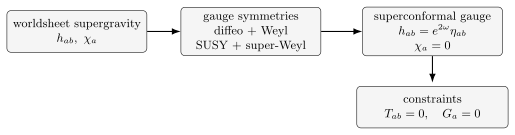
The two variations impose the classical conditions and . A local gauge choice simplifies the matter action but retains these constraints. The diagram is a schematic sequence of variations and gauge choices; it does not eliminate global moduli or spin structures, or set all quantum matter-current modes to zero as operator identities.
Euclidean fields and inverse kinetic kernels
Section titled “Euclidean fields and inverse kinetic kernels”Under the shared continuation , the sector becomes holomorphic: and . Continuing the action gives
The Euclidean chiral fermions are independent Grassmann integration variables. A Lorentzian Majorana condition does not require a nonconstant holomorphic field to be pointwise real.
Writing each quadratic form with a factor exposes its inverse kernel. Integration by parts gives the boson kernel ; the Majorana variation gives . Applying the shared distributional identities to their inverses gives
The logarithm has the usual infrared and zero-mode qualifications described on the free-boson page. Opposite chiralities have no separated-point fermion contraction. The target metric stays Lorentzian; these free matter fields alone do not constitute a positive-norm physical string Hilbert space.
An auxiliary field makes supersymmetry close off shell
Section titled “An auxiliary field makes supersymmetry close off shell”The superspace definition in the overview packages the fields in and introduces . Its four Grassmann coefficients are , , , and . This is the flat scalar multiplet with one left and one right worldsheet supersymmetry, often called . The corresponding superspace construction is discussed in Kiritsis, section 6.12.
Left differentiation gives
For example, . This sign is essential. Multiplying in the declared order produces
The Berezin integral in the overview contributes the compensating minus sign, so
There is no derivative of . Its equation is , and eliminating it recovers the earlier action. The auxiliary field supplies an off-shell component, not a new propagating string degree of freedom.
The superspace generators obey
with analogous barred identities. Acting on a superfield with and comparing its ordered coefficients yields
Here and are the Euclidean continuations of the two Lorentzian parameters. At , the first three equations give exactly the continued rigid transformations. With retained, their commutator on each component is
This is the continuation of the Lorentzian translation already found on . Exercise 1 verifies the mixed-term cancellation on the fermions without using their equations.
Invariance of the superspace action is also direct. Since and anticommute with , moving past the odd parameter shows that and transform as superfields. Their even product varies by . Berezin integration annihilates a total odd derivative; the remaining ordinary derivatives are surface terms. This proves off-shell invariance under compatible constant parameters.
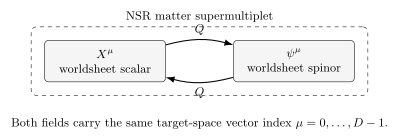
The Grassmann expansion has coefficients , , , and , with . Keeping gives closure without equations of motion; its algebraic equation removes it from the propagating spectrum. This is an algebraic schematic, not a spacetime diagram or a count of physical string polarizations.
The invariant superspace propagator
Section titled “The invariant superspace propagator”Under a diagonal coordinate supertranslation, and . The combination
is invariant: the variation of the product cancels the variation of the two even coordinates. The barred combination works independently. The separated-point propagator can therefore be written
To check more than its covariance, expand the nilpotent logarithm:
The corresponding component product is , because anticommutes with . Thus the coefficient recovers , including its sign. The barred expansion works identically. The auxiliary field instead has a contact covariance, derived in exercise 2; a separated-point logarithm does not specify all contact terms.
The stress tensor and supercurrent generate transformations
Section titled “The stress tensor and supercurrent generate transformations”Continuing and normal ordering gives
For the fermionic stress tensor, the graded single contractions are
Taylor expansion of the first numerator supplies half of the simple pole, while the second term supplies the other half. Hence
The other elementary OPEs give
Thus has weight and has weight one. Although has a local scalar transformation law, its logarithmic correlator and zero mode prevent treating it as an ordinary weight-zero plane primary with the usual primary two-point function.
A single contraction fixes each supercurrent action:
The first sign follows from ; the second follows from the unit fermion contraction. The positive CCW contour
uses an odd parameter to the left and graded operator action. It agrees with the rigid holomorphic transformation when . This phase relation connects the real-time action to the CFT current rather than leaving two apparent definitions of supersymmetry.
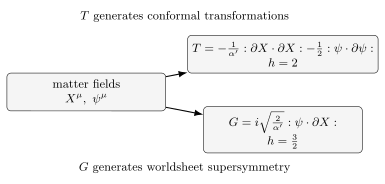
Each indicated contraction produces the simple pole displayed beside it. A counterclockwise contour extracts its residue; the odd parameter relation reproduces the continued rigid variation. Field slots represent contracted factors, not target-space directions. The contour geometry and radii are schematic.
The product of a weight- fermion and an independent weight-one derivative has weight , so is the supercurrent. As a normalization check, its double contraction is
The single contractions give . Together with the stress-tensor OPE, this identifies the matter central charge . The full contour-mode algebra, including NS/R moding, is developed on the next page.
Local supersymmetry, spin structures, and criticality
Section titled “Local supersymmetry, spin structures, and criticality”A locally conserved supercurrent need not give a globally constant supersymmetry parameter in a specified spin sector. For a closed string with periodic and antiperiodic , a constant would make antiperiodic. It therefore does not preserve that configuration space. A parameter with the appropriate spin transition can still define a local symmetry; it is not constant in the same cylinder trivialization. Open-string endpoints impose their own compatible gluing conditions, examined in exercise 4.
Quantization adds a separate requirement. Reparametrization ghosts contribute per chirality, and the commuting superghost system contributes . Their derivation belongs to the superghost treatment. Thus the matter sector must satisfy
For precisely free flat coordinate multiplets, constant dilaton, and no additional internal CFT, this becomes , or . Internal superconformal theories and background charges change the matter balance. Anomaly cancellation also does not by itself remove the NS tachyon or guarantee spacetime supersymmetry; exercise 6 displays the unprojected tachyon directly in superspace.
Exercises
Section titled “Exercises”Exercise 1. Where the on-shell restriction enters
Section titled “Exercise 1. Where the on-shell restriction enters”Compute the Euclidean commutator on both fermions with removed. Identify the obstruction to a translation on a general off-shell field. Then verify that keeping the auxiliary transformations cancels it on every component.
Solution
Set and . Without , direct composition gives
For instance, the off-shell choice , , with a constant odd , leaves the nonzero term in the first equation. The chiral equations remove these terms, but a mere statement that closes would not establish closure on the multiplet.
With retained, the two contributions to are
The coefficient of is symmetric under after reordering, and cancels in the commutator. The remaining terms give . The same calculation gives . On the even components, direct substitution yields
In the last equation the mixed second derivatives of cancel because ordinary derivatives commute. No field equation was used. This explicit component computation fixes the sign of the translation independently of a possible confusion between active variations and coordinate pullbacks.
Exercise 2. Eliminating an auxiliary field does not erase contact terms
Section titled “Exercise 2. Eliminating an auxiliary field does not erase contact terms”Perform the Berezin integral in the superspace action, determine the Gaussian covariance of , and explain why it is consistent with the separated-point superpropagator. What changes if only the order of the two odd derivative factors is reversed?
Solution
The bosonic derivative product contributes , and the two auxiliary terms contribute . The two fermion pairings give and . Multiplication by the prescribed Berezin integral produces the component action stated above.
Write the auxiliary part as . Its kernel is , without derivatives. For a source ,
and therefore
The timelike Gaussian is understood by the same analytic continuation used for the timelike coordinate. The result is zero for separated insertions, but it contributes when points coincide or when integrated against test functions. Thus replacing by its classical equation inside all quantum products would miss a contact term.
Both and are odd. Reversing them negates the integrand; leaving the measure fixed therefore negates the whole action. Reversing both the product and the Berezin orientation leaves the component result unchanged. This is why the order must be explicit.
Exercise 3. Supertranslations and the propagator
Section titled “Exercise 3. Supertranslations and the propagator”Verify invariance of , recover the component propagators from its logarithm, and explain why its covariance does not make an ordinary primary with a constant two-point function.
Solution
The variation is even, so
Together with , this gives . The barred transformation acts independently. Since ,
The coefficient of in the superfield product is , not . Matching coefficients therefore gives the unit fermion propagator. The body gives ; the barred bilinear gives ; and mixed chiral coefficients vanish at separated points.
Under an ordinary dilation , the bosonic correlator shifts by . This additive change and the noncompact zero mode distinguish from a conventional plane-vacuum primary of weight zero. Derivatives remove the additive ambiguity. Finally, Euclidean holomorphic and antiholomorphic Grassmann fields are independently continued variables; imposing pointwise real holomorphic fermions would incorrectly restrict the local solutions to constants.
Exercise 4. Endpoint gluing and surviving supersymmetry
Section titled “Exercise 4. Endpoint gluing and surviving supersymmetry”Consider a strip with a constant orthogonal reflection , equal to in Neumann target directions and in Dirichlet directions. Derive the boundary condition on the fermions and on a rigid parameter. Compare equal and opposite fermion gluing signs at the two endpoints.
Solution
Varying the first-order action and integrating the spatial derivative gives the endpoint term
It vanishes for with , since and the variation obeys the same relation. The bosonic condition is : its Neumann part says , and its fixed Dirichlet part says .
Preserving the fermion condition requires
so a surviving parameter obeys . In a Dirichlet direction this also makes . In a Neumann direction, the normal derivative of vanishes on solutions: differentiate the fermion gluing along the boundary and use the chiral equations. Thus the conditions preserve the usual space of classical solutions.
Let the endpoint signs be and . A common constant parameter exists only if . Doubling the strip transports a chiral fermion through both reflections, giving the monodromy . Equal signs give the periodic sector; opposite signs give the antiperiodic sector and force a constant preserved parameter to vanish. This does not remove the local supercurrent or its nonconstant allowed modes. General boundary interactions or fluxes require their own gluing analysis.
Exercise 5. Checking the graded contour action
Section titled “Exercise 5. Checking the graded contour action”Derive the two elementary supercurrent residues and the fermion stress OPE, then compose two constant holomorphic contour transformations. Verify the translation sign and explain the relation to the rigid Euclidean parameter.
Solution
Contracting with gives . Contracting the fermions instead gives , leaving . Thus
Because the variation is even, . The commutator is , and the same calculation holds for . Taking reproduces both continued rigid variations and the same translation.
For the stress OPE, contracting the external fermion with the first factor in requires moving it past one odd factor. This contributes . Contracting it with the derivative gives . Multiplication by and Taylor expansion yields
Using an ungraded Wick rule would reverse one of these contributions and spoil the translation coefficient. The contour is counterclockwise; reversing its orientation without changing the prefactor would also reverse the transformation.
Exercise 6. A supersymmetric vertex can still be tachyonic
Section titled “Exercise 6. A supersymmetric vertex can still be tachyonic”Expand the jointly normal-ordered scalar superfield exponential through its top component. Determine the weights of that component after eliminating , and find when its integral over the worldsheet is marginal. State what this calculation does and does not establish about a superstring spectrum.
Solution
Write , , and . The odd-coordinate part of the exponent is . Although and are odd, each of the first two products is even. Their cross term is . Therefore
All factors at the same point are normal ordered together. Away from auxiliary contact terms, the top coefficient after eliminating is .
The bottom field has . Each fermion adds in its own chirality, so the top coefficient has weights . One can check its descendant interpretation directly:
The barred residue similarly supplies . If it acts after the holomorphic residue, its odd current passes the odd factor , giving : the sign agrees with the top coefficient. Reversing the two odd actions reverses that sign. This is a local matter-supermultiplet statement, not a choice of superghost picture.
Marginality of the top component requires , hence
This is the mass of the unprojected closed NS–NS tachyon. Worldsheet supersymmetry alone therefore does not remove it. A physical vertex also requires the ghost/superghost construction and BRST conditions, and the spectrum depends on the GSO projection. The local superspace calculation by itself does not select that projection or assert spacetime supersymmetry.
References
Section titled “References”- Brink, Lars, Paolo Di Vecchia, and Paul S. Howe. “A locally supersymmetric and reparametrization invariant action for the spinning string.” Physics Letters B 65, no. 5 (1976): 471–474. doi:10.1016/0370-2693(76)90445-7.
- Kiritsis, Elias. Introduction to Superstring Theory. CERN-TH/97-218, 1997; version 2, 30 March 1998, section 6.12. arXiv:hep-th/9709062.
- Weigand, Timo. Introduction to String Theory. Heidelberg University lecture notes, winter term 2011/12, sections 6.1–6.3. Course notes.