
Bosonization, Spin Fields, and Superghosts
How does a local operator create a Ramond state? A polynomial in the worldsheet fermions cannot change their boundary condition. A spin field can: its operator product with a fermion has a square-root branch. Bosonization constructs these fields explicitly and turns their conformal weights, zero-mode algebra, and chirality into calculations with bosonic charges.
There is a second ingredient in a physical Ramond vertex. The matter spin field has weight , and its superghost dressing supplies . We will derive both contributions, then explain why that dressing carries a picture and why picture changing requires a statement about the state space. We work with one chiral sector of the flat ten-dimensional RNS theory, using the shared bosonization and superghost definitions. The next page develops the physical vertex operators.
Complex fermions and bosonic charge sectors
Section titled “Complex fermions and bosonic charge sectors”Begin with two real fermions whose OPE metric is positive. Their normalized complex combinations are
The same-sign products have no singularity. For a chiral boson , write . Wick contraction gives
Thus has the required simple pole, whereas begins with . This suggests for one pair, with the required zero-mode phases understood. Multiple pairs will require explicit cocycles.
Recovering the current and stress tensor
Section titled “Recovering the current and stress tensor”Matching weights alone would be a weak test. We can recover the two conserved currents directly. Split the insertions symmetrically about , with separation :
The constant term is the charge current. The coefficient of in the fermionic expansion is
which is precisely the stress tensor of two real fermions. Therefore
Another contraction now computes charge and weight:
The double contraction in is , so the boson has , equal to the sum of the two real-fermion central charges. These calculations establish the local fermion OPE, current, and stress tensor in the bosonic description.
Integer and half-integer charges
Section titled “Integer and half-integer charges”The fermion fields change by . Starting with the NS identity vacuum gives integer charge sectors. The Ramond sectors instead have . Within each charge sector, bosonic oscillators generate descendants above the lowest weight .
This is the useful meaning of compactness here: the allowed charges are quantized, and their sectors must be specified. An identification alone does not make a single-valued function of an ordinary scalar. Half-charge operators belong to twisted modules, on which the fermion algebra acts with a different spin structure. A full nonchiral theory also requires a choice of left–right pairings. Local bosonization does not determine those pairings or prove modular invariance. The charge-sector construction is developed in Friedan, Martinec, and Shenker.
Spin fields and the Ramond boundary condition
Section titled “Spin fields and the Ramond boundary condition”The two lowest half-charge operators are
Their fermion products distinguish a ground-state transition from an excited state:
The first term changes one Ramond ground state into the other. The second starts regularly and creates a field of weight : it is one unit above the ground weight, not a third ground spin field. Both products change sign when the fermion circles the spin-field insertion.
In the Ramond mode expansion,
the coefficient of gives the zero-mode action. Consequently,
and reverses these roles. Their anticommutator is one. The regular term instead comes from and raises the weight by one. Bosonization has recovered both the two-state zero-mode module and its first charged excitation.
The axes show the actual charge and lowest conformal weight for one complex fermion, with linear scales. Filled circles mark integer NS charges and open squares mark half-integer Ramond charges. The two indicated actions have different leading powers: reaches another ground state, whereas reaches a level-one excitation. Five Ramond ground contributions sum to .
Why the cylinder fermion is periodic
Section titled “Why the cylinder fermion is periodic”A plane branch sign is not yet a cylinder boundary condition. Under , a fermion of weight transforms as
A cylinder turn gives a minus sign from . Around the NS plane vacuum the fermion is single-valued, so its cylinder representative is antiperiodic. Around a spin field, the plane fermion also changes sign; the two minus signs give a periodic Ramond fermion. This is why a square-root plane OPE describes the Ramond sector.
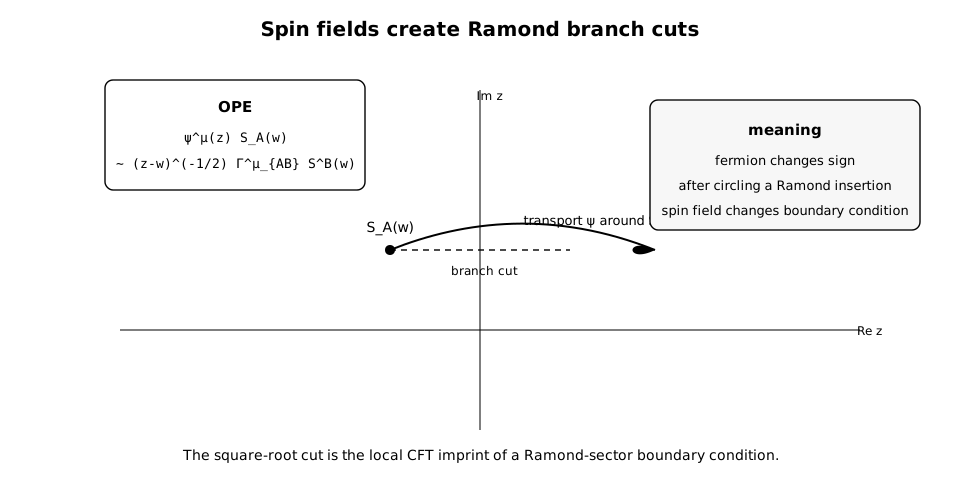
The contour closes after one counterclockwise turn. A branch-cut ray records a choice of branch for the fermion–spin-field OPE; it is movable and is not a physical boundary. The plane monodromy and the conformal spin-frame factor must both be included. The geometry is schematic, without a physical length scale.
Five fermion pairs and spacetime spinors
Section titled “Five fermion pairs and spacetime spinors”Independent bosonic exponentials commute, but different fermion species must anticommute. Cocycles supply the missing exchange phases by acting on charge zero modes. Let
For two species one can take
Indeed, for ,
Within the second species, the two inverse cocycles cancel and preserve the unit pole. The inverse matters: is not its own inverse on a half-integer charge sector. The five-species extension is
Spin fields also carry consistent zero-mode phases. Those phases determine matrix elements but do not change conformal weights or the powers of a separation. We include them in the spin-field basis below; an explicit two-species phase calculation appears in exercise 2.
Treating the timelike component explicitly
Section titled “Treating the timelike component explicitly”Ten Lorentzian vector components cannot all be paired as positive-norm fermions without a continuation. For the bosonization calculation, use
All ten have positive OPE metric. This is a basis for computing the complexified Clifford algebra, not an additional Lorentzian reality condition. Five half-charges give
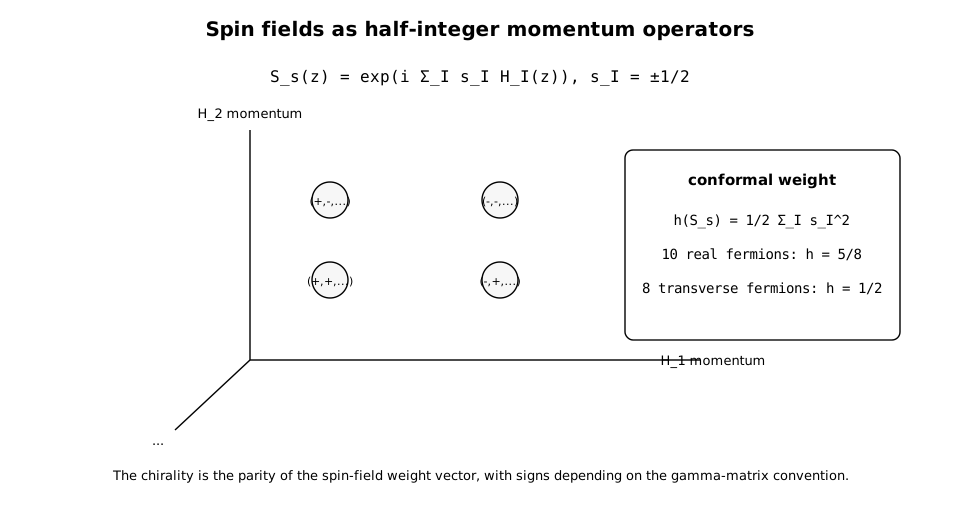
The arrow suppresses only the fixed cocycle phases. There are ground spin fields. The component description is complex; a spacetime Majorana condition relates the full field and its conjugate, rather than halving this fixed-momentum complex component count again.
Chirality in this ordered pairing
Section titled “Chirality in this ordered pairing”On the ground states, set and . The all-plus charge state is annihilated by every , and
Here is an occupation number; it is not the charge operator in the cocycle. The Euclidean Clifford matrices are represented by
The Lorentzian matrices in this pairing are and for . Using the fixed oriented from the spacetime spinor definitions, move across nine factors:
Thus has chirality , with sixteen states of each sign. The earlier Clifford construction put the timelike generator first in a different Euclidean pairing and obtained for its occupation labels. The labels and pairings differ; the oriented spacetime operator has not changed.
Finally, canonical normalization requires , since . In the normalized spin-field basis,
A gamma matrix changes chirality, exactly as flipping one half-charge does. The factor follows from the zero-mode algebra; it cannot be dropped while retaining .
Superghosts and the background-charge scalar
Section titled “Superghosts and the background-charge scalar”Gauge fixing a fermionic worldsheet symmetry introduces commuting ghosts. Their holomorphic weights are and : the ghost has the weight of the supersymmetry parameter, and its conjugate antighost makes a density. These fields can be packaged with the reparametrization ghosts as and , where .
The shared ordered OPEs lead to the stress tensor
For example, contracting or with and expanding the remaining field gives
The analogous contraction gives . We will recover the system’s central charge while explaining why a single scalar is insufficient.
Deriving the improvement formulas
Section titled “Deriving the improvement formulas”Let and consider an improved stress tensor
This temporary parameter lets us derive a formula and then specialize it. The contractions with are
The double pole in therefore gives
For the central charge, the quadratic part contributes , and
The coefficient in is consequently , or . An improvement changes both the vertex weights and the central charge; the two effects must be kept together.
For the superghost scalar , the shared stress tensor has . Hence
Unlike the matter exponential , this is a real exponential with a background-charge contribution. In particular, , not . This is a ghost field, distinct from the spacetime dilaton.
Why the eta–xi pair is necessary
Section titled “Why the eta–xi pair is necessary”The product begins with , not a first-order pole. The additional anticommuting pair fixes that power:
Using the fixed ordered products and gives
Cocycles make the integer-charge exponentials odd. Their products with the odd or are therefore even, as commuting superghosts must be. Omitting this statistics information would also spoil the equivalence. See Fuchs and Kroyter, section 8.1, for the ordered bosonization and its gradings.
The weights now agree separately:
The stress tensor is and has central charge . Thus , and the full critical worldsheet balance is
Exercise 4 derives the general first-order-system formulas behind these numbers. Central-charge cancellation is the prerequisite for a nilpotent quantum BRST charge; the detailed construction is on ghosts, superghosts, and BRST.
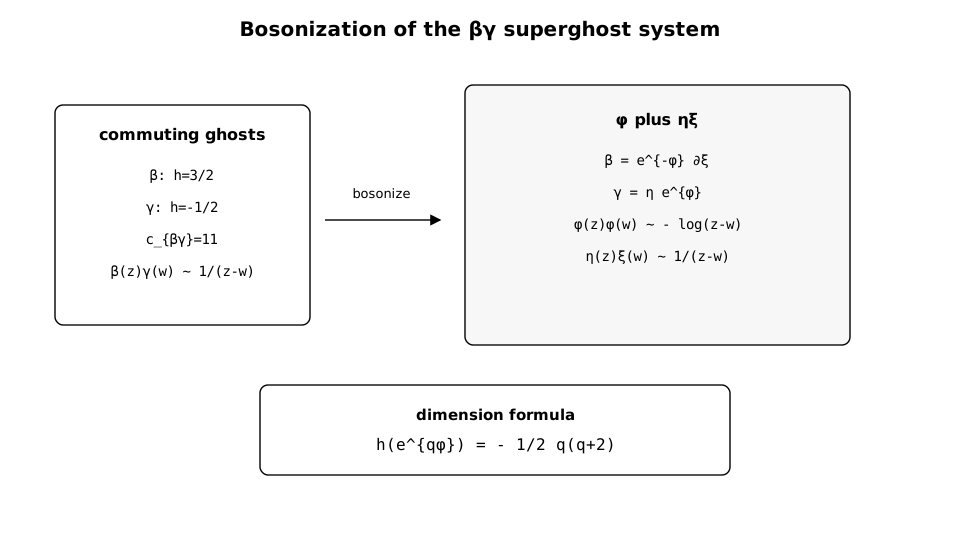
The scalar and the system are both needed. The derivative on changes the scalar product’s factor into the required first-order pole, with the displayed ordered sign. Their stress tensors add and their central charges give . This diagram shows algebraic relations, not distances or evolution in time.
Superghost vacua and vertex dressings
Section titled “Superghost vacua and vertex dressings”The background-charge scalar produces a family of vacua
with the identity vacuum understood. The integer or half-integer value of selects the appropriate NS or Ramond module. Expand
The leading scalar factors are in and in . The remaining or action on the identity vacuum starts at nonnegative powers of . Modes that would require a lower power must therefore annihilate the state:
The inequalities use the sector’s mode lattice: half-integers in NS and integers in R. These conditions can also be found in Friedan, Martinec, and Shenker, where bosonized ghost vacua are constructed explicitly.
| Sector and picture | Beta annihilators | Gamma annihilators | Scalar weight |
|---|---|---|---|
| NS, | |||
| R, | |||
| R, |
The two Ramond rows differ in which zero mode annihilates the vacuum. Both zero modes cannot annihilate the same nonzero state because . Their towers are features of the ghost Fock spaces, not extra matter polarizations.
The familiar canonical dressings now follow from a calculation:
| Sector | Matter factor | Ghost factor | Combined weight |
|---|---|---|---|
| NS | , | , | |
| R | , | , |
For massless momentum the momentum exponential contributes zero weight. Multiplication by , of weight , gives a weight-zero unintegrated vertex. These dimension checks are necessary; BRST closure must still impose transversality or the Dirac equation, and BRST equivalence must identify gauge representatives. The vertex-operator page addresses those further conditions.
Picture and the small Hilbert space
Section titled “Picture and the small Hilbert space”Picture specifies more than the visible exponent of . Applying the shared ghost-number and picture currents to the fields gives
| Operator | Ghost number | Picture |
|---|---|---|
For example, gives charge to , while contributes to and to . Hence . Reading picture solely from the exponential would fail on the original fields themselves. For canonical vertices without or factors, the exponent still gives the correct picture directly.
The role of the missing zero mode
Section titled “The role of the missing zero mode”The original superghosts involve and contain no . Allowing that zero mode enlarges the state space. The anticommutator implies
This separates the large space into a small-space component and its partner. In the small Hilbert space, states obey , and allowed gauge parameters obey the same restriction. If is a nonzero small-space state, then , so lies outside the small space.
What picture changing does and does not assert
Section titled “What picture changing does and does not assert”The BRST charge has ghost number and picture zero. Therefore
has ghost number zero and picture . Nilpotence makes it BRST closed. Although this expression is exact in the large space, is not an allowed small-space gauge parameter. It need not be exact in the small-space cohomology. Also, and imply that preserves the small space. Merely being a closed picture-raising operator does not prove that its action is invertible everywhere.
A precise useful result is available: at fixed nonzero momentum, the chiral relative cohomologies are isomorphic across pictures in the NS and R sectors. For BRST-closed states, together with also implies ; the relative complex has these two restrictions. The statement does not add a separate Ramond superghost zero-mode restriction. Berkovits and Zwiebach, section 2, prove it by composing the picture-changing zero mode with an integrated operator. The composition is a nonzero multiple of up to BRST-exact terms that preserve the relative condition. Choosing a nonzero component of momentum provides an inverse on cohomology. Their construction also preserves the closed-string semirelative condition .
At zero momentum that inverse argument fails, and Ramond/RR examples can depend on picture. This does not say that every zero-momentum sector fails. Nor is a cohomology isomorphism a license to collide local picture-changing insertions: contact singularities and amplitude prescriptions require further analysis.
Tree-level charge balance
Section titled “Tree-level charge balance”The improved scalar stress tensor has a background charge. Its chiral sphere selection rule can be read from conformal covariance. With the appropriate small-space zero-mode prescription, the contractions of pure scalar exponentials give
Let denote the total insertion charge. At the th insertion, the sum of separation exponents must equal . Thus
For nonzero this requires . This is the covariance selection rule for the background-charge sphere vacuum. Its conjugate identity at infinity carries charge , so a charge- insertion pairs with , rather than with . The degenerate case in which every vanishes does not determine the background-charge vacuum through this equation alone. Exercise 5 checks the two-point pairing. The zero modes still need their prescribed saturation; scalar charge counting does not by itself evaluate a full ghost correlator.
A closed tree amplitude is on a sphere and has total picture in each chiral sector. An open tree amplitude is on a disk; boundary doubling gives one holomorphic prescription with total picture . For instance, two canonical NS vertices contribute , and two Ramond vertices with one NS vertex contribute . Other insertions or pictures must be chosen consistently. These conditions are separate from saturation of the three -ghost zero modes per holomorphic sector: one set on the doubled disk and two chiral sets on the closed sphere. Exercise 6 verifies the position dependence of the latter example explicitly.
Common pitfalls
Section titled “Common pitfalls”A pairing is not an orientation change. An occupation-parity formula for chirality depends on how the Clifford generators are paired and which operators annihilate the chosen vacuum. Translate those labels before comparing signs; keep the oriented spacetime fixed.
Picture is not ghost number. Both charges act on the enlarged bosonized space. The contribution makes the original superghost fields picture neutral even though their formulas contain .
Correct dimension is not the full physical-state condition. A dressed weight-one field is only a candidate integrated vertex. BRST closure, the allowed state space, and equivalence under admissible gauge parameters still determine whether it describes a physical state.
Exercises
Section titled “Exercises”1. Four fermions and a higher-charge state
Section titled “1. Four fermions and a higher-charge state”Evaluate by bosonization and by Wick contraction, including the exchange signs. Then find the lowest-weight charge-two state in the NS fermion Fock space and compare it with .
Solution
Write . The charges sum to zero, so the bosonic formula gives
The fermionic Wick expansion has the pairings and with positive signs; the middle pairing vanishes because its equal-charge contractions vanish. Thus
The elementary identity establishes equality. An arbitrary minus sign on the second term would spoil it.
Two identical modes cannot be occupied. The lowest charge-two state instead uses distinct modes:
Bosonization predicts . The zero of the equal-charge OPE is the local manifestation of the same exclusion principle.
2. Cocycle phases on half-integer charges
Section titled “2. Cocycle phases on half-integer charges”For two species, start with . Compute the two orders of the lowering zero modes and . Explain why replacing the inverse cocycle in by the cocycle of gives the wrong same-species anticommutator. Finally, relate the five-species phase basis to the usual Jordan–Wigner basis of fermion oscillators.
Solution
The second lowering operator has phase . Lowering the first charge before the second gives
In the reverse order,
Their sum vanishes. In a same-species lowering-and-raising sequence, stays fixed, so the correct phases multiply to . Using the plus cocycle twice instead produces on a half-integer sector. This would turn the unit anticommutator into minus one.
For five species, let . The charge-dependent cocycles act as
The parity strings are the usual Jordan–Wigner strings. The extra phases disappear in the rephased basis
For an annihilation in slot , the basis-phase ratio is , which cancels . For creation the inverse ratio cancels . Hence the matrices become the standard fermion-oscillator matrices. This change of basis preserves their Clifford algebra and the eigenvalues of the fixed .
3. Spin-field fusion and a locality test
Section titled “3. Spin-field fusion and a locality test”Let and be two five-component spin weights differing in signs. Determine the leading power and conformal weight in their matter OPE, and relate to their chiralities. Repeat the power count for . Identify the identity and vector matter channels.
Solution
An equal sign contributes to , and an opposite sign contributes . Therefore
The OPE exponent is indeed . The product of the chiralities is
The superghost pair contributes to the exponent, giving
This power is an integer precisely for even , which here means equal spacetime chirality. Cocycles still determine exchange signs; they do not alter this power test.
For , all charges cancel and the leading matter operator is the identity. The chiralities are opposite. For , exactly one component of is , so the output is a vector fermion of weight ; the chiralities are equal, and the dressed product has a simple pole. The pole is the channel relevant to the spacetime supersymmetry algebra. This necessary locality and channel check alone does not establish the complete GSO projection or all interacting supersymmetry relations.
4. General first-order ghost systems
Section titled “4. General first-order ghost systems”For fields of weights , derive the central charge of an anticommuting system using and . Then derive it for a commuting system using and . Recover the three ghost central charges used on this page.
Solution
Use and the derived formulas and . For , the condition gives
Then , and
For the commuting system, and both have weight one. Thus
This also gives . Including yields
The anticommuting cases and give and . The commuting case gives . Omitting would give instead, as well as the wrong elementary OPE power; its role cannot be absorbed into a weight adjustment alone.
5. Ramond ghost zero modes and BPZ pairing
Section titled “5. Ramond ghost zero modes and BPZ pairing”Realize the zero-mode algebra in the and ghost vacua using polynomials in . Identify the annihilating operator and the tower in each case. Show that the BPZ-dual picture has the same conformal weight and the correct two-point separation power.
Solution
At , take the constant polynomial as the vacuum and represent
Then , , and successive actions give . At , use
The commutator is still , but now annihilates the constant and generates the tower. If both annihilated a nonzero state, their commutator would annihilate it too, contradicting . These are infinite polynomial representations, so no artificial highest-state cutoff is being used.
The background-charge pairing has . Its conformal weights satisfy
The exponential contraction gives
which is the required two-point power for equal weights. In particular the two Ramond pictures and are paired and both have weight . These ghost modules do not themselves count BRST physical states; the cohomology and its allowed gauge parameters still have to be specified.
6. A two-Ramond, one-NS disk correlator
Section titled “6. A two-Ramond, one-NS disk correlator”Consider three massless boundary insertions with canonical pictures and one ghost at each point. Take
and a vector fermion with charge . Calculate every separation power from the matter spin fields, superghost exponentials, and ghosts. Explain the cancellation and its limits.
Solution
Here , so the vector fermion is . The matter charges sum to zero and give
Up to a separation-independent cocycle coefficient, their correlator is
The superghost charges sum to and contribute
Finally, . For each pair the exponents add to zero:
For three massless momenta satisfying , one has , so the exponentials add no separation powers. This statement is algebraic and can be used with analytically continued three-point kinematics. We have checked the expected independence of the three fixed insertion positions and the total picture. The cocycle coefficient, spinor polarizations, coupling normalization, and full amplitude prescription remain additional information; position balance alone does not determine the S-matrix.
References
Section titled “References”- Berkovits, Nathan, and Barton Zwiebach. “On the Picture Dependence of Ramond–Ramond Cohomology.” Nuclear Physics B 523 (1998), 311–343. doi:10.1016/S0550-3213(98)00132-1, arXiv:hep-th/9711087. Section 2 proves picture independence at nonzero momentum with the relative and semirelative restrictions used above.
- Friedan, Daniel, Emil Martinec, and Stephen Shenker. “Conformal Invariance, Supersymmetry, and String Theory.” Nuclear Physics B 271 (1986), 93–165. doi:10.1016/0550-3213(86)90356-1, author-hosted article. The bosonization and ghost-vacuum constructions supply the operator framework developed here.
- Fuchs, Ehud, and Michael Kroyter. “Analytical Solutions of Open String Field Theory.” Physics Reports 502 (2011), 89–149. arXiv:0807.4722, published article. Section 8.1 explains the ordered superghost bosonization, ghost and picture charges, and small versus large Hilbert spaces.