
Stress Tensor, Primaries, and Conformal Transformations
The stress tensor turns the local singularities of a quantum field theory into symmetry transformations. In two dimensions, its two chiral components allow us to compute those transformations by contour integration. This page develops that connection: metric variation fixes the stress tensor, its OPE identifies primary fields, and contour deformation constrains their correlation functions.
Use the global conventions and the contractions, plane normal ordering, and zero-mode qualifications developed on the free-boson page. We work with the covariant matter fields , before imposing the physical-state conditions. The classical metric constraint motivates those conditions; it does not set the quantum matter operator to zero. Ghosts and the total stress tensor enter the later BRST treatment.
From metric variation to a holomorphic stress tensor
Section titled “From metric variation to a holomorphic stress tensor”Vary the matter action with respect to the inverse Euclidean worldsheet metric. Writing the real coordinates as , the variation is
The definition of in the overview therefore gives
Its classical trace vanishes in two dimensions: contracting the first term gives , while the trace of the second gives the same quantity. Diffeomorphism invariance gives on the field equation. These two statements have a particularly strong consequence in a flat complex coordinate patch. Since ,
Thus , and the conjugate equation gives . The CFT normalization is , so quantization with the plane subtraction yields
The contraction subtracted in defining the composite is proportional to the identity. In this plane vacuum prescription, . A change to the cylinder involves a finite vacuum term; it is not obtained by declaring the same subtraction in every coordinate system.
In the quantum theory, holomorphicity means that inside correlation functions away from insertions. At an insertion there are contact terms, represented equivalently by poles and contour residues. On curved worldsheets there is also a trace anomaly. Neither qualification prevents the flat-patch calculation here, but neither should be discarded when using it elsewhere.
Local conformal maps and primary fields
Section titled “Local conformal maps and primary fields”Consider an orientation-preserving change of coordinates
on a patch. For a real Euclidean coordinate change, the barred map is the complex conjugate of the unbarred one. Treating them as independent variables is a convenient complexification when differentiating or computing OPEs.
For the same metric expressed in the new coordinates,
A Weyl rescaling can restore the chosen conformal-gauge representative. The reciprocal factor in this passive metric formula is consistent with the geometric statement that the map multiplies a tangent displacement by : its absolute value rescales lengths, and its phase rotates all tangents through the same angle. A zero of invalidates the local coordinate change.
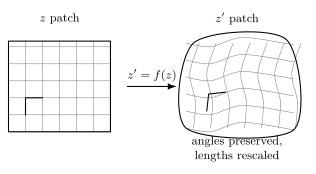
The map is regular on the displayed square. At , multiplication by preserves the right angle and multiplies both tangent lengths by . The grids are actual mapped curves; the tangent arrows display the differential, rather than finite grid displacements.
A primary field has a simple local Jacobian law,
The weights label its response to holomorphic and antiholomorphic changes of scale. Powers of the Jacobian are understood on a consistent local branch. Unlike the number of indices of an ordinary tensor, a quantum weight need not be an integer.
A real dilation , with , multiplies the field at corresponding points by , where . A rotation multiplies it by , where . These statements explain dimension and spin. Primarity requires the full local transformation law, which is stronger than having definite dimension and spin.
Passive coordinates and an active field variation
Section titled “Passive coordinates and an active field variation”To keep track of the sign, let . At the same numerical coordinate , the old coordinate is to first order. Substituting this into the finite law gives
We will use the opposite, active action for contour generators:
Equivalently, the active finite operation at fixed coordinates sends to . This fixes which transformation the positive residues below generate. Tong’s §§4.2.2–4.2.3 present the Ward construction using the passive variation; comparing the named variations resolves the apparent sign difference.
How a charge becomes a contour around an operator
Section titled “How a charge becomes a contour around an operator”On the cylinder, a conserved charge inserted just after an operator gives ; inserted just before it gives . Their difference is . Under the cylinder-to-plane map, later Euclidean time becomes larger radius. The commutator is therefore represented by an outer contour minus an inner contour, both originally oriented counterclockwise. If no other insertion lies in the intervening annulus, this difference deforms to a small counterclockwise contour around .
For holomorphic and antiholomorphic , the local conformal charge is
Here is one counterclockwise contour in the physical plane. To see why the minus sign matters, parameterize a small circle by , . Then
The conjugate coordinate goes clockwise. The minus sign in compensates that reversal, so both chiral sectors give positive residues in the active transformation. One may instead orient a separate barred contour counterclockwise in the plane, but that is a different contour convention.
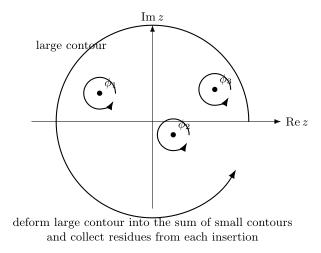
The outer and inner radial contours are both counterclockwise before subtraction. Their difference represents . A counterclockwise physical loop gives for the normalized integral and for its barred counterpart, explaining the charge one-form’s relative minus sign. The contours are schematic and exclude other insertions.
A charge associated with a vector field regular only on a patch should be used locally. A globally defined symmetry charge requires the vector field and integration domain to respect the global geometry and any boundaries.
The primary OPE follows from the charge action
Section titled “The primary OPE follows from the charge action”Suppose the holomorphic singular part is
Taylor expanding and performing the small contour gives
For a primary, the active law contains and , but no higher derivative of an arbitrary local . Comparing their coefficients determines the OPE:
The barred formula replaces by their barred counterparts. Conversely, these two OPEs reproduce the infinitesimal primary law. The simple pole moves the insertion; the double pole changes the field by its local Jacobian weight. Higher poles would generate additional derivatives of and require a more general transformation law.
Free fields, descendants, and the special status of X
Section titled “Free fields, descendants, and the special status of X”There are two possible contractions between the fields in and an external . Wick’s theorem gives
Expanding the uncontracted field at is essential: it produces the simple pole as well as the double pole,
Thus is primary of weights , and is primary of weights . For the free mixed composite
the two OPE calculations act on the two factors separately, giving . The definition includes the local contact subtraction discussed on the preceding page. There is no mixed pole at separated points. This argument applies to this free composite; arbitrary coincident products do not inherit primary transformation laws merely by adding weights.
For itself, contraction instead gives
This is the local scalar transformation law. It does not make the unregulated noncompact an ordinary weight-zero primary in a conformally invariant vacuum. Its logarithmic contraction changes by an additive constant under dilation, and its unsuppressed target zero mode prevents an unqualified vacuum two-point function. Derivatives remove the additive ambiguity. Properly defined exponentials have their own quantum weights, derived on the next page. The infrared and higher-derivative qualifications are explicit in Tong’s §4.3.3.
The qualification about chirality also matters for target-space Lorentz transformations. For example, the antisymmetric currents
obey on the free equation away from insertions: differentiating each component gives mixed derivative products which cancel in the sum. A single component need not be holomorphic, because it contains the full field . Conservation of a two-dimensional current is a weaker statement than separate conservation of two chiral currents.
Now differentiate the primary OPE with respect to . The derivative acts on both fields and denominators, yielding
The derivative has weights under dilation and rotation, but for its third-order pole prevents primarity. For example, has weight two and a third-order pole with coefficient . A field obtained by differentiating a primary is a descendant. The exceptional case removes this particular third-order obstruction; it does not repair the zero-mode problem of .
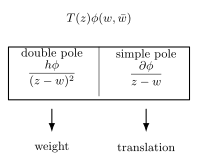
Differentiation raises the holomorphic weight by one but also produces the pole . Its contour residue is . For a nonzero primary with , this extra term distinguishes the descendant from a primary of weight ; the barred weight is unchanged.
Local poles and the plane Ward identity
Section titled “Local poles and the plane Ward identity”Let for mutually separated primary insertions. Work in the conformally invariant plane vacuum, or equivalently on the sphere with the vacuum at infinity, without additional boundaries or sources. Subtract from the stress insertion the poles predicted by each local OPE:
This difference has no singularity at any finite insertion and is holomorphic elsewhere. The vacuum condition at infinity makes the first term decay as ; the explicit pole sum is at worst . Thus is an entire function tending to zero at infinity. By Liouville’s theorem, :
There is a conjugate Ward identity for . This is an equality of separated-point correlators; its distributional completion includes contact terms at the .
Why the condition? In the coordinate , no operator has been inserted at . The stress tensor is regular there and transforms as a quadratic differential under this Möbius change, giving . For free bosons, covariance of the plane subtraction under inversion follows directly from
For a general local map the subtraction has a finite mismatch: the stress tensor is not itself primary. The associated central term is studied next. Inversion has no such mismatch. We have also specified a vacuum state; a different state or topology can leave a holomorphic contribution that local poles alone do not fix.
Global Ward equations and two-point functions
Section titled “Global Ward equations and two-point functions”Expanding the pole sum at large and setting its , , and coefficients to zero gives
These are the translation, dilation/rotation, and special-conformal Ward equations. The barred equations supply the other chiral components. They can also be obtained by integrating against and moving the contour to infinity. See Ginsparg’s §§2.1 and 2.4 for the relation between these constraints and correlation functions.
For two insertions, translations give , where . The second equation gives
Using this result in the third equation leaves . For a nonzero separated correlator, , and the barred equation similarly requires . Therefore
The constant is theory- and normalization-dependent; symmetry does not set it to one or make it positive. In particular, the covariant matter theory includes the timelike coordinate. Its two-point bilinear should not be confused with a positive inner product on physical string states.
Why only Möbius maps act globally on the sphere
Section titled “Why only Möbius maps act globally on the sphere”A local vector field must be regular in every chart to generate a global symmetry. Under its component is
Regularity at finite rules out finite poles; regularity at then restricts the entire function to a polynomial of degree at most two. Hence
The resulting finite, globally invertible holomorphic maps of the sphere are
Their group is : a common nonzero rescaling of the four coefficients changes no map; after setting the determinant to one, an overall sign remains redundant. This gives three complex, or six real, parameters. For real Euclidean coordinate transformations the barred map is conjugate, so it is not a second independent set of three complex parameters. A degree-two rational map is also a map of the sphere, but its branching prevents it from being an invertible coordinate transformation.
Three distinct sphere points can consequently be moved to . Four points leave a cross-ratio and therefore genuine functional freedom in a correlator. This distinction will matter when worldsheet symmetries are used to fix insertion positions in string amplitudes.
Exercises
Section titled “Exercises”Exercise 1. Determine the stress normalization from a metric response
Section titled “Exercise 1. Determine the stress normalization from a metric response”For one spacelike scalar, work on a unit coordinate-area patch with the classical profile , where are constant target-length parameters. Vary the inverse metric through . Compute at zero directly, recover , and compare the resulting with the free-field expression. Then use to check holomorphicity explicitly, where is a constant target length and are dimensionless worldsheet coordinates.
Solution
The determinant of the covariant metric is , so the action for the linear profile is
The stress definition gives . Directly,
Changing tensor components, rather than identifying real and complex components, gives
For the quadratic profile, , hence and . This profile solves the Laplace equation. The qualification is necessary: the off-shell profile instead has and . Tracelessness of the classical expression alone does not imply conservation for an arbitrary off-shell field.
Exercise 2. Recover a complete target-space translation
Section titled “Exercise 2. Recover a complete target-space translation”On a physical counterclockwise contour define the target momentum operator by
Compute its commutator with and the transformation . Explain what goes wrong if the barred minus sign is omitted or if only one chiral sector is kept. Check the normalization against the noncompact closed-string zero mode.
Solution
Differentiating the logarithmic contraction gives
The holomorphic normalized integral contributes . The barred normalized integral before the charge’s extra minus sign contributes . Thus
Omitting the relative minus sign would make the two contributions cancel. Keeping only the holomorphic charge gives half the translation with the displayed normalization. Here the conventional Hermitian momentum generates a translation through ; the conformal above was defined directly by its active commutator, without an extra .
The noncompact closed-string expansion has
The two integrals extract and , respectively. Their sum is , as required. This last equality uses the unwound noncompact zero mode; it is not a general equality of the two chiral fields.
Exercise 3. A descendant under a genuinely local map
Section titled “Exercise 3. A descendant under a genuinely local map”Starting from the finite primary law, derive the transformation of . Compare it with the stress OPE of . As a concrete test take a holomorphic primary of weight one, , and evaluate the transformed derivative at . Why would testing translations and dilations alone miss the result?
Solution
For the holomorphic derivative, use while holding fixed:
The extra term is absent from the primary law of weight . For , expansion at fixed numerical coordinates gives
The contour OPE gives the negative of this expression. In particular, the third-order pole contributes , including the factorial from Taylor expansion.
At the origin in the stated weight-one example, and , so
A weight-two primary would give only . Translations and dilations have , so they do not detect this failure. Applying the result to yields the nonprimary transformation of . For a genuine primary, this derivative does pass the holomorphic primary test; itself still requires the infrared qualification in the main text.
Exercise 4. One-point functions and the logarithmic scalar
Section titled “Exercise 4. One-point functions and the logarithmic scalar”In a translation-, dilation-, and rotation-invariant plane vacuum, determine when a primary can have a nonzero one-point function. Does symmetry alone show that every nonidentity primary has zero expectation? Compare the two-point constraints with both and the formal logarithmic contraction.
Solution
Translations first give , a constant. Dilations require for every positive , so . Rotations similarly give . A nonzero therefore requires . Translation invariance by itself does not force .
The conformal Ward identities leave arbitrary for a weight-zero primary. Concluding that only the identity can occur needs extra information about the theory and its vacuum, such as the absence of other independent weight-zero vacuum states. Those assumptions are not part of the local OPE.
For the derivative fields, the two-point result takes the form
This is exactly the free contraction, with its normalization and target tensor retained. In contrast, under a simultaneous real dilation of both arguments, the regulated logarithmic contraction changes by
It is not the constant two-point function required of two ordinary weight-zero primaries. An arbitrary infrared additive constant does not solve this covariance requirement for every dilation while preserving a fixed vacuum prescription. This illustrates why the local scalar OPE must be distinguished from a globally well-defined primary state and correlator.
Exercise 5. Check a Ward identity by independent Wick contractions
Section titled “Exercise 5. Check a Ward identity by independent Wick contractions”For one spacelike scalar define the normalized current , so that and . Compute directly and from the Ward identity. Then extend the argument to four current insertions, exhibiting the terms and their combinatorial factors.
Solution
Normal ordering removes the self-contraction inside . Its two currents must contract with the two external currents. There are two assignments, cancelling the factor , so
Let , , and . The Ward expression, using weight one for each current, is
The simple-pole derivative terms are indispensable for this cancellation.
For four currents write . Wick’s theorem gives three pairings,
To include , choose any unordered pair of external currents to contract with it. The remaining two labels are . There are six choices and two assignments within each choice; again the assignments cancel . Therefore
Acting with the Ward differential operator on each of the three products in gives two contributions: it acts on either pair. The two-current identity just proved turns each contribution into one term of the six-term Wick result. This checks the four-point Ward identity without assuming it in the Wick calculation. Each term decays as , also checking the vacuum condition at infinity.
Exercise 6. The sphere, three points, and the remaining cross-ratio
Section titled “Exercise 6. The sphere, three points, and the remaining cross-ratio”Show that a vector field , with integer , is regular on the sphere only for . Construct a Möbius map taking three distinct finite points to . Derive the coordinate dependence of a three-point primary correlator and explain why four points are different.
Solution
Regularity at requires . In the infinity chart,
so regularity at requires . This proves the three-generator statement directly. Exponentiating their flows gives translations, rescalings, and maps , which together generate the Möbius group.
The required map is
The zero, value one, and pole are immediate. The pole at is regular as a map to the target’s infinity chart; it is not a branch point. Distinctness of the three points ensures a nonzero determinant.
Translations and dilations suggest writing the holomorphic factor of a three-point function as . The special-conformal Ward equation fixes the three exponents by
For example, the contribution of to the special-conformal derivative is ; gathering the coefficient of each gives these equations. Their solution is , , . The barred equations work independently. Thus, defining with the remaining label,
Branches and any exchange phases are fixed consistently for the chosen local fields. There is no additional position-dependent invariant of three distinct sphere points: the displayed map sends every such triple to the same reference triple. Hence the power-law ansatz loses no functional freedom. The constant is dynamical data, not fixed by conformal symmetry.
A fourth point maps to a nontrivial number . Equivalently, the cross-ratio
is unchanged by a Möbius map: each difference transforms with the same determinant and two denominator factors, which cancel in the ratio. Consequently a four-point correlator can retain a function of after its required Jacobian factors are extracted. Local conformal symmetry supplies further tools, but global covariance alone does not determine that function.
References
Section titled “References”- Paul Ginsparg, “Applied Conformal Field Theory,” in Fields, Strings and Critical Phenomena, Les Houches, Session XLIX (1988), edited by É. Brézin and J. Zinn-Justin (North-Holland, 1989), pp. 1–168; arXiv:hep-th/9108028. §§2.1–2.4 develop primary correlators, free-field examples, and contour Ward identities.
- David Tong, Lectures on String Theory (2009), arXiv:0908.0333. §§4.2.2–4.2.3 derive the local Ward identities and primary transformation law; §4.3.3 checks free-boson primaries and higher derivatives. His passive variation and the active variation defined here differ by the explicitly stated sign.