
Superconformal Algebra and NS/R Sectors
The same local worldsheet theory has two different fermionic state spaces. Neveu–Schwarz fermions have half-integer frequencies on the cylinder; Ramond fermions have integer frequencies and Clifford zero modes. Both realize the same plane superconformal algebra. Their different vacuum weights are essential to making that statement consistent.
We will derive the current algebra and its oscillator representation, then explain why the free Ramond ground state has plane weight but zero cylinder energy. These are matter-CFT statements. Physical string states also require the constraints, ghosts and projection discussed in the spectrum pages. We use the shared fermion, coordinate and normal-ordering definitions, together with the currents derived on the previous page.
The stress tensor and supercurrent close under OPEs
Section titled “The stress tensor and supercurrent close under OPEs”The supercurrent contains one fermion and one bosonic derivative. Its self-OPE therefore has a double contraction and two distinct single contractions. Keeping all three explains both the central term and the stress tensor that generates translations.
Let . Applying Wick’s theorem to the shared current gives
For the first term, the factor multiplies the negative boson contraction and the fermion contraction . The target trace is , including the timelike component: the two metric factors contract to a Kronecker trace.
The last bilocal has no constant Taylor term. At the same point, the contraction of the antisymmetric normal product with vanishes. Its first nonzero term is
It supplies the fermion part of , whereas the other single contraction supplies the boson part. Thus
In particular, there is no second-order pole. Missing the first Taylor term of the fermion bilocal would incorrectly remove its stress tensor from the result.
To compute , separate . The boson stress tensor acts only on and the fermion stress tensor only on . Their double-pole coefficients are respectively and . Their simple poles add by the product rule:
Consequently, is a primary field of weight :
The two stress tensors have no singular mixed OPE. Adding the bosonic and Majorana stress OPEs gives
Each real boson contributes to , and each real Majorana fermion contributes . Together these OPEs define the chiral superconformal algebra. The opposite chirality has its own copy. Kiritsis, section 6.12, develops this algebra and its representations; here the free-field contractions fix its normalization directly.
Spin structure determines the mode labels
Section titled “Spin structure determines the mode labels”On the cylinder, the fermion can return with either sign after one spatial circuit. The same choice applies to , since is periodic in the untwisted directions considered here. In the shared cylinder coordinate, a holomorphic mode transforms under by . Therefore
| Sector | Cylinder fermion sign | Frequencies |
|---|---|---|
| Neveu–Schwarz, NS | ||
| Ramond, R |
The cylinder and plane signs are different. Under , the weight- transformation law is
As increases by , moves counterclockwise around the origin, and the continued square root changes sign. A cylinder NS field is therefore single-valued on the punctured plane, whereas a cylinder R field changes sign around the origin. The latter behavior is created by a spin-field insertion. Its branch cut can be drawn in different places; the monodromy around the endpoint is the invariant information.
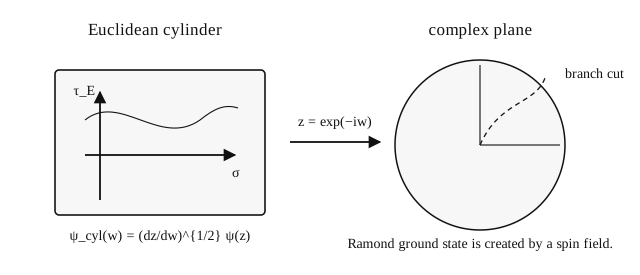
A spatial cylinder circuit becomes a counterclockwise loop under . The factor changes sign, so NS cylinder antiperiodicity gives plane single-valuedness, while R cylinder periodicity gives plane monodromy . The identified cylinder edges and the puncture are topological features; a branch cut is a choice of chart, not a physical boundary. The cuts at and map to radii and , drawn at equal scale. The cylinder strip is a schematic coordinate display.
Dividing the cylinder expansion by yields
The same reasoning gives . Although the conformal weight is now , its Jacobian also changes sign after one circuit. The stress tensor remains integer-moded:
For an open string with uniform untwisted endpoint gluing, doubling leaves one chiral mode family; the relative endpoint sign selects NS or R. Closed strings admit separate left and right labels: NS–NS, NS–R, R–NS and R–R. A consistent physical theory still requires level matching and a projection. Detailed massless tensor and spinor content does not follow from the four labels alone.
The local algebra exists in either sector. It does not imply that a constant supersymmetry parameter is globally allowed in every cylinder spin frame. That distinction is the same one encountered in the boundary discussion on the previous page.
Graded contours give the super-Virasoro algebra
Section titled “Graded contours give the super-Virasoro algebra”The contour definitions invert the mode expansions:
We use counterclockwise holomorphic contours. The difference of the two radial orderings is deformed to a small contour around the other insertion, as in the Virasoro derivation. Because is odd, exchanging the two insertions supplies the sign needed for an anticommutator:
The local contour already represents the whole graded bracket. Adding a second expression with and exchanged would double-count it.
In the R sector, the individual factors and have a branch, but their product is single-valued around the Ramond insertion. For the small contour around , expand both using one local branch. The cubic pole contributes
The outer integral picks out . The simple pole contributes . Thus
For the mixed bracket, the double and simple TG poles give
The second line follows by integrating the derivative term by parts. Its coefficient is , which combines with . The TT fourth-order pole similarly gives the third derivative of and hence
These three formulas have the same plane central terms in NS and R. Only the allowed supercurrent labels differ.
The fermion algebra follows from the same graded contour argument applied to its simple OPE pole:
A negative label creates an excitation above the appropriate oscillator vacuum; a positive label annihilates it. Integer moding leaves additional operators, whose role is different from either.
Oscillator currents and the finite plane shift
Section titled “Oscillator currents and the finite plane shift”Substituting the bosonic oscillator expansion into cancels its two square-root factors and its phases:
There is no mixed boson–fermion contraction to subtract. For , differentiating a mode first produces . At fixed total mode number , antisymmetrizing the two fermions replaces this by
Write for positive-frequency oscillator ordering in the chosen sector, keeping R zero modes as Clifford operators. Then
This bilinear is not automatically the plane generator. The ordinary colons in the local stress tensor subtract the plane OPE singularity. Oscillator ordering subtracts the contraction appropriate to the sector vacuum. Their finite difference can affect the zero mode:
Here is the plane weight of the zero-momentum oscillator ground state. The NS identity vacuum has ; we will derive the R value shortly. This distinction also translates the sector-dependent oscillator central terms found in Weigand, sections 6.4.3–6.4.4, into the common plane algebra above.
Let be the dimensionless eigenvalue of . Combining positive and negative frequencies at gives
The bosonic frequency is already contained in . In particular, raises the level by , and raises it by . For a doubled open string ; for either unwound noncompact closed chirality . The zero-mode factor must be chosen for the string under discussion before converting a level to a mass.
NS superprimaries and their partners
Section titled “NS superprimaries and their partners”A superprimary state in NS obeys
Its first partner is . Since , its weight is . For every integer ,
Thus a nonzero partner is itself a Virasoro primary. It is generally not a superprimary, because
The second identity uses . Under state–operator correspondence, produces the ordinary derivative of the inserted field. Two odd lowering operations therefore give a translation descendant, rather than a second independent primary.
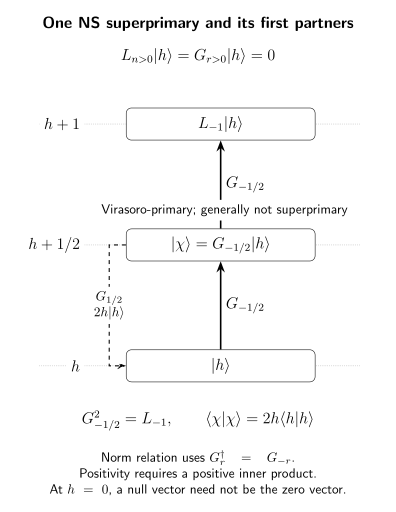
The states have weights , and . The first image is Virasoro-primary, but its image is , so it is generally not superprimary. The second lowering gives . Arrows denote exact operator actions, not transition probabilities; a vanishing or null state must be treated separately. The placement is schematic.
With the radial adjoint and a normalized parent, the partner has norm
In a positive-norm unitary representation this implies . Covariant matter with a timelike oscillator is not such a Hilbert space, so one must not apply the positivity conclusion to all of its states. Exercise 2 gives a nonzero null partner.
The identity state obeys stronger regularity conditions than a generic superprimary:
Indeed, and cannot have a pole at an origin with no insertion. The five modes close without central terms and form the global algebra. This plane statement does not assert the existence of a constant cylinder supersymmetry parameter in NS.
Ramond zero modes fix the free ground-state weight
Section titled “Ramond zero modes fix the free ground-state weight”In R, the zero-frequency fermions satisfy
They act on a Clifford ground-state space. No nonzero vector is annihilated by every real orthonormal zero mode: each such mode has a nonzero scalar square. A complex combination can be an annihilator, however, as exercise 3 demonstrates. The Clifford components have not yet been reduced by physical constraints, reality conditions or GSO projection.
Setting in the plane superalgebra gives
On an oscillator ground state , every nonzero-mode term in annihilates the state. Hence
Comparing with determines
The spin field that creates the zero-momentum R ground state therefore has plane weight . Exercise 4 independently derives the weight of each real fermion from its mode-summed two-point function and point splitting. The zero-momentum bosons add no plane weight.
For a general unitary Ramond representation, the adjoint instead gives the bound
It does not prove that a saturating state exists. When and there is a fermion-parity grading that anticommutes with , the normalized operator pairs even and odd states at the same weight. At equality, annihilates the state; it does not fix how many such ground states there are. The free calculation above establishes saturation at in this theory. Neither a universal ground-state multiplicity nor a positivity theorem for covariant timelike matter follows.
Cylinder energies and physical intercepts
Section titled “Cylinder energies and physical intercepts”The finite stress-tensor transformation under gives
This is a coordinate-induced subtraction common to both sectors. It is different from choosing the oscillator ground state in the definition of . The zero-momentum values for free coordinate multiplets are
| Sector | Plane weight | Cylinder energy |
|---|---|---|
| NS | ||
| R |
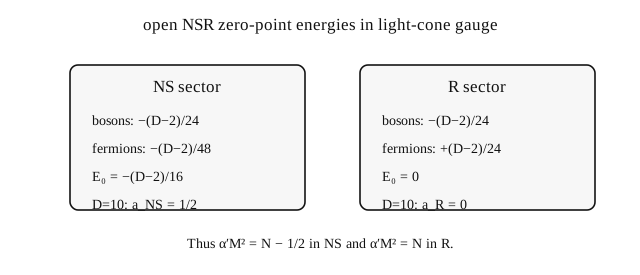
Per free zero-momentum coordinate multiplet, and the common shift is . NS changes from plane weight to cylinder energy ; R changes from to . Multiply by for the covariant matter theory. Physical transverse intercepts instead use multiplets after constraints have been imposed; they are not the plane Ramond weight. The vertical levels are equally spaced in units of ; horizontal placement only separates the two descriptions.
The central polynomials also change when expressed in cylinder generators. In the LL bracket, the extra zero-mode term is ; it cancels the linear part of the plane cocycle. In the GG bracket, it is , which cancels the constant part. Therefore
The mixed bracket is unchanged. In particular, in R. The negative NS cylinder vacuum energy presents no contradiction: there is no NS mode whose square would equal that energy.
A common regulator derives the vacuum energies
Section titled “A common regulator derives the vacuum energies”For each bosonic oscillator of frequency , the zero-point contribution is . For a real fermionic oscillator it is , as follows from replacing an ordered pair by its anticommutator. Use the same exponential cutoff in both sums:
Their small-cutoff expansions are
The common divergent terms cancel in the boson–fermion pair, leaving
The R fermion uses the same integer frequencies as the boson, so their regulated energies cancel for every . Its zero mode has zero frequency and contributes no energy. Equivalently, the finite boson term is , the NS fermion term , and the R fermion term .
These numbers also resolve a useful apparent mismatch. The fermions alone have and R plane weight , so their cylinder energy is . It is the bosonic cylinder contribution that makes the complete R matter vacuum energy zero.
From transverse vacuum energy to a string mass
Section titled “From transverse vacuum energy to a string mass”For the critical flat RNS string, light-cone constraints remove two bosonic and two fermionic directions, leaving transverse multiplets. The physical intercept is minus their vacuum energy:
With the reparametrization and superconformal ghosts, central-charge cancellation requires matter per chirality. For precisely free flat coordinate multiplets and no extra internal CFT or dilaton background charge, this gives , hence . The critical open-string transverse mass formulas are then
They are not obtained by inserting the covariant plane weight as an intercept. In the covariant description, the positive matter-mode conditions are only part of the physical-state construction: a mass-shell condition, the R zero-mode constraint, and the ghost or equivalent null-state quotient are also needed. GSO projection and closed-sector pairing are further choices. The next page develops the open spectrum; exercise 6 illustrates what level matching already tells us before projection.
Exercises
Section titled “Exercises”1. Current modes act on elementary oscillators
Section titled “1. Current modes act on elementary oscillators”Derive the actions of and on and from local OPEs. Verify the graded Jacobi identity with two supercurrent modes acting on a fermion oscillator.
Solution
The fermion stress OPE is . Its residue with is . Multiplying by and integrating the derivative by parts gives
The elementary supercurrent OPEs from Wick contraction are
For the first OPE, the factor in cancels the displayed phase and normalization, yielding
For the second, use . The double pole gives , and the derivative term, after the outer integration by parts, gives . Their sum is
Now evaluate the graded Jacobi identity on :
On the other hand, has precisely this value; the central term commutes with the oscillator. Treating either mixed odd bracket as an ordinary commutator would destroy this identity.
2. An NS partner can be nonzero and null
Section titled “2. An NS partner can be nonzero and null”Let be the no-oscillator NS state with real dimensionless momentum . Construct its first two superdescendants and calculate the first norm. Compare zero momentum with nonzero null momentum. Determine when is superprimary.
Solution
All positive modes annihilate , and its weight is . The only surviving term in the first action is
Using the oscillator action from exercise 1,
The square of the same negative-frequency fermion combination vanishes. With the momentum delta function stripped from the parent normalization,
For , the partner is the zero vector. For with real nonzero , it is instead
The two basis excitations are independent, so this vector is nonzero, but its norm vanishes. Covariant Lorentzian matter is indefinite; the vector’s existence does not contradict a positive-norm representation theorem. No physical cohomology statement has been inferred solely from this zero norm.
For , all positive annihilate the state, since their resulting fermion label is . The only potentially nonzero positive supercurrent action is
Higher give positive boson modes. Thus is exactly the superprimary condition at this level, with weight . Mass shell and the physical quotient are additional conditions.
3. Clifford ground states and Ramond shortening
Section titled “3. Clifford ground states and Ramond shortening”Consider a toy matter theory of two positive-metric coordinate multiplets. Represent its zero modes by and . Construct a complex annihilator, calculate at momentum , and determine what the saturation of the Ramond bound says about multiplicity.
Solution
The Pauli matrices anticommute and square to one, so the required zero-mode anticommutators hold. Define
Then , , and . This does not contradict the absence of a vector annihilated by both real zero modes. The ground space has two basis states, and the parity operator can be taken to be .
The supercurrent zero mode is
Here , and the free R ground-state plane weight is
For nonzero real , is an involution interchanging the two parity states. At , both states saturate , and is the zero matrix on the entire two-dimensional space. The unitary bound removes the nontrivial pairing at saturation; it does not remove one of the two states or establish a unique ground state. This positive-metric toy calculation does not count ten-dimensional physical fermion polarizations.
4. Recover the spin-field weight by point splitting
Section titled “4. Recover the spin-field weight by point splitting”For one real fermion, sum the radially ordered R ground-state kernel using positive integer modes and the zero-mode value . Obtain the plane expectation of . Compare with NS and with the incorrect omission of the R zero mode.
Solution
For and a consistent local square-root branch, the integer modes give
In NS the corresponding sum starts at and has no zero mode:
Set only after specifying the derivative operation. Expanding the R kernel locally,
The stress tensor differentiates the second insertion at fixed z, so . It follows that
The NS expectation is zero. The coefficient of therefore gives for each real fermion, and for the full spin field. In a multi-component spin state, antisymmetric zero-mode expectations can depend on the spin polarization, but their trace does not enter .
If the zero mode were omitted, the kernel would be . The derivative of the omitted term at coincidence is ; consequently the incorrect stress coefficient would be . Omitting the local singular subtraction instead leaves a divergent coincidence limit. Differentiating at fixed , rather than fixed , would also miss the finite contribution. These are different errors, despite beginning from the same formal mode sum.
5. Restore a dimensionful cylinder circumference
Section titled “5. Restore a dimensionful cylinder circumference”Let the auxiliary worldsheet cylinder have spatial circumference , with dimensionful coordinate . Map it to the plane by . Derive the closed-string worldsheet Hamiltonian for two equal central charges , and calculate its NS–NS and free R–R vacuum energies. Explain the relation to the regulated chiral sums.
Solution
Translation by Euclidean time multiplies the plane radius by . Plane dilatation therefore contributes to the Hamiltonian. The Schwarzian derivative of the exponential subtracts in each chirality:
For the NS–NS identity vacuum, both plane weights vanish, so
For two free zero-momentum R ground states, each plane weight is , and . For example, one coordinate multiplet in each chirality has , giving .
The dimensionful oscillator frequencies are or . Regulating them by amounts to the dimensionless cutoff . Thus a chiral boson–fermion pair has finite energy in NS and zero in R, exactly reproducing the two-chirality result. The cancellation and finite term require a common frequency regulator.
These energies scale as inverse worldsheet length. They are energies associated with an auxiliary worldsheet metric; they are not spacetime masses and should not be inserted directly into a target-space dispersion relation. The open mass formula follows after constraints and the zero-mode normalization have been used.
6. Unprojected levels and mixed-sector matching
Section titled “6. Unprojected levels and mixed-sector matching”Count the first few levels of eight transverse coordinate multiplets before GSO projection. Find the NS multiplicities at and the R multiplicities at . Then impose level matching for an unwound noncompact NS–R closed string at .
Solution
Use a formal counting variable , with each excitation contributing . Bosons have unrestricted occupation while each fermionic oscillator is either occupied or empty:
At there are eight choices of . At there are eight states and pairs of distinct fermions. At , the possibilities are a single , one , or three distinct oscillators. Their counts are .
The eight transverse R zero modes form a complex Clifford representation of dimension . Above it,
There are eight bosonic and eight fermionic choices at the first excited level, each acting on all sixteen ground states. This is an unprojected transverse count, not a count after choosing a Weyl/GSO subspace.
The two closed chiral mass-shell conditions are
Since , the NS vacuum at cannot occur in this unwound mixed sector. The first allowed pair is and is massless; it has unprojected transverse states for this fixed left–right sector. Projection changes the count and selects the physical type-II spectrum. Momentum/winding asymmetry or twisted internal sectors would modify this elementary matching problem.
References
Section titled “References”- Kiritsis, Elias. Introduction to Superstring Theory. CERN-TH/97-218, lectures given in 1996–1997; revised March 1998. Section 6.12. arXiv:hep-th/9709062v2.
- Weigand, Timo. Introduction to String Theory. University of Heidelberg lecture notes, Winter Semester 2011–2012. Sections 6.4.3–6.4.4. Author-hosted lecture notes.