
Black Hole Entropy and the Holographic Principle
Black holes are the place where the slogan “geometry has entropy” becomes a formula. In ordinary thermodynamics, entropy counts microscopic states compatible with macroscopic data. In black-hole physics, the macroscopic data are geometric: mass, angular momentum, charge, and horizon area. The surprising statement is that the entropy is not proportional to the volume hidden behind the horizon, but to the area of the horizon:
This formula is the first clue that quantum gravity is not an ordinary local quantum field theory with independent degrees of freedom at every point of space. It is also the ancestor of the modern entropy formulas used later in this section: RT/HRT, quantum extremal surfaces, and islands.
This page develops the chain of ideas
The most important lesson is not merely that black holes have entropy. It is that gravitational systems appear to have far fewer independent degrees of freedom than a naive bulk field theory would suggest.
Conventions
Section titled “Conventions”Unless stated otherwise, we use units with , but keep and visible when they clarify the physics. In these units,
in a -dimensional bulk spacetime, up to dimension-dependent conventions. In four dimensions, when .
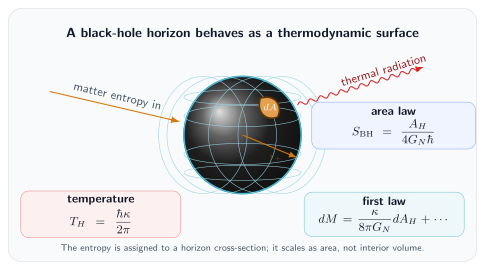
For a stationary black hole, denotes the area of a spatial cross-section of the event horizon, denotes the surface gravity, and denotes the Hawking temperature:
In formulas involving electric charge or angular momentum, is the angular velocity of the horizon and is the electric potential at the horizon. Factors of are suppressed by the choice of electromagnetic units.
The classical starting point: area behaves like entropy
Section titled “The classical starting point: area behaves like entropy”Classically, a black hole is a region from which no future-directed causal signal can escape to infinity. The boundary of this region is the event horizon. For a stationary black hole, the horizon is generated by a Killing vector field
where generates time translations at infinity and generates rotations. On the horizon, becomes null. The surface gravity is defined by
on the horizon.
The analogy with thermodynamics begins with the four laws of black-hole mechanics. For an ordinary thermodynamic system, one has a first law such as . For a stationary black hole in Einstein-Maxwell theory, the corresponding mechanical first law is
The formal similarity suggests the identifications
More precisely, after Hawking’s quantum calculation fixes the temperature to be , the first law fixes the entropy to be .
The four laws can be summarized as follows.
| Ordinary thermodynamics | Black-hole mechanics |
|---|---|
| Zeroth law: is constant in equilibrium. | Surface gravity is constant on a stationary horizon, under suitable energy conditions. |
| First law: . | . |
| Second law: entropy does not decrease. | Classically, horizon area does not decrease: . |
| Third law: is unattainable by finite operations. | Extremal black holes with are not reached by finite classical processes, in the analogous formulation. |
The second-law entry is Hawking’s classical area theorem. Under the null energy condition and cosmic-censorship-type assumptions, the area of the event horizon cannot decrease:
This already makes area look entropy-like. But the analogy is not yet thermodynamics. In classical general relativity, black holes do not radiate, so the temperature would seem to be zero. The real thermodynamic interpretation requires quantum field theory in curved spacetime.
Bekenstein’s argument: entropy must not disappear
Section titled “Bekenstein’s argument: entropy must not disappear”Imagine dropping a box of matter with entropy into a black hole. To an exterior observer, the matter disappears behind the horizon. If black holes had no entropy, the ordinary entropy outside the black hole would decrease, apparently violating the second law of thermodynamics.
Bekenstein’s proposal was to assign an entropy to the black hole itself. The total entropy relevant for exterior observers should not be merely the entropy of matter outside the horizon. It should be
The generalized second law says
Since the black-hole area increases when energy is thrown into the hole, it is natural to take proportional to . Dimensional analysis then gives
where is a dimensionless constant. Hawking radiation fixes .
This logic is conceptually important. Black-hole entropy was not introduced merely because the first law has a suggestive form. It was introduced because otherwise the disappearance of matter behind the horizon would destroy the second law. Gravity forces us to enlarge the meaning of entropy.
Hawking temperature fixes the coefficient
Section titled “Hawking temperature fixes the coefficient”Hawking’s calculation shows that a black hole emits approximately thermal radiation with temperature
Combining this with the mechanical first law determines the entropy. For a nonrotating, uncharged Schwarzschild black hole in four dimensions,
Hence
For Schwarzschild, the first law is , so
Integrating gives
Choosing the additive constant to vanish when ,
Restoring and gives the familiar dimensionful expression
The entropy is enormous for astrophysical black holes. In four dimensions,
where the entropy is measured in units with . A solar-mass black hole therefore has far more entropy than an ordinary star of comparable mass.
What does the area law count?
Section titled “What does the area law count?”The formula
suggests that the number of black-hole microstates compatible with the same macroscopic data is approximately
This is a statistical-mechanical statement. The black hole is not just a classical geometry; it represents an enormous degeneracy of quantum states.
However, the formula itself does not tell us what the microstates are. It only tells us their logarithmic count. Different approaches to quantum gravity explain the counting in different regimes:
- In string theory, certain supersymmetric or near-supersymmetric black holes can be counted using D-brane or CFT degrees of freedom.
- In AdS/CFT, large AdS black holes are dual to high-energy thermal states of the boundary CFT.
- In loop quantum gravity and related approaches, the entropy is associated with horizon degrees of freedom.
- In effective field theory, entanglement across the horizon contributes an area-divergent entropy, which is absorbed into the renormalization of .
For this section, the holographic viewpoint is the most important one: is the leading large- entropy of a boundary quantum system whose gravitational dual contains a black hole.
Why area scaling is shocking
Section titled “Why area scaling is shocking”In ordinary local quantum field theory, one expects degrees of freedom to be local in space. If a spatial region has volume and a UV cutoff , the rough number of field-theory cells is
in a -dimensional spacetime. If each cell carries a finite number of states, the entropy can scale like volume.
Gravity changes this conclusion. If one tries to put too much energy or entropy into a region, the region collapses into a black hole. The largest entropy that fits in a region of boundary area is therefore expected to be of order
not proportional to the volume.
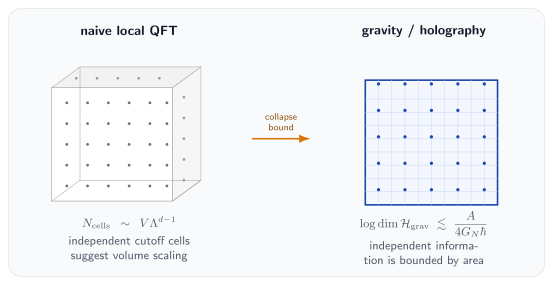
This is the origin of the holographic principle. Roughly, a quantum theory of gravity in a region should be describable by degrees of freedom living on a lower-dimensional surface, with about one independent unit of information per Planck area.
More carefully, the number of independent bits associated with area is bounded by
The factor of only converts entropy units into bits. The factor of is the same universal coefficient appearing in the Bekenstein-Hawking entropy.
The word “holographic” should not be understood as saying that the universe is a projected illusion. The statement is sharper and more technical: the independent quantum degrees of freedom of a gravitational system scale like a boundary area, not like a bulk volume. AdS/CFT is the best-understood realization of this principle.
The Bekenstein bound
Section titled “The Bekenstein bound”A related but distinct statement is the Bekenstein bound. For a weakly gravitating isolated system of total energy contained in a region of characteristic radius , the entropy is bounded by
This bound is not the same as the black-hole area law. It applies to weakly gravitating systems, while applies to black holes. But the two are compatible. If a Schwarzschild black hole of mass is assigned radius , then the Bekenstein bound gives
Thus the black hole saturates the bound parametrically and with the standard coefficient in this simple comparison.
The physical message is that black holes are the densest possible entropy containers. If one tries to exceed the entropy of a black hole of the same size, the system is no longer weakly gravitating; it must be treated as a black hole.
The generalized entropy
Section titled “The generalized entropy”The quantity that survives into modern black-hole information theory is not alone, but the generalized entropy
Here is the area of a codimension-two surface, is the von Neumann entropy of quantum fields on one side of that surface, and denotes counterterm and higher-derivative contributions needed to make the expression finite and scheme-independent.
For an event horizon in an evaporating spacetime, a useful version is
The generalized second law states that this quantity should not decrease:
This is a quantum refinement of Hawking’s classical area theorem. Classically, area increases. Quantum mechanically, Hawking radiation can make the horizon area decrease because the black hole loses mass. But the entropy outside the black hole increases, and the generalized entropy is expected to obey the appropriate second law.
The generalized entropy is also the prototype of the quantum extremal surface prescription. Later we will replace the event horizon by a candidate surface and extremize
The rule “area plus bulk entropy” is already present here. The island formula will use exactly this structure.
Entanglement entropy and the species problem
Section titled “Entanglement entropy and the species problem”There is a tempting explanation of black-hole entropy: perhaps is simply the entanglement entropy of quantum fields across the horizon. Indeed, entanglement entropy in local QFT is dominated by short-distance correlations near an entangling surface and has an area-law divergence:
where is a UV cutoff and counts matter fields.
This resemblance is important, but it is not the whole story. The Bekenstein-Hawking entropy is finite when expressed in terms of the renormalized Newton constant, while the naive entanglement entropy depends on the cutoff and on the number of matter species. The modern effective-field-theory viewpoint is that the area term and the entanglement entropy must be renormalized together. The coefficient absorbs the same UV sensitivity that appears in the matter entanglement entropy.
Thus the generalized entropy is not a casual sum of two unrelated terms. It is the finite gravitational entropy associated with a surface:
This is one reason the QES and island formulas are subtle: is an ordinary von Neumann entropy, but it is only meaningful in the gravitational entropy formula after being combined with the geometric counterterms.
Covariant entropy bounds
Section titled “Covariant entropy bounds”The naive statement “the entropy inside a spatial region is bounded by the area of its boundary” is too rigid. In cosmology and dynamical gravitational collapse, there may not be a preferred spatial slice or a clean notion of “inside.” Relativity asks for a covariant formulation.
Bousso’s covariant entropy bound starts with a codimension-two spacelike surface of area . Consider null geodesics orthogonal to . A light-sheet is generated by one of the null congruences whose expansion is nonpositive:
The conjectured bound is
where the light-sheet is followed until caustics, singularities, or boundaries where the construction must stop.
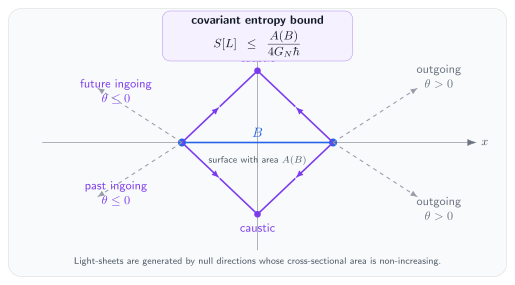
For a round sphere in flat spacetime, the future-directed and past-directed ingoing null congruences have decreasing area and therefore define light-sheets. The outgoing null congruences expand and are not light-sheets in this simple example.
This construction captures a central moral of gravitational entropy: the correct entropy bound is not fundamentally tied to a spatial volume. It is tied to causal structure and null focusing.
Holography in AdS/CFT
Section titled “Holography in AdS/CFT”The holographic principle becomes concrete in AdS/CFT. A gravitational theory in -dimensional asymptotically AdS spacetime is dual to a nongravitational CFT in dimensions. The CFT lives on the conformal boundary, but it describes all bulk physics, including black holes.
At large and strong coupling, the CFT has a classical gravity dual. The rough dictionary is
where is the AdS radius and is a measure of the number of CFT degrees of freedom. For example, in AdS/CFT with type IIB string theory on AdS, one has up to numerical factors.
A large AdS black hole is dual to a thermal state of the CFT. The entropy of the CFT thermal state matches the black-hole area:
at leading order in large . In this setting, black-hole entropy is not merely an analogy; it is the statistical entropy of states in an ordinary quantum system.
This is why AdS/CFT sharpens the black-hole information problem. The boundary CFT evolves unitarily, so the bulk black hole must also be described by unitary dynamics. The puzzle is how this unitary behavior is encoded in a semiclassical bulk description that seems to lose information.
Example: BTZ entropy from a two-dimensional CFT
Section titled “Example: BTZ entropy from a two-dimensional CFT”A particularly clean example is the BTZ black hole in AdS. The asymptotic symmetry algebra of AdS gravity contains two copies of the Virasoro algebra with central charge
where is the AdS radius and is the three-dimensional Newton constant. The nonrotating BTZ black hole has horizon circumference
so its Bekenstein-Hawking entropy is
The dual CFT thermal entropy reproduces this result. In Cardy form, the entropy of a high-energy two-dimensional CFT state is controlled by the central charge. Schematically,
and using the BTZ/CFT dictionary gives precisely . This example is historically important because it shows, in a highly controlled setting, how a gravitational area law can arise from ordinary CFT state counting.
From entropy bounds to holographic entanglement
Section titled “From entropy bounds to holographic entanglement”The entropy-area relation does not stop at horizons. In AdS/CFT, the entropy of a boundary spatial region is computed by a bulk surface. The classical Ryu-Takayanagi formula is
where is a minimal surface homologous to . Its covariant generalization, HRT, uses extremal surfaces. Quantum corrections replace the area by generalized entropy.
Thus black-hole entropy is the first example of a broader rule:
When the relevant surface is a horizon, the formula gives black-hole entropy. When the surface is an RT/HRT surface, it gives boundary entanglement entropy. When the surface is a QES, it gives quantum-corrected entropy and eventually the island formula.
Common pitfalls
Section titled “Common pitfalls”Pitfall 1: “The entropy is proportional to the volume inside the black hole.” The interior volume of a black hole is slicing-dependent and can grow with time even when the horizon area is fixed. The thermodynamic entropy of a stationary black hole is controlled by the horizon area, not by an arbitrary interior volume.
Pitfall 2: “The holographic principle says the world is a literal optical hologram.” The word is metaphorical. The precise claim is about the scaling and encoding of independent quantum degrees of freedom in a gravitational theory.
Pitfall 3: “The area law is only a classical statement.” The area theorem is classical, but is quantum. The factor of enters through Hawking radiation and the temperature .
Pitfall 4: “Generalized entropy is just black-hole entropy plus ordinary entropy.” It is subtler than a naive sum. The area term and bulk entropy are separately UV sensitive; their renormalized combination is the meaningful quantity.
Pitfall 5: “Entropy bounds are already a complete microscopic theory of quantum gravity.” Entropy bounds are powerful constraints. They do not by themselves specify the microscopic degrees of freedom, the Hilbert space, or the dynamics. AdS/CFT gives a concrete realization in special asymptotics.
Takeaway equations
Section titled “Takeaway equations”The formulas to remember are:
The first two convert black-hole mechanics into thermodynamics. The third is the classical first law. The fourth is the object that later becomes quantum extremal entropy. The fifth is the covariant entropy bound, a relativistic expression of holographic scaling.
Exercises
Section titled “Exercises”Exercise 1: Schwarzschild entropy from the first law
Section titled “Exercise 1: Schwarzschild entropy from the first law”For a four-dimensional Schwarzschild black hole,
Use to derive .
Solution
From ,
Integrating,
Taking , and using
we get
Exercise 2: Saturating the Bekenstein bound
Section titled “Exercise 2: Saturating the Bekenstein bound”The Bekenstein bound for a weakly gravitating system of energy and radius is
Insert and for a Schwarzschild black hole. Show that the result equals the Bekenstein-Hawking entropy.
Solution
Substituting and gives
The Schwarzschild horizon area is
so
Thus the Schwarzschild black hole saturates the bound in this comparison.
Exercise 3: Why a volume entropy estimate cannot be fundamental
Section titled “Exercise 3: Why a volume entropy estimate cannot be fundamental”Consider a region of linear size in four spacetime dimensions. A cutoff QFT with UV cutoff has roughly
available local degrees of freedom. Estimate why this cannot be the fundamental entropy at arbitrarily large once gravity is included.
Solution
A local field theory with cutoff also has energy of order
if the modes are highly excited up to the cutoff. To avoid forming a black hole larger than the region, this energy should be less than the mass of a Schwarzschild black hole of radius :
Thus
or
Then the entropy estimate becomes
This is parametrically smaller than the black-hole entropy
for large in Planck units. The exercise illustrates that ordinary local QFT overcounts states if it is extrapolated without gravitational collapse constraints.
Exercise 4: Light-sheets of a round sphere
Section titled “Exercise 4: Light-sheets of a round sphere”Consider a round two-sphere at in flat four-dimensional spacetime. There are four null congruences orthogonal to : future-outgoing, future-ingoing, past-outgoing, and past-ingoing. Which ones are light-sheets?
Solution
A light-sheet is generated by null geodesics with nonpositive expansion . For a round sphere in flat spacetime, outgoing future-directed light-rays move to larger spheres, so their cross-sectional area increases and . They are not light-sheets. Future-ingoing light-rays move toward the center, so their area decreases and until they reach a caustic. They define a light-sheet.
The same reasoning applies in the past direction. Past-outgoing light-rays expand as one moves along the past-directed congruence, so they have positive expansion. Past-ingoing light-rays shrink toward the center and define a light-sheet. Thus the two ingoing congruences are light-sheets in this simple example.
Exercise 5: Generalized entropy during evaporation
Section titled “Exercise 5: Generalized entropy during evaporation”Suppose a black hole emits Hawking radiation and loses a small amount of mass, causing its horizon area to decrease by . If the exterior entropy increases by , write the condition imposed by the generalized second law.
Solution
The generalized entropy is
The generalized second law requires
Since , the outside entropy must increase enough to compensate:
Exercise 6: Entropy as a microstate count
Section titled “Exercise 6: Entropy as a microstate count”Assume that a black hole has microstates compatible with fixed macroscopic data and that . Express in terms of the horizon area.
Solution
Using
and , we find
If one wants the number of bits, then
Further reading
Section titled “Further reading”- J. M. Bardeen, B. Carter, and S. W. Hawking, “The Four Laws of Black Hole Mechanics”, Communications in Mathematical Physics 31, 161–170 (1973).
- J. D. Bekenstein, “Black Holes and Entropy”, Physical Review D 7, 2333–2346 (1973).
- S. W. Hawking, “Particle Creation by Black Holes”, Communications in Mathematical Physics 43, 199–220 (1975).
- G. W. Gibbons and S. W. Hawking, “Action Integrals and Partition Functions in Quantum Gravity”, Physical Review D 15, 2752–2756 (1977).
- G. ‘t Hooft, “Dimensional Reduction in Quantum Gravity”, arXiv:gr-qc/9310026.
- L. Susskind, “The World as a Hologram”, Journal of Mathematical Physics 36, 6377–6396 (1995).
- R. Bousso, “A Covariant Entropy Conjecture”, Journal of High Energy Physics 07, 004 (1999).
- R. Bousso, “The Holographic Principle”, Reviews of Modern Physics 74, 825–874 (2002).
- R. M. Wald, “Black Hole Entropy is Noether Charge”, Physical Review D 48, R3427–R3431 (1993).
- R. M. Wald, “The Thermodynamics of Black Holes”, Living Reviews in Relativity 4, 6 (2001).
The next page turns from entropy to radiation: how Hawking’s calculation makes black holes thermodynamic, why the radiation is approximately thermal, and why this leads to the information paradox.