
One-Loop Strings, Tori, and Modular Invariance
The one-loop vacuum diagram of an oriented closed string is a torus. Its shape is described by a complex number, but many values of that number describe the same surface. Dividing out this redundancy changes the loop integral: the region of arbitrarily short proper time in a particle calculation is absent from a fundamental domain of torus moduli space. The remaining degeneration is a long tube, whose behavior depends on the spacetime spectrum.
We will derive the measure and oscillator factors before summing over fermion spin structures. This makes two distinct questions accessible: whether an integrand consistently describes the same torus in different coordinates, and whether its integral converges. The critical bosonic string and type 0 strings satisfy the first requirement while their tachyons spoil the second. Flat type II strings instead have a vanishing one-loop vacuum integrand.
The shared worldsheet normalization, plane and cylinder generators, and closed-string GSO projections are prerequisites. Here denotes the complex torus modulus, not Lorentzian worldsheet time. The discussion concerns an unpunctured, oriented torus; the other one-loop surfaces and their source conditions were treated on the orientifold page.
Torus lattices and changes of cycles
Section titled “Torus lattices and changes of cycles”Write the torus as
A useful coordinate is , with . The ordered cycles have complex periods . Opposite edges of this parallelogram are identified by translations; the edges are cuts in a closed surface, not physical boundaries.
Changing the two primitive generators of the same oriented lattice preserves the torus. For integers with , choose
Their periods are and . Normalize the first period back to one by changing coordinates:
The coordinate rescaling is essential: taking the ratio of the new periods, rather than merely naming a matrix, produces the fractional linear transformation. Two generators suffice:
These are large diffeomorphisms. On the modulus, a matrix and its negative act identically, so the effective group acting on the upper half-plane is . On the surface, however, also sends . It need not act trivially on fields, marked insertions, or chosen spin frames. Their transformation laws require the appropriate modular action, including its phases; one should not discard that information merely because is unchanged.
A standard region of representatives is
Its vertical sides are paired by , and the two halves of its circular edge are paired by . Boundary representatives are therefore still identified. The fixed points and have additional finite automorphisms; the quotient has orbifold points, not extra degeneration ends. Its one noncompact end is the cusp .
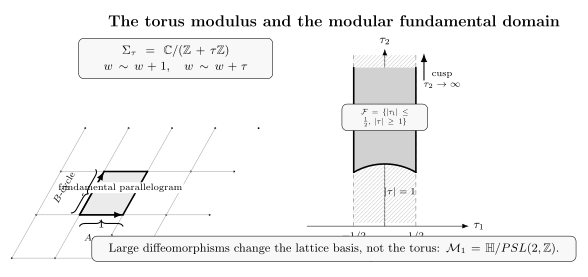
The worldsheet cell has identified opposite edges. The separate modulus-plane plot uses equal coordinate scales and the exact unit-circle boundary of , whose lowest height is . Its paired boundary points represent the same torus, and its cusp extends to infinity. The cell is illustrated at .
To reduce a generic point to , first subtract an integer from to enter the strip, then apply if , and repeat as necessary. A single exchanges and on the imaginary axis. For a general short torus the reduction can require several generators, and its final representative need not lie far up the cusp.
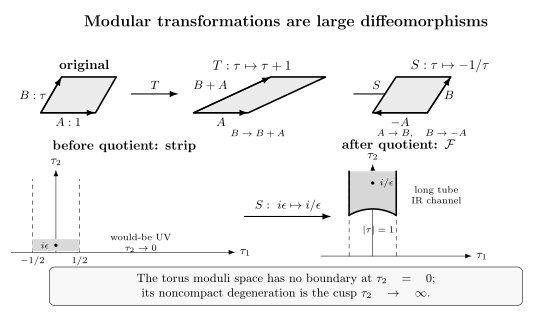
Both branches start with : and . The branch normalizes the new first period by . The additional short/long example is restricted to the imaginary axis. All periods and moduli shown are dimensionless.
The trace, the measure, and the scalar determinant
Section titled “The trace, the measure, and the scalar determinant”A cylinder glued with a twist
Section titled “A cylinder glued with a twist”The torus can be cut along into a cylinder. In coordinates where its spatial circumference is , propagation lasts and the ends are glued with a translation . For a CFT the cylinder generators are
Here and are dimensionless; the physical Hamiltonian for another circumference includes the corresponding inverse length. With and , the glued trace is
This is initially a CFT trace; a string vacuum amplitude also requires gauge fixing and an integral over inequivalent metrics. Periodicity under tests integer total spin, while the cylinder twist will implement physical level matching in the degeneration channel. A worldsheet trace with periodic Euclidean time is a thermal trace of the worldsheet theory; it is not by itself a finite-temperature ensemble in target spacetime.
The area element on moduli space
Section titled “The area element on moduli space”Differentiating the fractional linear map and using gives
Consequently
We abbreviate the modulus-plane coordinate area by . It is distinct from the worldsheet complex integration measure in the overview.
There is a metric explanation of this measure. Use the unit-area representative
Both variations of this constant metric are traceless and transverse to infinitesimal diffeomorphisms: their divergence vanishes, so integration by parts makes their inner product with zero for every periodic vector field . Their norm is
The square root of this two-dimensional Gram determinant is proportional to . This derives the measure up to a constant independent of .
One noncompact coordinate
Section titled “One noncompact coordinate”For a single target coordinate, the center-of-mass momentum contributes to each chiral . After rotating the target-time momentum to a Euclidean Gaussian, its trace is
is the length of a large target-space box. Each bosonic creation mode has occupation number , so its trace is . Including the cylinder vacuum energy yields
The Gaussian and oscillator product describe different parts of the same trace. They must each appear once. The ratio is dimensionless, as a partition function requires.
The functional integral gives the same result through a primed scalar determinant. For the unit-area metric the positive Laplacian has eigenfunctions and eigenvalues
A prime excludes the constant mode already integrated into . Comparison with the convergent oscillator trace, or spectral regularization of this eigenvalue product, gives
Only a -independent normalization is suppressed. The eta transformations
then show directly that , and hence , is invariant. The square root uses its analytic branch on the upper half-plane. Poisson resummation provides an independent derivation of the transformation; it expresses the exchange of the two lattice directions. Ginsparg, Sections 7–8, develops these trace and determinant descriptions.
Gauge fixing and the critical bosonic amplitude
Section titled “Gauge fixing and the critical bosonic amplitude”The target coordinates are not independent physical oscillator towers. Reparametrization ghosts remove the longitudinal oscillator contributions. They also have zero modes, so an unsaturated ghost vacuum trace, which vanishes, is not the gauge-fixed torus measure.
For clarity, consider the infinitesimal diffeomorphism operator on a vector field ,
On a flat torus, integration by parts gives on each of its two real vector components. Thus its nonzero-mode Faddeev–Popov Jacobian is
The omitted vector zero modes are constant translations. In unit-square coordinates their inner-product matrix is , whose determinant is one. Dividing by their group volume therefore contributes no further dependence in this unit-area metric. The constant traceless metric variations are precisely the two moduli already included in . In the ghost formulation, antighost insertions for these moduli and treatment of the conformal Killing vectors implement this same separation of zero and nonzero modes.
Combining these factors gives the connected genus-one vacuum functional
is one overall, -independent vacuum normalization, including the finite automorphism factor; it does not hide powers of or . We use the connected vacuum functional , whose contribution is the negative of the Euclidean effective action. Its absolute normalization is unnecessary for the modular and infrared questions here.
The factors before multiplication are instructive:
In this form the target momentum integral is still -dimensional. The surviving oscillator product has transverse directions. The extra is part of the combined gauge-fixed measure, not a second momentum Gaussian. A modular-weight check confirms the result, but does not replace the treatment of the zero modes. A light-cone motivation for the same answer is given by Tong, Section 6.4; that argument has its own caveat at vanishing light-cone momentum.
This derivation presupposes the critical theory, so that local Weyl transformations are a valid gauge symmetry. The fact that an expression such as is modular invariant for any does not remove a local Weyl anomaly or determine the critical dimension.
The cusp and spacetime propagation
Section titled “The cusp and spacetime propagation”For a Euclidean scalar of mass , the connected one-loop vacuum functional is, up to a mass-independent subtraction,
Here has dimensions of length squared. For the string Gaussian the corresponding parameter is . The modulus itself is dimensionless.
Expand the chiral transverse bosonic trace as
For , the fundamental domain contains the full interval . Therefore
Combining the left and right oscillator energies with the target momentum then produces
The cusp integral consequently begins as
The first term is the tachyon with . The next counts massless polarizations. The massive terms decay. These are spacetime propagation statements, extracted from the long-cylinder channel. They do not imply that the full fundamental-domain integral is literally a sum of independent particle proper-time integrals: below , the allowed interval has a curved exclusion, and the simple Fourier projection above no longer applies.
For superstrings the corresponding oscillator condition is
For example, a massless NS–R state has and . This condition uses transverse oscillator intercepts. It is not equality of the bare covariant matter-plane weights: the Ramond matter ground weight and the ghost dressings are accounted for as explained on the spectrum page.
The region obeys . Thus the unpunctured torus has no independent small- degeneration. Its cusp can still diverge exponentially if there is a tachyon. By contrast, a finite number of massless states in noncompact dimensions contributes a convergent vacuum tail . Tadpoles, amplitudes with insertions, zero-momentum limits, and compact zero modes can have different infrared behavior. The geometry of this vacuum domain is not a proof that every string amplitude is finite.
Fermion traces and spin structures
Section titled “Fermion traces and spin structures”Choose the signs of one complex chiral fermion around the two torus cycles:
These labels specify the new torus boundary-condition data. Antiperiodic spatial boundary conditions () give the NS Hilbert space; periodic ones () give the R Hilbert space. An ordinary fermionic trace imposes antiperiodicity in Euclidean time. Inserting fermion parity changes that temporal sign to periodicity.
A complex fermion has two occupation modes at each positive frequency, one for each charge. With the NS vacuum assigned even oscillator parity, the traces are
The exponents follow from with : the NS ground weight is zero, and the complex Ramond ground weight is . The factor two in comes from the zero-mode Clifford pair. Its two ground states have opposite parity, so the graded R vacuum trace vanishes.
The same calculation admits continuous holonomies for a complex fermion. They are useful generating variables even when the superstring spin structures are restricted to signs. Let be the charge with fermion charges , choose , and set . The twisted ground state has charge and weight , as follows from the bosonized operator . Its two towers of creation energies are and . Thus the charge trace is
At the second tower includes a zero mode: its two ground charges are , explaining the factor two when . In the NS sector, instead has one neutral ground state. Continuous twists here describe a free complex-fermion charge trace; they are not a claim that arbitrary twists preserve the full RNS supercurrent.
The Jacobi triple product identifies this product with a theta function divided by eta. Define
The identity is . Here is a charge chemical-potential variable, not a worldsheet coordinate. We use the usual functions , , and . The last sign gives the standard positive leading term in . All theta constants below have .
| Spatial / temporal signs | Vacuum trace of one complex fermion | |
|---|---|---|
| NS / NS | ||
| NS / R | ||
| R / NS | ||
| R / R | zero |
The zero in the last row is not a missing sector. A constant Grassmann mode is allowed around both cycles and its integral without an insertion is zero. Sufficient fermion insertions can saturate the zero modes, making an odd-spin-structure correlator nonzero. The graded Ramond trace has a conventional phase relative to the odd characteristic when the chemical potential is nonzero. Exercise 4 fixes this phase explicitly; the vanishing trace at zero chemical potential cannot determine it.
How the spin structures transform
Section titled “How the spin structures transform”From the Gaussian sum, acts by
Poisson resummation gives the complementary transformation
Characteristics are reduced modulo integers with their associated phases. In particular, at zero argument,
The three even structures form one orbit. The odd, doubly periodic structure remains odd under both generators. This also follows geometrically: for , the sign along is the product of the two old signs, giving the affine shift ; for , the two signs are exchanged. These formulas and the phases are discussed in Ginsparg, Section 7 and tabulated in the NIST DLMF.
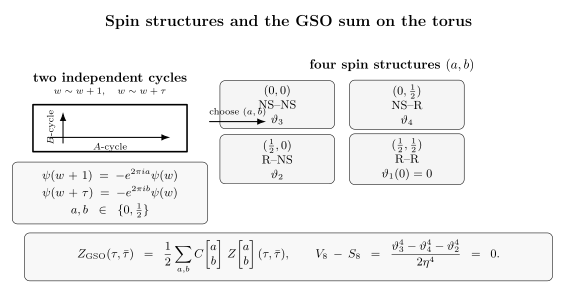
This is the permutation action on one chiral fermion’s spin-structure labels; multiplier phases are suppressed in the drawing and retained in the equations. The isolated R/R structure has unsaturated zero modes in the vacuum amplitude, but need not vanish in correlators with suitable insertions. A closed superstring has independent left and right spin data.
Type II and type 0 torus integrands
Section titled “Type II and type 0 torus integrands”After gauge fixing, the oscillator content is eight transverse bosons and eight transverse fermions. The latter are four complex fermions. For a fixed even spin structure on each side, cancellation of the longitudinal matter and superghost determinants leaves a chiral fermion factor . Together with the bosonic part, the common measure is
is the left–right fermion and GSO sum. The ten-dimensional target Gaussian has already contributed and gauge fixing has supplied ; their product is the displayed . There is no additional ten-dimensional momentum factor to multiply this expression. The volume coefficient is dimensionless; dividing by gives a vacuum density of dimension length.
For example, before summation the nonzero block with spin structures is
Under , the ratio is permuted, while is invariant. Under , phases must also be included. Checking these nonzero blocks is meaningful even when a chosen sum eventually vanishes.
The characters separate the GSO eigenspaces:
and have identical unrefined functions at zero argument, but describe distinct chiral representations. Their equality does not erase the difference between type IIA and type IIB. With the chirality choices of the preceding spectrum page,
Expanding the first expression gives positive NS–NS and R–R terms and negative NS–R and R–NS terms, as required for spacetime bosons and fermions in a vacuum loop. Each chiral factor includes its own GSO projection. These are not a single common spin-structure choice imposed on both sides.
Jacobi’s identity,
makes both type II vacuum integrands vanish pointwise. Equivalently, the transverse chiral spectra obey
The equality describes Bose–Fermi degeneracy level by level. The existence and action of spacetime supercharges require the additional operator analysis developed on the spin-field page; an identity between unrefined partition functions alone is not that construction.
Modular invariance also permits nonsupersymmetric sums. The type 0 choices are
They have equal unrefined vacuum functions,
which are nonzero and modular invariant. The sector contains a tachyon, and there are no mixed-sector spacetime fermions to cancel the bosonic vacuum contribution. Thus modular invariance neither uniquely chooses the supersymmetric projection nor cures a tachyon. Angelantonj and Sagnotti, Section 3.1, formulate these choices as modular constraints on the matrix pairing left and right characters. Factorization, spin-statistics, and consistency of interactions supply requirements beyond equality of a single torus function.
Exercises
Section titled “Exercises”Exercise 1: Cycle reduction and the area of the quotient
Section titled “Exercise 1: Cycle reduction and the area of the quotient”Reduce into using explicit operations. Give the final integer matrix and the corresponding new periods in the original lattice. Then compute the hyperbolic area , explaining why an unbounded cusp can have finite area.
Solution
Apply , then , then , then , then :
The product is , represented by
Thus and have periods and . Their ratio is . Multiplying all periods and by gives the same modulus. In particular, the first alone gave imaginary part , which is still small.
The area follows without any oscillator function:
For , the area above height is . Finite hyperbolic area does not guarantee a finite vacuum integral, because the integrand can grow at the cusp.
Exercise 2: Keeping the worldsheet area until the end
Section titled “Exercise 2: Keeping the worldsheet area until the end”Replace the unit-area metric by , with . Track the constant scalar mode, the primed scalar determinant, the moduli Gram determinant, and the translation-vector volume. Show that the final gauge-fixed torus expression is independent of this constant area. For the scalar Laplacian use , and explain the origin of this value.
Solution
The normalized scalar constant mode is . If the physical constant coordinate ranges over length , its expansion coefficient ranges over . All nonzero scalar eigenvalues scale as , so spectral regularization gives
The heat trace with the constant mode removed has small- form
The torus has zero integrated scalar curvature. Its only constant term is therefore the subtraction of the one zero mode, yielding . Each scalar contributes , independent of .
For variations at fixed , the moduli norm is multiplied by . Its two-real-dimensional measure therefore gains one factor . The two translation vectors have Gram matrix : one factor comes from the volume element and one from the metric used to norm the vector. Their group volume is its square-root determinant, . Finally the nonzero diffeomorphism Jacobian is proportional to , and gains . Hence
This constant-area test checks the treatment of zero modes. It does not test arbitrary local Weyl transformations: on a torus a constant Weyl rescaling has vanishing integrated-curvature anomaly even for a noncritical matter theory. Criticality remains necessary for gauging the local Weyl symmetry.
Exercise 3: The first three closed bosonic levels
Section titled “Exercise 3: The first three closed bosonic levels”Count the transverse chiral states at oscillator levels directly from creation operators, and recover the first three terms of the level-matched cusp trace. Identify a term present before the twist integral that must disappear after it. Evaluate the massless tail above after removing the common volume and normalization factor.
Solution
The vacuum is unique, and gives level-one states. At level two there are states and symmetric states . Thus , without imposing a trace subtraction on this transverse oscillator count.
The left–right product before the twist projection contains
The terms and its conjugate have and integrate to zero over the full cusp twist interval. They are not additional physical tachyons. The level-matched terms are
corresponding to masses squared , , and . The massless vacuum tail is
It converges. The tachyonic term makes the original bosonic vacuum integral divergent regardless of this convergence. The oscillator expansion is convergent at every fixed ; the divergent operation is integration to the end of the cusp.
Exercise 4: A chemical potential detects the odd zero modes
Section titled “Exercise 4: A chemical potential detects the odd zero modes”For one complex Ramond fermion, let its two ground states have charges and parity eigenvalues , with the same ordering. Set . Derive the ordinary and graded traces with the insertion , express the graded one in terms of , and compute its first derivative at . Explain what that derivative measures.
Solution
The zero-mode trace is in the ordinary case and with parity. Each positive integer mode has charges . Hence
Since , the triple product yields
This fixes the phase for the specified ground-state parity. Reversing both ground parities reverses the graded trace. At the leading zero is linear. The derivative of the oscillator product is multiplied by the vanishing zero-mode factor, leaving
Equivalently, . The derivative inserts in the trace. Its zero-mode part is a fermion bilinear and saturates the two real zero modes of one complex chiral fermion. Four complex fermions require enough independent insertions to saturate all their zero modes; one derivative with respect to a common chemical potential does not suffice.
Exercise 5: A chiral GSO sum and a nonsupersymmetric invariant
Section titled “Exercise 5: A chiral GSO sum and a nonsupersymmetric invariant”Define the nonzero holomorphic functions
Determine the relative coefficients in a formal combination that is invariant under and has modular weight under , before imposing Jacobi’s identity. Then prove that is a nonzero modular invariant, determine its leading cusp growth, and test the effect of erroneously multiplying it by another .
Solution
The eta multiplier is essential. Under , acquires the factor , while also acquires . Thus
Requiring these formal coefficient vectors to agree gives and . The result is proportional to , which vanishes by Jacobi’s identity. This establishes a relative sign within this particular chiral ansatz; it is not a classification of all left–right GSO pairings.
For the sum of absolute squares, only permutes magnitudes, and multiplies each square by and permutes them. Since , the factors cancel. This is the unrefined type 0 integrand, before the common volume coefficient and .
At the cusp, , and . Consequently
The invariant has a tachyonic divergence. If it were multiplied by an extra , an transformation would instead multiply the answer by . This fails modular invariance at generic . Testing a vanishing type II sum would have concealed the same normalization error.
Exercise 6: A finite vacuum tail with singular derivatives
Section titled “Exercise 6: A finite vacuum tail with singular derivatives”For , and , consider the contribution of a finite number of states to the vacuum tail,
Evaluate and express the massive result using the upper incomplete gamma function. Determine when the th derivative with respect to remains finite at , and find the first singular derivative in ten noncompact dimensions. What does this teach about amplitudes with insertions?
Solution
The massless result is elementary:
For , set . Then
For strictly positive , all mass derivatives can be taken under the integral. Their limits as are controlled by
This converges precisely when . At the integrand is and the divergence is logarithmic; larger gives a power divergence. For , the vacuum tail and its first four derivatives are finite, while
as . The nonanalyticity is infrared: the lower cutoff is fixed away from zero throughout. Insertions or background derivatives can introduce extra powers of propagation time and expose such infrared behavior even when the vacuum integral converges. A particular scattering amplitude still requires its own vertices, momentum dependence and factorization analysis. Finally, if , the original tail itself grows exponentially and no massless convergence argument applies.
References
Section titled “References”- Carlo Angelantonj and Augusto Sagnotti, “Open Strings,” Physics Reports 371 (2002), 1–150; erratum 376 (2003), 339–405. arXiv:hep-th/0204089. Sections 2.4 and 3.1 derive the torus trace, its modular transformations, and the type II/type 0 character pairings.
- Paul Ginsparg, “Applied Conformal Field Theory,” in Fields, Strings and Critical Phenomena, Les Houches, Session XLIX (1988), edited by Édouard Brézin and Jean Zinn-Justin, North-Holland, Amsterdam (1989), pp. 1–168. arXiv:hep-th/9108028. Sections 7–8 treat fermionic spin structures, theta functions, and bosons on the torus.
- National Institute of Standards and Technology, Digital Library of Mathematical Functions, Chapter 20, “Theta Functions,” Sections 20.7(i) and 20.7(viii). Jacobi identity and modular transformations. Its elliptic argument is relative to the theta-series variable used here.
- David Tong, “Lectures on String Theory,” University of Cambridge Part III lecture notes (2009; revised 2012). arXiv:0908.0333. Section 6.4 explains torus geometry, the bosonic one-loop trace, and the distinction between ultraviolet and infrared limits.