
Highest-Weight Modules, Null States, and the Kac Determinant
A primary field determines an infinite collection of Virasoro descendants. Their inner products are fixed by the central charge and the primary’s conformal weight. At special values of these parameters, some formal descendants are orthogonal to the whole representation. Removing these states gives a smaller representation; in correlation functions, the same relations can become differential equations.
The important questions are therefore algebraic and physical: which descendants are independent before any quotient, which relations can consistently be imposed, and when is the resulting inner product positive? We will derive the first examples explicitly, state the general Kac determinant theorem, and distinguish that theorem from the classification of unitary representations.
This page builds on radial quantization and the state–operator correspondence, using the shared conventions. The detailed minimal-model spectra and correlators follow on page 15.
Universal highest-weight representations
Section titled “Universal highest-weight representations”A highest-weight vector satisfies
The Verma module is the universal representation generated by this vector: impose these highest-weight conditions and the Virasoro algebra, but no additional relations among negative-mode descendants. The Poincaré–Birkhoff–Witt theorem gives a basis
The ordering matters because the negative modes do not commute. For example,
Thus an operator acting on a basis vector generally produces a linear combination of basis vectors.
Since , a descendant with has weight . Consequently,
where counts partitions of . The first levels are
These are exact dimensions of the universal module, including at special . A singular vector is still a nonzero vector in this formal basis.
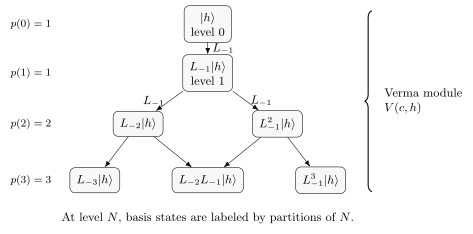
Each row of length represents a factor ; the total number of boxes is the level. The counts are dimensions of the universal Verma module. The separate reordering example produces a sum of two basis states, rather than an arrow to one descendant. The tiles display partitions, not physical lengths.
A concrete CFT need not contain the full Verma module. Acting with the same words on an actual primary state defines a map from to its CFT representation, and this map can have a kernel. For example, the formal vector is nonzero in , whereas the identity field satisfies
This is a relation in the identity representation, not a failure of the PBW theorem.
The character records these dimensions. As a convergent series for , or as a formal power series after its leading factor,
Each factor sums the allowed multiplicity of one negative mode. The cylinder shift enters the character; it does not change the plane highest-weight equation .
The contravariant form and the first Gram matrices
Section titled “The contravariant form and the first Gram matrices”For real , normalize the highest-weight vector by and extend the form by
This is the contravariant Hermitian form. It realizes the radial adjoint , but need not be positive. For complex parameters one instead uses the algebraic bilinear contravariant form; its matrix entries are the same polynomials in .
Different levels are orthogonal. For and , self-adjointness of gives
so when . It is therefore enough to study the finite Gram matrix at each level.
At level one,
A positive semidefinite representation must have . This is a necessary condition, not a sufficient test of every higher level.
At level two use the basis . The first entry follows from . For the off-diagonal entry,
For the remaining entry, commute one at a time:
Hence
and
A negative determinant of this real symmetric matrix implies one positive and one negative direction. A zero determinant means that the form is degenerate. Neither statement is the same as the existence of an arbitrary zero-norm vector: an indefinite, nondegenerate form also has such vectors.
Zero norm, the radical, and singular vectors
Section titled “Zero norm, the radical, and singular vectors”Three different notions need to be kept separate.
- A vector is isotropic if its norm is zero.
- A vector lies in the radical if it is orthogonal to every vector in the module.
- A nonzero, positive-level descendant is singular if every positive mode annihilates it. It is another highest-weight vector inside the Verma module.
The radical is
In a positive semidefinite form, the Cauchy–Schwarz inequality makes every isotropic vector radical. In an indefinite form the implication fails. At , for example,
The state has zero norm but has overlap with . It cannot consistently be set to zero while retaining this inner product.
The radical, in contrast, is an invariant submodule. For ,
for every and every integer . Thus all mode descendants of a radical vector remain in the radical.
Why does a singular vector belong to the radical? Let be singular at level . It pairs only with level- states. The adjoint of any such PBW word contains positive modes, whose rightmost action already kills . Therefore every such pairing vanishes. Its descendants are radical as well, but they need not themselves be singular.
The simplest example occurs at :
Its descendant obeys
in the universal module. Thus is radical but not singular.
Conversely, suppose the radical first appears at level . A positive mode sends a level- radical vector into a lower-level radical space, which is zero. Every vector in this first nonzero radical space is therefore singular. At later levels, degeneracy can simply be inherited from earlier singular vectors. This is why a zero of does not automatically reveal a new highest-weight vector at level .
Solving for a level-two singular vector
Section titled “Solving for a level-two singular vector”To find a singular vector with a nonzero coefficient, write
Positive modes and suffice: their commutators generate every higher positive mode, using for . Modes with index greater than the level also vanish automatically, since they would produce a negative level.
The two conditions are
The first gives
and the second becomes
The excluded denominator removes no solution of this polynomial: for every .
This calculation isolates the quadratic factor in . The other factor, , has a different origin: it is inherited from the level-one singular vector. At , the radical at level two is generated by , even though this vector is not singular. At , the independent combination
is also singular. Intersections of determinant conditions require this additional analysis; a list of roots alone does not describe all submodules.
Quotients and the number of surviving states
Section titled “Quotients and the number of surviving states”The form descends to the quotient by its full radical,
For a Verma module, is its unique maximal proper submodule, so this quotient is irreducible. Here is the reason. Any proper submodule is graded by and cannot contain the grade-zero vector , which would generate the whole module. If lies in that submodule at level , its pairing with a PBW state of level is obtained by applying positive modes to until reaching level zero. The result stays in the submodule and must vanish. Thus every proper submodule lies in . The radical itself is proper because .
Irreducibility does not imply positivity. An indefinite form can remain nondegenerate on an irreducible quotient. Unitarity imposes a further restriction on .
For counting purposes, suppose a singular vector at level generates a submodule isomorphic to , and this is the entire radical. Then the exact sequence of graded spaces gives
At level one removes states, with for . The hypothesis about the entire radical is essential. With several singular submodules, one must also account for their intersections and descendants; subtracting each tower independently can overcount the removed states.
For the vacuum representation at , the sole generating relation is . The radical is the submodule generated by the formal , and
In the ordered PBW basis, every word containing an ends in that factor and belongs to this submodule. The surviving basis words have all parts at least two. There are of them at levels zero through four.
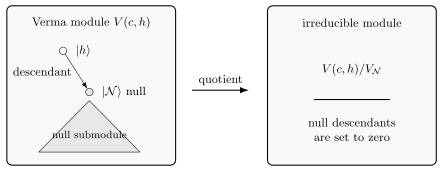
For , filled dots count PBW directions in the radical generated by ; open dots count surviving quotient directions. These are basis counts, not a picture of norm geometry. The descendant is radical but is not highest-weight, since . This single-submodule example does not describe the intersecting relations of general minimal models.
The Kac determinant theorem
Section titled “The Kac determinant theorem”The first matrices suggest that special weights organize degeneracy at every level. The Kac determinant theorem makes that statement precise. In the fixed, unrescaled PBW basis used above,
where is positive and independent of both and . Changing the basis changes this normalization; it does not change the degeneracy locus. The theorem is an all-level result, not an inference proved by checking two or three Gram matrices. The original contravariant-form construction and the determinant’s use in unitarity are discussed in Kac and Friedan, Qiu, and Shenker.
A useful parametrization, which does not assume a minimal model, is
One can choose complex to describe a general central charge. Replacing by exchanges and , so the product is unchanged. The positive integers label determinant factors; need not be rational or real.
At the first two levels,
The level-three calculation in Exercise 3 gives
This agrees with and the Kac factors with . In particular, the level-one factor now has exponent , because there are two level-two descendants of its singular vector.
The exponent explains how a singular submodule contributes descendants at higher levels. It is a multiplicity in a determinant, however, not an unconditional count of new primitive singular vectors. Coincident factors need care. At , choose :
At , the matrix has a one-dimensional kernel despite the double root. Likewise does not mean that the first singular vector of occurs at level four: it already occurs at level one. The equality marks a determinant condition, not by itself the first degeneration of that representation.
What unitarity requires
Section titled “What unitarity requires”For a unitary highest-weight representation, and are real and all descendant norms are nonnegative before the radical is removed. Besides , positivity forces . Indeed,
If , the cubic term makes this negative for sufficiently large , regardless of a fixed nonnegative .
These elementary tests do not give the full answer. The complete unitary highest-weight classification is:
- and ; or
- the discrete series
with integers , , , and the identification . The endpoint is ; its irreducible unitary representation is the one-dimensional identity representation. Nontrivial unitary theories in the discrete series start at .
This is a theorem about irreducible highest-weight representations, obtained by combining positivity restrictions with constructions of the allowed representations. Friedan, Qiu, and Shenker establish the restrictions below ; the Goddard–Kent–Olive construction establishes the discrete-series existence. We are stating those all-level results, rather than claiming to derive them from .
For , the Verma form is positive definite. At its vacuum relation must be removed. At , additional special weights can have radical states, as the example shows. Throughout the allowed set, the irreducible quotient has a positive definite form.
A representation is not a complete CFT. One must also choose the holomorphic and antiholomorphic representations and specify consistent OPE coefficients and correlation functions. Unitarity of individual modules does not by itself establish crossing symmetry or modular invariance.
There is also a separate issue in covariant string theory. Timelike matter and ghost sectors are indefinite, and the physical-state or BRST quotient involves constraints on their combined state space. A zero-norm matter descendant is not automatically a string gauge transformation. The representation-theoretic radical discussed here must not be identified with the full physical-state quotient without that additional analysis.
Null relations become differential equations
Section titled “Null relations become differential equations”Suppose a primary of holomorphic weight occurs in a CFT representation in which the level-two radical vector is set to zero. Its corresponding local field relation is
Here the local descendant is defined by the stress-tensor contour
Take a plane-vacuum correlator with other primary insertions,
Antiholomorphic coordinates are held fixed when taking the holomorphic derivatives. Assume separated insertions and the usual vacuum behavior at infinity so that the contour at infinity gives no contribution. Deforming the counterclockwise contour around gives minus the sum of contours around the . The Ward OPE at then gives the residue
Including the minus from contour deformation therefore yields
The null relation becomes the second-order BPZ equation,
This step needs more than a zero determinant: the radical relation must actually decouple in the chosen CFT representation and correlators. In a unitary CFT that decoupling follows from the zero-norm quotient. Nonunitary theories require the representation and correlator assumptions to be stated explicitly. The equation then constrains conformal blocks and possible OPE powers, as Exercise 6 illustrates; its local solutions alone do not determine all OPE coefficients.
Exercises
Section titled “Exercises”1. Count the descendants that survive a vacuum relation
Section titled “1. Count the descendants that survive a vacuum relation”Derive the Verma character from mode occupations. For the vacuum quotient, find the dimensions through level six and list the surviving level-six PBW words. Explain why setting does not set every descendant containing a derivative to zero.
Solution
An ordered basis word contains copies of and has level . Summing over each gives . Thus the coefficients of the Verma character are
A PBW word in the submodule generated by is obtained by appending one final to an arbitrary PBW word. At level , this gives independent vectors. Removing them leaves
for . The four surviving level-six words are
acting on the vacuum class. These are precisely the partitions of six with no part equal to one.
A factor at the far left differentiates the field represented by the remaining state. It need not annihilate that state. For example,
which represents and is nonzero at . The relation kills the derivative of the identity; it does not kill derivatives of every field.
2. Compare isotropic and radical vectors
Section titled “2. Compare isotropic and radical vectors”At , show that has zero norm, yet the level-two form is nondegenerate and indefinite. Find explicit positive- and negative-norm vectors. Then repeat the radical test for at , and determine whether it is singular.
Solution
Write and . At ,
Thus is isotropic but not radical: . The two vectors and have respective norms and . A quotient setting would make its nonzero overlap with ill-defined.
At ,
Now is orthogonal to both states at its level and, by grade orthogonality, to every other level. It is in the radical. Nevertheless,
in the Verma module. It is a descendant of a singular vector, rather than a new singular vector. The distinction persists before the quotient even though both vectors become zero classes afterward.
3. Derive the level-three matrix
Section titled “3. Derive the level-three matrix”Use the ordered basis . Compute all independent Gram entries and factor the determinant. Interpret the power and check the leading normalization in the Kac product.
Solution
The first row follows from
For the second diagonal entry, apply first:
The remaining produces . Also,
Finally the repeated identity
gives the last norm. The result is
Direct expansion and factorization give
The factor reflects the two level-three descendants and of the level-one vector . It does not mean that two new singular vectors appear at level three.
The quadratic factors have leading coefficients and in . Thus the coefficient of is . The six powers of agree with the total Kac exponent .
4. Identify primitive and inherited relations
Section titled “4. Identify primitive and inherited relations”At , find the level-two singular vector and check its annihilation by positive modes. Compare this with at and at . In the last case, determine the unitary irreducible quotient.
Solution
For , the coefficient is . The matrix is
whose kernel is spanned by . Therefore
The coefficient is , and the coefficient is . Higher positive modes vanish as explained in the main text. Since , there is no earlier radical level: this relation is primitive at level two.
For , . Its only radical direction is , inherited from level one and not singular. If as well, both level-two directions are radical, but a singular combination is
After quotienting by the level-one submodule, this imposes . Commuting with gives ; starting from , it follows that every annihilates the vacuum class. All positive-level states vanish, leaving the one-dimensional identity representation. This is the unitary endpoint.
5. Resolve a coincident Kac zero
Section titled “5. Resolve a coincident Kac zero”At , compare the order of the zero in with the dimension of its kernel. Find the singular vector and determine whether an additional independent radical state appears at level three. Also explain why the label at does not locate the first null relation.
Solution
At , , so
At the specified point,
There is one kernel direction, , not two. Its singular vector is . The order of a determinant zero as a parameter varies need not equal the nullity of the matrix at that parameter: an eigenvalue can vanish to higher order.
At level three the matrix from Exercise 3 becomes
It has rank two: for example, its upper-left minor is , while its determinant vanishes. The kernel vector is precisely
It is inherited and is not singular, since .
For , both and vanish. The level-one relation is already present. The factor first enters the determinant formula at , but the representation did not wait until level four to become reducible. Deciding whether a later vector is primitive requires studying the earlier submodules, not just naming another Kac factor.
6. Extract possible fusion powers from a null relation
Section titled “6. Extract possible fusion powers from a null relation”Consider a correlator containing two identical primaries of holomorphic weight at and , in a CFT where the level-two null relation decouples. Other insertions remain separated from these two. Use the BPZ equation to determine the possible leading powers as , and hence the possible holomorphic weights in their OPE. State what the calculation does not determine.
Solution
Let and seek a channel with
where has a nonzero, regular leading coefficient as . In the derivative with respect to , the coordinate is held fixed, so
The most singular terms in the BPZ equation therefore give
Terms from distant insertions and derivatives of have lower singular order and do not affect this indicial equation. Substituting and gives
An exchanged primary of weight contributes the leading power , so
These are the two possible holomorphic fusion weights selected by this null relation. The calculation does not prove that both associated OPE coefficients are nonzero, determine their normalizations, specify the antiholomorphic pairing, or establish crossing symmetry. Those require additional CFT data and consistency conditions. It also assumes that the formal radical vector is actually removed in the representation used for the correlator.
References
Section titled “References”- Friedan, Daniel; Qiu, Zongan; and Shenker, Stephen. “Details of the Non-Unitarity Proof for Highest Weight Representations of the Virasoro Algebra.” Communications in Mathematical Physics 107 (1986), 535–542. doi:10.1007/BF01205483. The determinant formulation and the all-level restrictions on unitary highest-weight representations below .
- Ginsparg, Paul. “Applied Conformal Field Theory.” In Fields, Strings and Critical Phenomena, Les Houches Session XLIX (1988), edited by Édouard Brézin and Jean Zinn-Justin, North-Holland (1989), pp. 1–168. arXiv:hep-th/9108028, §§4.1–4.3. Detailed level-two null vectors, null-decoupling equations, the Kac determinant, and unitarity.
- Goddard, Peter; Kent, Adrian; and Olive, David. “Unitary Representations of the Virasoro and Super-Virasoro Algebras.” Communications in Mathematical Physics 103 (1986), 105–119. doi:10.1007/BF01464283. Construction of the unitary discrete-series representations.
- Kac, Victor G. “Contravariant Form for Infinite-Dimensional Lie Algebras and Superalgebras.” In Group Theoretical Methods in Physics, edited by Wolf Beiglböck, Arno Böhm, and Eiichi Takasugi, Lecture Notes in Physics 94, Springer (1979), pp. 441–445. doi:10.1007/3-540-09238-2_102. The universal highest-weight construction and its contravariant form.