
Worldsheet Symmetries, Boundary Conditions, and Conformal Gauge
The Polyakov formulation turns string motion into a two-dimensional field theory coupled to an auxiliary metric. Its coordinate and Weyl symmetries let us choose a locally flat worldsheet metric, so the embedding fields obey a wave equation. The metric equation still has to be imposed: it restricts which waves describe a physical string. Boundaries further restrict both the waves and the gauge transformations.
This page develops that classical argument in flat target space, including the boundary conditions that define a static D-brane. It assumes the variation of the Nambu–Goto and Polyakov actions and uses the global conventions. In particular, denotes the constraint tensor with the tension removed; it is distinct from the normalized CFT stress tensor introduced later.
Gauge symmetry of the worldsheet metric
Section titled “Gauge symmetry of the worldsheet metric”Let be the induced metric. The Lorentzian Polyakov action is
There are two local symmetries. Under a change of worldsheet coordinates, is a scalar and is a tensor. Thus the same embedding can be described by different labels on the surface. Under a Weyl transformation,
we have and . Their product is invariant in two dimensions. Weyl symmetry changes the auxiliary metric’s local scale without changing the embedded surface.
The metric variation gives
Therefore the metric equation is , and the Lorentzian Hilbert tensor is . The trace vanishes identically:
This is an off-shell identity, expressing classical Weyl symmetry; it does not require the equations. Consequently only two components of the metric equation are independent. With dimensionless worldsheet coordinates, has dimension length squared, whereas is dimensionless. Removing the tension is not the same as making every tensor component dimensionless in every coordinate system.
Flat-target Poincaré transformations, , are another symmetry of the bulk action. They move the string in spacetime and are not worldsheet gauge transformations. Whether they are symmetries of a complete open-string problem also depends on the endpoint conditions.
Conformal gauge from local null coordinates
Section titled “Conformal gauge from local null coordinates”A smooth, nondegenerate Lorentzian metric in two dimensions has two distinct null directions at each point. Locally, each one-dimensional distribution can be integrated to a family of null curves. Choose coordinates adapted to the two families, so that the curves with fixed and those with fixed are null. Then
The cross term is nonzero because the metric is nondegenerate. Choose the local orientations so that . With
the metric becomes
A Weyl transformation with gives the conformal-gauge representative . This argument explains why the gauge exists locally. Counting three metric components, two coordinate functions, and one Weyl function is a useful check, but does not by itself construct the gauge.
Several limitations matter. This is a statement about a nondegenerate auxiliary metric. It is not an assertion that the induced geometry of a string in spacetime is intrinsically flat. Nor does it identify all globally different metrics: topology, boundary data, and conformal moduli can survive local gauge fixing. Those global questions enter the Polyakov path integral.
The wave equation and the equations it does not contain
Section titled “The wave equation and the equations it does not contain”Substituting into the action gives
The embedding equation is
Locally its general solution is a sum of chiral functions,
A profile depending on travels toward decreasing ; a profile depending on travels toward increasing . These propagation directions follow by holding the profile’s argument fixed. They should not be confused with the directions of increasing and .
The metric equation has not disappeared. In this gauge it reads
Thus a classical string must satisfy both
For example, , , with all other coordinates zero, solves the wave equation for any constants . However,
so the conformal-gauge metric equation additionally requires . Gauge fixing the action first and varying only would lose precisely this information.
Null components and chiral conservation
Section titled “Null components and chiral conservation”The worldsheet line element and its nonzero null components are
Transforming as a tensor gives
The last equation is the trace identity. The two remaining metric equations,
are the classical Virasoro constraints. The factor in their expressions in terms of and follows from .
Unlike the trace identity, stress-tensor conservation requires the embedding equation. Direct differentiation in conformal gauge gives
Equivalently,
Hence is a function of and a function of for any solution of the wave equation. They need not vanish for an arbitrary free-field solution; vanishing is the additional metric equation. This distinction is useful when deriving the generators that will impose the constraints after quantization.
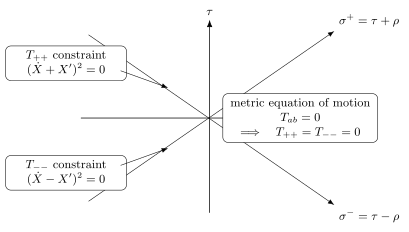
With future upward and increasing to the right, increasing points upper right and increasing upper left. Constant-phase curves run in the opposite null direction. The wave equation makes and chiral; the metric equation sets both to zero. Static Neumann or Dirichlet conditions glue their boundary values. The coordinate diagram is schematic.
Residual conformal transformations
Section titled “Residual conformal transformations”Conformal gauge still admits coordinate changes accompanied by a compensating Weyl transformation. Use the passive coordinate transformation
The same metric, expressed in the new coordinates, is
A Weyl factor therefore restores the flat representative. In the component connected to the identity and preserving time and space orientations, take and . A zero derivative makes the coordinate map singular. A negative product cannot be removed by a positive Weyl factor; taking both derivatives negative reverses time orientation and lies outside the chosen connected component.
The reciprocal factor above comes from expressing the metric in new coordinates. The pullback of a flat metric by the map instead has factor . Either description works, but they must not be mixed when choosing the compensating Weyl transformation.
Because is Weyl invariant and is an ordinary classical tensor under coordinate changes,
Thus the zero constraints are preserved. The anomalous transformation of a normal-ordered quantum stress tensor is a later, separate question.
For completeness, the infinitesimal version follows directly from keeping the gauge condition fixed. For , compare transformed fields at the same coordinate argument. Then and
Setting this to zero and taking its trace gives , so
The and components imply
Locally, therefore, and . On a surface with boundaries these two functions are further related.
Boundary variation and D-branes
Section titled “Boundary variation and D-branes”Take an open string on , and set variations to zero at the initial and final values of . Integrating by parts gives
The signed bracket means at the left endpoint and at the right endpoint. The outward worldsheet derivatives are correspondingly at and at .
For each target coordinate there are two elementary ways to make its boundary contribution vanish in the present flat, background-free problem:
| Boundary condition | Allowed endpoint variation | Consequence |
|---|---|---|
| Neumann | arbitrary | |
| Fixed Dirichlet | prescribed |
For a time-independent Dirichlet value, at the boundary as well. There is no requirement that vanish there: the string may meet the fixed locus with a nonzero normal tangent. With worldvolume gauge fields or additional boundary couplings, the boundary variation can instead lead to mixed conditions. The table is not a classification of all possible string boundaries.
For a closed string, a cut at a chosen is not a physical endpoint. Periodicity of derivatives and variations cancels the two cut contributions. In a fixed winding sector of a compact target direction, itself can differ by the winding displacement across the cut while its variation remains periodic.
A static Dp-brane
Section titled “A static Dp-brane”Choose Neumann conditions in the directions , , and Dirichlet conditions in , :
The endpoint lies on a -dimensional worldvolume: time plus spatial dimensions. Its spatial locus is a Dp-brane. Time is Neumann for this static Lorentzian boundary problem. The two ends of an open string can lie on the same brane or on different branes.
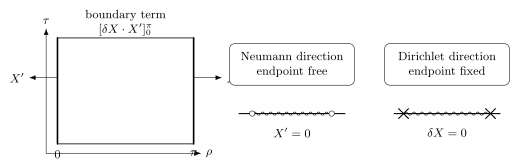
The two endpoint contributions have opposite signs because their outward normals point in opposite worldsheet directions. Neumann sets the corresponding normal derivative to zero; fixed Dirichlet sets the variation to zero. In the target-space spatial slice, endpoints may move along the Dp-brane but remain at fixed transverse coordinates. Time is a Neumann direction and is not drawn as another spatial axis. The geometry is schematic and assumes no additional boundary coupling.
At this stage the brane is a prescribed boundary condition. Its dynamical fields and tension are developed later. Suitable Type II superstring D-branes also carry Ramond–Ramond charges, as established by Polchinski. That charge statement does not apply to this bosonic worldsheet theory, which has no Ramond–Ramond sector.
Why an open string has one chiral conformal symmetry
Section titled “Why an open string has one chiral conformal symmetry”First consider the residual coordinate transformations. Requiring to remain gives
Requiring to remain gives
Equivalently, the single function is a monotone lift of a circle reparametrization:
Infinitesimally, with . Thus the two chiral maps that are independent on a local patch are not independent on the open strip. These equations preserve each boundary component; any imposed initial or final boundary data can restrict the maps further.
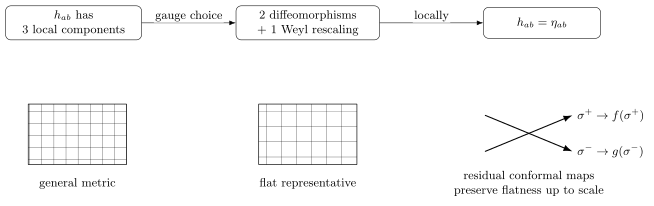
Local null coordinates put a nondegenerate Lorentzian metric into with ; Weyl symmetry removes . Residual passive coordinate maps produce a reciprocal factor , canceled by the positive Weyl factor . Preserving both boundaries of a strip of width leaves one common lift with period shift . This local construction does not remove global conformal moduli.
The same reduction is visible in the fields. At a Neumann boundary,
whereas at a static Dirichlet boundary,
Writing these together as , the reflection matrix has in Neumann directions and in Dirichlet directions. It preserves the target metric, , and therefore
This is the vanishing of the worldsheet energy flux,
It follows from the boundary conditions even before imposing the string constraints. If and , the boundary at sets and the boundary at gives . The open string therefore has one independent set of stress-tensor modes. Its quantization produces one Virasoro family. Closed strings have two chiral families, subject to their global conditions and level matching.
Target-space charges and forces at endpoints
Section titled “Target-space charges and forces at endpoints”Worldsheet energy flux is not the same quantity as target-space momentum flux. In conformal gauge, the translation-current density is
Integrating over an open string gives
Thus Neumann conditions conserve the corresponding momentum component. Fixed Dirichlet conditions do not set the right-hand side to zero: a support that holds an endpoint at a fixed transverse position can supply or absorb transverse momentum.
For angular momentum, the same calculation gives
Only symmetries preserving the complete boundary problem are automatically associated with conserved charges. A fixed flat brane preserves translations along its worldvolume and an appropriate subgroup of Lorentz transformations, but breaks normal translations and transformations mixing tangent and normal directions. If the brane is treated dynamically, the total charge of string plus brane can be conserved even when the string’s charge alone changes.
There is no conflict with energy conservation for a static brane. Time is Neumann, so and is conserved. Transverse endpoint velocity is zero, so a transverse force does no work. For a gauge with , the physical forces entering are
The factor converts a derivative with respect to the dimensionless worldsheet time to one with respect to target time.
Physical oscillations and the limits of classical gauge fixing
Section titled “Physical oscillations and the limits of classical gauge fixing”The constraints say that and are null vectors in target space. Their mutual product controls whether the induced worldsheet is timelike. They are not two additional free scalar oscillations.
A local way to see the remaining degrees of freedom is to introduce target light-cone coordinates,
where . In a compatible sector, and on a patch where the relevant chiral derivatives do not vanish, residual conformal transformations can set
The constraints then become
The transverse fields carry the local oscillations; is determined by them, up to integration data and global restrictions. For an open string, the target direction chosen for and the residual map must also be compatible with its boundary conditions. This local explanation does not establish a global gauge for every embedding. The light-cone quantization page treats the spectrum and Lorentz-symmetry test.
Nothing in the classical conformal-gauge construction fixes . Quantum Weyl invariance requires cancellation of the total central charge. For a matter sector consisting of free coordinates and the usual reparametrization ghosts, the condition is . More generally it is for the complete matter CFT, which can include an internal sector. The anomaly and the implementation of the constraints are derived on the Weyl-anomaly and BRST page; the classical argument alone is not a quantum consistency proof. The role of the critical dimension in the worldsheet path integral originates in Polyakov’s formulation.
Euclidean continuation
Section titled “Euclidean continuation”To use Euclidean field-theory methods, continue . The formal Euclidean action is
The contractions still use the target metric. A worldsheet Wick rotation alone therefore leaves the target-time field with a negative kinetic term. When a positive free-field Gaussian is needed, also analytically continue the target time, , and continue physical spacetime quantities back afterward. These are two different continuations.
Locally the residual Euclidean maps are holomorphic coordinate changes with nonzero derivative, together with their complex conjugates on a real Euclidean surface. Boundaries again restrict the maps. The connection with the free-boson CFT is developed on page 10. For a complementary systematic treatment of the classical gauge and boundary arguments, see Tong, sections 1.3–1.4 and 3.
Exercises
Section titled “Exercises”1. Construct null coordinates for a nonconstant lapse
Section titled “1. Construct null coordinates for a nonconstant lapse”Consider the dimensionless-coordinate metric
Construct local null coordinates and the Weyl transformation to a flat representative. Work out the coordinate explicitly for and verify the limit. Explain why this does not establish a global equivalence of coordinate ranges.
Solution
Define
Since , this is a locally invertible spatial coordinate. Then
The Weyl factor gives . For the exponential lapse,
Even if ranges over the entire real line, need not do so: for , . A local coordinate construction and Weyl rescaling do not remove boundaries, change topology, or prove that coordinate ranges coincide globally.
2. A finite conformal map of the strip
Section titled “2. A finite conformal map of the strip”Let be a positive integer and choose the same function in the two null directions,
Find a condition ensuring that this is a smooth residual diffeomorphism of the full strip . Check that it preserves the interior as well as the two boundaries. Explain what fails at the limiting value and why choosing independently generally fails.
Solution
The derivative is . Hence
makes it strictly positive everywhere. The integer ensures . At , the transformed spatial coordinate is zero; at , it is .
For an interior point, . Monotonicity and the period shift imply
Thus . The null-coordinate Jacobian is , and is bounded, so is also onto the real line. Together these facts give a smooth invertible map of the full strip. At , the derivative vanishes at some points and the inverse is not a smooth diffeomorphism there. For larger magnitude it changes sign.
If while is nontrivial, the left boundary maps to , which is generally not zero. Local conformal form alone does not ensure that a map preserves a specified boundary problem.
3. Mixed endpoints and half-integer modes
Section titled “3. Mixed endpoints and half-integer modes”A spatial coordinate obeys Neumann conditions at and fixed Dirichlet conditions at . Use the chiral decomposition to derive the periodicity of its chiral derivative. Find the allowed nonzero mode frequencies, and explain why its contribution to the chiral stress tensor still has period .
Solution
Write . At the left endpoint, gives
At the right endpoint, the fixed value implies , so
The derivative is antiperiodic. A Fourier factor must therefore satisfy , which gives . Equivalently, separation of variables gives the spatial profiles
with . Their derivative vanishes at and their value at . There is no nonzero constant mode compatible with . Although changes sign, does not. This coordinate’s contribution to is therefore -periodic, consistent with the single integer-indexed stress-tensor mode family. A single transverse mode alone is not a full constrained string embedding; the other coordinates must complete the constraints.
4. Conserved chiral integrals and gauge constraints
Section titled “4. Conserved chiral integrals and gauge constraints”Take any solution of the free wave equation with static Neumann or Dirichlet conditions at both endpoints. For a smooth -periodic function , show that
is conserved. Explain what happens to these integrals when the metric equations are imposed, and why they should not be identified with target-space momentum.
Solution
Chirality implies that the first integrand has equal and derivatives, whereas the second has opposite derivatives. Thus
At , the two arguments agree and the boundary condition gives . At , the arguments differ by , so periodicity of and the same boundary gluing again make the bracket zero. Therefore is conserved for the unconstrained free-field problem with these boundaries.
For a physical classical string, pointwise, so every vanishes. Their role is to express the residual gauge constraints. The target-space momentum instead generates translations of the embedding in spacetime and need not vanish. With dimensionless coordinates and dimensionless , is dimensionless, while has dimension inverse length.
5. Null tangents and free-endpoint speed
Section titled “5. Null tangents and free-endpoint speed”At a regular point of a constrained string, let and be nonzero, future-directed null vectors that are not parallel. Show that the induced metric is Lorentzian, is timelike, and is spacelike. What changes at an endpoint with Neumann conditions in every target direction? Explain why a fixed Dirichlet endpoint need not move at the speed of light.
Solution
In a mostly-plus target metric, two nonparallel future null vectors have . For example, write and with and unit spatial vectors. Then
The induced null-coordinate components are and . Hence
Since and ,
At an all-Neumann endpoint, implies , so . When , this means unit target-space speed. The induced metric can degenerate at such an endpoint even though the auxiliary conformal-gauge metric remains regular. The regular timelike interior and the endpoint limit must be distinguished.
With Dirichlet directions, can be nonzero normal to the brane. The constraint then allows . For instance,
on has time Neumann and spatial endpoints fixed at . It satisfies both constraints and has timelike, stationary endpoints. Their supports balance the string tension. The lightlike-endpoint result applies to the all-Neumann case, not to every open-string endpoint.
6. Which Poincaré transformations preserve a fixed brane?
Section titled “6. Which Poincaré transformations preserve a fixed brane?”Place a static flat Dp-brane at in uncompactified -dimensional Minkowski space. Determine the connected target-space symmetry group preserving this fixed locus. Use the boundary-flux formulas to check conservation of the associated string charges. Count the continuous generators for a D3-brane in ten dimensions, without invoking supersymmetry.
Solution
On the brane, an infinitesimal Poincaré transformation changes a normal coordinate by
For this to vanish for every point of the brane, and . Tangential translations and Lorentz transformations remain allowed, as do rotations among the normal spatial coordinates. The identity component is therefore
At an endpoint, gives and . Since there, the normal-rotation flux also vanishes, so is conserved. Normal momentum and mixed angular momentum have no such guarantee: a fixed brane can exchange them with the string.
The number of generators is
For , , this is , compared with generators of the full ten-dimensional Poincaré group. This is a geometric symmetry count. Statements about preserved supercharges require a superstring theory and additional information.
References
Section titled “References”- Polchinski, Joseph. “Dirichlet-Branes and Ramond-Ramond Charges.” Physical Review Letters 75 (1995), 4724–4727. doi:10.1103/PhysRevLett.75.4724; arXiv:hep-th/9510017. Establishes the Ramond–Ramond charge interpretation for Type II D-branes.
- Polyakov, Alexander M. “Quantum Geometry of Bosonic Strings.” Physics Letters B 103 (1981), 207–210. doi:10.1016/0370-2693(81)90743-7. The worldsheet-metric formulation and its quantum conformal anomaly.
- Tong, David. Lectures on String Theory. University of Cambridge Part III lecture notes, 2009; revised 2012. arXiv:0908.0333, especially sections 1.3–1.4 and 3 on the Polyakov action, constraints, and open-string boundary conditions.