
D-Brane Interactions and the Annulus Amplitude
Why does the force between two parallel D-branes vanish even though both branes source gravitational and Ramond–Ramond fields? The annulus answers this question by comparing two nonzero spectra. In the open description, physical bosonic and fermionic states cancel in a graded vacuum trace. In the closed description, attractive NSNS exchange cancels repulsive RR exchange. Replacing one brane by an antibrane changes the relative projection and exposes a stretched-string tachyon below a definite separation.
This page derives the oscillator sums and their modular transformation, then examines what the onset of that tachyon does to the integral. The open/closed-duality calculation supplies the cylinder geometry and calibrated sources, while the BPS and charge analysis explains their spacetime interpretation. Use the shared physical tensions and gravitational couplings and RR brane-coupling basis.
Stretched strings in the vacuum loop
Section titled “Stretched strings in the vacuum loop”Consider two static, parallel, unfluxed type II D-branes at transverse positions and , with separation . They fill the same spacetime directions. We work at weak coupling in flat noncompact space. For separately finite long-range exchange integrals we will use , with even in IIA and odd in IIB.
The classical Dirichlet profile on is
Its contribution to the worldsheet Hamiltonian follows directly from the gradient term:
Thus the stretched-string spectrum has
These are oscillator intercepts. The covariant plane Ramond conformal weight discussed on page 6 is a different quantity. Nor does a Dirichlet direction carry a momentum integral: its zero-mode information here is the endpoint separation.
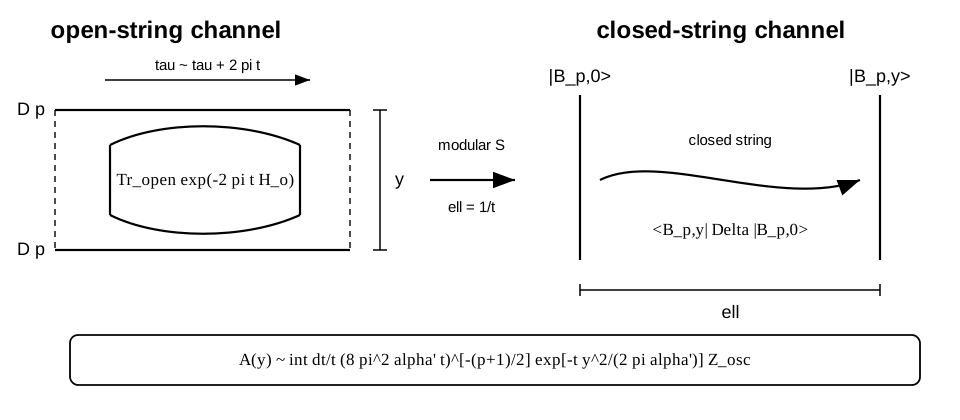
Let be the open-cylinder modulus, so its Euclidean time period is . For Euclidean worldvolume momentum , define the dimensionless Hamiltonian
The interbrane Hilbert spaces and have opposite endpoint orientations and identical masses. The connected vacuum contribution is
Here the trace is over GSO-projected physical states. The supertrace weights spacetime bosons by and spacetime fermions by . This statistical sign is separate from the worldsheet parity used in the GSO projector. We include the two interbrane sectors, not the separation-independent and self-energies.
Write for the regulated Euclidean worldvolume. As on page 19, and the interaction energy density is
The time-volume regulator is taken large; it does not introduce a thermal spin structure. Performing the continuous worldvolume Gaussian gives
If denotes the projected oscillator supertrace in one orientation, the two orientations give
The cylinder factor , the orientation multiplicity , and the GSO projector are distinct. Exercise 1 connects them to a complex-field determinant. The normalization follows Polchinski’s TASI lectures, §§2.6 and 3.5.
Building the physical oscillator traces
Section titled “Building the physical oscillator traces”Set . A unit increment of contributes . One bosonic mode of frequency has occupations , whereas a fermionic mode of frequency has occupations :
In ten dimensions there are eight physical transverse bosons and eight transverse fermions. Longitudinal matter and ghosts have already been removed from this physical-state trace. It is useful to name the bosonic occupation product
NS vacuum parity and the projection
Section titled “NS vacuum parity and the projection”The NS fermions have . Including the intercept gives the ordinary, unprojected trace
The GSO parity is : its vacuum eigenvalue is . Therefore the trace with this parity inserted is
For equal-charge parallel branes, the projector retains odd fermionic occupation. The NS vacuum is removed, but survives.
Ramond zero modes and the statistical minus sign
Section titled “Ramond zero modes and the statistical minus sign”The R fermions have integer frequencies, together with eight zero modes. Their Clifford algebra has a -dimensional unprojected ground-state space, split into two -dimensional chiral subspaces. Consequently
Ramond GSO parity includes both zero-mode chirality and nonzero-mode occupation parity. Its inserted trace vanishes: at any fixed nonzero-mode occupation, the trace of the zero-mode chirality operator is . Either chiral GSO choice therefore gives half the unrefined R trace. Reversing that choice changes spinor representations, even though this trace cannot distinguish them.
All projected NS states are spacetime bosons and all projected R states are spacetime fermions. Thus the vacuum supertrace subtracts the R character. The vanishing inserted R trace is not the reason for that minus sign.
Product notation and level-by-level cancellation
Section titled “Product notation and level-by-level cancellation”Package the products into
The powers encode the vacuum energies, and supplies the R zero-mode multiplicity. For one orientation the projected characters and graded combination are
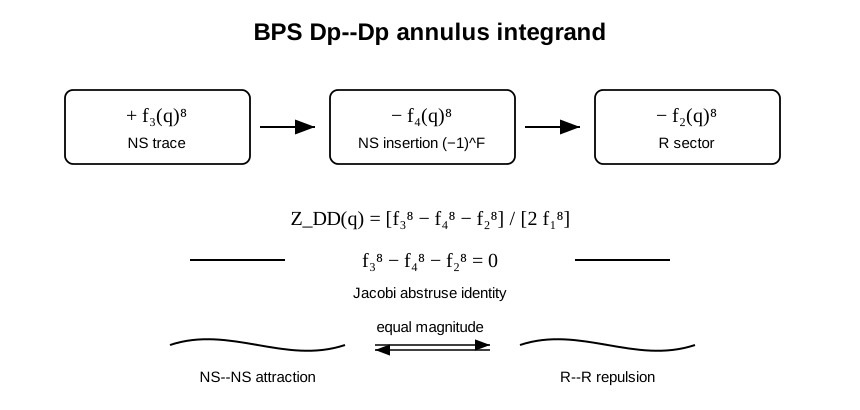
Jacobi’s theta identity gives
For example, and for , so this is . The relevant theta transformations and spin structures were developed on page 14.
The two ordinary projected characters are individually nonzero:
The first coefficients can be obtained without the theta identity by counting oscillator occupations; Exercise 2 does so. The identity establishes equality at every level, while a finite coefficient check tests only the levels counted. A common factor multiplying the whole zero numerator would still give zero, so cancellation alone cannot determine the absolute interaction normalization.
The arrows distinguish and endpoint orientations. For equal-charge branes, is retained and the vacuum of parity is removed. For a brane–antibrane pair the relative projection retains that vacuum. The opposite orientations describe a field and its complex conjugate: together the two ground states give one complex scalar. The geometric separations are schematic; this is a projection diagram, not a plot of mass against length.
The bosonic comparison
Section titled “The bosonic comparison”In the critical bosonic theory the same occupation argument gives transverse bosons and intercept :
The worldvolume Gaussian still has momenta, but now the transverse spacetime dimension is . There is no GSO subtraction. The term is an open tachyon; after modular transformation, becomes , whose term is a closed tachyon. These occur at opposite ends of the modulus integral. The tachyon-free closed type II spectrum removes the latter problem, while the boundary projections determine whether an open tachyon remains.
Modular exchange of the spin structures
Section titled “Modular exchange of the spin structures”Exchange cylinder space and time as on page 19:
The closed string has circumference and propagates for worldsheet time . The variable is dimensionless, not a target-space proper time. The product transformations are
Hence the denominator supplies , and the fermionic sectors are permuted. In the following table, each displayed ratio transforms with this common factor:
| Open-channel term before the common factor | Closed-channel contribution |
|---|---|
| from the ordinary NS trace | |
| from the statistical R subtraction | |
| from the inserted NS trace |
The first two combine into closed NSNS exchange. The last is closed RR exchange. Thus the open NS sector as a whole is not the closed NSNS sector. Interchanging the cycles changes which fermionic boundary condition is spatial and which is an insertion in a trace.
Set . The measure, Gaussian and modular weight combine as
The sign in reverses the integration limits. Including the GSO factor already derived above gives
where the closed characters are
They agree, but each begins with , not zero. More explicitly,
The common limiting coefficient measures the nonzero coupling to massless closed states. Their signs in are opposite; their signs in are attractive and repulsive, respectively.
The dimensionless ordinate is for . The solid curve is the oscillator product; the dashed curve retains . Equality of the positive characters permits cancellation between their signed contributions. Massless dominance of the integrated interaction additionally requires large separation, which suppresses the small- region.
A nonzero normalization check
Section titled “A nonzero normalization check”At , retain the massless term in either closed sector. With , the transverse heat kernel is
The substitution gives the separate NSNS exchange
This checks the same absolute coefficient extracted from the original annulus by Polchinski, equations (8)–(13). Here the final equality uses the shared physical tension. The factors are oriented sectors, the cylinder factor , the projector factor , and the raw closed massless coefficient ; together they give . Exercise 3 keeps the heat-kernel constants explicit.
The RR magnitude is . For an ordinary independent RR form, rescaling its kinetic term to gives canonical source strength . This is different from the unrescaled WZ coefficient . The self-dual D3 channel uses the constrained/string normalization explained on page 21, rather than a second unconstrained five-form action.
Each exchange has energy-density dimension : the coefficient has dimension and has dimension . Its order is , as required for the annulus, since has that order. Linearized spacetime exchange also requires weak backreaction, for example for one brane.
The total equal-charge annulus vanishes pointwise at every modulus, not merely in this long-distance approximation. Its interpretation as BPS no-force is explained by the supersymmetry algebra on page 21. The theta identity by itself concerns the stated one-loop, flat, static background; it is not a proof about every deformation or higher-order correction.
Reversing one brane’s RR charge
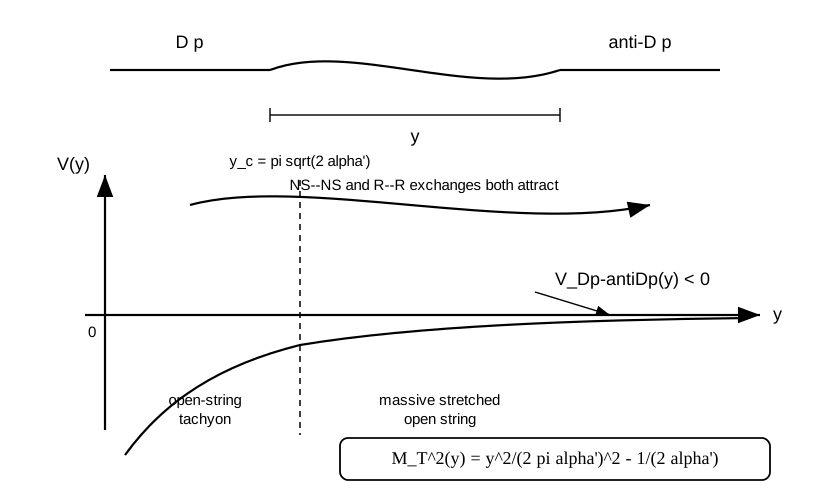
Section titled “Reversing one brane’s RR charge”An antibrane has the same positive tension and opposite RR orientation. The NSNS exchange keeps its sign while the RR exchange reverses. Applying the same modular permutation backwards therefore changes the inserted NS term from to . The stretched NS sector now uses :
The final equality uses Jacobi’s identity. The Ramond projection also reverses its chirality, as required by the relative boundary orientation, but its unrefined trace remains . The statistical sign of a Ramond loop does not reverse.
The graded expansion illustrates the distinction between signs and multiplicities:
The negative terms count fermions with the vacuum-loop minus sign. They are not negative-dimensional Hilbert spaces. The leading coefficient in each oriented NS sector is the vacuum which the equal-charge projector removed.
In the closed channel the amplitude contains . At large separation,
Both exchanges attract. This attraction already exists when every stretched-string mass squared is nonnegative. It should not be equated with the separate appearance of a tachyon at shorter distance.
The open infrared threshold
Section titled “The open infrared threshold”The retained NS vacuum has
Introduce the dimensionless variables and . Then
At large , the interbrane contribution is dominated by one complex scalar:
The continuum momentum integral is essential to this power. For the tail decays exponentially. At it is still integrable for every static . For it grows exponentially, so the fixed-background Gaussian annulus has an open-string instability. A finite cutoff does not turn that unstable expansion into a physical static potential.
A finite value at threshold need not be analytic there. Taking derivatives with respect to adds ; the threshold tail converges only when
Equality gives a logarithm. These statements concern the noncompact worldvolume density with continuous momentum and the zero-temperature limit; changing to a fully finite spacetime box changes the last infrared modes.
The upper curve is the exact free-string mass . The lower panel shows only the D3 ground-mode infrared approximation, normalized by its value at : . At the kernel decays as ; at it eventually grows; at it decays exponentially. Neither panel is a nonlinear tachyon potential or the full annulus integrand.
The D3 logarithm
Section titled “The D3 logarithm”For and , isolate the tail above a dimensionless matching scale :
Integration by parts twice gives this expression. Since ,
After converting to energy, the universal nonanalytic term is
Here , and is a mass scale specifying where analytic terms are separated from the logarithm. A different matching cutoff changes analytic coefficients, not this logarithmic coefficient. The factor is that of one complex scalar, or two real scalars. The energy and its first derivative with respect to are finite at zero; the second derivative has the logarithmic singularity. Exercise 5 derives the coefficient and checks this statement directly.
This calculation diagnoses the loss of stability, not the nonlinear decay. Sen’s brane–antibrane argument concerns the classical tachyon minimum and tension cancellation using additional duality information. The time evolution, emitted closed strings, and possible charged remnants require further dynamics. The string-field-theory page develops an off-shell framework; no endpoint follows from the quadratic annulus alone.
Regulating the two channel limits
Section titled “Regulating the two channel limits”A safe comparison begins with a common interval . Its image is . The equal-charge NSNS and RR characters cancel before either endpoint is removed. An equality of regulated integrands is meaningful even where the separate unregulated integrals do not exist.
There are two different dangers. At , the lightest open mass controls convergence, producing the antibrane tachyon divergence below . At , equivalently , massless closed propagation behaves as . It converges for , is logarithmic for , and diverges more strongly for . A noncompact isolated-source Green function cannot simply be extrapolated through these cases. Nor does pointwise BPS cancellation remove a compact-space RR tadpole constraint.
The present calculation concerns parallel boundaries. Relative angles and mixed Neumann–Dirichlet directions change the oscillator spectrum and its supersymmetry; they are the subject of page 23.
Exercises
Section titled “Exercises”Exercise 1. Stretching energy and a complex determinant
Section titled “Exercise 1. Stretching energy and a complex determinant”Starting from the worldsheet Hamiltonian, derive the stretch contribution and the worldvolume Gaussian. Track the two endpoint orientations, the cylinder factor, and the GSO projection separately. Explain why the retained brane–antibrane ground states give one complex scalar determinant rather than two.
Solution
The zero-mode Hamiltonian is . The static Dirichlet profile gives . Along the brane, , so the momentum term is . Cross terms with Dirichlet oscillations integrate to zero because their endpoint displacements vanish. The mass shell therefore gives
For , each Euclidean momentum integral contributes , so their product is . There is no analogous momentum zero mode in a Dirichlet direction.
One real scalar with operator has . Up to a mass-independent subtraction,
The two orientations contribute twice this expression. Equivalently, is a single complex field with . Thus , not .
The GSO factor is applied to an unprojected string Hilbert space before this determinant comparison. In the opposite-charge NS ground state, ; it does not leave an extra factor on an already retained scalar. In the complete equal-charge raw-character expression, the distinct factors combine as
This is precisely the prefactor multiplying and on page 19.
Exercise 2. Count states before using the theta identity
Section titled “Exercise 2. Count states before using the theta identity”Count the lowest two retained NS and R levels in one orientation. Then count the first two levels retained by the opposite NS projector and assemble the beginning of the brane–antibrane supertrace. Why can the Ramond projection change while its unrefined trace stays the same?
Solution
For the equal-charge NS projector, has the eight states . At , odd fermionic occupation allows
The total is . These give the coefficients of and because the exponent is .
The R ground state retains one chiral eight-dimensional zero-mode space. At level one, acts on that chirality, while acts on the opposite ground chirality: the latter oscillator flips nonzero-mode occupation parity. Each gives , for a total of . This is why one cannot project the zero-mode chirality once and then ignore the oscillator contribution to Ramond GSO parity.
The opposite NS projector retains even fermionic occupation. Its vacuum contributes . At , the possibilities are and , giving states and coefficient .
For another independent check, at the occupations give
Subtracting the Ramond contribution therefore yields . Reversing the R projection exchanges equally sized zero-mode chirality spaces at every oscillator occupation, so its ordinary character is unchanged. Its spacetime-fermion sign remains negative.
Exercise 3. Follow a nonzero sector through the channel change
Section titled “Exercise 3. Follow a nonzero sector through the channel change”Transform the raw open spin structures and the full measure separately. Identify the open contribution that produces closed RR exchange. Derive the massless coefficient in terms of , and evaluate the separate energy densities for a D3 pair. Explain which error would result from counting the two orientations twice.
Solution
The modular maps are , and . Thus the inserted open NS term gives the closed RR term . The ordinary open NS and statistically subtracted R terms instead give , the closed NSNS numerator.
The raw ratio has weight . With ,
One closed sector begins with , while the common coefficient outside the raw ratio is . The required integral is
Multiplying by gives . This equals , using the shared definitions. An erroneous additional orientation factor would double this nonzero answer and infer a tension larger by . The total BPS zero would fail to reveal that error.
For , and the coefficient is . Hence
These are energy densities at large separation and weak backreaction. The D3 RR value is the string/self-dual normalization, not the result of doubling an unconstrained five-form propagator.
Exercise 4. Convergence is not the same as stability
Section titled “Exercise 4. Convergence is not the same as stability”Derive the critical separation and classify the ground-mode tail above, at and below it. For which derivative orders does the threshold integral converge? For the D3 plot at , find the minimum of its normalized log kernel. Explain why large-distance attraction is compatible with a positive stretched-string mass squared.
Solution
Setting gives . The leading NS coefficient is , so together with the stretch factor it gives with .
Put . The large-modulus integral is . It is exponentially convergent for . At it converges because for . For , no power of defeats the exponential growth.
After derivatives with respect to , the threshold power is . It is integrable precisely for . At there is a logarithm; for larger there is a power divergence. For a D0 the energy is finite but its first mass-squared derivative diverges, while for a D3 the first divergent derivative is the second.
For the D3 normalized log kernel,
At it vanishes at and the second derivative is . A tachyonic integrand can therefore decrease initially before its eventual exponential growth; a short numerical integration interval can conceal the instability.
For , the two oppositely charged branes still have attractive NSNS and RR exchange. That force accelerates freely moving branes, but it does not create a negative quadratic mass for the stretched field at that fixed separation. The annulus here computes an interaction for prescribed static boundaries, not their time-dependent motion.
Exercise 5. Extract the complex-scalar threshold logarithm
Section titled “Exercise 5. Extract the complex-scalar threshold logarithm”For and , evaluate and extract the first nonanalytic energy-density term. Check the singularity by differentiating the integral. Which terms can change if the matching cutoff is replaced by a different fixed positive number?
Solution
Let . Integration by parts gives
Applying it for yields . Expanding the two terms gives
The ground-mode energy density is . Substituting , the logarithmic coefficient becomes
Changing the constant in the logarithm changes only a term analytic in . Integrating over the finite interval between two positive matching cutoffs likewise gives an analytic function near . Massive string states stay gapped there and do not alter this lowest-mode logarithm; the full annulus fixes additional analytic terms.
For , differentiation under the integral gives
Thus and are finite, whereas diverges logarithmically. In terms of ,
This agrees with the second derivative of up to analytic terms. Counting and as two independent complex scalars would incorrectly double this coefficient.
Exercise 6. Transform the regulators before removing them
Section titled “Exercise 6. Transform the regulators before removing them”Restrict the open modulus to . Transform the interval and show how a common regulator preserves cancellation. For and , compute the leading massless closed tail between a fixed large and an upper cutoff . Show explicitly how different sector cutoffs can produce a spurious force. Is this the same divergence as a brane–antibrane tachyon?
Solution
Since , the transformed interval is . Both the interval and the modular weight must be transformed. At every point of this finite interval, , so the equal-charge regulated amplitude vanishes before any limit is taken.
At large , the separation exponential is and either closed character is . Factoring out
the leading tail is
The RR contribution has the opposite sign for equal-charge branes. If the NSNS cutoff is but the RR cutoff is , a false residue survives as . Allowing such a mismatched to depend on separation would even manufacture a false force. For the mismatch is and generally diverges. These are regulator artifacts, not violations of the theta identity.
For , the leading upper tail instead falls as , although the other endpoint still needs the appropriate open-spectrum check. An antibrane tachyon comes from , or , rather than this large- massless tail. Common cutoffs cannot cure its negative quadratic mass. Likewise, cancellation of a regulated parallel-brane force does not satisfy global charge constraints in an arbitrary compactification.
References
Section titled “References”- Joseph Polchinski, “Dirichlet-Branes and Ramond–Ramond Charges,” Physical Review Letters 75 (1995), 4724–4727, doi:10.1103/PhysRevLett.75.4724, arXiv:hep-th/9510017. Equations (8)–(13) separate physical-state multiplicities from the RR kinetic normalization.
- Joseph Polchinski, “TASI Lectures on D-Branes,” in Fields, Strings and Duality, edited by Costas Efthimiou and Brian Greene, World Scientific, Singapore (1997), pp. 293–356; arXiv:hep-th/9611050, revised 23 April 1997. Sections 2.6 and 3.5 supply the oscillator traces, modular transformations, and nonzero exchange normalization.
- Ashoke Sen, “Tachyon Condensation on the Brane Antibrane System,” Journal of High Energy Physics 08 (1998), 012, doi:10.1088/1126-6708/1998/08/012, arXiv:hep-th/9805170. The classical minimum argument uses flux, T-duality, and a BPS continuation, beyond the quadratic annulus calculation.