
Entanglement Wedge, JLMS, and Relative Entropy
The RT/HRT and QES prescriptions compute entropies. But the deeper claim of holography is not merely that a number in the boundary theory equals an area in the bulk. The deeper claim is that a boundary density matrix knows about a bulk region.
For a boundary spatial region , the associated bulk region is called the entanglement wedge of , denoted . Roughly,
This slogan is sharpened by the JLMS relation: boundary relative entropy in equals bulk relative entropy in the entanglement wedge. In its most useful semiclassical form,
where is the bulk entanglement-wedge region bounded by and the appropriate RT/HRT/QES surface.
This page explains the chain of ideas
The important conceptual upgrade is this: after the Page time, the radiation region does not merely have small entropy. Its entanglement wedge can include an island behind the black-hole horizon. Thus parts of the semiclassical interior can be encoded in the radiation density matrix.
Boundary regions and domains of dependence
Section titled “Boundary regions and domains of dependence”Let be a spatial region in the boundary CFT on a boundary Cauchy slice. The domain of dependence is the set of boundary spacetime points whose physics is determined by initial data on . Equivalently, every inextendible causal curve through a point in intersects .
In a relativistic theory, the reduced density matrix is naturally associated not merely with the spatial set , but with the causal diamond . Operators supported in are the operators whose expectation values are determined by .
This distinction matters in holography because there are two natural bulk regions associated with :
- the causal wedge, defined by bulk causality;
- the entanglement wedge, defined by the RT/HRT/QES surface.
The entanglement wedge is generally larger. This is the first hint that boundary entanglement knows more than boundary causality alone.
The causal wedge
Section titled “The causal wedge”The causal wedge of is
where is the set of bulk points that can be reached by future-directed causal curves from , and is the set of bulk points that can send causal signals to .
In words, a bulk point lies in if it can both receive a signal from the boundary domain and send a signal back to .
The causal wedge is important because it is directly tied to causal propagation. In favorable circumstances, HKLL-type reconstruction gives bulk fields in the causal wedge as nonlocal boundary operators supported in . But the causal wedge is too small to be the full answer to subregion duality. Many bulk points that are not causally accessible from are nevertheless encoded in .
The boundary of the causal wedge contains a codimension-two surface called the causal information surface, often denoted :
This surface is not, in general, the same as the RT/HRT surface. The distinction between and is one of the cleanest geometric ways to see that causal access and entanglement access are different notions.
The entanglement wedge
Section titled “The entanglement wedge”Let denote the entropy surface associated with . Depending on the approximation, this means:
- in a static classical bulk, , the RT minimal surface;
- in a time-dependent classical bulk, , the HRT extremal surface;
- in a quantum-corrected bulk, is the relevant QES.
The surface must satisfy the boundary condition
and the homology condition: there must exist a bulk codimension-one region such that
The entanglement wedge of is then
where is the bulk domain of dependence of the homology region .
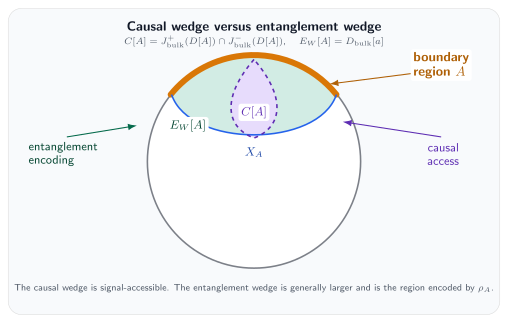
The entanglement wedge is the candidate bulk dual of the boundary reduced density matrix . This does not mean that every point of can communicate with . It means that the algebra of bulk observables in can be represented, within a suitable code subspace, on the boundary region .
The inclusion
is therefore a statement that entanglement reconstruction extends causal reconstruction. The causal wedge is what can probe by signals. The entanglement wedge is what can encode.
Classical, quantum, and island entanglement wedges
Section titled “Classical, quantum, and island entanglement wedges”At leading order in large , the entanglement wedge is determined by the classical HRT surface . The entropy is
At the next order, the relevant surface is a quantum extremal surface , which extremizes generalized entropy:
The quantum-corrected entropy is schematically
The quantum entanglement wedge is the domain of dependence of the region bounded by and the winning QES.
For ordinary boundary subregions in AdS/CFT, this distinction is a perturbative refinement. For evaporating black holes coupled to a nongravitating bath, it is dramatic. If is a radiation region in the bath, the entropy is computed by
After the Page time, the dominant saddle can contain a nonempty island . The entanglement wedge of the radiation is then not just the exterior radiation region. It includes the island:
This is the entanglement-wedge version of the modern black-hole information story.
Relative entropy as distinguishability
Section titled “Relative entropy as distinguishability”The bridge from entropy formulas to reconstruction is relative entropy. Given two density matrices and , the relative entropy is
provided the support of lies in the support of . Otherwise .
Relative entropy has three crucial properties.
First, it is nonnegative:
with equality if and only if .
Second, it is not symmetric:
in general. It is not a distance. It is better thought of as a measure of distinguishability of from the reference state .
Third, it is monotonic under restriction. If , then
A larger region contains at least as much information for distinguishing two states. This simple inequality becomes extremely powerful in holography because it constrains how entanglement wedges can fit inside one another.
Modular Hamiltonians and the first law of entanglement
Section titled “Modular Hamiltonians and the first law of entanglement”For a reference density matrix , define the modular Hamiltonian
The additive constant in is fixed by the normalization of . With this convention,
The relative entropy can be rewritten as
where
and
This identity is simple algebra, but it is conceptually huge. It says that relative entropy measures the difference between the change in modular energy and the change in entropy:
For a one-parameter family of nearby states with , relative entropy begins at second order in . Therefore the first-order variation obeys
This is the first law of entanglement. It resembles the thermodynamic first law, but it is an identity of quantum information theory.
For a ball-shaped region in the vacuum of a CFT, the modular Hamiltonian is local:
where is the radius of the ball. This special formula is one reason relative entropy became so useful in holography: for ball-shaped regions in the vacuum, the boundary modular Hamiltonian is directly related to the stress tensor, while the entropy variation is related by RT/HRT to a bulk area variation.
From entanglement first law to gravitational equations
Section titled “From entanglement first law to gravitational equations”The first law of entanglement already hints that gravity is encoded in entanglement.
For small perturbations of the CFT vacuum and ball-shaped boundary regions, the equation
can be translated holographically into a relation between the variation of an extremal-surface area and the boundary stress tensor. Using the standard holographic dictionary for the boundary stress tensor, this relation implies the linearized Einstein equations in the bulk around AdS:
This is not the main topic of this page, but it gives useful context. Relative entropy is not merely a diagnostic after the geometry is known. In holography, consistency of relative entropy can impose the gravitational equations themselves.
The JLMS relation is a more refined statement in the same spirit: not only the first variation, but the relative entropy of boundary subregions is controlled by the corresponding bulk relative entropy in the entanglement wedge.
The JLMS modular Hamiltonian relation
Section titled “The JLMS modular Hamiltonian relation”Let be a boundary region and let denote its entanglement-wedge homology region. The FLM/QES entropy formula says, schematically,
The JLMS relation upgrades this entropy formula to a statement about modular Hamiltonians. In a suitable perturbative code subspace,
Here is the boundary modular Hamiltonian for , and is the bulk modular Hamiltonian for the reference state restricted to the entanglement wedge.
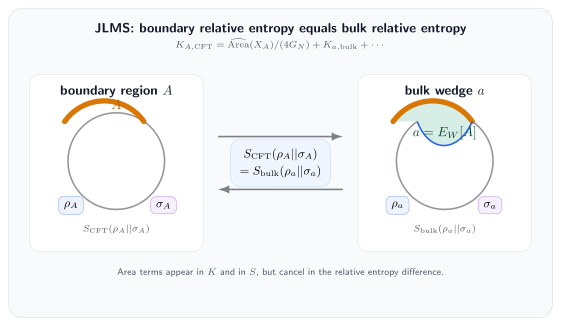
To see why relative entropy equality follows, compare two nearby states and whose entanglement wedge is the same semiclassical region . The boundary relative entropy is
Using JLMS for the modular Hamiltonian gives
Using the quantum-corrected entropy formula gives
Subtracting, the area variation cancels:
Therefore
This cancellation is one reason JLMS is so elegant. The boundary relative entropy is order , even though both the modular-energy change and the entropy change separately contain order- area terms.
What exactly is equal?
Section titled “What exactly is equal?”The phrase “relative entropy equals bulk relative entropy” should be read carefully.
It does not mean that the boundary density matrix is literally the same object as the bulk density matrix . They live in different Hilbert spaces, and in gravity the notion of a subregion Hilbert space is subtle.
It means that, within a semiclassical code subspace and to the relevant perturbative order, the distinguishability of two code-subspace states using boundary observations in equals the distinguishability of the corresponding bulk states using observations in the entanglement wedge .
In more operational language:
is already encoded in
This is why JLMS is so closely tied to entanglement wedge reconstruction.
There are important qualifications:
- The statement is perturbative in unless a more complete nonperturbative framework is supplied.
- The compared states should lie in an appropriate code subspace.
- The entanglement wedge should not jump discontinuously between the compared states, unless one treats phase transitions carefully.
- In gauge theory and gravity, subregion algebras can have centers and edge modes. These subtleties lead naturally to operator-algebra quantum error correction, the topic of the next page.
Modular flow
Section titled “Modular flow”The modular Hamiltonian generates modular flow. For an operator ,
For a generic spatial region in an interacting QFT, is highly nonlocal, so modular flow is not ordinary time evolution. In holography, JLMS implies that boundary modular flow generated by acts like bulk modular flow generated by inside the entanglement wedge:
This is an important clue for explicit reconstruction. Even if a bulk operator lies outside the causal wedge, modular flow can smear boundary operators in a way that reaches into the full entanglement wedge.
The price is that modular reconstruction is generally nonlocal and state-dependent through the choice of reference state and code subspace. That is not a bug; it is exactly what one should expect for reconstructing regions behind horizons or beyond causal access.
Entanglement wedge nesting
Section titled “Entanglement wedge nesting”Suppose are two boundary regions on the same boundary Cauchy slice. Since contains more boundary degrees of freedom than , the corresponding bulk reconstructable region should not become smaller. The expected geometric property is
This is entanglement wedge nesting.
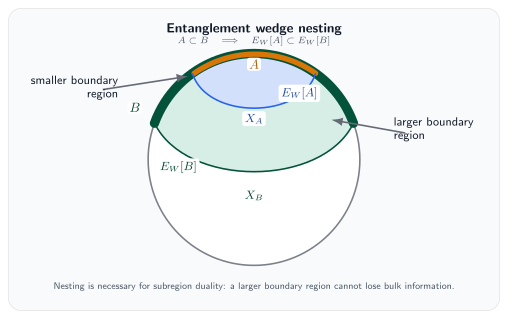
There are two complementary ways to understand this result.
Geometrically, in classical holography, maximin methods show that HRT surfaces move inward in a way compatible with nesting, under suitable energy and causality assumptions.
Information-theoretically, nesting is tied to monotonicity of relative entropy. If , then
Using JLMS, this becomes
where and in shorthand.
This inequality is natural if : the larger bulk region has more observables with which to distinguish from . But if contained a point not included in , then one could consider states differing by a localized excitation in that point. The smaller boundary region would distinguish the states, while the larger region would not. That would contradict monotonicity.
This argument is schematic, but it captures the logic: entanglement wedge nesting is the bulk image of the elementary boundary fact that larger regions contain more information.
Entanglement wedge reconstruction
Section titled “Entanglement wedge reconstruction”Entanglement wedge reconstruction states that every bulk operator in has a boundary representative supported on , at least within an appropriate code subspace:
More precisely, for a bulk operator localized in the entanglement wedge, there exists a boundary operator supported in such that
for all states in the chosen code subspace.
This is stronger than causal wedge reconstruction. The causal wedge is the region one might reconstruct using boundary sources and causal propagation. The entanglement wedge is the region one can reconstruct using the full quantum information contained in .
The reason relative entropy is central is that equality of relative entropies is an operational statement about distinguishability. Quantum information theorems say, roughly, that if restricting to preserves distinguishability of all code-subspace states in the bulk region , then the information in is recoverable from .
Thus the logical chain is
The next page will recast this in the language of quantum error correction.
Complementary wedges and no-cloning
Section titled “Complementary wedges and no-cloning”If the total boundary state is pure and is the complement of , then
In a classical RT/HRT phase with a single shared surface, the entanglement wedges of and are complementary bulk regions separated by the same extremal surface. Bulk operators in are reconstructable from , while bulk operators in are reconstructable from .
This protects the construction from a no-cloning paradox. A bulk operator should not be independently reconstructable on two disjoint boundary regions in a way that allows two independent copies of the same quantum information. When phase transitions occur, the division of the bulk between and can change abruptly, but the winning entanglement wedges still organize which region reconstructs which bulk algebra.
At finite or beyond leading semiclassical order, the statement is more naturally phrased using approximate reconstruction and operator algebras rather than exact point localization.
Black holes: the island as part of the radiation wedge
Section titled “Black holes: the island as part of the radiation wedge”The entanglement-wedge language gives a clean interpretation of islands.
Before the Page time, the winning saddle for the radiation entropy is usually the no-island saddle:
Then the radiation entanglement wedge contains only the radiation region in the bath. The black-hole interior is not reconstructable from the radiation alone.
After the Page time, the island saddle dominates:
Then the generalized entropy is computed using , and the entanglement wedge of the radiation includes the island:
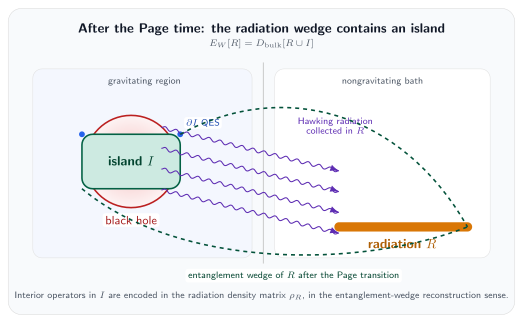
The JLMS relation then suggests
This is a precise form of a phrase often used in the island literature:
The island is encoded in the radiation.
This does not mean that an observer can jump into the black hole and also independently decode the same interior information from the radiation without qualification. The reconstruction is code-subspace-dependent, highly nonlocal, and constrained by quantum error correction. It also does not mean that semiclassical locality is simply false everywhere. Rather, it means that the map between bulk interior degrees of freedom and microscopic boundary or radiation degrees of freedom is redundant and subtle.
The island rule computes the entropy. Entanglement wedge reconstruction explains what region the radiation density matrix represents.
Example: a thermal black hole and the homology constraint
Section titled “Example: a thermal black hole and the homology constraint”Consider a one-sided AdS black hole dual to a thermal state in the boundary CFT. Let be the entire boundary. The entropy of is the thermal entropy, and the RT surface is the horizon. The homology region includes the exterior region bounded by the boundary and the horizon. The area term gives
Now consider a proper boundary subregion . Depending on its size and the state, the HRT surface can either avoid the horizon or combine with horizon components in a way constrained by homology. The entanglement wedge can therefore undergo phase transitions as changes.
This is a precursor of island physics. In both cases, the entropy is determined by competing saddles, and the winning saddle determines the bulk region encoded by the boundary or radiation region.
Example: ball-shaped regions and bulk equations
Section titled “Example: ball-shaped regions and bulk equations”For a ball-shaped region in the CFT vacuum, the modular Hamiltonian is local, so the first law
can be checked using ordinary CFT stress-tensor data. Holographically, is an area variation of the RT surface. The equality for all balls implies the linearized gravitational equations in the bulk.
This example is useful because it makes a general moral concrete:
JLMS is a sharper version of the same theme, but now for the full entanglement wedge rather than infinitesimal perturbations around vacuum.
Common pitfalls
Section titled “Common pitfalls”Pitfall 1: “The entanglement wedge is the region that can signal to .”
Section titled “Pitfall 1: “The entanglement wedge is the region that can signal to AAA.””That is the causal wedge. The entanglement wedge can include points that cannot send a causal signal to the boundary domain .
Pitfall 2: “JLMS says boundary and bulk density matrices are identical.”
Section titled “Pitfall 2: “JLMS says boundary and bulk density matrices are identical.””No. JLMS equates relative entropies and modular data within a semiclassical holographic code subspace. Boundary and bulk density matrices live in different descriptions.
Pitfall 3: “The area term is irrelevant because it cancels in relative entropy.”
Section titled “Pitfall 3: “The area term is irrelevant because it cancels in relative entropy.””The area term cancels in the relative entropy relation after using the modular Hamiltonian and entropy formulas, but it is essential in both formulas. It also controls which surface wins in the first place.
Pitfall 4: “Entanglement wedge reconstruction is ordinary local reconstruction.”
Section titled “Pitfall 4: “Entanglement wedge reconstruction is ordinary local reconstruction.””Generally no. Reconstruction from is often very nonlocal in the boundary degrees of freedom. For black-hole interiors and islands, it may also be computationally complex and code-subspace-dependent.
Pitfall 5: “The island is a new place added to spacetime.”
Section titled “Pitfall 5: “The island is a new place added to spacetime.””The island is a region in the gravitating spacetime that belongs to the entanglement wedge of the radiation. It is not an extra universe glued onto the radiation region. Its appearance is a statement about which saddle computes the fine-grained entropy and which bulk algebra is encoded in .
Summary
Section titled “Summary”The main points are:
- The causal wedge is defined by bulk causal communication with .
- The entanglement wedge is defined by the RT/HRT/QES surface and the homology region.
- In semiclassical holography, .
- Relative entropy measures distinguishability and satisfies monotonicity.
- The modular Hamiltonian satisfies and gives .
- JLMS states that boundary modular data equals area plus bulk modular data, implying boundary relative entropy equals bulk relative entropy in the entanglement wedge.
- Entanglement wedge nesting is the bulk expression of boundary monotonicity of information.
- Entanglement wedge reconstruction says that bulk operators in can be represented on within a suitable code subspace.
- After the Page time, the radiation entanglement wedge can include an island, so part of the black-hole interior is encoded in the radiation.
Exercises
Section titled “Exercises”Exercise 1: Relative entropy for diagonal qubit states
Section titled “Exercise 1: Relative entropy for diagonal qubit states”Let
with . Compute .
Solution
Since and are diagonal in the same basis,
Therefore
becomes
This is the classical relative entropy, or Kullback-Leibler divergence, between two Bernoulli distributions.
Exercise 2: The first law of entanglement
Section titled “Exercise 2: The first law of entanglement”Let with . Show that, to first order in ,
where .
Solution
The entropy is
The first variation around is
The second term vanishes because . Thus
But
so
Exercise 3: Area cancellation in JLMS
Section titled “Exercise 3: Area cancellation in JLMS”Assume that for two nearby holographic states and with the same entanglement wedge ,
and
Show that
Solution
Start from the boundary identity
Using the assumed JLMS modular Hamiltonian relation,
Using the assumed entropy formula,
Subtracting gives
The right-hand side is precisely
Exercise 4: Entanglement wedge nesting from monotonicity
Section titled “Exercise 4: Entanglement wedge nesting from monotonicity”Give a conceptual argument that if , then one should have .
Solution
In the boundary theory, relative entropy is monotonic under inclusion:
This means that the larger region cannot contain less distinguishability than the smaller region .
Using JLMS, these relative entropies are mapped to bulk relative entropies in the corresponding entanglement wedges:
This is naturally true if . If instead there were a bulk point contained in but not in , one could imagine two code-subspace states differing only by a local excitation near that point. Region would be able to distinguish them, while region would not, contradicting monotonicity.
Therefore consistency with boundary information theory requires the nesting property
Exercise 5: Causal wedge versus entanglement wedge
Section titled “Exercise 5: Causal wedge versus entanglement wedge”Explain why is compatible with the idea that signals cannot travel faster than light.
Solution
The causal wedge consists of bulk points that can causally communicate with the boundary domain . It is therefore the natural region associated with signal propagation.
The entanglement wedge can be larger because reconstruction from is not the same thing as sending and receiving causal signals. A boundary operator supported in may encode a bulk operator in a highly nonlocal way, using the quantum correlations of the holographic state.
This does not violate causality. A reconstructed operator supported on does not mean that a local observer at the bulk point can send a faster-than-light signal to . It means that the microscopic degrees of freedom in contain a representation of that bulk operator within the holographic code subspace.
Thus causal access and entanglement encoding are different notions. The causal wedge is about signals; the entanglement wedge is about quantum information.
Exercise 6: The island as part of the radiation wedge
Section titled “Exercise 6: The island as part of the radiation wedge”In an evaporating black-hole setup, suppose the radiation region has two candidate saddles:
and
Explain what happens to the entanglement wedge of when the island saddle becomes smaller.
Solution
The fine-grained entropy is obtained by choosing the minimal generalized entropy among the candidate saddles:
Before the Page transition, the no-island saddle dominates. Then the entanglement wedge of contains only the radiation region in the nongravitating bath, and no black-hole interior region is encoded in .
After the Page transition, the island saddle dominates. The entropy is computed from plus the QES area term. The entanglement wedge of therefore includes the island:
In subregion-duality language, operators in the island can be reconstructed from the radiation degrees of freedom, within the appropriate code subspace. This is the entanglement-wedge interpretation of information recovery after the Page time.
Further reading
Section titled “Further reading”- Matthew Headrick, Veronika E. Hubeny, Albion Lawrence, and Mukund Rangamani, Causality & holographic entanglement entropy. Introduces and motivates the entanglement wedge as the natural bulk dual of a boundary density matrix.
- Aron C. Wall, Maximin Surfaces, and the Strong Subadditivity of the Covariant Holographic Entanglement Entropy. Develops maximin methods and proves key geometric properties of HRT surfaces, including nesting behavior under suitable assumptions.
- Thomas Faulkner, Aitor Lewkowycz, and Juan Maldacena, Quantum corrections to holographic entanglement entropy. Gives the bulk-entropy correction that prepares the way for the JLMS relation.
- Daniel L. Jafferis, Aitor Lewkowycz, Juan Maldacena, and S. Josephine Suh, Relative entropy equals bulk relative entropy. The central JLMS reference.
- Xi Dong, Daniel Harlow, and Aron C. Wall, Reconstruction of Bulk Operators within the Entanglement Wedge in Gauge-Gravity Duality. Shows how JLMS and quantum error correction imply entanglement wedge reconstruction.
- Nima Lashkari, Michael B. McDermott, and Mark Van Raamsdonk, Gravitational Dynamics From Entanglement “Thermodynamics”. Explains how entanglement first laws imply linearized gravitational dynamics in holography.