
The Open Superstring Spectrum
An open RNS string has two oscillator sectors. The Neveu–Schwarz sector produces spacetime tensor states, beginning with a tachyon and a massless vector. The Ramond sector has fermion zero modes, so even its oscillator ground state carries a spacetime spinor. The constraints turn these oscillator states into particles: transversality and a null-state quotient leave eight photon polarizations, while a Dirac equation leaves sixteen Ramond ground-state polarizations before a chirality projection.
We study a free string in flat ten-dimensional spacetime with Neumann conditions in every target direction and suppress Chan–Paton multiplicities. The shared worldsheet and fermion definitions and the plane versus oscillator ordering derived on the previous page apply throughout. We will derive the low-level physical spaces explicitly. The full spinor construction and the consistency of the GSO projection belong to the next two pages.
Endpoint gluing selects NS or Ramond modes
Section titled “Endpoint gluing selects NS or Ramond modes”On the strip , the fermion equations give one function of each null coordinate. Let the endpoint signs be :
The same relations hold for allowed variations, so the endpoint expression vanishes separately at both boundaries. Write . The first endpoint determines the other component:
The second then requires . Thus the doubled field satisfies
Equal endpoint signs give periodic, integer-moded Ramond fields; opposite signs give antiperiodic, half-integer-moded NS fields. Flipping the sign of reverses both endpoint signs and leaves their product unchanged. There is therefore one independent chiral oscillator family, with two choices of spin structure. This argument, developed in Polchinski, Chaudhuri and Johnson, section 3.1, assumes the uniform NN endpoints specified above; mixed Neumann–Dirichlet directions change the moding.
The periodicity refers to the doubled strip or cylinder spin frame. On the plane, reverses this sign after a circuit. In particular, a Ramond insertion produces a plane branch point. Doubling does not erase the distinction between the two spin structures.
Physical constraints relate oscillator levels to masses
Section titled “Physical constraints relate oscillator levels to masses”A state is built with negative-index bosonic and fermionic oscillators. Positive-index modes annihilate the oscillator ground state. Ramond zero modes are different: they act within a degenerate ground-state space and do not increase the level. Let denote the dimensionless eigenvalue of the open-string zero mode,
The level operator and the exact supercurrent modes are
The fermion indices are half-integer in NS and integer in R. No extra is needed in the boson term: already makes raise by . The oscillator algebra gives two useful identities:
In old covariant quantization, the positive matter modes must annihilate a physical state:
The zero-mode conditions require more care. Using plane matter generators at , they are
The R ground state has plane weight . The resulting zero modes are
Since , the physical conditions give
The physical oscillator intercepts are therefore and . They are not the plane vacuum weights. In R, the plane superalgebra says
so implies the mass shell. Its square alone is weaker than the unsquared equation; we will see this explicitly for a null momentum.
These conditions select a subspace of an initially indefinite oscillator space. Physically null states, meaning states orthogonal to the entire constrained subspace, must also be identified. The critical theory admits an equivalent description with eight transverse bosons and eight transverse fermions. We use that equivalence when counting higher levels; the calculations below prove the particular low-level quotients, not an all-level BRST equivalence theorem. Weigand, sections 6.4.3 and 6.5, discusses the covariant and transverse descriptions. His oscillator-ordered must be distinguished from the plane generator used here.
The NS massless vector is a null-state quotient
Section titled “The NS massless vector is a null-state quotient”The NS oscillator vacuum has and hence . It is a scalar tachyon of the unprojected theory. The next level is
Apply the exact supercurrent mode. Every term except its zero-mode contraction vanishes:
Thus the polarization is transverse, . Higher positive modes lower the oscillator level below zero and give no additional conditions. For real nonzero null , this leaves a nine-dimensional space, rather than the eight physical photon polarizations. The remaining reduction is a quotient.
At the same null momentum, consider
The precursor has plane weight zero. It is not the on-shell tachyon state, whose plane weight must be . Its descendant has the required weight , and
Its norm is . More strongly, for any physical vector ,
This is why it can be removed: a zero-norm vector in an indefinite space need not be orthogonal to every physical state, but this one is. Adding it changes the polarization by a multiple of :
Choose a Lorentz frame , . Transversality sets ; the equivalence removes both together. The eight remaining components , , have norm . They transform as the vector of the massless rotation little group. The translation part of the massless little group acts through the removed gauge direction.
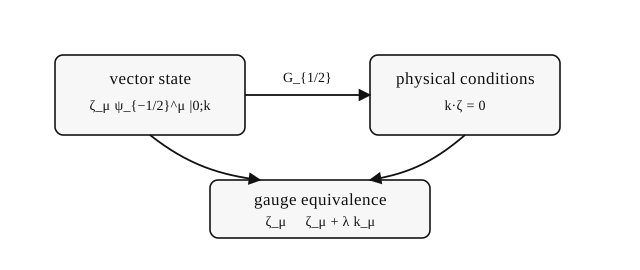
At real nonzero null momentum in ten dimensions, the constrained polarization space has dimension nine and radical of dimension one. Representatives and describe the same physical class. The resulting eight-dimensional space has positive norm. The drawing represents linear subspaces schematically; its lengths and angles do not depict a Euclidean geometry for the Lorentzian null hyperplane.
At , neither step has the same rank: transversality imposes no condition and . The eight-polarization argument therefore has a nonzero-momentum hypothesis. This observation does not classify the exceptional zero-momentum BRST cohomology.
A massive NS level shows how the quotient works
Section titled “A massive NS level shows how the quotient works”At , the mass is , so . The complete covariant state includes both oscillator types:
There are coefficients. The graded identities give
In particular, moving the odd generator past the first fermion produces a minus sign in the second contraction. Antisymmetry of then makes the two terms add. The constraint is
It fixes in terms of and implies . There are 45 constrained coefficients. The condition follows from ; all larger positive modes vanish by level.
To find the radical, start from with . At this timelike momentum the precursor has plane weight . Its descendant gives the shifts
They preserve the constraint because
The descendant is orthogonal to every physical state by the same adjoint argument used for the photon. Its nine parameters are independent: its coefficient is itself.
Now choose . This is allowed because , and it yields a representative with
In the rest frame, . The state is an antisymmetric tensor on nine spatial directions, with
This norm is positive unless the representative vanishes, so the nine descendants account for the full radical. The reduction is . Exercise 4 supplies the explicit oscillator contractions and proves uniqueness of the representative.
In transverse quantization the same level consists of eight states and two-fermion states. Their sum, , is the restriction of the SO(9) two-form to SO(8). Here the representation identification follows from the covariant construction, not just from a matching dimension.
The next level and the GSO preview
Section titled “The next level and the GSO preview”At , the transverse states have three possible forms:
They give polarizations at . The decomposes into a symmetric traceless tensor, an antisymmetric tensor and a scalar: . The massive SO(9) representations have the branchings
The is a symmetric traceless rank-two tensor in nine dimensions; the is a three-form. Splitting a spatial index into eight directions plus the ninth proves these branchings. Using critical Lorentz covariance, they identify the physical massive bosons as . This is a transverse representation analysis; we have not repeated the entire covariant constraint elimination at level .
The supersymmetric NS projection retains an odd number of fermion creation operators. It removes and , while retaining and . This is a choice of projection within the NS sector. It is not an operation converting an NS vector into a Ramond spinor.
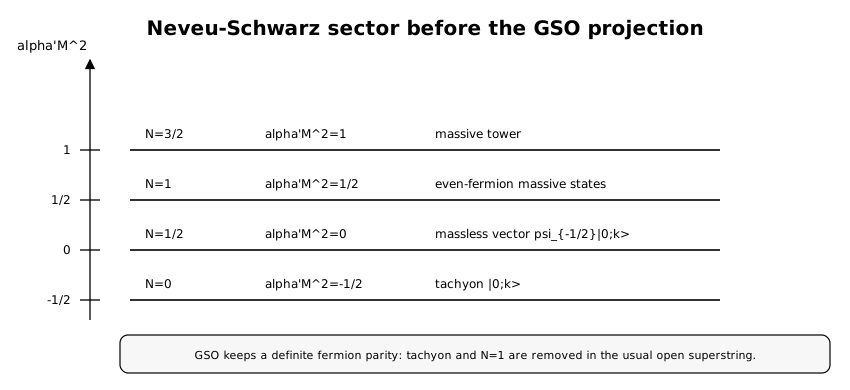
The first four unprojected NS levels have and transverse polarization counts . The mass-squared spacing is drawn quantitatively; horizontal positions are schematic. The supersymmetric NS parity retains the odd-fermion levels. The massive SO(9) representations are a two-form of dimension 36 and of dimension 128. No massive rest-frame little group is assigned to the tachyon.
Ramond zero modes impose a Dirac equation
Section titled “Ramond zero modes impose a Dirac equation”The R ground state is annihilated by positive oscillators, but its zero modes satisfy a Clifford algebra:
Thus the covariant ground states carry a 32-component Dirac index in ten dimensions. Write them as . Their level is zero, so the mass shell gives .
In , a term with has an annihilating boson mode, which commutes through the fermion. A term with has an annihilating fermion mode on the right. Only remains. Consequently,
Define . The physical zero-mode condition is precisely
The coefficient is fixed by the open-string zero mode, and its square is . Although a nonzero rescaling would leave the equation’s kernel unchanged, it would fail to reproduce the correctly normalized superalgebra. At excited levels, the nonzero-mode terms of matter; exercise 6 exhibits their mixing explicitly.
Count the kernel before choosing chirality
Section titled “Count the kernel before choosing chirality”Let be real, nonzero and null. Choose another null vector satisfying . The Clifford relation gives
These are complementary projectors. Moreover, , and if , then . Therefore the image of is the Dirac kernel. Since ,
The shared chirality operator anticommutes with each gamma matrix and commutes with . A chosen chirality has projector . The trace of vanishes, so
These are the dimensions of the complex polarization spaces at a fixed nonzero momentum. A Majorana condition relates Fourier coefficients of a real spacetime spinor field at opposite momenta; it is not another halving of the independent positive-energy polarization labels. The next page develops the Clifford construction, reality conditions and transverse spinor chiralities.
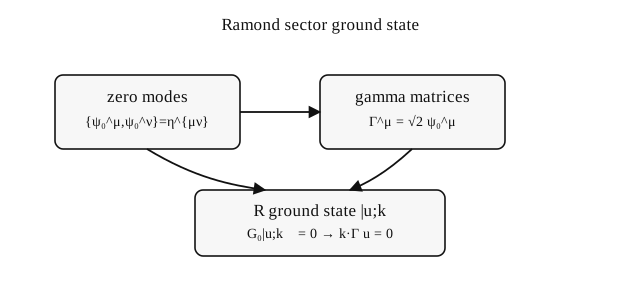
For a ground state at nonzero null momentum, on its spinor polarization. The Dirac constraint leaves 16 complex amplitudes; a single Weyl chirality leaves eight. The slash maps a complementary space isomorphically onto its kernel and vanishes on ; the physical spinors remain in , with no quotient by the image. The chirality choice is a projection. The diagram is schematic and does not assign positive norm to the entire covariant 32-component space.
There is an instructive difference from the NS vector. Because and its rank is 16, one has as subspaces. Nevertheless, the physical spinor is the kernel itself. Quotienting by the image would remove every polarization. A spin- Dirac equation is an equation of motion, not a longitudinal gauge equivalence. Also, holds for every spinor at null momentum, whereas holds for only half of them.
Projection and spacetime supersymmetry are further steps
Section titled “Projection and spacetime supersymmetry are further steps”Before projection the massless NS sector has eight polarizations, while the massless R sector has sixteen, and the NS vacuum is tachyonic. Worldsheet supersymmetry by itself does not make this a spacetime-supersymmetric particle spectrum. Nor do the physical particles simply form the superconformal modules from which the constraints were constructed: the positive supercurrent modes annihilate physical states, and some negative-mode descendants are removed as null.
The supersymmetric GSO choice keeps the massless NS vector, removes the NS tachyon and selects one Ramond chirality, yielding eight bosonic and eight fermionic polarizations. These are the on-shell field contents of a ten-dimensional vector multiplet. At higher R levels the projection also depends on nonzero-oscillator parity; it is not just the ground-state chirality rule applied unchanged. Polchinski, Chaudhuri and Johnson, section 3.1, explains this physical organization. The GSO page will develop the projection and its relation to spacetime supersymmetry. Matching counts is a useful check, but it does not by itself construct the supercharges or establish interaction consistency.
Exercises
Section titled “Exercises”1. Test the endpoint signs with actual modes
Section titled “1. Test the endpoint signs with actual modes”For arbitrary , solve the free fermion equations and both endpoint conditions using a single mode . Derive the allowed , verify cancellation of the variational boundary term, and explain why changing the sign of one chiral field leaves the sector unchanged. Give a mode which fails when the wrong frequency set is chosen.
Solution
The first boundary gives and . The second requires
Thus for equal signs and for opposite signs. For a real Lorentzian solution, pair a mode with its conjugate; the frequency condition is unchanged.
At either endpoint , allowed variations obey . Keeping the odd factors in their original order gives
No commuting of the Grassmann fields is used. Redefining reverses both and and preserves their product.
For a concrete failure, choose but . At , whereas , so the endpoint residual is . It satisfies the opposite-sign endpoint condition instead. A local equation of motion does not determine a sector until its global endpoint conditions are imposed.
2. Translate the Ramond zero-mode operators
Section titled “2. Translate the Ramond zero-mode operators”At an arbitrary R oscillator level , compare plane , oscillator-ordered and the cylinder generator . Derive the open mass formula and the exact ground-state Dirac coefficient. Compare with one closed chirality at the same physical momentum, and test the incorrect prescription for a massless R ground state.
Solution
For ten matter multiplets, and the R plane vacuum weight is . Hence
The last equality is special to the R vacuum shift. Since , its vanishing on a physical state implies , or . It does not make vanish: a physical R matter state has plane weight .
On the ground state the nonzero modes drop out, leaving
For a noncompact closed chirality, instead. Its ground-state operator is and its square is . The common local OPE is unchanged; the physical momentum is related differently to a single chiral zero mode.
If one imposed plane at open R level zero, one would obtain . Then and no nonzero state could also obey . The erroneous mass shell conflicts with the unsquared physical constraint. By contrast, the correct condition permits a nontrivial massless Dirac kernel.
3. Choose a photon representative without choosing a Lorentz frame
Section titled “3. Choose a photon representative without choosing a Lorentz frame”Take real nonzero null and a null reference vector with . Show that
projects onto the eight-dimensional transverse space. For , compare for two choices of , prove equality of their norms, and explain exactly what fails at .
Solution
The null conditions and give , , and . The map is self-adjoint in the target metric. The plane spanned by and has one timelike and one spacelike direction, so its orthogonal complement is positive definite.
For a constrained polarization,
It differs from by a gauge vector and obeys both and . If is another admissible reference,
The two representatives therefore define the same class. For a complex polarization at real , the conditions also imply
This norm is nonnegative on the constrained space and vanishes precisely for a longitudinal representative.
At there is no vector satisfying . The constraint imposes no restriction, and the gauge vector is zero. In particular, the elementary covariant state satisfies these positive-mode conditions but has negative oscillator norm. This illustrates the failure of the nonzero-momentum reduction; it is not a substitute for the full zero-momentum cohomology analysis.
4. Complete the massive NS two-form reduction
Section titled “4. Complete the massive NS two-form reduction”At and , derive the constraint on and the null descendant generated by , . Show that every physical state has a unique representative with , calculate its norm, and compare the covariant and transverse counts. Determine the parity of this entire level under the supersymmetric NS choice.
Solution
The single-boson term gives . Call the two-fermion term . It gives
Thus . The coefficient of in these ten equations is the identity, so the constraint rank is ten. Contracting with gives .
For the descendant, move past the single fermion before acting on the vacuum:
Reordering the last two fermions gives , with the positive sign stated in the text. The precursor obeys and has , so its descendant is physical. For any physical ,
These nine independent descendants are therefore in the radical. Setting gives and . Any further such shift preserving has , so the representative is unique within this family of identifications.
The oscillator contractions yield, before gauge fixing,
The mixed boson/fermion term vanishes. In a timelike rest frame with , the constraint makes and ; the negative contribution of cancels . Equivalently, in the representative , only spatial remain, with positive norm . There is no further radical after this reduction. Hence the physical dimension is .
The SO(9) two-form splits under SO(8) into with 28 components and with eight, agreeing with the light-cone oscillator count. Both original oscillator types have even fermion occupation, zero or two. The supersymmetric NS projection keeps odd occupation, so it removes this whole unprojected level, not just one of its two oscillator descriptions.
5. A Dirac kernel is not a gauge quotient
Section titled “5. A Dirac kernel is not a gauge quotient”Using the two null vectors , prove that and are complementary projectors. Count the Dirac and Weyl kernels and establish . What happens at zero momentum or at ? Why does the equality of kernel and image not remove the physical spinor?
Solution
Use and . Then
The image of is exactly the kernel, as shown in the text. Its trace is . Furthermore, if ,
so every kernel vector is in the image; the reverse inclusion follows from .
The even Clifford product commutes with . The trace identities and in ten dimensions imply
For example, gives . Multiplication by turns the equation into . The matrix squares to one and has equal eigenspace dimensions; a Weyl condition halves each again.
At , the slash vanishes and its kernel is all 32 components, while its image is zero. At , it is invertible, with inverse , so the massless Dirac equation has no nonzero solution.
Finally, no gauge transformation has been established on the spinor polarizations. The physical equation is itself. Replacing its solution space by kernel modulo image would give dimension zero at nonzero null and would contradict the explicit nonzero solutions above. In the vector problem, by contrast, the longitudinal states were proved to lie in the radical of the physical oscillator pairing.
6. See the oscillator mixing in an excited Ramond state
Section titled “6. See the oscillator mixing in an excited Ramond state”At R level , let and . Consider
where and are ground-state spinor polarizations and the nonzero creation modes stand to their left. Compute and solve its two oscillator coefficients. Then derive the additional equation. Explain why imposing only a ground-state Dirac equation on would be wrong. No full massive R null-state quotient is requested.
Solution
On the ground-state spinors acts as , whose square is . The relevant relations are
The second relation is an anticommutator, so moving to the right of reverses its sign. Therefore
The first coefficient gives . The second then becomes , which holds precisely at this mass shell. Thus the constraint mixes the two oscillator types.
For the positive mode, annihilates each ground-state spinor, while
Consequently,
and substituting gives
This is an additional vector-spinor condition. Modes vanish by level, and follows from ; these statements still do not perform the massive null-state quotient.
A ground-state-only rule would kill every polarization, because makes invertible here. The full has nontrivial solutions because its nonzero oscillator terms cancel the zero-mode action. This is the string’s excited-state extension of the Dirac constraint.
References
Section titled “References”- Polchinski, Joseph, Shyamoli Chaudhuri, and Clifford V. Johnson. Notes on D-Branes. Institute for Theoretical Physics lectures, report NSF-ITP-96-003 (1996), section 3.1. arXiv:hep-th/9602052.
- Weigand, Timo. Introduction to String Theory. Heidelberg University lecture notes, winter semester 2011/12, sections 6.3, 6.4.3 and 6.5. Lecture notes.