
Tree-Level String Amplitudes from Worldsheet Correlators
A closed-string tree amplitude is a correlation function on a sphere, integrated over the inequivalent positions of its vertex operators. For four tachyons, this construction leaves one complex integral. Its three degeneration regions describe the three scattering channels of the same amplitude.
We work with the critical bosonic string in flat, noncompact spacetime. Its tachyon makes the perturbative vacuum unstable: the calculation below defines the familiar analytic bosonic-string amplitude, rather than scattering of stable particles in a tachyon-free vacuum. The simple tachyon vertex nevertheless exposes the geometry and normalization factors needed for more general external states.
Use the global conventions, the Gaussian correlators of page 10, and the sphere ghost functional of page 17. Page 18 supplies the moduli measure, and page 19 explains the physical BRST representatives. Here we apply that machinery; page 21 evaluates the resulting integral and studies its poles.
Sphere amplitudes and physical vertices
Section titled “Sphere amplitudes and physical vertices”An external closed-string state can be represented by a local insertion at the end of its cylindrical worldsheet. Conformally shrinking that end gives a puncture on the sphere. The puncture is a marked point, not an open-string boundary.
For an even matter primary of weights , the two useful representatives are
The first has total weights and ghost number two. The second contains the area element needed to integrate a position. Indeed, under ,
Their product is invariant. Being primary matters: an operator with the right numerical weights but extra poles in its stress-tensor OPE need not satisfy the BRST constraints. Gauge-equivalent BRST representatives also describe the same physical state, subject to the usual treatment of boundaries of moduli space.
For distinct, labeled punctures on a sphere, the effective conformal automorphism group is . Its three complex parameters fix three positions. The other complex positions are moduli. With fixed labels , the prescription has the form
The integration is over the configurations of the remaining distinct labeled points; collision limits require a convergence or continuation prescription. There is no additional integral over their positions after this moduli integral. Equivalently, one can begin with all vertices unintegrated and use the ordered antighost insertions associated with each moving puncture:
This is the local descent discussed on page 18. Applying it and then integrating the same position a second time would double count that modulus. Amplitudes with fewer than three insertions require separate treatment of their conformal stabilizers.
The power of also has two ingredients. A filled genus-zero surface contributes from its Euler characteristic. A canonically normalized external closed-string insertion contributes one , giving . The constants retain external-state normalization, the sphere functional normalization and a possible overall phase; we do not determine the absolute S-matrix normalization here. This construction is described in Polchinski, sections 2.7–2.8, and the explicit tachyon calculation in Tong, section 6.2.
Tachyon correlators and the Koba–Nielsen factor
Section titled “Tachyon correlators and the Koba–Nielsen factor”The matter tachyon vertex is
Consequently its physical-state condition and mass are
All momenta in the correlator are incoming. An outgoing spacetime particle therefore appears with the negative of its outgoing momentum.
The target zero mode enforces momentum conservation
Section titled “The target zero mode enforces momentum conservation”Separate the constant target coordinate from the nonzero modes, . The action is independent of , and its integral gives
This factor is not obtained by inverting the kinetic operator: that operator annihilates the constant mode. Normalize the Gaussian nonzero-mode functional as on page 10 and keep the zero-mode integral explicitly. Likewise, the ghost functional is saturated by insertions; it is not divided by its vanishing, unsaturated sphere partition function.
For the nonzero modes, write the component contraction as
The scalar kernel is distinct from the target trace . Contracting the momenta first gives , with no extra factor of .
Normal ordering removes self-contractions
Section titled “Normal ordering removes self-contractions”For a Gaussian field, exponentiation sums every contraction between different normal-ordered vertices. The two factors of supply a minus sign:
where . There is one term for each unordered pair; self-contractions have already been subtracted by normal ordering. Define this last product as . Then
This is the Koba–Nielsen factor. The formula uses the plane coordinate and its local normal ordering on the punctured sphere. A correlator expressed in a round-sphere metric includes the corresponding primary and Weyl factors; it is not obtained by treating every as a coordinate-independent scalar.
We write and call the momentum-delta-stripped amplitude. The analytic continuation below acts on this stripped quantity, rather than on a delta function of complex momenta.
Möbius fixing and the ghost determinant
Section titled “Möbius fixing and the ghost determinant”The infinitesimal motion of three marked positions under the sphere conformal Killing vectors is a linear combination of . Thus the change from group parameters to these positions has the determinant
Its absolute square is
The ordered chiral ghost functional produces the same magnitude, with its sign fixed by the order of the three odd insertions:
The grouped product of this expression and its antiholomorphic counterpart is . Moving three interleaved pairs into that grouped order takes three odd transpositions and gives a minus sign. We absorb this single, position-independent sign into the overall amplitude constant when passing from the earlier prescription to the positive determinant below. No relative sign may be discarded inside a chiral calculation.
Accordingly, with a consistently normalized constant ,
Why the fixed positions do not matter
Section titled “Why the fixed positions do not matter”For with determinant ,
It follows that . Using momentum conservation,
On shell this is . Each moving vertex has an area Jacobian , and the fixed-position determinant has precisely the product of those same factors at the three fixed points. The complete density is therefore invariant. This checks the gauge fixing directly, including its Jacobian.
One exact cross-ratio
Section titled “One exact cross-ratio”For four labels choose the map
It sends labels to . The remaining position is
We subsequently call this coordinate , so the fixed configuration is
Other cross-ratios describe the same moduli space, but their relation to must be calculated. For example, becomes in this configuration, not .
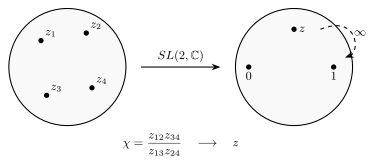
For , the map is and . Both finite-coordinate plots use equal real and imaginary scales; infinity denotes the sphere point omitted from the finite-coordinate plot. Worldsheet coordinates are dimensionless. The map’s pole is not a boundary of the surface.
Three tachyons and the insertion at infinity
Section titled “Three tachyons and the insertion at infinity”The three-point amplitude provides a first test of the prescription. For three on-shell tachyons with ,
and similarly for the other pairs. Hence
The ghost determinant cancels all coordinate dependence. There is no modulus to integrate. This is a constant three-tachyon coupling in the chosen external-state normalization, not a determination of .
For four points, take the third position to a finite value first:
The factors in involving behave as
Here the other coordinates and momenta are fixed as . The grouped ghost determinant at the fixed points is , which grows as . Their product has a finite limit.
The chiral ordering is visible before taking the absolute square:
where . Interchanging the last two odd fields gives .
One can instead define the matter insertion and the two ghost insertions at infinity separately. Their rescaling factors cancel. These are two descriptions of the same limit: after using the finite- product, do not attach another factor of .
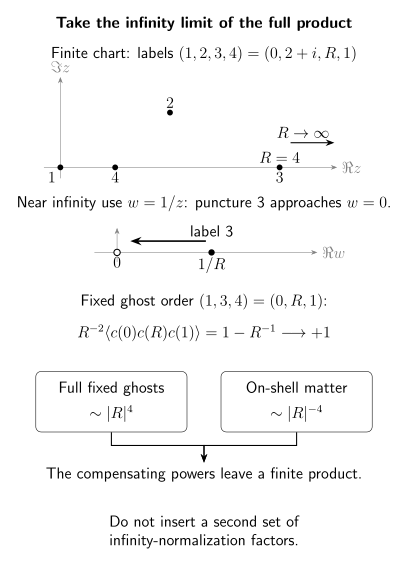
Momentum conservation and give the matter scaling . The ordered fixed ghosts at give in one chirality and in the grouped closed-string functional. The cancellation is an asymptotic statement with other punctures fixed; the separately rescaled infinity operators give the same finite result.
The four-tachyon moduli integral
Section titled “The four-tachyon moduli integral”After the finite- cancellation, the only nonconstant finite separations are and . Thus
The points are excluded from the space of distinct configurations; the notation denotes the corresponding improper integral. There is no open-string cyclic ordering restriction: the moving closed-string puncture explores the entire complex moduli plane.
Define the invariants by the pairs that occur in this coordinate choice:
Since ,
For the last identity, replace the pair defining by using momentum conservation, expand the three squares and use . The sum becomes .
Our final integral is therefore
All exponents are dimensionless: have dimensions of inverse length squared, and has dimensions of length squared. Worldsheet coordinate Jacobians cannot be replaced by dimensional powers of target-space momentum.
Where the integral converges
Section titled “Where the integral converges”Introduce parameters for the three neighborhoods,
We use here to avoid confusing a parameter with the ghost field . The integrand is . For complex , these powers mean exponentials of the real logarithms of the positive moduli.
Near , the absolute value of the integrand behaves as . The radial measure supplied by the overview is , so integrability requires . Near it requires . At large , the radial integrand behaves as , requiring . Equivalently,
or
This domain is nonempty: gives . There the integral is absolutely convergent and the changes of variable used below are justified. Outside it, the amplitude is defined by analytic continuation from that domain. In particular, inserting physical real scattering invariants into a divergent integrand is not an alternative evaluation prescription. Page 21 obtains the meromorphic continuation through the complex beta integral.
Three channels in one moduli space
Section titled “Three channels in one moduli space”When , punctures and approach each other and their combined momentum is the -channel momentum. When , the pair is , giving . The limit is an ordinary collision in the reciprocal coordinate : label approaches label , giving .
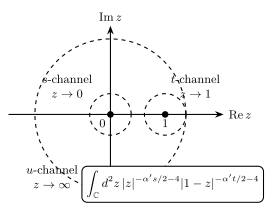
For , the three collision regions carry , and , respectively. The infinity neighborhood is shown in a reciprocal coordinate. The displayed coordinate radius is , so the inverse-chart disk corresponds to . These illustrative regions are not extra disjoint amplitudes or a choice of physical cutoff. All three belong to the single four-punctured-sphere integral.
A collision can be described by a long intermediate tube and expanded in exchanged string states. We defer the pole spectrum and its factorization to page 21. At this stage the geometric conclusion is already clear: adding three copies of the full moduli integral, one for each named channel, would overcount the amplitude. Crossing is implemented by relabeling punctures and changing the modulus coordinate.
Common pitfalls
Section titled “Common pitfalls”Dropping a ghost sign because the full determinant is positive. An absolute square hides the difference between two chiral orderings. Keep the odd-field order through a calculation, and absorb only a single explicitly identified overall sign into the chosen amplitude normalization.
Treating infinity as a divergent insertion. Infinity is a regular point in another sphere chart. Work at finite and take the combined matter–ghost limit, or use the separately rescaled operators, but not both.
Using on-shell conformal weights to justify an off-shell amplitude. The usual integrated prescription is invariant only with the appropriate weights and BRST conditions. Off-shell string amplitudes require additional choices, such as local coordinates in a string-field-theory construction.
Exercises
Section titled “Exercises”Exercise 1. An off-shell test of the sphere prescription
Section titled “Exercise 1. An off-shell test of the sphere prescription”For neutral momenta with arbitrary , transform the formal all-integrated density under a Möbius map. Identify its uncanceled factors. As a numerical scaling example, take two momenta with and . Does dividing by a formal group volume put these insertions on shell?
Solution
The finite-distance identity gives
The factors cancel locally for ordinary tachyon insertions precisely when . In the example, each exponent is , so the density changes by . Directly, the two area measures contribute , while contributes , again leaving .
The two-point example diagnoses local covariance; it is not a valid application of the stable sphere fixing recipe. A formal division by the group volume does not remove an insertion-dependent Jacobian. More generally, satisfying a scaling identity does not prove BRST closure for an arbitrary nonprimary vertex. Off-shell constructions require extra geometric data and cannot be obtained by simply ignoring the physical-state conditions in this formula.
Exercise 2. Changing which puncture is at infinity
Section titled “Exercise 2. Changing which puncture is at infinity”Start from the noncollinear configuration in the first figure. In the normalized coordinate its points are with . Now send labels to by . Compute the new movable coordinate and the real area Jacobian there. Transform the full four-point density and identify which exponents are exchanged.
Solution
At the specified point,
The first normalization map has , so its real area Jacobian is . The composite map from the original plane to has Jacobian at the movable puncture. This uses the determinant of a real two-dimensional map, not its complex derivative without an absolute square.
Put and . Since ,
The last equality uses . The and regions have exchanged roles. Label now approaches label at and label at infinity.
With the fixed label order , the chiral determinant in the new coordinate is , whereas the old one was . The antiholomorphic factor changes sign as well, so the grouped closed determinant remains . This accounts for the ghost order independently of the area Jacobian. The two expressions represent exactly the same integration density.
Exercise 3. Infinity factors away from the tachyon shell
Section titled “Exercise 3. Infinity factors away from the tachyon shell”Keep momentum conservation, but let the scalar exponential at the third puncture have arbitrary equal weights . Determine the large- behavior of the unrescaled product of that matter insertion with the three-fixed-point ghost determinant. Derive the rescaling needed for its ghost-dressed operator. Then check the on-shell three-tachyon amplitude when every matter vertex is multiplied by a constant .
Solution
The factors joining the third puncture to all others give
The grouped ghost determinant contributes . Their product therefore scales as . The combined primary has weights , so its infinity definition requires the reciprocal factor:
This is the same factor obtained by multiplying the matter rescaling by the ghost rescaling . For an ordinary physical tachyon , no net rescaling of remains. Away from the shell, defining this local infinity operator does not repair the failure of the integrated amplitude to be coordinate invariant.
For the three on-shell tachyons, conservation gives for all three pairs. The product is canceled in position dependence by the ghost determinant, leaving
Thus the cancellation checks coordinate independence, while the numerical coupling still depends on the normalization of the external fields. It cannot determine an absolute three-point normalization by itself.
Exercise 4. Real center-of-mass kinematics
Section titled “Exercise 4. Real center-of-mass kinematics”Consider the following all-incoming momenta, with the unused spatial components zero:
Find , , and on the tachyon shell. For , and , determine whether the original integral converges. Explain the role of this real kinematic example despite the vacuum instability.
Solution
The four vectors sum to zero and each has norm . The shell condition gives
A real positive energy requires . Squaring the appropriate pair sums gives
Their sum is . For the numerical choice,
The integrand is , which is not integrable near zero. The analytic amplitude must instead be obtained by continuation from the convergence domain. This exercise determines the kinematics and the failure of the original integral; evaluating the continued expression or its limit at special invariants requires the pole and zero analysis on page 21. Nearby generic real choices also remain outside the original convergence domain.
These vectors are an exact check of the signature, momentum labels and invariant identities. They do not establish a stable tachyon scattering experiment: the background about which this perturbation theory is organized is unstable.
Exercise 5. Cutoffs and logarithms at degeneration thresholds
Section titled “Exercise 5. Cutoffs and logarithms at degeneration thresholds”For real , compute the leading radial contribution from , and similarly near . At infinity use with . Determine the cutoff dependence both away from and at each convergence threshold. Do not evaluate the full complex beta integral.
Solution
Near zero, the factor tends to one. Its leading local model gives
For , the omitted disk contributes to leading order and vanishes as . For , the retained annulus diverges as . At the divergence is logarithmic. Corrections from the smooth second factor do not change this leading integrability condition. The same calculation at replaces by .
At large radius the leading model is
Thus gives a finite tail, a logarithm and a power divergence. All three coefficients contain the doubled complex measure; using the ordinary Euclidean area would divide them by two. For complex parameters, absolute convergence depends on their real parts. A purely oscillatory radial power at zero real part does not give absolute convergence.
Exercise 6. Crossing from changes of the modulus
Section titled “Exercise 6. Crossing from changes of the modulus”Let denote the convergent integral in the main text, subject to . Show that exchanges , and that exchanges . Find the orbit of a generic cross-ratio under these two maps. Why should one not add six copies of the same integral for six cross-ratio values?
Solution
The first map has unit area Jacobian and exchanges with . Hence .
For inversion,
The net exponent of is
The exponent remains , giving . Omitting the area Jacobian would change the first exponent by and destroy this equality.
Repeated composition gives the six generic values
Special cross-ratios can have a smaller orbit. These maps permute the three degeneration points and generate the channel permutations. For labeled external states, the full moduli integral is already the required amplitude; alternative labels give equal representations of it for identical tachyons. They are not extra processes to sum. Nor should one restrict to a permutation fundamental region without also reformulating the labeling and symmetry factors.
The equalities were established where all integrals converge absolutely. They extend together by analytic continuation; this argument does not separately prove every statement about residues or unitarity.
References
Section titled “References”- Joseph Polchinski, What Is String Theory? (1994), lectures at the Les Houches Summer School “Fluctuating Geometries in Statistical Mechanics and Field Theory,” report NSF-ITP-94-97. arXiv:hep-th/9411028. Sections 2.7–2.8 explain vertex descent, coupling powers and the sphere amplitude.
- David Tong, Lectures on String Theory (2009), arXiv:0908.0333. Sections 6.2.1–6.2.2 derive the residual sphere symmetry and the tachyon correlator; the momentum-label choice must be translated when comparing formulas.