
Open/Closed Duality and D-Brane Scattering
An open-string loop can describe the exchange of a closed string. For two D-branes, these descriptions are two ways of quantizing the same annulus. Keeping the normalization reveals something stronger than a correspondence of pictures: the open-string spectrum determines the absolute strength of the branes’ gravitational interaction.
We will derive that interaction and then test the brane action with disk amplitudes. Two closed strings probe scattering from a fixed brane; one closed string and two open strings probe the conversion of worldvolume excitations into bulk radiation. The latter process has a nontrivial form factor even though it has only three external states.
Use the shared dilaton and Einstein-frame normalization and physical D-brane tensions. The DBI action supplies the low-energy sources; the vertex-operator page supplies the boundary doubling and ghost-complete operators. The calculation concerns parallel, unfluxed type II branes in a flat background at weak coupling.
One annulus, two Hamiltonian descriptions
Section titled “One annulus, two Hamiltonian descriptions”Let the Euclidean worldsheet be the rectangle
The two edges at fixed lie on the branes. Evolution in traces over open strings with one endpoint on each brane. To quantize across the rectangle instead, set
Now has period and the closed string propagates for Euclidean worldsheet time . The rescaling is a Weyl transformation of the flat cylinder. Neither nor is a target-space proper time.
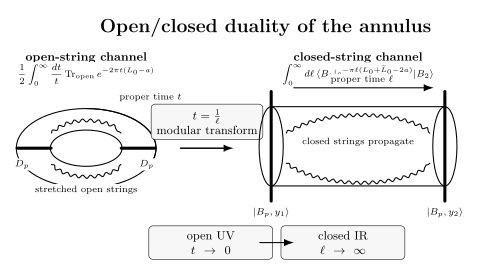
The quantitative rectangles use and , with the same coordinate-length unit in both panels. Identified edges form the spatial circle in the closed description; the other two edges remain brane boundaries. Evolution arrows refer to Euclidean worldsheet time. The coordinate change gives a closed circumference and propagation length .
Write for the transverse separation. The stretched-string spectrum gives
These are oscillator intercepts, not the plane Ramond conformal weight. After Wick rotating the worldvolume momentum, each state contributes the Gaussian
Let be the regulated Euclidean worldvolume. We compute the connected vacuum contribution ; the interaction energy is . There are two oriented interbrane sectors, and . Combining that multiplicity, the cylinder measure and the GSO factor gives
Here . The factor already includes those three contributions; it is not an additional GSO projection to apply again. This is the normalization of Polchinski, sections 2.6 and 3.5.
The oscillator functions are
The open NS contribution is ; the open R contribution is with the minus sign appropriate to a spacetime-fermion vacuum loop. The eight powers count physical transverse oscillators. Thus the expression has already incorporated the cancellation of longitudinal matter and ghosts; it is not an unprojected covariant matter trace.
Separating the closed exchange sectors
Section titled “Separating the closed exchange sectors”The transformations needed for are
Consequently the oscillator ratio supplies . Combining it with and the momentum Gaussian gives
where all functions on the right are evaluated at :
Notice the permutation of spin structures. The closed NSNS contribution comes from the open terms; it is not the open NS sector taken as a whole. The closed RR exchange comes from the open trace with the NS fermion-parity insertion.
Jacobi’s identity makes the total answer vanish for identical parallel BPS branes. Each separate closed sector is nonzero. At large ,
It is these two coefficients, with their relative sign, that determine the force normalization. An equality of two zero total amplitudes would not determine it.
Boundary states and the transverse heat kernel
Section titled “Boundary states and the transverse heat kernel”The closed description has the form of propagation between boundary states. Its bosonic matter factor obeys
where along the brane and transversely. The zero-mode conditions are and . Exercise 1 constructs this state. A full superstring boundary state also contains fermionic gluing, ghost and superghost factors, and a GSO-compatible sum over spin structures. The bosonic coherent state alone does not establish BRST invariance.
In a physical transverse description, the Hamiltonian in the propagator is
For a massless NSNS state, and ; for a massless RR state all four oscillator quantities vanish. The resulting momentum factor is the same. A covariant boundary-state expression must instead retain its ghost insertions and total Virasoro generators; one must not subtract a universal intercept from a plane matter in both sectors.
Set and introduce the particle heat-kernel parameter , which has dimensions of length squared. Then
Integrating over gives the massless Green function. For ,
The large-separation NSNS term therefore is
For example, changing variables contributes , while rewriting as the heat-kernel prefactor contributes . These factors account for the absolute coefficient, not only its dimensions.
Here suppresses massive closed exchange; Exercise 2 quantifies that suppression. For , comparison to linearized gravity also requires weak backreaction, parametrically for one brane. Separating the full NSNS and RR integrals outside this long-distance regime may require a regulator even though their supersymmetric sum cancels pointwise. The total BPS cancellation itself holds at every modulus in the stated background.
Canonical sources and the absolute tension
Section titled “Canonical sources and the absolute tension”The Einstein-frame action derived on the DBI page reduces at zero flux to
Expand the canonical graviton through and use the shared canonical dilaton . The source terms are
Equivalently with
The sign is physical: is positive, while the longitudinal pressures are negative. The dimensionless shifted dilaton and the canonical field have different source coefficients.
In de Donder gauge, the graviton numerator in ten dimensions is
Let and . The two contractions needed for the static force are
The coefficients are nonnegative, giving attraction or an absent channel for the displayed range . Converting to interaction energy gives
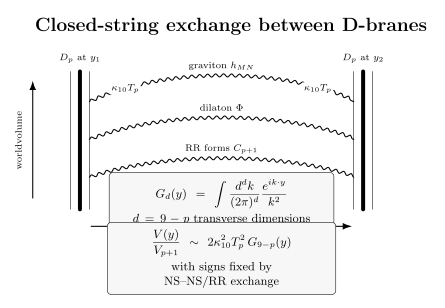
The dots are the actual coefficients at integer . Each multiplies the common attractive factor in the interaction energy per spatial p-volume. The D3 has and . The graph concerns canonical Einstein-frame fields and isolated noncompact Green functions, not a universal equal-strength dilaton coupling.
Matching the nonzero annulus coefficient to this field-theory result yields
This is an absolute determination given the bulk gravitational normalization, the open-string measure and the two oriented sectors. It agrees with the globally specified tension; it did not require guessing an unspecified disk constant.
The RR part has the opposite sign. Its repulsive magnitude is , so identical BPS branes have zero net static force. RR potentials and charge signs use the shared brane-coupling basis. For the D3, the RR coefficient is fixed by the string calculation or the properly constrained self-dual field theory; treating the IIB pseudoaction as an unconstrained ordinary form action would miscount degrees of freedom. More general relative orientations and brane–antibrane sectors belong to the annulus interaction page.
The annulus is order , as is . A disk one-point vertex for a canonical closed field is order , and a disk with two canonical closed external fields is order . The number of normalized external vertices matters when comparing powers of .
Two closed strings scattering from a brane
Section titled “Two closed strings scattering from a brane”Take all closed momenta incoming:
In a physical elastic process, and . The transferred momentum is transverse, so . A fixed heavy brane absorbs it; this disk calculation does not include the brane’s recoil dynamics. Total momentum would include the brane if it were treated as a dynamical finite object.
The doubling matrix replaces antiholomorphic fields by their reflected holomorphic partners. Two bulk insertions consequently produce the four chiral momenta
Their boundary relation is not the open vertex relation: a physical open momentum appears as in a doubled chiral exponential. Keeping this distinction gives the dimensionless combinations
A transverse graviton calculation
Section titled “A transverse graviton calculation”A concrete polarization choice makes the numerator manageable. Choose symmetric traceless supported on transverse directions orthogonal to both momenta. For generic noncollinear transverse momenta, at least two such directions are needed; is a sufficient setting. Define .
Use pictures and for the two closed vertices. Their total disk picture is . Fix their locations to and , with ; only in this paragraph is an insertion coordinate, not a brane separation. The real projective transformation group removes three real positions and gives the Jacobian proportional to .
The contractions simplify because every momentum–polarization contraction and every polarization trace vanishes. In the two tensor structures of Garousi and Myers, equations (9)–(13), only the term proportional to remains. Including the exchange of the two states gives and in their units. Thus the numerator supplies two powers of in the universal gamma ratio; it cannot be dropped when discussing poles.
The change of variable
reduces the remaining integral, including its polarization numerator, to a multiple of
The integral initially converges for and ; the gamma expression defines its meromorphic continuation elsewhere. Strip the momentum-conservation delta function and the common S-matrix factor . With canonically normalized graviton modes the answer is
The normalization can be checked without relying on a paper’s tension symbol. The low-energy graviton-exchange numerator contains
The trace terms cancel. Multiplying the brane and bulk vertices and the transferred propagator gives the residue . Since , this fixes the restored- prefactor above. Garousi and Myers call by their tension symbol; their printed coupling is therefore our .
This selected amplitude has no massless open pole at . It has candidate massive open poles at and closed poles at , with cancellations at special invariants or polarizations. The positive closed poles are not accessible real elastic transfer: they describe analytic factorization. At small invariants,
Here the first local correction starts at order at fixed physical momenta. This conclusion uses the numerator and normalized form factor, rather than the gamma-function denominator in isolation.
One closed string and two brane excitations
Section titled “One closed string and two brane excitations”Now place two massless open strings on one brane and a massless closed string in the bulk. With all three momenta incoming,
There is one independent invariant:
Unlike a three-point amplitude with full momentum conservation in all ten dimensions, this quantity need not vanish. Two traveling brane excitations can produce bulk radiation, or the time-reversed process can absorb a bulk quantum.
For an explicit example, take scalar polarizations and a transverse traceless graviton , all in directions orthogonal to . We need spatial worldvolume directions for nonzero on-shell open waves, and at least two such transverse polarization directions; permits this example. Let .
The modulus and its numerator
Section titled “The modulus and its numerator”Use open picture-zero integrated densities and a closed vertex, so the total picture is . Fix the closed point at and the open points at . Doubling adds the image ; it does not add a second physical closed state. The remaining modulus is real , with the two orderings treated together as in Hashimoto and Klebanov, section 3.
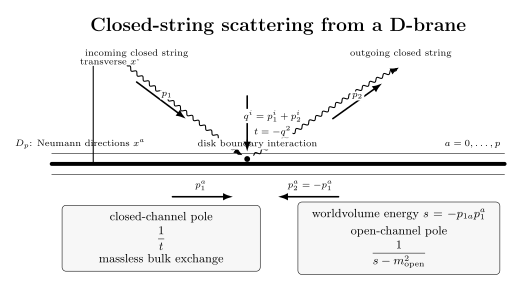
The upper half-plane contains one physical bulk insertion at and two boundary insertions at . The dashed point at is its doubling image. The displayed representative has ; negative exchanges the labeled open positions, and the amplitude below uses the full real integral with that ordering prescription. The target-space invariant is , not the worldsheet coordinate .
The doubled momenta are . The pairwise exponential contractions give, up to a position-independent phase,
The factor 16 is a consequence of boundary doubling and the separation between and ; it is not an adjustable normalization.
For this polarization choice, the derivative terms in the two open picture-zero vertices vanish or multiply the graviton trace. The surviving terms are their fermion bilinears. Contract the two worldvolume fermions with each other, and contract each transverse fermion with a closed-vertex fermion. The symmetric graviton contraction contains
Its momentum coefficient is proportional to . The superghost contraction is constant. The projective gauge-fixing Jacobian supplies , leaving the even rational density proportional to . A Faddeev–Popov fixing of the integrated correlator is being used here; replacing every picture-zero unintegrated vertex by would in general omit its required completion.
The entire nontrivial momentum dependence of the remaining integral is therefore
For , substitute in its even integrand:
The last equality follows from the duplication formula. In particular, . Analytic continuation extends the result beyond the integral’s convergence domain.
Matching a canonical scalar–graviton vertex
Section titled “Matching a canonical scalar–graviton vertex”Let be the canonical transverse brane scalar. Expanding the Einstein-frame pullback for the chosen transverse traceless graviton gives
Thus the stripped low-energy vertex is
The tension cancels between the DBI prefactor and the two canonical scalar fields. Fixing the disk normalization by this vertex gives
This is a normalized effective-action matching, not a second independent determination of the disk normalization. The annulus calculation above already fixed the brane tension absolutely.
A representation using has a compensating kinematic factor: . Hence its apparent pole at is absent here. The full amplitude instead vanishes linearly with at low energy. Its form factor obeys
At positive integers the denominator removes the numerator pole and leaves a zero; at positive half-integer nonintegers a pole remains. These are selection rules for this process, subject also to the chosen polarization factor. They are not the assertion that every open-string level couples to every bulk state.
What the comparison establishes
Section titled “What the comparison establishes”Three different calculations now have distinct roles. The nonzero annulus sectors fix the absolute source strength. The two-closed disk amplitude tests bulk exchange and its massive string corrections. The one-closed/two-open amplitude tests a local worldvolume coupling and supplies a controlled form factor for emission or absorption.
The Green function with a decaying boundary condition applies to noncompact codimension greater than two. Lower codimension and compact transverse spaces require IR or global information, as Exercise 6 illustrates. No force between two BPS branes is a statement about their combined NSNS and RR sources; it does not mean that either source is absent. Finally, scattering from a fixed background source does not by itself determine recoil, backreaction beyond the linear approximation, or the high-energy fate of the brane.
Exercises
Section titled “Exercises”Exercise 1. A boundary state and its oscillator overlap
Section titled “Exercise 1. A boundary state and its oscillator overlap”Construct the bosonic nonzero-mode boundary state from the gluing equation. For one spacelike oscillator pair, regulate its overlap by , , and evaluate it. Then give the zero-mode factor for a localized brane and derive its transverse heat kernel.
Solution
Let
The oscillator commutator gives . Higher nested commutators vanish, so
The right-moving equation follows in the same way. For a single normalized oscillator pair with reflection eigenvalue ,
Therefore the regulated overlap is . Identical reflection signs at the two ends drop out of this one-pair norm. Multiplying over modes supplies the bosonic oscillator product; it does not supply the fermion or ghost factors.
The zero-mode state is proportional to
Since , it is localized at . Propagation between two positions gives the Gaussian Fourier integral
The overall boundary-state normalization remains to be fixed by open–closed matching. The calculation constructs only its bosonic matter factor.
Exercise 2. Massive exchange and the long-distance limit
Section titled “Exercise 2. Massive exchange and the long-distance limit”Derive the transverse propagator for a closed state of mass from its heat kernel. Recover the massless limit for , determine the large-distance suppression, and explain what changes in codimension two.
Solution
The mass adds :
Use the integral representation of the modified Bessel function, with :
For , reproduces . At large ,
For this is exactly . The first massive type II closed level has , so its exchange is exponentially suppressed at large separation, unlike the massless power law.
In two transverse dimensions,
As , an additive IR divergence remains. Differences of potentials, or an IR boundary condition fixing that constant, can still be meaningful. In one dimension the corresponding zero-mass Green function is up to homogeneous terms. Neither case has an isolated positive Green function decaying at infinity like the expression.
Exercise 3. Orthogonal branes and the number of mixed directions
Section titled “Exercise 3. Orthogonal branes and the number of mixed directions”Consider static D- and D-branes sharing time and spatial directions, with their other spatial directions mutually orthogonal. Compute the local graviton-plus-dilaton exchange coefficient multiplying . Express it in terms of the number of mixed Neumann–Dirichlet directions. Apply it to a D1 within a D5.
Solution
The worldvolume projectors have traces and , while their contraction is . Thus
Their sum is
Unlike identical branes, the two dilaton charges can have opposite signs; their exchange can then be repulsive. For a D1 within a D5, gives , , and zero NSNS coefficient. The two branes couple electrically to different RR potentials, so there is no corresponding direct linear exchange between equal-rank electric sources in this flat background. This agrees with the familiar four-mixed-direction supersymmetric system discussed by Polchinski, section 4.2.
This exercise computes the source contraction, not the complete geometry-dependent propagator normalization for intersecting infinite branes. That calculation must integrate over their different worldvolumes and impose the appropriate common-transverse boundary conditions. Nor does this single massless calculation prove cancellation at every string level; that stronger statement uses the preserved supersymmetry or the complete annulus.
Exercise 4. Residues of the transverse-graviton amplitude
Section titled “Exercise 4. Residues of the transverse-graviton amplitude”For the selected two-closed amplitude, compute the residue at and at an open pole . Find a kinematic zero of a massive open residue, and show explicitly why there is no pole. Derive the first two terms in beyond its constant.
Solution
Write . Since ,
As a residue in physical , multiply by , giving as required by graviton exchange.
Near , . Meanwhile
Therefore
The empty product for is one. At the residue vanishes at , demonstrating a canceled pole without setting the polarization factor to zero. At , the beta function is , finite for fixed nonzero , and the explicit factor makes the amplitude vanish. A generic gamma numerator by itself would miss this selection.
Finally, expand . Linear terms cancel and
The same terms occur in through cubic order; exponentiation first produces an additional term at fourth order. This expansion requires small invariants away from poles.
Exercise 5. The emission form factor and its selection rules
Section titled “Exercise 5. The emission form factor and its selection rules”Evaluate also by setting , and derive its first nonconstant terms. Compute the residue of at , , and its first-order behavior near a positive integer . Explain the regular low-energy limit of the full scalar amplitude.
Solution
Since and ,
Splitting the interval at zero and using the sine beta integral reproduces . Its endpoint integrability requires , the same domain as the real-line integral.
The logarithm of the normalized result is
There is no linear form-factor correction. Near , the numerator gamma function is near its pole at , while the denominator is finite. Hence
At , , the numerator has one pole and the squared denominator has two. Their ratio is
Thus these integer locations are zeros. At , neither gamma function in the normalized expression is singular and . Since , the full is proportional to , not . The source of the erroneous massless-pole inference would be omitting the momentum numerator when changing to the representation.
Exercise 6. A compact transverse space
Section titled “Exercise 6. A compact transverse space”Construct the zero-average Green function on a flat transverse torus of volume . Explain why the unsubtracted zero mode prevents an isolated uncompensated source from solving the periodic Poisson equation. For a circle of circumference , obtain the Green function explicitly on .
Solution
For torus momentum lattice , the periodic heat kernel is
Its zero mode tends to at large . Remove it before integrating:
The Fourier series is interpreted with the heat-kernel regulator when necessary. Poisson summation also gives an image sum for in position space; subtracting the constant mode is still required in its proper-time integral.
Integrating a periodic Poisson equation over the torus gives zero on the left, so its total source must vanish. The subtraction corresponds to a compensating uniform source in this Green-function problem. It is not a license to insert such a source into a string compactification without specifying its physics.
For one circle, away from the source . Periodicity, the derivative jump , and zero average give
Equivalently . It has the correct cusp at the source and is not everywhere positive. Its additive normalization and global behavior differ from the isolated noncompact propagator. A supersymmetric cancellation between two exchange sectors does not separately solve the compact RR charge constraint.
References
Section titled “References”- Mohammad R. Garousi and Robert C. Myers, “Superstring Scattering from D-Branes,” Nuclear Physics B 475 (1996), 193–224; doi:10.1016/0550-3213(96)00316-1, arXiv:hep-th/9603194. Section 2 derives the disk amplitudes; the discussion specifies the relation between its tension parameter and physical tension.
- Akikazu Hashimoto and Igor R. Klebanov, “Decay of Excited D-branes,” Physics Letters B 381 (1996), 437–445; arXiv:hep-th/9604065. Sections 3–4 give the one-closed/two-open process and its effective-action limit.
- Joseph Polchinski, “TASI Lectures on D-Branes,” in Fields, Strings and Duality, edited by Costas Efthimiou and Brian Greene, World Scientific, Singapore (1997), pp. 293–356; arXiv:hep-th/9611050, revised 23 April 1997. Sections 2.6 and 3.5 establish the annulus normalization, and section 4.2 treats mixed boundary conditions.