
Vertex Operators, OPEs, and the Virasoro Algebra
A string’s spacetime momentum and polarization become local worldsheet operators. Their stress-tensor OPEs determine whether they can represent physical external states. The same method, applied to two stress tensors, produces the Virasoro algebra and its central charge. This page derives both results and explains why an oscillator expansion can contain several conformal families.
Use the global conventions, the free-field contractions and normal ordering from page 10, and the active contour action from page 11. We study the flat bosonic matter theory. Local contractions are understood with the earlier zero-mode and infrared prescription; they are not unqualified vacuum correlators of the noncompact field .
Exponential vertices and their quantum weights
Section titled “Exponential vertices and their quantum weights”Define the momentum-carrying operator
Here has inverse-length units, so and are dimensionless. The colons subtract self-contractions within the operator. They do not remove contractions with another insertion. Expand the exponential and contract one field with . In the term with powers of , there are choices, converting into . Resumming gives
Now insert . Two kinds of cross-contraction can be singular. Contracting both fields in with the exponential gives
There is no extra factor of two here: the two identical exponential contractions have already been counted by its power-series coefficients. For a single contraction there are two choices of stress-tensor field. Their contribution is
The last equality Taylor expands the uncontracted field about and uses . Consequently
The barred calculation gives . There are no higher poles: the exponential is a primary, not merely an operator with a particular scaling dimension. Its weight is a quantum effect of contractions, and need not be positive in the covariant theory with a timelike coordinate. Tong’s §4.3.3 develops this free-field calculation.
CFT operators and physical string insertions
Section titled “CFT operators and physical string insertions”The local CFT operator exists for general allowed ; imposing a string mass shell is an additional step. For an integrated bosonic closed-string matter insertion , coordinate invariance requires to be a primary of weights . Indeed, under a regular local map the measure supplies , while a primary supplies .
For the exponential alone, the condition is
This is the bosonic closed-string tachyon. A fixed-position, unintegrated representative instead includes the reparametrization ghosts, , whose weights are then . Physical states also require the gauge quotient and consistency of the total matter-plus-ghost theory. These statements describe the usual on-shell bosonic construction; they are not a claim that every local CFT operator is physical or that all superstring pictures obey the same matter-only rule. The BRST page supplies the cohomological formulation.
For a Neumann open-string boundary, the image contraction doubles at the real insertion . Thus , and the double stress contraction gives boundary weight . An integrated boundary vertex uses and weight one. The resulting open-string tachyon has . This factor of four relative to the bulk holomorphic weight follows from the doubled contraction squared, not a different value of . See Tong’s §§5.4–5.4.2 for the distinction between the two constructions.
Tensor vertices require transversality
Section titled “Tensor vertices require transversality”Consider a jointly normal-ordered tensor insertion,
Joint normal ordering matters because the derivative fields and exponential occupy the same point. Adding their individual weights identifies the double poles, but does not test for higher ones.
A useful intermediate operator is , with constant . In , contract one field in with and the other with the exponential. There are two assignments. Their total is
The remaining contractions and the Taylor expansion give
Thus is holomorphically primary exactly when , apart from an identically vanishing operator. The tensor calculation has the same mixed double contraction, with the uncontracted barred derivative as a spectator:
The barred third-order pole has coefficient . At separated points there is no holomorphic contraction with ; the coincident contact subtraction is already part of the composite’s definition. Therefore the conditions for this massless matter vertex are
They reproduce the oscillator constraints of page 7. The physical polarization also has the equivalence
For example, away from contacts, . It is a total derivative in the integrated description. Decoupling in amplitudes requires the usual treatment of other punctures, moduli boundaries, and BRST-exact states; a local total derivative is not a license to discard arbitrary contact contributions. The transverse symmetric traceless, antisymmetric, and trace polarizations describe the graviton, antisymmetric tensor, and dilaton. The trace is taken in the physical transverse space, not by assuming is transverse.
Exponential fusion contains more than one conformal family
Section titled “Exponential fusion contains more than one conformal family”Wick’s theorem resums all cross-contractions between two exponentials:
This is a local free-field identity in radially ordered correlators, with the prescribed contractions. To expand it about , write and . The first terms are
Every term carries momentum . The tower is built by the free-boson, or Heisenberg, oscillators acting on that momentum sector. It need not be a single Virasoro family, which is generated from one primary by negative stress-tensor modes.
The distinction is already visible in the first holomorphic term. If , decompose
Then
The first term is a derivative descendant of . The second passes the primary test just derived, and has weights . For generic noncollinear momenta in more than one target dimension it is nonzero: another Virasoro family is needed. Orthogonality here uses the target metric; it does not assume a positive Euclidean inner product. When , this projection is unavailable. One should use the unsplit operator and its OPE, not divide by zero. At , for example, while can be a nonzero primary current.
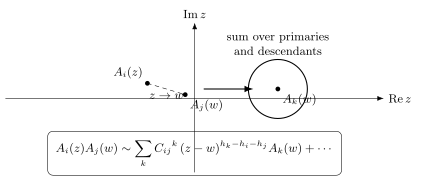
For with , the component of parallel to produces . Its metric-orthogonal component produces a primary of weight . Both belong to the same momentum sector, but generically to different Virasoro families. The diagram is an algebraic decomposition, not a picture of positive-norm target-space directions. Higher terms in the OPE can require additional families.
Scaling determines OPE powers, not all coefficients
Section titled “Scaling determines OPE powers, not all coefficients”Suppose have definite weights and a local operator of weights occurs in their product. Under a simultaneous dilation of the separation and insertion point, the left side scales with weight in the holomorphic sector. Covariance therefore fixes its coefficient’s power to . The barred argument is independent. A complete operator-basis expansion has the form
The basis includes descendants as well as primaries. If one organizes the sum by primaries, each family must contain its descendant series with the corresponding additional integer powers. In a noncompact theory the primary label may include continuous momentum, with sums replaced by integrals as appropriate. This expression assumes a basis of scaling eigenoperators; logarithmic representation theory needs a more general form.
For the leading exponential, . Combining holomorphic and barred factors gives precisely . Symmetry fixes such powers, but the primary coefficients remain dynamical data. Relative descendant coefficients can then be constrained by Ward identities.
A full OPE is used inside a correlator with a separating circle containing the fused pair and excluding all other insertions. In the free-field examples its local Taylor series converges within that separation domain, with branches chosen consistently. The symbol below keeps only singular terms relevant to residues; it does not assert that regular terms vanish. Expanding in complete local states also underlies factorization of string amplitudes, but only after the physical-state and ghost prescriptions are included.
Wick contractions of two stress tensors
Section titled “Wick contractions of two stress tensors”Put temporarily to expose the contraction counting. The two fields at and the two at have two complete cross-matchings and four choices of a single cross-contraction. No self-contraction within a stress tensor is allowed. The double contractions give
The four single contractions leave a bilocal normal product:
Taylor expansion supplies both remaining poles:
We obtain
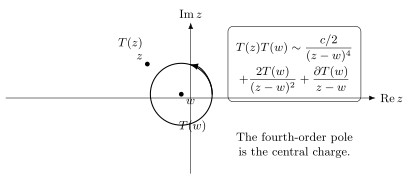
The slot numbers label individual fields, not target-space indices, and make the factors two and four explicit. The complete pairings yield ; the single pairings leave . Taylor expansion of that bilocal product gives and . Lines represent contractions, not propagating worldsheet trajectories.
A timelike boson contributes to , just as a spacelike one does. The two inverse metrics from contractions multiply the two metrics in the stress tensors to give , not . The covariant matter Hilbert space can nevertheless have negative norms. Central charge is not a signature count or a proof of unitarity. The negative central charge of the ghosts arises from their own statistics and conformal weights.
The fourth-order pole is proportional to the identity, and so is called central. It also proves that is not a primary when , even though its weights are . Using the active contour rule of page 11 gives
For the last term vanishes: the stress tensor still transforms covariantly under the global Möbius transformations. Its finite anomalous transformation and the cylinder vacuum shift are developed on the next page. The free-field derivation and its general CFT interpretation are discussed in Tong’s §§4.3.3–4.4 and Ginsparg’s §3.1.
Radial modes and the ordered contour difference
Section titled “Radial modes and the ordered contour difference”On an annulus around the origin, the Laurent expansion and its inverse are
The contour is counterclockwise. Since increasing radius means later Euclidean cylinder time, places the contour outside the contour, while reverses their radial order.
Fix , and choose . The whole commutator is represented by
Both contours are counterclockwise before subtraction; denotes radial ordering. With no additional insertion in the intervening annulus, their difference deforms to a single small contour around . Thus
There is no further subtraction with and exchanged. The outer-minus-inner contour has already performed that subtraction. Adding it again would double the answer. This contour operation is described explicitly in Ginsparg’s §3.3 and Tong’s §4.5.2.
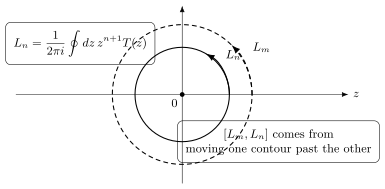
The two radial orderings are subtracted once. At fixed , the remaining contour surrounds and excludes the origin; the contour still surrounds the origin. Every displayed holomorphic contour is counterclockwise. For barred modes on the same physical loop, the barred coordinate runs clockwise and the mode integral needs a minus sign. The radii are schematic and may be deformed without crossing other insertions.
All three residues are needed
Section titled “All three residues are needed”On the small contour about , the function is analytic, even for negative integer , provided that contour excludes the origin. Cauchy’s differentiation formula gives
Applying it to the fourth-, second-, and first-order stress poles yields
For the operator terms, integrate the last term by parts on the closed contour:
Its coefficient combines with to give . The identity term has the remaining integral . Therefore
This is the Virasoro algebra. The central coefficient is odd in on the support , as antisymmetry demands. It vanishes for , so the global conformal generators close without a central term. The cubic polynomial, including its linear subtraction, follows from a third derivative; it is not an arbitrary extra constant.
The vector fields obey , the Witt algebra. They provide the geometric algebra to which Virasoro is a central extension. Their sign refers to coordinate vector fields; the positive local residue action on an operator remains . For the unimproved classical free-boson stress tensor the Poisson-bracket algebra has no such central term. In the quantum calculation above it comes from double contractions. This last statement does not exclude classical central extensions in other, improved systems or boundary charge algebras.
Two chiral algebras and the oscillator construction
Section titled “Two chiral algebras and the oscillator construction”Using a single counterclockwise physical contour in the plane, define
This is equivalent to a positive integral on a separate counterclockwise contour in the plane. For , one has , which verifies the sign directly. The same local residue derivation gives
Here is the same antiholomorphic operator denoted in the oscillator discussion. For the present free matter theory, . Mixed holomorphic–antiholomorphic contractions have contact support, not separated chiral poles; the independent chiral oscillator algebras of page 6 commute. The contact distribution in differentiated correlators does not generate a mixed Virasoro central term. An open-string boundary instead glues the two chiral components into one mode family.
Substituting the previously derived plane expansion of into the stress tensor gives
for the unwound noncompact closed string. Normal ordering is the plane prescription: the oscillator vacuum at fixed has . The eigenvalue of is a holomorphic weight. Neither a cylinder vacuum shift nor the physical intercept is to be inserted again into this definition. The critical bosonic physical condition is , accompanied by the positive-mode constraints and gauge quotient; the independent barred condition gives level matching. The derivation of the total critical theory is separate from the local matter identity .
Exercises
Section titled “Exercises”Exercise 1. A neutral correlator checks the exponential weights
Section titled “Exercise 1. A neutral correlator checks the exponential weights”For separated exponential insertions with , factor out the momentum delta function and use
Compute directly by Wick contraction. Show that it equals the primary Ward expression, including the simple-pole terms, and check its large- decay. Explain the role of momentum neutrality.
Solution
Each field in contracts with the exponential product with coefficient . Its two contractions therefore give
Both fields can contract with the same exponential, or with two different ones; the square includes both possibilities. Expanding it gives diagonal terms and cross terms
On the other hand,
Combining the contributions to the Ward simple poles uses
Thus the Wick result is exactly . Omitting the simple poles would miss all cross terms.
At infinity the vector in parentheses is
Neutrality removes the first term, so the stress insertion decays as . In the noncompact theory the zero-mode integral enforces precisely that neutrality. A nonneutral expression without an additional charged state at infinity is not the vacuum correlator assumed in this Ward check. The stripped formula is used on the support of the momentum delta function.
Exercise 2. The trace polarization and a pure-gauge vertex
Section titled “Exercise 2. The trace polarization and a pure-gauge vertex”Let be null in -dimensional Minkowski space, and choose a null reference vector with . Show that
gives a transverse massless tensor vertex, while does not. Find the trace of . Next take with and express its vertex as a derivative. Does the absence of third-order poles alone remove this polarization from the physical spectrum?
Solution
Contraction with gives , and the other contraction vanishes as well. Raising one index shows that : it annihilates and acts as the identity on vectors orthogonal to both. Its trace is .
Hence has weights and no third-order pole. It represents the transverse trace polarization. In contrast, , so fails the primary test despite its double-pole weights. In the transverse trace contains 24 directions; it is the scalar polarization in the physical decomposition. A unit-normalized transverse trace tensor is .
For the second polarization, and . Thus it also passes the primary test. Using the free equation away from insertions,
The field being differentiated has holomorphic weight zero, so its derivative has no third-order obstruction. Primarity therefore does not distinguish this pure-gauge insertion from nontrivial physical polarizations. Removing it uses the null-state or BRST quotient. This example separates the mass-shell condition, transversality, and gauge equivalence into three distinct steps.
Exercise 3. A new primary in a fixed momentum sector
Section titled “Exercise 3. A new primary in a fixed momentum sector”Take two orthonormal spacelike directions , with , , . Decompose the first holomorphic term in into a derivative of and a separate primary. Independently derive the coefficient of the derivative from global conformal covariance. Finally explain what changes for .
Solution
For , one has and . Therefore
The second polarization is orthogonal to , so it is primary of weights , where . It is nonzero and cannot be replaced by : the two have different stress third-order poles. In particular, has coefficient , whereas the new primary has none.
For an independent coefficient check, use holomorphic three-point covariance. Put the fused operators at and and their momentum-dual primary , of weight , at . The three momenta now sum to zero. After stripping a common structure constant, its holomorphic dependence is
Expanding in gives relative linear coefficient . In an OPE term , differentiation of the two-point factor at gives relative . Thus
This projects onto the family; it does not assert that this is the only family. The separate primary has a different weight and no two-point pairing with in the plane vacuum.
If , then and , so . The first term of the expansion is still , a nonzero weight-one primary for nonzero spacelike . It belongs to a current family rather than the identity family. The expression for cannot be used at . This example makes the failure of a universal single-family interpretation especially explicit.
Exercise 4. Three stress tensors and the timelike sign
Section titled “Exercise 4. Three stress tensors and the timelike sign”Compute the separated plane-vacuum correlator for free coordinates by enumerating Wick pairings. Verify its leading OPE as . Explain why a timelike coordinate contributes with the same sign as a spacelike one.
Solution
There are six fields in total, two at each insertion, and normal ordering forbids an edge joining fields at the same insertion. A complete pairing must join each pair of distinct insertions once: its contraction graph is a triangle. There are eight assignments to the two labeled field slots at each vertex. For one spacelike coordinate, their common factor including the three stress normalizations is
The target-index contraction around the triangle is the trace of the identity, giving . Hence
For a timelike field each propagator changes sign, but each occurrence of that field in also changes sign. There are three of each, so the two sign changes cancel. The coordinate contributes to the displayed coefficient.
Let and . The result expands as
The stress OPE predicts . Since , both terms agree. The fourth-order identity pole multiplies and contributes nothing here. This checks the single-contraction coefficients independently of the two-point central term.
Exercise 5. Residues, negative modes, and a Jacobi check
Section titled “Exercise 5. Residues, negative modes, and a Jacobi check”Use the single local contour formula to compute and , keeping the integration-by-parts contribution visible. Check the Jacobi identity for modes . What algebra would result if the minus sign in the barred physical-contour definition were omitted?
Solution
For , the inner residue is . Multiplying by and integrating gives
The derivative contribution is . Antisymmetrizing this answer again would erroneously give .
For , the fourth-pole residue is , the second-pole residue is , and the simple-pole residue is . With , multiplication by leaves
Neither the identity Laurent monomial nor the total derivative has a residue. Negative powers of did not obstruct the local Taylor expansion: its center was , and its circle excluded .
The three Jacobi terms are
They sum to zero, including the central parts. This finite check is not a proof of all Jacobi identities, but it would detect several normalization or sign mistakes.
Without the barred minus sign the proposed operators would be . They would obey
The central coefficient retains its sign because there are two minus signs on the left, while the linear term reverses because expressing the result in terms of introduces one more. Thus the error cannot be repaired by simply declaring a negative barred central charge.
Exercise 6. A level-two Gram matrix from the algebra
Section titled “Exercise 6. A level-two Gram matrix from the algebra”As an algebraic application, take a normalized highest-weight vector satisfying , for , and , with real . Compute the Gram matrix of and . At , find the null combination and verify that positive modes annihilate it. Check its image in the one-spacelike-boson Fock representation with and .
Solution
Move each positive mode to the right with the commutator. The diagonal first entry is . For the off-diagonal entry,
For the other diagonal entry, first use
Applying again gives . Therefore
At , all four entries equal . The null vector is
Its positive-mode conditions follow directly:
Modes vanish after commutation because every resulting positive mode annihilates . Thus the null vector is also highest weight in the abstract module, not merely a vector with zero diagonal norm.
For the free boson, the oscillator formula yields
At , these vectors coincide. The abstract null combination is therefore represented by zero in this Fock realization. A Virasoro module and its independent physical states must not be counted by listing descendant symbols alone. This is a small example of the representation theory developed on page 14; it is not a general no-ghost proof for the covariant string.
References
Section titled “References”- Paul Ginsparg, “Applied Conformal Field Theory,” in Fields, Strings and Critical Phenomena, Les Houches, Session XLIX (1988), edited by É. Brézin and J. Zinn-Justin (North-Holland, 1989), pp. 1–168; arXiv:hep-th/9108028. §§3.1 and 3.3 discuss the central stress pole and the contour construction of the Virasoro algebra; §§3.6 and 4.1 develop descendants and their inner products.
- David Tong, Lectures on String Theory (2009); arXiv:0908.0333. §4.3.3 derives the exponential and stress OPEs; §4.5.2 evaluates the Virasoro contour commutator; §§5.4–5.4.2 distinguish physical matter vertices, tensor primarity, and boundary weights.