
Ten-Dimensional Spinors and Ramond Ground States
Ramond fermion zero modes turn the string ground state into a spacetime spinor. Understanding that statement requires more than counting components: we must construct the spin representation, distinguish chirality from reality, and determine how the massless Dirac equation selects its physical polarizations. In ten dimensions, a Majorana–Weyl field has sixteen real components before its field equation, while its positive-energy massless states have eight independent polarization amplitudes.
We use the shared worldsheet fermion definitions and spacetime gamma matrices and orientation. The previous page derived the exact open-string condition on the Ramond ground state. This page explains the representation on which that operator acts. The consistency and full oscillator form of the GSO projection are developed on the next page.
Clifford zero modes generate spin transformations
Section titled “Clifford zero modes generate spin transformations”The Ramond zero modes obey
Thus the zero modes act on a module of the spacetime Clifford algebra. None of the real orthonormal zero modes can annihilate a nonzero ground state: its square is a nonzero multiple of the identity. A suitable complex combination can be an annihilator, however, and will let us construct the module explicitly.
The Clifford algebra also constructs the Lorentz action. Define the matrix generators
Moving through the two factors with the Clifford relation gives
Applying this identity to the two factors in then yields
These are the Lorentz Lie-algebra relations in a matrix representation. A product of two gammas therefore acts as an infinitesimal rotation or boost on the spinor components. In terms of the original zero modes, .
For two spatial directions, , so the finite transformation is
At it equals , although conjugation by returns every gamma matrix to itself. A spinor consequently transforms under the double cover of the connected Lorentz group. The distinction is physically visible under a full rotation.
The matrices are not all Hermitian observables in a positive-definite component norm. In the construction below, spatial are Hermitian with eigenvalues , while the finite boost matrices are not unitary. This finite covariant representation should not be confused with the unitary representation on the full one-particle Hilbert space, which also transforms momentum. Exercise 1 makes the distinction explicit.
Constructing the spinor module
Section titled “Constructing the spinor module”Fermionic creation operators and explicit matrices
Section titled “Fermionic creation operators and explicit matrices”Temporarily construct a Euclidean Clifford algebra in dimensions with Hermitian matrices . An explicit realization uses Pauli matrices:
An empty tensor power is the scalar identity. Here
Each matrix squares to one. For generators belonging to different tensor slots, the first slot where they differ supplies exactly one anticommuting Pauli pair, so distinct generators anticommute. This proves the Clifford relation for the entire construction. It also gives a recursion: append an identity to the old matrices, then add and . The matrix size doubles when the dimension increases by two. Van Proeyen, section 3.1, develops this construction and its signature dependence.
Define
The Clifford relation becomes the fermionic oscillator algebra,
Choose a vector annihilated by all . Its ordered basis states are
There are such states. The ordering matters: , whereas . This is an auxiliary finite Clifford Fock space; is not the NS string vacuum, and these creation operators do not raise the string mass level.
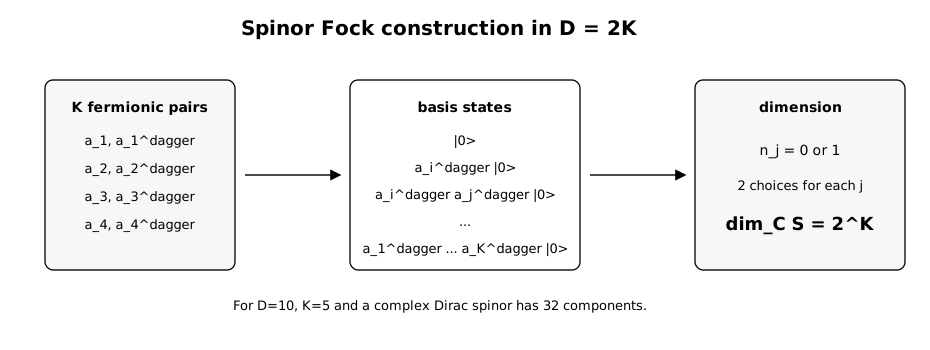
The square displays the four ordered basis states for two Clifford oscillators. The two routes to differ by a minus sign. The separate five-oscillator row gives the ten-dimensional occupation counts ; even and odd occupations each contribute sixteen states. These are basis diagrams, not spacetime geometry. The chirality signs use the explicit Lorentzian realization derived below.
Chirality and the Lorentzian continuation
Section titled “Chirality and the Lorentzian continuation”Let . For each pair,
Multiplying the pairs gives
This normalized Euclidean volume matrix squares to one and anticommutes with each . Because a Lorentz generator contains an even number of gammas, it commutes with chirality. Its two eigenspaces are therefore invariant spin representations, the Weyl spinors. Each has dimension for .
Now realize the Lorentzian algebra by
Then , the spatial squares are , and is anti-Hermitian while the spatial gammas are Hermitian in this component basis. Multiplication by changes the signature; it does not change the complex module dimension.
In ten dimensions the shared, oriented chirality product consequently has the definite value
Thus even occupation has and odd occupation has in this realization. No extra phase is left to choose after the shared definition and the displayed matrices have been fixed. A different basis conjugates both the gammas and chirality; it does not alter this operator relation under that same change of basis.
Why odd dimensions have no Weyl split
Section titled “Why odd dimensions have no Weyl split”Starting with Euclidean gammas, use their normalized volume matrix as the additional spatial gamma in dimensions. It anticommutes with all the preceding matrices and squares to one. Continuing the first gamma to Lorentzian signature again gives a module of dimension
The new generator is the old chirality matrix. It cannot also be an odd-dimensional chirality operator, because it does not anticommute with itself. More directly, the new Lorentz generators mix the old Weyl subspaces. If the added gamma is , then
The product of all the odd-dimensional gammas is a scalar multiple of the identity. The two signs of the last gamma distinguish two complex Clifford modules, but their restrictions to the spin group are equivalent. There is no Weyl decomposition of an irreducible odd-dimensional spinor. Exercise 2 exhibits the ten-to-eleven-dimensional extension explicitly.
Majorana reality is an antilinear condition
Section titled “Majorana reality is an antilinear condition”A Weyl projection is complex-linear. Reality is a different operation. Let denote componentwise complex conjugation in a chosen basis and consider
To define a Majorana spinor as a fixed vector , two tests are needed. First, must commute with the spin representation, so Lorentz transformations preserve the condition. Second,
must equal . If , the putative fixed-vector equation implies and has no nonzero solution. Multiplying by a phase does not help: that phase cancels between and .
Compatibility with a Weyl condition requires one further test: must preserve the chosen chirality eigenspace. Van Proeyen, sections 3.2 and 3.4.1, gives the general signature-dependent classification. We will establish the ten-dimensional result by explicit matrices and use other dimensions to distinguish the possible obstructions.
An explicit ten-dimensional real structure
Section titled “An explicit ten-dimensional real structure”For the displayed tensor-product matrices, a realization of the shared transpose intertwiner is
The label emphasizes a calculation in this basis; it does not impose a new global phase on . The odd spatial gammas are imaginary and antisymmetric under transpose. The even spatial gammas are real and symmetric, while is imaginary and symmetric. A product of five odd spatial gammas commutes with each member of that product and anticommutes with every other gamma. Therefore
By contrast, is the product of the six imaginary gammas. Conjugation by this even product reverses each included gamma and preserves each excluded one. Complex conjugation supplies precisely the compensating signs:
This also implies , so commutes with spin transformations. There are six imaginary factors, hence . Reversing the six factors when squaring gives fifteen minus signs, and the single timelike square contributes another:
Finally, applying the conjugation identity to the product of all ten gammas yields
Thus is an antilinear involution preserving each sixteen-complex-dimensional Weyl space. Its fixed space has sixteen real dimensions. To see why the dimensions agree in this way, write any Weyl spinor as
Both and are fixed by . A complex basis of the Weyl space can therefore be obtained by complexifying its real fixed space. Imposing reality removes one set of real coefficients, not one set of complex basis vectors.
The roles of and must remain distinct. The former relates transposed matrices and allows an invariant bilinear; the latter accompanies complex conjugation. For example, the transpose relation gives
so is spin-invariant. It does not follow that is the correct real structure. Exercise 4 checks their different transformation laws under a change of component basis.
The ten-dimensional conclusion is Majorana–Weyl compatibility. It is not true in every dimension. In four dimensions a Majorana real structure exchanges the two Weyl spaces; in six dimensions a Weyl space instead has an antilinear structure whose square is . Exercise 3 constructs both cases. These examples explain the mechanism; they do not replace a proof of the full periodic classification in arbitrary signature.
A massless spinor carries a transverse Spin(8) representation
Section titled “A massless spinor carries a transverse Spin(8) representation”The null stabilizer includes null rotations
Section titled “The null stabilizer includes null rotations”Take a real nonzero future-null momentum along the ninth spatial direction,
Then the ground-state Dirac equation is
The subgroup fixing this momentum is larger than the transverse rotation group. Besides , , its Lie algebra contains
The Lorentz commutator derived above gives
These are the translations and rotations of . Its spin cover is . The generators are called null rotations: the translation terminology describes their algebra, not literal translations of spacetime. Bekaert and Boulanger, sections 3.2–3.3, derive this massless stabilizer and distinguish its helicity and continuous-spin representations.
For the spinor in question, its Clifford realization gives a stronger result:
Thus on the Dirac kernel. The null-translation subgroup acts trivially, leaving an ordinary finite-dimensional representation of . This is why transverse spinor labels suffice for the physical Ramond states; the full little group itself has not become .
Transverse chirality and its weights
Section titled “Transverse chirality and its weights”Define the transverse volume product for this frame,
Moving through eight gammas produces no sign, so
A spinor of ten-dimensional chirality in the massless kernel therefore obeys
This is a derived relation in the stated momentum frame. In particular, the shared negative ten-dimensional polarization chirality gives positive transverse chirality here.
Four commuting transverse rotations can be diagonalized simultaneously:
Since , their eigenvalues are . Pairing the eight spatial gammas into four Clifford oscillators constructs all sixteen weights. Moreover,
Hence an even number of negative weights gives transverse chirality , while an odd number gives . Each set contains eight weights. Denote the corresponding spaces by and ; they are the two half-spin representations commonly named and , with the assignment of those names tied to the transverse orientation. The NS vector instead transforms in .
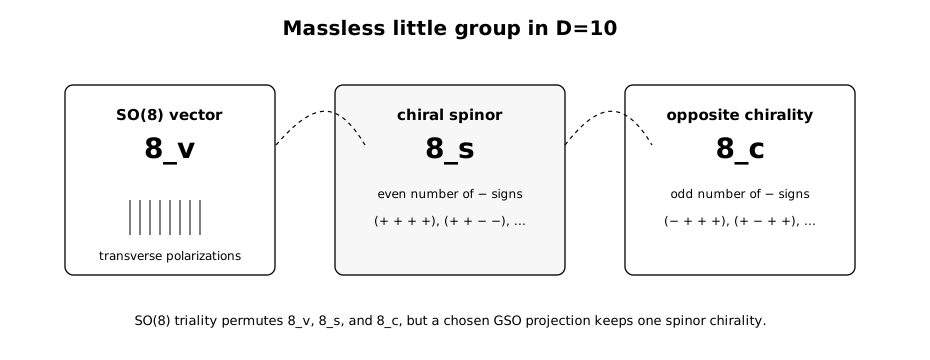
The axes show the dimensionless eigenvalues at equal scales. Each point represents two distinct weights, whose remaining coordinates are written beside it. The upper and lower panels have even and odd numbers of negative signs, respectively. These are projections of four-dimensional weight sets, not spacetime trajectories. Null translations act trivially on the Dirac kernel; for momentum along , its transverse chirality is the negative of its ten-dimensional chirality.
Equal dimension does not make these three representations identical. For a fixed rotation, their characters can differ; a rotation acts as on the vector and on either spinor. Triality is the outer automorphism that permutes the three representations while also changing the identification of group elements. It is not an operation identifying vector and spinor polarizations under the same fixed spacetime rotations. Exercise 5 computes their characters directly.
Field reality does not halve the polarization count again
Section titled “Field reality does not halve the polarization count again”The open Ramond ground state satisfies
At nonzero null momentum the Dirac kernel has complex dimension sixteen; restricting to one Weyl chirality leaves complex dimension eight, as the null-projector derivation established. The plane matter weight of a physical R ground state is ; neither chirality nor reality changes that ordering shift.
Now consider a spacetime field satisfying . Its Fourier coefficients obey
They need not obey at the same positive-energy momentum. For example, a real massless field can be expanded as
where is a Lorentz-invariant mass-shell measure and is any amplitude in the chiral Dirac kernel. The identity guarantees that the conjugate term also solves the Dirac equation. Chirality is preserved for the same reason. Applying interchanges the two terms and leaves their sum unchanged.
On a momentum patch, choose eight basis polarizations of that kernel. Then
has eight arbitrary complex coefficients on the positive-energy mass shell. The negative-frequency coefficients are determined by them. In a quantized Majorana field, the corresponding creation and annihilation operators are related by conjugation; there is no independent antiparticle species. For a complex Weyl field, the two sets of operators are independent. In neither case does field reality reduce the number of spin polarization labels from eight to four.
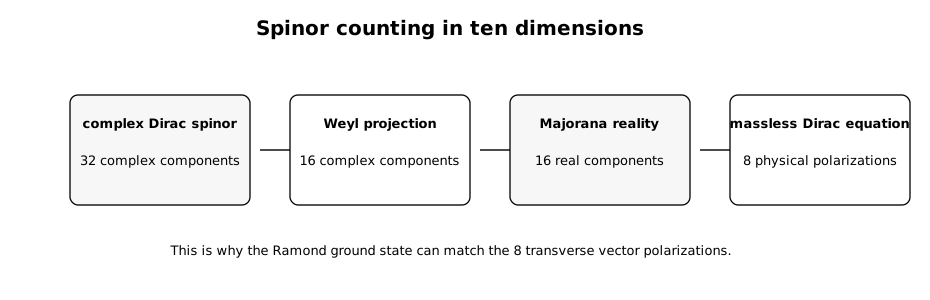
The upper panel counts complex spaces at fixed nonzero null momentum. The lower panel shows the reality relation between opposite Fourier momenta, with equal axis scales and sample points and for an arbitrary . Reality fixes the opposite-frequency coefficient; it is not another projection of the eight positive-energy polarization labels. This explains the relation to a sixteen-real-component Majorana–Weyl field before its equation of motion.
Finally, the spinor constraint is a kernel, not a gauge quotient. Although at nonzero null momentum, quotienting by that image would erase every solution. At the kernel is the full spinor space and the rank argument changes. These qualifications are essential when translating covariant components into physical states.
Choosing one Ramond chirality and the compatible NS projection produces the eight fermionic and eight bosonic polarizations of the ten-dimensional vector multiplet. The representation-theoretic connection is discussed in Weigand, sections 6.4.2 and 6.5. Matching these dimensions is a check on the spectrum, not by itself a construction of supercharges or proof of the full GSO projection.
Exercises
Section titled “Exercises”1. Finite rotations and boosts
Section titled “1. Finite rotations and boosts”Compute and , their conjugation action on the associated gamma pair, and their adjoints. For , determine how and a vector in its kernel transform under . Explain the sign and the difference between this finite-dimensional representation and a unitary particle representation.
Solution
The spatial product squares to , whereas . Thus
Direct multiplication, or differentiating the conjugation at the identity, gives
The signs follow the explicitly specified matrices , so no separate active/passive rotation assumption is needed. They imply
On the kernel, , hence . The transformed spinor solves the transformed Dirac equation.
Since , one has . But , so and
for nonzero real . The boost is not unitary in the component norm. The unitary one-particle action includes the transformed momentum, mass-shell measure and little-group polarizations; it is not this finite matrix alone. Finally and , displaying the double cover.
2. Adding an eleventh gamma matrix
Section titled “2. Adding an eleventh gamma matrix”Append to the ten-dimensional realization. Verify the Clifford relation, determine the eleven-dimensional volume product and reality condition, and show why the ten-dimensional Weyl decomposition is not invariant under the new Lorentz generators. What changes if ?
Solution
The shared product satisfies and anticommutes with all ten original gammas. It is therefore a valid new spatial gamma, without increasing the matrix size. Its full volume product is
For the negative choice it is . These scalar volume signs cannot be changed by similarity, so they distinguish the two irreducible complex Clifford modules in odd dimension.
The new generators are . Consequently
They mix the two ten-dimensional Weyl spaces, leaving one irreducible thirty-two-dimensional spin representation. The same obeys , so remains valid and gives a thirty-two-real-dimensional Majorana representation. This is a representation-theoretic statement, not an eleven-dimensional RNS string spectrum.
For the negative choice the new mixed generators reverse sign. Conjugation by preserves the old even generators and reverses precisely these mixed generators. Thus the two Clifford modules give equivalent spin representations, even though their scalar Clifford volume products differ.
3. Two different obstructions to Majorana–Weyl spinors
Section titled “3. Two different obstructions to Majorana–Weyl spinors”Use the same Pauli tensor construction in four and six dimensions. In four dimensions set and . In six dimensions set and . Calculate and the action of on chirality. Explain why a phase does not fix a negative square, and how an auxiliary doublet can do so.
Solution
In four dimensions the explicit matrices are
Only is real. Conjugation by reverses the other three gammas, compensating their complex conjugation. Thus and . But the explicit factor in changes sign under conjugation:
So a Majorana condition is possible, but it exchanges the two Weyl spaces. A nonzero spinor cannot obey both a single Weyl condition and this Majorana condition.
In six dimensions the four imaginary gammas are exactly the factors in . The same conjugation argument works. Their product is real, but its square is
There is no extra imaginary factor in the displayed , so . Chirality is preserved, but : a single fixed spinor would have to vanish. These are different obstructions from the four-dimensional case.
For , . Instead introduce an auxiliary two-dimensional space with
Then has square and preserves chirality. This is the mechanism of symplectic Majorana reality. The auxiliary doublet illustrates a six-dimensional representation; it does not add fields to the ten-dimensional string studied here.
4. Changing a spinor basis
Section titled “4. Changing a spinor basis”Let for an invertible complex matrix . Derive the transformations of the gammas, the antilinear real structure and the transpose pairing. For the simple nontrivial choice , test whether imposing componentwise reality or leaving unchanged gives the same Majorana condition.
Solution
Requiring the gamma action to represent the same vector gives
Requiring instead gives
The conjugate of is essential. Substitution proves and
For the bilinear, requires
It follows that . The transformation laws of and are different because conjugation and transpose are different operations.
For , the gammas are unchanged but
If , then satisfies . Leaving unchanged would instead give , which differs from for generic . Likewise, componentwise conjugation need not commute with the gamma matrices or preserve the specified real subspace. “Real spinor” means fixed by the appropriate antilinear involution, not necessarily a column of real numbers in every basis.
5. Characters of the transverse representations
Section titled “5. Characters of the transverse representations”Derive the null-rotation algebra and its action on the massless spinor. Then compute the characters of , and the vector under . Evaluate them when all four angles equal , and when only . What do these examples say about triality?
Solution
Expand . The timelike part gives and the ninth-direction part gives ; the mixed terms cancel. Thus . The transverse brackets give . The Clifford expression then annihilates every Dirac solution.
Each spinor weight contributes . Separate the sixteen sign choices by inserting the projector onto the product of their signs:
Because , this becomes
The vector weights are the eight vectors , hence
At , the cosine and sine products are both . Thus the three characters are . At they are .
The representations therefore do not agree on the same group element. Triality permutes them by an outer automorphism of , changing which group element is being compared. It neither turns a fixed spacetime rotation into the same action on vectors and spinors nor constructs a string supercharge.
6. A real field with an imaginary Fourier amplitude
Section titled “6. A real field with an imaginary Fourier amplitude”Let be a nonzero vector in a chosen chiral massless kernel with . Take at a positive-energy momentum. Construct its Majorana field, check the Dirac and chirality conditions, and explain why this example rules out an extra reality projection on positive-energy amplitudes. Extend the reasoning to a wave packet with eight arbitrary complex coefficient functions.
Solution
Antilinearity gives . The required paired-frequency field is therefore
It is fixed by . Its derivative is proportional to , so follows from . Both terms have the selected chirality because preserves that Weyl space.
An additional rule would delete this nonzero solution. The error is applying a spacetime reality condition to one frequency alone. In the general Fourier expansion, reality imposes , relating two different momentum coefficients.
On a momentum patch, choose a J-real basis of the chiral kernel’s real form, . Arbitrary complex functions define
on the future mass shell. Each real and imaginary part produces an independent cosine or sine component of the real field. There remain eight positive-energy spin polarization labels. Upon quantization, the conjugate frequency uses the adjoint operators; an independent antiparticle set is unnecessary for a Majorana field. A complex Weyl field instead permits independent particle and antiparticle coefficients.
Finally, the Dirac equation has imposed a linear equation of motion, not a gauge equivalence. Quotienting its kernel by the equal image of would erase this explicit solution as well as all the others. The count assumes ; the zero-momentum kernel has a different dimension.
References
Section titled “References”- Xavier Bekaert and Nicolas Boulanger, The unitary representations of the Poincaré group in any spacetime dimension, arXiv:hep-th/0611263, version 2 (13 June 2021), sections 1.1 and 3.2–3.3. arXiv.
- Antoine Van Proeyen, Tools for supersymmetry, KUL-TF-99/37 (1999), arXiv:hep-th/9910030, version 7 (12 February 2016), sections 3.1–3.2 and 3.4.1. arXiv.
- Timo Weigand, Introduction to String Theory, lecture notes, Universität Heidelberg, winter term 2011/12, sections 6.4.2 and 6.5. Lecture notes.