
The bc Ghost System and Ghost Zero Modes
The anticommuting fields turn the Jacobian of worldsheet gauge fixing into a local conformal field theory. Its central charge is , but its role is more than anomaly cancellation: its zero modes explain why three insertion positions are fixed in a tree-level closed-string amplitude. Understanding both statements requires care with fermionic signs and with the difference between the identity vacuum and the lowest oscillator states.
We use the shared worldsheet and ghost conventions, the OPE and contour methods, and the state–operator correspondence. This page develops the local ghost CFT and its sphere functional. The metric path integral and moduli measure are developed on the next page; BRST quantization follows on page 19.
Anticommuting fields from the gauge-fixing determinant
Section titled “Anticommuting fields from the gauge-fixing determinant”A useful finite-dimensional model is a matrix acting on infinitesimal gauge parameters. Integrating a quadratic expression in ordinary commuting variables produces an inverse determinant. Integrating Grassmann variables instead produces a determinant:
Here the Berezin measure is oriented so that the integral is one when is the identity. Only the term containing every Grassmann variable survives; its antisymmetric sum is precisely the determinant. A zero eigenvalue leaves an unsaturated Grassmann integral, which vanishes. In the field theory, this elementary observation will account for ghost zero-mode insertions.
For a worldsheet metric, the traceless part of an infinitesimal diffeomorphism is
The trace can be removed by a Weyl transformation. The Faddeev–Popov determinant for the remaining variation is represented by a Grassmann vector and a symmetric traceless antighost . Thus represents a diffeomorphism parameter, not an additional Weyl scalar. In complex conformal coordinates, the independent holomorphic components are and , so their weights are and . The local action is the first-order ghost action given in the overview. Tong, sections 5.1.3–5.2 derives this reduction from the metric path integral.
It is useful to study the more general local first-order system with
Changing changes the stress tensor and the tensor bundles occupied by the fields, while leaving their local kinetic pairing unchanged. The equations of motion are . Inverting that first-order operator gives
and no singular or contraction. These two displayed expressions are consistent with anticommutation: exchanging the fields and their positions gives .
The singularity is a local operator statement. It does not imply that the unsaturated sphere two-point functional is nonzero; additional distant insertions must saturate the zero modes when such a functional is evaluated.
Stress tensor and graded Wick contractions
Section titled “Stress tensor and graded Wick contractions”A stress tensor with the required weights is
The colons mean plane OPE normal ordering, as in the overview. One can determine the coefficients by requiring the simple-pole terms of and to generate translations and the double poles to give the desired weights. Let . Contracting with a third odd field gives
For example, contracting with in requires passing the external through and therefore contributes a minus sign. This sign combines with the coefficient . Taylor expanding the uncontracted fields about gives
Thus both fields are primary, despite the negative weight of the string ghost .
The complete stress-tensor OPE
Section titled “The complete stress-tensor OPE”To keep track of the four bilinear products, define the local operators
For four odd fields in the order , the two possible complete cross-contractions have signs . Here only the second is nonzero. Differentiating the elementary contraction then gives the fourth-order coefficients
There are also single contractions. For example,
Anticommuting the remaining fields and Taylor expanding gives the first line below. Applying the same procedure to the other products yields
The mixed products separately have cubic poles; these cancel in their sum. Combining the three lines produces
In particular, the fourth-order coefficient is
For reparametrization ghosts and . Anomaly cancellation requires matter central charge in each chiral sector. For free target coordinates, including a timelike coordinate, and this becomes . An interacting or compact internal matter CFT is constrained by its central charge, not simply by a count of coordinates.
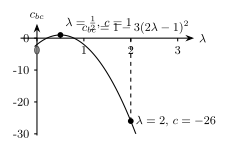
The dimensionless central charge is invariant under , which exchanges the field weights. A complex fermion at has ; reparametrization ghosts at have . The curve is quantitative and does not assert that every real defines a globally untwisted theory on every surface.
Modes, spin sectors and the identity vacuum
Section titled “Modes, spin sectors and the identity vacuum”For integer with untwisted fields, expand
The inverse contour integrals are
The contours are counterclockwise in the holomorphic plane. The anticommutator is the difference between the two radial contour placements after using the fermionic sign in radial ordering. Their deformation leaves one small contour around :
Likewise . No second antisymmetrization is to be applied to the local contour. In a barred calculation, use the corresponding positively oriented contour in the plane; the same physical counterclockwise curve runs clockwise in .
Substitution into gives
This expression inherits plane OPE ordering. The coefficient follows because the power of sets the two mode indices to sum to . The primary OPEs, or the oscillator algebra directly, then give
These are ordinary commutators because is even.
Why a weight-one-half field needs a sector choice
Section titled “Why a weight-one-half field needs a sector choice”At , write
The two are real fermions of the same chirality. Their action splits into two copies of the free Majorana action, and
Each Majorana field has ; the pair has . The antiholomorphic copy is a separate pair, not the complex conjugate notation used to split this chiral pair.
Under the cylinder-to-plane map from page 13,
The square root changes sign during this continuation. Consequently,
| Cylinder sector | Cylinder boundary condition | Plane continuation | Indices in |
|---|---|---|---|
| Neveu–Schwarz (NS) | |||
| Ramond (R) |
Thus an integer-mode formula at describes the Ramond sector, not the plane identity sector. More general fractional weights or twists require a specified bundle and monodromy. Ginsparg, sections 6.1–6.2 discusses these sector-dependent mode sums and their twist fields.
The identity state and the oscillator doublet
Section titled “The identity state and the oscillator doublet”Return to . Acting on the plane identity state, and must be regular at the origin. The Laurent powers therefore imply
It has plane weight zero and ghost number zero. The two useful oscillator ground states are instead
Both are killed by for , while
These relations follow from and . The inverse relation follows from . The identity is therefore a higher-energy state than this doublet; it is not the oscillator ground state of this nonunitary theory.
Since ,
Regularity also fixes the local operator dictionary without an ordering ambiguity:
This distinction between the identity and oscillator vacua is explained in Polchinski, section 1.6.
If annihilators of are placed to the right, the positive-mode oscillator energy is
The constant is fixed by the already derived weight of ; it is not a new arbitrary intercept. For the general integer-mode doublet, the corresponding constant is . Exercise 2 derives it from a finite mode calculation. Cylinder energy is a further, distinct quantity: in one chiral sector it is . At , the doublet has cylinder energy .
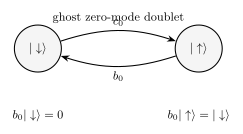
For , the plane identity and the oscillator doublet are distinct. The labels give plane and plane ghost number; cylinder shifts are derived separately in the text. The and arrows connect the two ground states. This is an algebraic state diagram, not a depiction of a positive-norm Hilbert space.
Ghost current and its anomalous transformation
Section titled “Ghost current and its anomalous transformation”The current which counts c fields minus b fields is
The two possible charge assignments are therefore fixed relative to one another. With the identity charge fixed by the overview, and have charges 1 and 2.
A current carrying these charges need not be a primary. Graded contractions give
For the cubic term, each of and has double-contraction coefficient . Their combination in gives . The single contractions in give , and those in give its negative. This proves the complete displayed OPE. At , .
Point splitting and the cylinder charge
Section titled “Point splitting and the cylinder charge”The finite current transformation can be derived without guessing an anomalous term. For a locally invertible map , pull back the two primary fields, then subtract the local singularity in the new coordinate:
The transformed contraction has the expansion
The regular product transforms with one factor of , so
Expanding gives the extra also obtained by taking the residue of the cubic pole.
For , integrate around the cylinder at fixed Euclidean time:
At , this is a shift by . The doublet consequently has cylinder charges , while its plane operator charges remain . The current anomaly explains the difference; it is not a reason to relabel the shared plane convention.
Sphere zero modes and the three-ghost functional
Section titled “Sphere zero modes and the three-ghost functional”The sphere requires regularity both at finite and in the coordinate near infinity. A holomorphic ghost is a vector, so
Regularity at both ends permits exactly the three solutions
They generate translations, dilations and special conformal transformations. Their finite effective group is , rather than its double cover . The three global field zero modes are not just the single Fourier mode named .
The antighost is a quadratic differential:
A holomorphic function on the finite plane which also satisfies this regularity at infinity must vanish. Hence there are no b zero modes on the unpunctured sphere.
Saturating the Berezin integral
Section titled “Saturating the Berezin integral”The action does not depend on . Integration over them extracts the coefficient of their ordered product. Define the chiral sphere functional by
This fixes its overall normalization; the ghost functional with no insertions is zero, so there is no division by an unsaturated ghost partition function. In the product , the coefficient of this ordered monomial is
Therefore
The order of the fields matters: exchanging two insertions reverses the sign. This calculation supplies both the position dependence and its normalization, rather than inferring the answer from conformal weights alone.
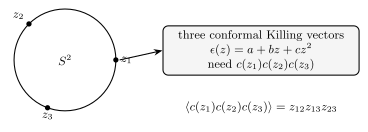
The holomorphic vector zero modes span . With the ordered Grassmann coefficients , the determinant has columns and equals . The sphere drawing is schematic and has no physical boundary. General chiral correlators require net ghost number three; a closed-string sphere has an additional antiholomorphic copy.
Why the selection rule counts net ghost number
Section titled “Why the selection rule counts net ghost number”Nonzero modes contract b with c in pairs. After all such pairings, three unpaired c zero modes must remain. Thus a necessary condition for a nonzero chiral sphere functional is
It is not sufficient in every case: coincidences, antisymmetry or other operator constraints can still make the correlator vanish. In particular, a product of only two c fields vanishes, while a product of four c fields and one b field can be nonzero, as exercise 6 shows.
The current anomaly gives the same rule geometrically. Apply its finite transformation to at :
A large counterclockwise contour in encloses all insertions. The first term can be contracted to zero in the regular infinity patch, while the second integrates to three. Shrinking the original contour onto the insertions counts . This argument, also given in Polchinski, section 1.9, relates the local cubic pole to the global saturation condition.
For comparison, the index theorem for integer-weight fields on a compact unpunctured genus- surface gives
where is the canonical line bundle of holomorphic one-forms. This is Riemann–Roch applied to , with Serre duality identifying its complementary space. The index counts c zero modes minus b zero modes. For , the torus has one of each; for , it has no c zero modes and b zero modes. Punctures and boundaries require modified conditions. The index is quoted here to indicate the geometric extension; the full moduli measure is not derived on this page.
Closed strings and fixing three positions
Section titled “Closed strings and fixing three positions”For a closed-string sphere, specify the grouped product of the two chiral functionals:
where and are insertions, not mode indices. This equation fixes the overall full functional normalization. Moving the three barred fields into an interleaved product of pairs takes three odd transpositions if the two sectors anticommute; that minus sign must be included or absorbed consistently into the overall amplitude normalization.
The same determinant is the Jacobian of the three marked positions under the three conformal Killing parameters. For a generic sphere amplitude with at least three insertions, one therefore fixes three positions and attaches the corresponding c and fields. The remaining matter vertices are integrated over their positions. This is the origin of the usual three unintegrated vertices at tree level. Collision limits and the remaining moduli integrals still need treatment; saturation of ghost zero modes alone is not a complete scattering prescription.
The sphere functional also defines an indefinite pairing. In particular, the identity has zero self-pairing, and the two oscillator ground states have vanishing diagonal pairings but a nonzero off-diagonal pairing. Exercise 3 makes this explicit. Negative or zero ghost norms are expected before imposing the physical BRST cohomology; the ghost CFT by itself is not a unitary physical state space.
Exercises
Section titled “Exercises”1. Improving the stress tensor changes the weights
Section titled “1. Improving the stress tensor changes the weights”Starting with , add , where is a real constant. Determine the new weights and central charge. Explain why the same local algebra can support these different stress tensors without all choices describing the same global ghost theory.
Solution
Since ,
One can also differentiate the current OPEs: and . Thus the new weights are and ; the translation poles do not change.
To check the central term directly, differentiating the cubic poles in and gives a combined fourth-order coefficient . Differentiating at both positions gives . Consequently
Treating the current as a primary and omitting its cubic pole would lose the linear term . The quadratic term instead follows from the differentiated OPE. Although the local anticommutator stays unchanged, the new weights change the powers in the mode expansion, the tensor bundles, and generally the admissible global sectors. An improvement is not permission to use a new sphere zero-mode count while retaining the old field bundles.
2. A mode calculation of the vacuum constant and central term
Section titled “2. A mode calculation of the vacuum constant and central term”Consider the integer-mode doublet for general , with positive b and c modes annihilating and . Use the nonzero stress-tensor modes to find its plane weight from . Then evaluate directly and check the central term. Specialize to the string ghosts.
Solution
For , the sum can be written ; terms are evaluated by the anticommutators and the stated annihilation conditions. Only one term survives when :
Using and gives
The global conformal algebra has no central term in this commutator, so the weight is . Because , the up state has the same weight.
At level two the two surviving terms are
The commutators imply and . Therefore
For , this coefficient is . Omitting the plane vacuum constant would give the wrong answer . The plane weight is , the oscillator energy measured relative to the doublet is zero, and the chiral cylinder energy is . These three numbers refer to different operators.
3. The zero-mode pairing is indefinite
Section titled “3. The zero-mode pairing is indefinite”Use the ordered basis to construct . Find a Hermitian pairing matrix for which both are self-adjoint, fixing the off-diagonal normalization to one. Determine the adjoint of the plane ghost-number matrix, and explain why zero norm does not mean a vector is orthogonal to every state.
Solution
The action of the two zero modes gives
Solving and forces both diagonal entries of to vanish and its off-diagonal entry to be real. The chosen normalization gives
This also follows from the sphere normalization: with the mode adjoints , the cross-pairing is . The normalized sum and difference of the basis states have norms and . Each basis state separately is null, but pairs nontrivially with the other, so neither lies in the radical of this pairing.
The plane degree is . Its adjoint with respect to is
Thus a nonzero pairing joins charges adding to three, as the sphere functional requires. The shifted cylinder charge is anti-self-adjoint with respect to this indefinite pairing. There is no contradiction with the real eigenvalues: the usual positive-metric spectral argument does not apply. Ghost number here is a grading, not a positive-Hilbert-space observable.
4. NS and Ramond propagators and vacuum weights
Section titled “4. NS and Ramond propagators and vacuum weights”For a single real fermion, use to sum the radially ordered propagator for in the NS vacuum and in a Ramond ground state. In the latter sector use . Extract the Ramond plane weight by point splitting the stress tensor, and compare cylinder energies.
Solution
In the NS sector, only positive half-integer modes contract with negative modes:
In the Ramond sector the sum has positive integer modes plus the zero-mode contribution:
Choose the square roots continuously in a simply connected patch. Continuing either insertion around the origin changes the sign of , whereas is single-valued. Both have the same short-distance singularity; the distinction is global.
For , subtract the local singularity before coincidence:
The stress-tensor Ward identity therefore gives , while the NS identity has weight zero. For one Majorana fermion , so the chiral cylinder energies are
For the complex pair, the Ramond weight is , agreeing with at for the integer-mode sector. This check would fail if the integer-mode vacuum were incorrectly identified with the NS identity.
5. Three fixed points and finite conformal covariance
Section titled “5. Three fixed points and finite conformal covariance”Let with , and let the three distinct insertion points avoid its pole. Verify the finite primary covariance of the three-c functional. Derive the same determinant from the infinitesimal change of the three positions and explain the sign associated with the order of the gauge parameters.
Solution
Direct subtraction and differentiation give
If , their product is
Multiplying by the three weight-minus-one pullback factors leaves unchanged. This verifies the finite law without restricting to translations or real insertion positions.
For an infinitesimal vector , the Jacobian of with respect to the ordered parameters is the matrix with rows and determinant . Reversing the parameter order gives , just as reversing the three Grassmann coefficients does. The full closed-string positional Jacobian contains the product of chiral and antichiral determinants and has magnitude . When two marked points collide this coordinate choice degenerates; it cannot justify treating a collision boundary as an ordinary interior gauge-fixing point.
6. Four c fields and one antighost
Section titled “6. Four c fields and one antighost”Evaluate the ordered chiral sphere functional
Check its residues, its behavior at infinity, and the selection rule. Assume all insertion points are distinct.
Solution
Move through the first c fields to contract it with the th. Each passage produces a minus sign, so
Write . The rational function
has exactly those residues: dividing by leaves times the remaining three-point Vandermonde. It also vanishes at infinity. The difference between it and the partial-fraction sum has no pole and vanishes at infinity, hence is zero. Thus
Although individual contractions decay only as , their first three large- coefficients cancel; the sum falls as . This is the correct regularity of a weight-two antighost at the sphere’s infinity patch. The example has and is generically nonzero. By contrast four c fields alone cannot be saturated: there are only three independent c zero modes and no cc contractions.
References
Section titled “References”- Ginsparg, Paul. Applied Conformal Field Theory. Lectures at the 1988 Les Houches summer school; arXiv:hep-th/9108028 (1991), sections 6.1–6.2. arXiv.
- Polchinski, Joseph. What Is String Theory? Lectures at the 1994 Les Houches summer school; arXiv:hep-th/9411028 (1994), sections 1.6 and 1.9. arXiv.
- Tong, David. Lectures on String Theory. arXiv:0908.0333 (2009; revised 2012), sections 5.1.3–5.3 and 6.2.1. arXiv.