
The DBI Action and D-Brane Worldvolume Fields
A gauge field on a D-brane can become the shape or velocity of another brane under T-duality. The Dirac–Born–Infeld action, or DBI action, makes this relationship quantitative: one determinant describes the brane’s induced volume, its electromagnetic fields and their interactions. On a wrapped D-string, the same action turns quantized electric flux into the tension of a fundamental-string/D-string bound state.
We derive the bosonic action for a single type II D-brane at open-string tree level, retaining powers of the field strength and first embedding derivatives while neglecting higher-derivative corrections. The shared dilaton and frame definitions, tensions and gauge normalizations and the open-string T-duality construction are prerequisites. An unstable brane requires additional fields; the final section explains what a tachyon effective model can and cannot establish.
Gauge fields become brane geometry
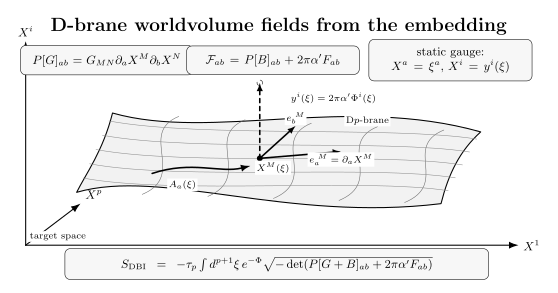
Section titled “Gauge fields become brane geometry”Consider fields independent of some spatial coordinates that will be T-dualized. Let label the surviving worldvolume directions and the dualized directions. For one Abelian brane, the corresponding gauge components become positions,
The abbreviation has dimensions of length squared. Thus and have dimensions of inverse length, whereas is dimensionless.
Because the fields are independent of the dualized coordinates, , and . The higher-dimensional electromagnetic matrix therefore has the block form
To compute its determinant, multiply on the left by a block-triangular matrix of determinant one:
Consequently,
The opposite signs in the off-diagonal blocks are essential. They turn the transverse gauge components into a positive induced-metric contribution. In static gauge, , , the metric induced from flat spacetime is precisely
This argument uses ordinary commuting Abelian fields. It does not define a determinant of arbitrary noncommuting Chan–Paton matrices.
The two simplest constant-field examples explain the square root geometrically. Dualize spatial direction 2. A magnetic field , represented by , gives a tilted brane and a spatial length factor . An electric field , represented by , gives velocity and the relativistic proper-time factor . This geometric route to DBI is developed in Polchinski, section 2.5.
Both panels dualize direction 2, with spectator directions suppressed and coordinates scaled by a common reference length . The spatial slope gives length factor ; the velocity gives proper-time factor . The lower panel is a spacetime diagram with a Lorentzian metric, so its proper-time factor is not its Euclidean drawn length. The dimensionless slopes are quantitative.
The pullback action and boundary gauge invariance
Section titled “The pullback action and boundary gauge invariance”For a general embedding, the background fields must first be pulled back to the worldvolume. In particular,
The leading Abelian action is
where . The prefactor is equivalently in the shared asymptotic normalization. The metric is the string-frame metric; using an Einstein-frame metric in this same expression would change the dilaton factors.
Why must and enter together? The bosonic open-string couplings, in differential-form notation, are
Under , Stokes’s theorem gives . It is canceled by . Since pullback commutes with the exterior derivative,
The usual transformation is also a symmetry. The two-form gauge transformation mixes a bulk field and a brane field because the fundamental-string worldsheet has a boundary.
The endpoint equation fixes the relative sign just as directly. Orient a Lorentzian strip by , with and fixed initial/final data. Its induced boundary orientation gives
Here the notation for means the brane one-form contracted with an allowed tangent endpoint variation. Combining this with the bulk kinetic action and gives
This formula is written in a locally flat, brane-adapted coordinate patch. Arbitrary tangent variations therefore require at both ends, using the same increasing- derivative. Dirichlet variations vanish in normal directions. Replacing by an outward normal derivative also changes the induced tangent orientation; the signs cannot be changed independently.
Setting leaves the induced-volume action. For it is the Nambu–Goto action with the D-string tension, including all first derivatives of the embedding. Curvature, gradients of background fields and higher embedding derivatives introduce additional corrections.
The disk origin and the Yang–Mills expansion
Section titled “The disk origin and the Yang–Mills expansion”A constant dilaton weights a worldsheet by . An oriented disk has Euler characteristic , so its contribution to the open-string effective action is proportional to . A sphere has and supplies the familiar scaling of the string-frame bulk action. Writing a disk amplitude with canonically normalized open-string vertices gives the equivalent relation . The term generates the bosonic part of the boundary gauge vertex; its superstring completion includes worldsheet fermions.
This explains the coupling dependence of the brane action. Its absolute coefficient is the tension specified in the overview; obtaining that coefficient from exchange amplitudes is the subject of open–closed duality and brane scattering.
In flat space with and , factor out of the determinant and define the mixed-index matrix
Using gives
Antisymmetry implies and . The scalar part of is already quadratic. Thus
With , matching the unit-charge Abelian Maxwell term gives
The field is therefore not itself canonically normalized. For a stack of identical parallel type II branes, comparing the same disk expansion with the shared matrix trace gives and the leading bosonic action
The covariant derivatives and field strengths have the minus- commutator signs used in the preceding page. For Hermitian scalars the commutators are anti-Hermitian, so their potential energy is nonnegative. The massless multiplet here is the GSO-projected superstring multiplet. A bosonic brane has an additional tachyon and does not provide the same stable low-energy vacuum.
Two approximations must be separated. The Yang–Mills truncation requires weak dimensionless field strengths and small scalar gradients. Abelian DBI retains these powers but still omits higher derivatives and string loops. A constant strong field has no field-strength derivatives; that fact does not justify replacing a many-brane action by an ordinary trace of the Abelian determinant. Near a critical electric field, even the derivative expansion must be assessed using the background-dependent fluctuation operator in Exercise 4.
Electric flux as fundamental-string charge
Section titled “Electric flux as fundamental-string charge”Take a straight D1-brane in flat space, with vanishing axion and . Write , a dimensionless electric field. The two-dimensional determinant is elementary:
The regular branch has . The electric displacement and Hamiltonian density are
Eliminating yields
The square root in the Lagrangian decreases with , while the energy increases. Confusing them would assign the wrong energy to the electric flux.
To establish quantization, wrap the D-string once around a spatial circle of circumference . In temporal gauge the source-free gauge field can be represented by its spatially constant holonomy coordinate
The periodicity follows from a large unit-charge gauge transformation. With , one has and
The circumference cancels. Wavefunctions are single valued precisely when , so . The local gauge equation is Gauss’s law, in the absence of charged endpoints. Charges would instead produce jumps in the flux. This compact-gauge-field mechanism is explained in Witten, section 2.
The resulting tension and electric field are
There is one D-string and oriented fundamental-string units. Indeed, restoring an infinitesimal replaces by , so
Thus the displacement measures the conserved string charge carried by the brane. The electric field is bounded on the regular branch, but its displacement is unbounded; approaches with divergent energy at fixed D1 tension. Exercise 3 includes the axion shift and the distinction between total energy and tension. The wider duality interpretation appears on the type IIB S-duality page.
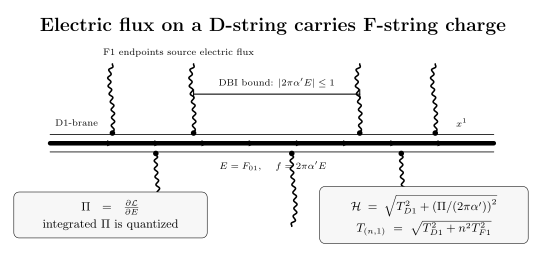
A source-free D1 wraps the circle once. Its periodic holonomy has integer momentum . At and , the plotted integer states obey and ; the circle’s drawn size is schematic. The circumference multiplies the tension to give total energy, but does not multiply the quantized displacement.
Brane sources and the choice of frame
Section titled “Brane sources and the choice of frame”The determinant supplies source couplings without guessing which background fields occur linearly. At a fixed embedding its variation is
The symmetric part of couples to a metric perturbation, and the antisymmetric part couples to a B-field perturbation. At , is symmetric, so the linear B term vanishes. The brane still has a two-form response at higher order, and a background electric flux gives the nonzero linear source just computed.
For an unfluxed flat brane, writing gives
This is a string-frame statement. Substituting the shared relation into the full determinant instead gives
The power follows from one factor for each matrix row, followed by the square root and the original . In particular, the unfluxed D3 induced-volume term has no direct linear dilaton coupling at fixed Einstein metric. Gauge-field terms behave differently because carries the factor . Exercise 5 makes this distinction explicit and converts to the canonical bulk dilaton.
RR charge is described by an additional Wess–Zumino coupling,
The bracket selects form degree . The potentials are the shared brane-coupling variables, including their explicit translation from bulk IIB potentials. DBI and Wess–Zumino terms play different roles and must be combined when calculating a charged brane’s response.
Tachyon potentials, rolling energy and brane defects
Section titled “Tachyon potentials, rolling energy and brane defects”The DBI action for the massless fields does not describe the decay of an unstable brane by itself. The bosonic open string has a tachyon; appropriate non-BPS type II branes and sufficiently close brane–antibrane pairs also have tachyonic modes. Their instability requires an additional field. The tachyon’s mass and interactions depend on the brane system; a well-separated brane–antibrane pair need not have a tachyonic stretched string.
A useful effective model for a real tachyon, with gauge fields set to zero, is
In this field parametrization has dimensions of length, and is an energy density. This is a model of tachyon dynamics, not a derivation of an exact potential or all higher-derivative terms. A non-BPS type II example can have a symmetric maximum at and as ; the shape and field coordinate are not universal. Sen’s effective-action discussion states the assumptions and the role of corrections explicitly.
A static tachyon vacuum with vanishing total energy density is distinct from a rolling solution with nonzero conserved energy. For a homogeneous field,
Time-translation invariance makes constant. Eliminating gives . If along a solution with fixed positive , then and , while the energy density remains nonzero. This is the effective-model mechanism behind the pressureless limit discussed in Sen, “Tachyon Matter,” section 5. Closed-string emission and backreaction require additional dynamics.
For a concrete illustration, choose and the positive rolling branch with . Then . It approaches the unstable maximum only in the infinite past; starting exactly at the maximum at rest at a finite time would leave the field there. The horizontal axis in the next figure is the field, not time.
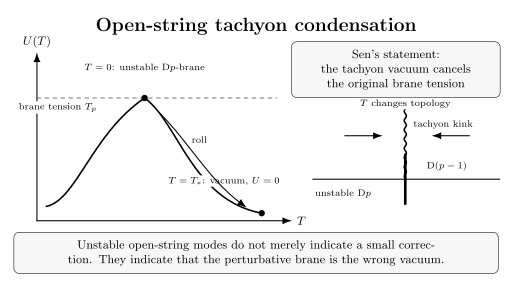
For this model, , , and . These are quantitative model curves along the rolling branch, not a universal string-field potential. The vacuum is asymptotic in this field coordinate; its vanishing static energy must not be identified with the energy of the rolling state.
Spatial tachyon profiles give another possibility. On an appropriate non-BPS type II D-brane, a real kink can describe a BPS D-brane; a complex tachyon on a brane–antibrane pair can produce a codimension-two vortex. These statements depend on the brane system and its charges. A bosonic descendant brane still has its own tachyon. The effective-model kink analysis in Sen is useful, but its thin limit does not by itself control every correction to the original brane action. Exercise 6 separates a model’s limiting kink energy from an exact string tension. The framework for treating the full tower of open-string fields is introduced on the string-field-theory page.
Exercises
Section titled “Exercises”Exercise 1: Crossed fields and the normal velocity of a brane
Section titled “Exercise 1: Crossed fields and the normal velocity of a brane”Take an Abelian D2 with , and all other components zero. Use and T-dualize direction 2. Calculate the original determinant and the dual D1 induced metric. Find the physical velocity normal to the tilted string, and explain why the regularity bound need not be when .
Solution
The original matrix and its determinant are
The dual graph is , where and . Its induced metric is
This is the one-column Schur complement of the original electromagnetic block. The actions have the same local volume factor; their overall tensions and compactification volumes are related as in page 17.
At fixed , a spatial unit normal to the graph in the plane is . The velocity of a point at fixed coordinate is , whose normal component is
A tangential component merely changes how points on a uniform string are labeled. Therefore
and the regular timelike worldvolume condition is . If but this inequality holds, the fixed- coordinate lines are not timelike trajectories of material markers. The normal motion is still subluminal. This example explains why the determinant condition is more general than a bound on a single electric component. Since the graph has constant derivatives, it also solves the source-free embedding equation .
Exercise 2: The electromagnetic determinant and its Hamiltonian
Section titled “Exercise 2: The electromagnetic determinant and its Hamiltonian”For a flat D3 set and . Derive the determinant in terms of and , its expansion through fourth order in these dimensionless fields, and the exact energy density at fixed magnetic field. Compare parallel and perpendicular electric and magnetic fields.
Solution
A spatial rotation can put along direction 3. A further rotation around that axis puts . The matrix is
Expanding this determinant and restoring rotational invariants gives
Set , of second order, and , of fourth order. Expanding yields
The electric displacement vector is
Thus the Legendre transform, expressed parametrically in and , is
The final equality follows by adding to . Positivity and reality require the regular branch . For parallel fields, , so . For perpendicular fields, , so the larger coordinate-field bound in Exercise 1 is recovered. Neither expansion in small fields nor a Lorentzian boost should be used across the singular surface .
Exercise 3: An axion-shifted compact rotor
Section titled “Exercise 3: An axion-shifted compact rotor”Place the wrapped D1 in a constant axion , with . Derive its quantum energy levels from DBI plus the shared Wess–Zumino coupling. Check invariance of the spectrum under , and compute the two-form source. At , compare the bound-state tension with that of separated constituents.
Solution
The degree-two Wess–Zumino term contains , since . With worldvolume orientation , the compact zero-mode Lagrangian is
The axion term is a total derivative for constant , but it affects quantum momentum. Differentiation gives
The wavefunctions remain periodic in , so has eigenvalues . The Hamiltonian depends on the mechanical momentum :
The change permutes the spectrum by . Equivalently, remove locally and write . The transformed wavefunction obeys , displaying the same mechanical momentum shift. This is the theta-angle effect discussed by Witten, with its sign here fixed by the shared Wess–Zumino action.
To compute the two-form source, restore before varying. The DBI part gives ; the Wess–Zumino term gives . Their sum is . The integer labels the total oriented fundamental-string charge in these brane-coupling variables, whereas DBI alone measures .
At zero axion, the separated tension is and exceeds when . For fixed and small ,
The added energy is much smaller than in this regime. For , instead, . These limits refer to tension; all energies of the wrapped object carry the extra factor .
Exercise 4: The fluctuation cone on an electric brane
Section titled “Exercise 4: The fluctuation cone on an electric brane”Consider a D2 with constant , no magnetic field and a small transverse displacement . Expand the full determinant to quadratic order in , without expanding in . Derive the dispersion relation and explain what becomes singular at the critical field.
Solution
Write and . The matrix determinant lemma gives the exact one-scalar identity
The antisymmetric inverse part drops out of the contraction. Defining , the quadratic action is
Direct inversion gives
For a Fourier mode , the equation becomes
Propagation along the electric field has speed one; transverse propagation has speed . At zero field the usual flat wave equation returns. At , the determinant vanishes, the inverse matrix diverges and the kinetic normalization degenerates. A calculation that keeps only small coordinate momenta is not automatically uniform in this limit: higher-derivative corrections must also be small in the background-dependent scales. This derivation concerns linear scalar fluctuations on a fixed, regular Abelian background, not the full interacting spectrum at the critical field.
Exercise 5: Stress, two-form charge and the Einstein-frame dilaton
Section titled “Exercise 5: Stress, two-form charge and the Einstein-frame dilaton”Use the determinant variation to find the energy density, longitudinal pressure and two-form source of the electric D1. Then derive the direct linear dilaton couplings of an unfluxed D-brane and of the D3 gauge kinetic term in the normalized Einstein frame. Express the latter in terms of the canonical dilaton.
Solution
Define the worldvolume stress tensor by at fixed other fields. The DBI determinant gives
For and the electric matrix from the main text,
Therefore and . The longitudinal tension equals the energy per unit length of the bound string. It is not the magnitude of the DBI Lagrangian at a fixed coordinate electric field. The two-form source is , which vanishes at .
For an unfluxed D-brane in Einstein frame, expansion of gives
For a D3 this induced-volume coupling is zero, including its direct scalar embedding kinetic term at fixed . However the quadratic gauge term follows from the extra inside the determinant:
Thus its linear interaction is . Using the shared canonical field, it is
The sign comes from expanding in an action whose Maxwell term already has a minus sign. A corresponding matrix expression uses . These are direct vertices at fixed Einstein metric; a complete scattering amplitude also includes the other fields and interactions allowed by the process.
Exercise 6: A rolling solution and a thin-kink limit
Section titled “Exercise 6: A rolling solution and a thin-kink limit”In the illustrative model , solve the positive homogeneous rolling branch with . Separately compute the energy per unit transverse volume of the static trial profile , , and compare it with an energy bound for monotone profiles. Decide whether the finite- profiles solve the static field equation and what their limit establishes.
Solution
Energy conservation gives on the positive branch. Set and integrate:
The potential and pressure along this solution are
It obeys the Euler–Lagrange equation . At it approaches the maximum at rest; at its speed approaches one and pressure tends to zero. It does not reach a zero-energy state.
For the static trial profile, change variables from to :
Since ,
More generally, implies
for a monotone profile connecting the two asymptotic vacua. The trial sequence approaches this bound as its width tends to zero.
It is not a sequence of exact finite-width static solutions. Stress conservation would require to be constant. The vacuum boundary conditions force that constant to zero, which is incompatible with finite wherever . The limiting solution is singular in this model, as in the analysis of Sen.
The number is a model prediction. Matching it to a particular BPS descendant tension fixes a relation among model parameters; it is not a derivation of an exact string tension from an arbitrary chosen potential. The thin limit also does not establish that the neglected higher-derivative terms of the original brane theory are small. The correct type II kink or vortex interpretation additionally requires the appropriate unstable brane and RR charge.
References
Section titled “References”- Joseph Polchinski, “TASI Lectures on D-Branes,” in Fields, Strings and Duality, edited by Costas Efthimiou and Brian Greene, World Scientific, Singapore (1997), pp. 293–356; arXiv:hep-th/9611050, revised 23 April 1997. Section 2.5 develops the geometric action and the combined bulk/boundary gauge invariance.
- Ashoke Sen, “Dirac-Born-Infeld Action on the Tachyon Kink and Vortex,” Physical Review D 68 (2003) 066008, doi:10.1103/PhysRevD.68.066008, arXiv:hep-th/0303057. Sections 1–2 specify the effective model and analyze its singular finite-tension kink.
- Ashoke Sen, “Tachyon Matter,” Journal of High Energy Physics 07 (2002) 065, doi:10.1088/1126-6708/2002/07/065, arXiv:hep-th/0203265. Section 5 derives the homogeneous effective-model stress tensor and its pressureless limit.
- Edward Witten, “Bound States of Strings and -Branes,” Nuclear Physics B 460 (1996) 335–350, doi:10.1016/0550-3213(95)00610-9, arXiv:hep-th/9510135. Section 2 explains the compact gauge zero mode, quantized string charge and RR-scalar momentum shift.