
Circle Compactification and T-Duality
A closed string on a circle carries two integers: momentum and winding. Exchanging them identifies a radius with . This equivalence relates complete worldsheet theories, and it also transforms the string coupling. At a special radius, additional string states become massless and enlarge the gauge algebra.
We develop these statements for a free spatial circle in the closed bosonic string, with 25 noncompact spacetime dimensions. The bosonic vacuum has a tachyon; its exactly solvable worldsheet CFT remains useful for studying compactification. The supersymmetric type II comparison at the end has a different physical spectrum. We use the shared worldsheet and string-scale definitions, the physical-state construction, and the torus geometry and traces from the preceding pages.
Momentum, winding, and the mass shell
Section titled “Momentum, winding, and the mass shell”Let be the compact coordinate, . A wavefunction is single-valued only if , with . A string configuration is a map from its spatial circle to this target circle. Its lift to the real line obeys
The integer is the degree of the map, including its orientation. It is not another oscillator occupation number: no continuous deformation of a nonsingular circle map changes it.
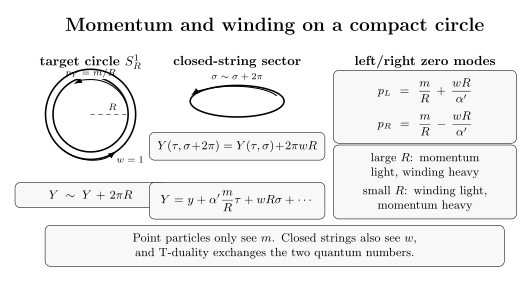
The example has winding and positive orientation. One traversal of the worldsheet spatial circle returns to the same target point, while the lifted coordinate changes by . Momentum is a separate quantum number. The circle drawing illustrates topology; the lift represents the stated linear winding configuration.
The zero modes in the left and right decomposition are
The oscillator part is periodic in . Integrating the canonical momentum density around the string and then imposing the winding condition gives
Therefore
This calculation fixes both the relative sign and the factor of two. A string wound times has classical rest energy , explaining the winding scale directly.
Let be the noncompact momentum and . With and the total left and right oscillator levels, the matter zero modes are
The closed bosonic conditions imply
and
Level matching is essential. For example, a state carrying both momentum and winding generally needs unequal oscillator levels. Using the mass formula without this constraint invents states that do not belong to the closed-string Hilbert space.
The integral momentum lattice and local operators
Section titled “The integral momentum lattice and local operators”Define the dimensionless radius and momenta
The vector has the expansion
Using the Lorentzian bilinear , these primitive vectors have Gram matrix
Every norm is even, and . The lattice is therefore integral, even, and unimodular: its dual under this bilinear is itself. This is the lattice . Its abstract integer pairing does not depend on ; changing changes its embedding into the left and right momentum axes. These are the ingredients behind the torus result below. Ginsparg derives this relation between compact-boson traces and Lorentzian lattices in section 8.1 of Applied Conformal Field Theory.
A local momentum–winding vertex contains
The factor is a cocycle acting on zero-mode states. For two charge labels and , the exponential OPE contains . A full turn of gives the phase
An exchange is a half turn and can still give a sign. The cocycle compensates that sign so that the complete bosonic operators have the correct exchange law. It also has to preserve associativity. Exercise 2 constructs an explicit choice and checks its transformation under duality. This operator information is stronger than equality of a partition function.
T-duality of the worldsheet and the coupling
Section titled “T-duality of the worldsheet and the coupling”The transformation
sends to and to . It preserves the mass and level-matching conditions. At the level of the free fields it is represented by
Right-moving oscillators change sign. Their commutators, stress tensor, and OPEs are unchanged, and the integer charge lattice maps to the lattice of the dual circle. Together with a compatible cocycle map, this gives an isomorphism of the free compact-boson operator algebra. The charge transformation does not by itself choose a unique phase convention for its action on vertex operators.
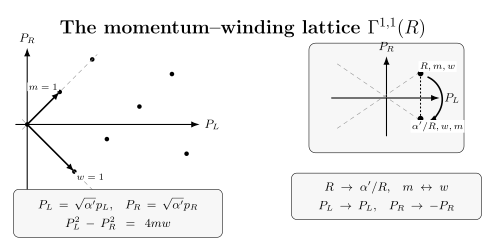
The two plots use and radii and . T-duality reflects and exchanges . The axes have equal scales; each plotted point is an actual integer lattice vector. The Lorentzian pairing is preserved while Euclidean lengths at fixed integer labels vary with radius. Corresponding duality-related vectors have equal Euclidean lengths because the map is a reflection.
Large makes momentum levels closely spaced and winding expensive. At small , winding levels become closely spaced and describe the momentum states of the dual large circle. This statement concerns the circle CFT; a perturbative expansion in the string coupling requires an additional transformation.
For a constant-radius product in string frame, reducing the gravitational term gives a prefactor proportional to . The lower-dimensional coupling must agree in the two descriptions. Thus
Here is the string-frame radius, and is the full dilaton used in the shared frame definitions. The torus has Euler characteristic zero, so its partition function alone cannot determine this coupling shift. Dimensional reduction provides a useful check; Exercise 6 derives the invariant lower-dimensional dilaton and radion kinetic term. The worldsheet path-integral argument and its coupling interpretation are discussed by Tong in section 8.3 of Lectures on String Theory.
Classical torus maps and Poisson resummation
Section titled “Classical torus maps and Poisson resummation”Let the Euclidean torus have coordinates and complex coordinate . The modulus is distinct from the Lorentzian time used earlier. In the unit-area metric derived on page 14, a classical circle map is
It increases by around the first cycle and around the second. Its gradient is constant, so the free field equation holds. The inverse unit-area metric is . Thus
The coordinate square has area one. Multiplying by in the Euclidean kinetic action gives
The nonzero-mode determinant is the same as for a noncompact coordinate. The constant mode now integrates over a length , giving
This is a CFT trace for one coordinate, before the remaining coordinates and the string moduli measure are included. There is one compact zero-mode factor; multiplying by another noncompact momentum Gaussian would count it twice.
To convert the map sum into a Hamiltonian trace, set and . The Gaussian Poisson identity is
It follows by Fourier transforming the Gaussian; the sign of the Fourier phase can be reversed by . Here we choose the form that identifies in the existing level-matching formula. The factor cancels the prefactor . Hence
where and . The two integers in this expression have different Hamiltonian meanings: labels momentum and labels spatial winding. The integers in the first expression instead label the two torus cycles.
Modular covariance and the noncompact limit
Section titled “Modular covariance and the noncompact limit”Under , take , so is unchanged. Under , take ; then
The prefactor is invariant under because and . Under , the eta multiplier has unit absolute value. This proves modular invariance of a nonzero partition function, without invoking a supersymmetric cancellation.
The Hamiltonian expression makes radius duality equally direct: interchange and replace by . In contrast, at with fixed the map sum is dominated by , so
The result is the noncompact coordinate trace with its target volume replaced by the circumference. This limit is uniform on compact subsets of moduli space, not all the way to the cusp. Exercise 1 examines the noncommuting limits.
The map representation also provides the starting point for separating zero wrapping from nonzero wrapping and expressing the latter through particle proper time. For a thermal circle, the spin-structure phases and the subtraction of the zero-temperature vacuum must be included; that application is developed on the thermal strings page.
Massless polarizations at a generic radius
Section titled “Massless polarizations at a generic radius”Take , , and a nonzero null noncompact momentum. The physical transverse space of the original 26-dimensional string is 24-dimensional. It splits into 23 noncompact transverse directions, with indices , and the compact direction .
The polarization matrix consequently splits into , , , and . Applying the transverse trace decomposition, rather than a trace with the full Lorentzian metric, gives
| Physical block | Lower-dimensional fields | Polarizations |
|---|---|---|
| Symmetric traceless part of | Graviton | |
| Antisymmetric part of | Two-form | |
| Trace of | Scalar | |
| and | Two vectors | |
| Scalar |
The sum is , as required. Covariant representatives still obey transversality and are identified under null-state gauge transformations; their unconstrained index count is not the physical count.
The two vectors come from the metric and the antisymmetric tensor with one compact index. Equivalently, one can choose the left and right current couplings. The two scalar polarizations combine into the lower-dimensional dilaton and the radius fluctuation, or radion. They are not both the original 26-dimensional dilaton. For example, if is the normalized trace of the 23 by 23 block and is the normalized compact component, the original transverse trace is
Field variables in a spacetime action mix these two scalar states according to the chosen frame. The string-frame reduction in Exercise 6 makes the relevant dilaton–radius combination explicit.
Enhanced currents, vectors, and scalars
Section titled “Enhanced currents, vectors, and scalars”At the self-dual radius , the massless conditions reduce to
There are four additional vector states:
| Charges | Current | |
|---|---|---|
For the left sector, introduce the currents
Cocycle factors are implicit in these exponentials. Their phases are chosen so that and the opposite-charge double pole is positive; Exercise 2 translates this choice to an explicit lattice basis. Their normalization follows from the shared free-boson OPE. Differentiating it twice gives , hence
For the product of opposite exponentials, expand the normal-ordered remaining exponential to first order in :
These are the affine OPEs at level one. The right sector has the same algebra. The compactification thus enhances the gauge Lie algebra from to . A global group statement additionally uses the allowed representations; Exercise 2 identifies the central element that acts trivially on the perturbative circle spectrum.
A new vector vertex contains or , with its usual physical constraints and ghost completion. The same current algebra fixes its charge. More generally,
At these charges are and .
There are also nine compact scalar polarizations, created at the enhanced point by , . One is the radion. Four accompany the charged vectors and become their longitudinal polarizations when the radius moves away from one. Four others have and no oscillators. Their masses are particularly informative:
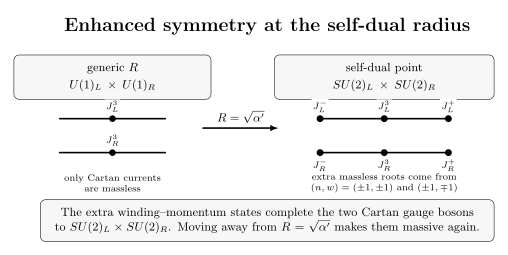
These are exact free bosonic-string masses for the indicated fixed charge and oscillator sectors. The upper curve represents four vectors; each lower curve represents two scalars. Four further scalar polarizations at join the massive vectors away from that radius, and the radion remains massless. The negative region marks tachyonic modes. The ever-present bosonic ground-state tachyon and other sectors are outside this selected plot.
The enhanced point is therefore not a stable minimum of a tachyon-free spacetime theory. Nor do nine operators of weights automatically give nine independent flat moduli. A single rotated Cartan product changes the radius, but a general linear combination can have an obstruction in conformal perturbation theory. Exercise 4 derives a concrete example. Ginsparg’s current-algebra discussion on pp. 130–132 explains why individual rotated radius deformations describe the same local family.
The fermionic radius and the global projection
Section titled “The fermionic radius and the global projection”Local bosonization identifies a complex chiral fermion with when . Globally, this does not specify which left and right charge sectors are allowed. A fermionic theory with a chosen spin structure and a bosonic theory summed over sectors are different objects until their state spaces and projection are specified.
At the fermionic radius
the circle charges have exactly the form needed for a nonchiral fermion projection. This radius is times the enhanced radius; its T-dual describes the same circle CFT.
For even , are integers with even difference. These are the NS charge sectors kept by the diagonal fermion-parity projection. For odd , the charges are half-integers with even difference; these supply the projected Ramond sectors. The opposite Ramond parity choice gives the T-dual presentation. A separate chiral projection on each side would select a different lattice.
Using the fermion traces of page 14, the resulting unrefined trace is
The NS sum implements the even difference of integer charges. The Ramond projection retains half of the half-integer charge pairs; its graded trace vanishes at zero chemical potential, leaving half the ungraded term. Exercise 5 restores charge fugacities and derives both statements without using that vanishing trace as a substitute for the projection. This is the global bosonization identity in Ginsparg section 8.2, equations (8.12)–(8.13).
The elementary chiral fermion by itself is not a local vertex of the projected bosonic circle: charge would require half-integer winding. It belongs to the larger spin theory. This distinction explains how a local bosonization formula can coexist with a nontrivial global GSO projection.
For a supersymmetric type II string on a spatial circle, the coordinate lattice is still present, but the GSO projection removes the states responsible for the bosonic gauge enhancement. Right-moving worldsheet fermions must reflect with the right-moving coordinate to preserve the supercurrent; this reverses the right Ramond chirality and exchanges IIA and IIB, as on page 12. The projected fermion example above is not a claim that every string GSO projection produces that circle theory.
Exercises
Section titled “Exercises”Exercise 1: Decompactification is not uniform at the cusp
Section titled “Exercise 1: Decompactification is not uniform at the cusp”Starting from the map sum, derive the leading large-radius correction at with fixed. Then take , with fixed, and find the limit of , where . Explain which low-energy states invalidate a uniform decompactification approximation over all moduli space.
Solution
At a rectangular torus the ratio factorizes:
For fixed , both sums tend to one exponentially. Their first terms give
If , the first sum instead remains finite and nontrivial, while every nonzero is suppressed by . Thus
The last equality is one-dimensional Poisson resummation. The ratio is generally not one. The Hamiltonian interpretation is that the long cylinder resolves the discrete momentum gaps precisely when its proper time is of order . Replacing this discrete spectrum by a continuum is then inaccurate, however large is. On any compact set of moduli, the quadratic form has a uniform positive lower bound for nonzero integer pairs, which restores uniform exponential convergence there. No corresponding bound exists at the cusp.
Exercise 2: Integral isometries, cocycles, and the center
Section titled “Exercise 2: Integral isometries, cocycles, and the center”Find all integer matrices preserving . Construct an associative lattice cocycle, and give a compatible lift of radius duality to the vertex algebra. At , determine how the two centers act on the allowed charge sectors.
Solution
Write . The condition gives
Either , , or , . Hence the group has four elements:
Flipping only or only sends to and is an anti-isometry. A transformation can act on the radius-dependent embedding as well as the integer labels; exchange becomes a symmetry of a fixed radius only at .
For and , choose the cocycle multiplication coefficient
Bilinearity implies , so the product is associative. Its exchange ratio is
which cancels the half-turn phase of the exponential OPE. The conformal spin of each full vertex is .
Let . One compatible duality lift is
Indeed,
The equality checks the zero-mode product, while reflection of every right oscillator preserves its Wick contractions. This choice obeys . Other lifts can differ by lattice characters and inner symmetries; the integer interchange alone does not fix those phases. In particular, one should not identify every possible lift with the same action on enhanced current generators.
In this cocycle basis, opposite root charges have . Thus normalized currents can be chosen as
The minus signs compensate the cocycle in the opposite-charge OPE and agree with the adjoint relation. They are phases of basis operators, not changes in the physical charge labels.
At , the Cartan eigenvalues are and . A center element acts by or . Their product is on every allowed state, while either center separately is nontrivial on sectors with odd. Thus the faithfully acting compact group inferred from these perturbative representations is , with the diagonal center divided out. The affine Lie algebra statement does not require this additional global analysis.
Exercise 3: All enhanced states and the Higgs mechanism
Section titled “Exercise 3: All enhanced states and the Higgs mechanism”Enumerate the solutions of the two massless equations at . Count their physical polarizations in 25 dimensions. Show explicitly how the scalar accompanying each charged vector becomes longitudinal away from the enhanced point, and determine which of the remaining charged scalars become tachyonic on each side.
Solution
The integers and have the same parity. Each square in the massless equations is at most four and divisible by four, so each is or .
- If both vanish, and . This is the generic 576-polarization sector.
- If only , then and .
- If only , then and .
- If both equal four, then and both oscillator levels vanish.
Each of the four single-oscillator sectors has 24 physical polarizations. At the enhanced point these split into a 25-dimensional massless vector with 23 polarizations and one compact scalar. The four zero-oscillator sectors each contribute one scalar. Therefore the total count is
Equivalently, the gravity/two-form/dilaton sector contributes , the six gauge vectors contribute , and the compact scalars contribute nine. The total is again 676.
Consider the left-root sector , with one right oscillator. Its right momentum is . The full right null momentum is , so the polarization conditions are
At , is a separate scalar and the noncompact vector has its massless gauge equivalence. At , use to set . The remaining vector obeys and has 24 polarizations, exactly a massive vector in 25 dimensions. Its mass is . The other three root sectors work identically with the appropriate chirality.
The remaining four scalar masses are for pure momentum and for pure winding. Pure momentum scalars become tachyonic at ; pure winding scalars become tachyonic at . T-duality exchanges them. With near one,
The opposite linear slopes rule out a stable minimum for this scalar subset. The original bosonic ground-state tachyon is present independently of these additional instabilities.
Exercise 4: Marginal currents need not give independent moduli
Section titled “Exercise 4: Marginal currents need not give independent moduli”Set . Derive the short-distance term proportional to in the OPE of with itself. Compare it with the deformation . Explain why nine weight- operators do not imply nine independent flat directions.
Solution
The current OPEs in the text give
For the product of with itself, multiply the left and right simple poles and sum the indices. Since ,
There is also an identity term and terms of other spin or descendant order. They do not cancel the displayed scalar logarithm. Expanding a perturbed action to second order in its coupling requires integrating the OPE over a short-distance annulus. The term above produces a nonzero multiple of
and hence a quadratic running of the coupling. Its convention-dependent overall beta-function coefficient is unnecessary for identifying the obstruction.
For , the abelian current OPE has no simple pole, so this mechanism is absent. More strongly, the deformation changes the coefficient of the free compact-boson kinetic action. Rescaling the field to restore the fixed kinetic normalization changes its periodicity and thus its radius. The resulting Gaussian CFT is exactly conformal for every positive radius.
A single product with fixed real vectors is related to the Cartan product by left and right rotations, up to its overall strength. Individual basis products are therefore radius directions in different symmetry frames. A general coupling matrix need not have this rank-one form: the isotropic matrix in is an explicit obstructed example. Counting operators of weights is a linearized test; the OPE controls whether finite deformations remain conformal.
Exercise 5: Resolve the fermion projection with two fugacities
Section titled “Exercise 5: Resolve the fermion projection with two fugacities”Introduce independent formal charge fugacities . Derive the charge-resolved circle sum at . Split it into integral and half-integral charge sectors, implement their even-difference projections, and recover the unrefined theta identity. Explain what changes for the opposite Ramond projection.
Solution
The oscillator determinant is independent of the zero-mode charges. Its charge-resolved lattice factor is
For even , write , . The inverse relations are , , so must be even. Its indicator is .
For odd , write , . Then and . The same condition even is required. This fixes the Ramond parity choice by the actual lattice rather than by the vanishing odd trace.
Define chiral charge sums, with or ,
The complete charge-resolved trace is
The product of the two factors is the desired even-difference projector because and have the same parity. These are convergent generating functions on an appropriate fugacity domain, or formal charge series; the two fugacities need not be complex conjugates.
At , , , and . Pairing with makes . The trace therefore reduces to the formula in the main text. At nonzero fugacity, is generally nonzero and is precisely the information needed to distinguish the two Ramond projections.
With the opposite Ramond projector, the half-integral sectors instead have odd. Reflecting changes to and exchanges these choices. The resulting lattice is the dual circle, with . At unit fugacities the two traces agree, as required by T-duality, but their charge-resolved descriptions differ by .
Finally, a single chiral fermion with charges is absent: it would require , . This is why a local chiral bosonization formula alone does not identify the projected bosonic state space.
Exercise 6: The radion action and the type II comparison
Section titled “Exercise 6: The radion action and the type II comparison”Reduce the metric–dilaton part of the bosonic string-frame action on a circle with varying radius , keeping no off-diagonal metric or two-form components. Derive the lower-dimensional dilaton and test T-duality of the two-derivative action. Then explain directly from the GSO-projected type II mass formula why the bosonic enhanced vector states have no counterpart on a supersymmetric spatial circle.
Solution
Let have period and use
The starting terms are proportional to . This is a two-derivative spacetime action; higher-curvature corrections are outside this reduction. The new Christoffel symbols are
Their contribution to the Ricci scalar gives
The volume factor is . Define , so that the exponential from the volume and dilaton becomes . Substituting into the dilaton kinetic term gives
Integrating the term by parts with weight produces , cancelling the cross term. Up to a boundary term and a fixed overall constant, the reduced action is
It is invariant under , , which implies . Thus for constant backgrounds. Applying the transformation twice returns both radius and coupling. Holding the original coupling fixed while shrinking the radius can make the dual description strongly coupled; exact worldsheet duality does not guarantee that both spacetime perturbation expansions are weakly coupled.
For a supersymmetric type II circle, write the mass shell using the oscillator intercepts , rather than the covariant Ramond plane weight:
The GSO-projected NS sector has , and the Ramond sector has . Every term on the right is nonnegative. At finite nonzero , a massless state therefore has and both shifted levels zero. The negative oscillator contribution that permits bosonic enhancement is absent. This argument does not apply to a thermal or other supersymmetry-breaking circle with different projections, nor to heterotic strings with different left and right sectors.
To preserve the right-moving supercurrent , reflecting requires . The reflection changes the chirality of the right Ramond representation and therefore exchanges type IIA and type IIB. The duality survives; the bosonic enhancement spectrum does not.
References
Section titled “References”- Ginsparg, P. “Applied Conformal Field Theory.” In Fields, Strings and Critical Phenomena, Les Houches Session XLIX (1988), edited by E. Brézin and J. Zinn-Justin, North-Holland, Amsterdam (1989), pp. 1–168. arXiv:hep-th/9108028. Sections 8.1–8.2 derive the circle lattice and global fermionization identity; the discussion on pp. 130–132 derives the enhanced current algebra and radius deformations. His radius is related to the physical radius here by .
- Tong, D. Lectures on String Theory. University of Cambridge Part III lecture notes (2009; revised 2012). arXiv:0908.0333. Sections 8.1–8.3 connect dimensional reduction, charged string states, enhancement, worldsheet T-duality, and the dilaton shift. Left/right and momentum/winding labels should be translated through the explicit zero-mode equations.