
D-Brane Charges, BPS Bounds, and Dirac Quantization
A D-brane is an electric source for a Ramond–Ramond field and, in the supersymmetric type II theory, an object whose tension saturates a charge bound. Three calculations make this statement quantitative: the supersymmetry algebra relates energy to charge, the annulus fixes their absolute normalization, and an electric–magnetic consistency condition tests the resulting charge product. None of these arguments substitutes for the other two.
We use the shared tensions, couplings and RR potential basis, together with the spinor and Hodge conventions. The main flux calculation concerns flat space, constant asymptotic dilaton, vanishing , and isolated sources. Nonlinear Chern–Simons terms, background flux and compact-space charge constraints require additional care. The normalized annulus calculation and the supersymmetry graph of a brane are prerequisites.
Electric sources and oriented linking spheres
Section titled “Electric sources and oriented linking spheres”Consider a flat D-brane with worldvolume coordinates . Its positive orientation is ; reversing the RR source orientation produces an antibrane. Write its signed charge as , with and . At zero worldvolume flux the relevant WZ term is
The distributional form is defined by its action on a test potential:
For a brane at the transverse origin, this means . It fixes the current orientation instead of leaving a sign implicit.
For an ordinary independent RR form, abbreviate and within this calculation. Its quadratic action and source are
The integration-by-parts sign depends on the degree of . For a compactly supported variation,
Consequently the field equation is
This sign is compatible with a positive physical electric charge. Let be the outward-oriented sphere in the transverse space, with its orientation induced from . Integrating the equation gives the charge measurement
A different convention for the order of the current form or the orientation of the linking sphere moves this sign. It does not change an electric–magnetic quantization condition when all orientations are translated together.
Checking the sign with an actual field
Section titled “Checking the sign with an actual field”For , set and let solve , with at infinity. A static potential can be written as
If is the unit-sphere volume form, the shared Lorentzian Hodge star gives
Since , where , this field reproduces the flux above. A second static positive source has interaction energy : equal RR charges repel. The sign of a component of is not, by itself, the sign of the source charge.
The ordinary-action argument excludes the self-dual IIB five-form. Its degrees of freedom and source normalization must be handled with the self-duality constraint. The string calculation on page 19 supplies the D3 exchange coefficient; a separate T-duality argument below supplies its Dirac quantization check.
Magnetic duals and the signs of their fluxes
Section titled “Magnetic duals and the signs of their fluxes”The dual of a -form has degree . Its potential has degree , so its electric source has spatial dimension . This gives the familiar pairs D0/D6, D1/D5, D2/D4 and D3/D3. The following ordinary Lorentzian linking-sphere discussion takes .
Degree counting determines the dual brane dimension, but not the sign of the dual field. The shared democratic relation implies
For example, , whereas . These dual forms describe the same modes, not additional particles.
To identify a magnetic source, orient a D worldvolume by and use its associated current . Apply the electric equation to and then use on . The result is
For , the sign follows from the same duality and current orientations, but the coefficient uses the self-dual/string normalization already explained. It is not obtained by varying a second unconstrained five-form action.
Thus the signed outward magnetic flux is
In particular, a positive D6 along directions has for the outward two-sphere in directions . This minus sign follows from and . It will appear explicitly in the monopole example.
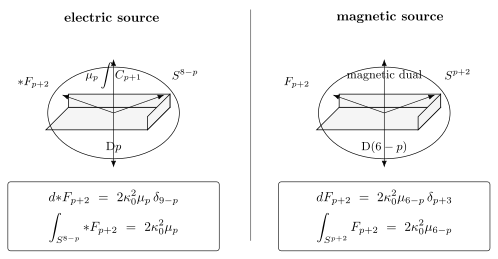
A fixed-time normal-space slice of a positive D6, with its six spatial tangent directions suppressed. The sphere lies in and has the outward orientation induced by . Here denotes : the duality and Hodge signs give , despite the positive D6 source charge. The D0’s history is a worldline; the two-sphere is a linking surface, not that history. Geometry is schematic and no length scale is implied.
The D7/D-instanton case involves Euclidean and axion-monodromy qualifications. D8 charge changes the Romans parameter, while a D9 couples to a nondynamical ten-form. Those cases are discussed on page 20; they are not obtained by drawing an ordinary negative-dimensional magnetic brane.
A positive supersymmetry algebra gives the BPS bound
Section titled “A positive supersymmetry algebra gives the BPS bound”An infinite flat brane has infinite total energy. Temporarily wrap its spatial directions on a large flat torus of volume , or work with densities after dividing by . Denote the total rest energy by and its signed RR central charge by
This normalization is an input from the type II supersymmetry algebra, with charges calibrated to the WZ sources. It is not a consequence of the RR kinetic action alone. The explicit algebra and its charge normalization are discussed by Polchinski, section 4.3, equations (104)–(110).
The brane extension is a spatial p-form charge in that algebra. A appears when expressing the algebra as a rest-frame Hermitian norm matrix; it does not turn the spatial charge into a different -form charge. The latter degree belongs to the WZ potential and to the brane’s spacetime history.
To see the bound, choose an orthonormal real basis for the allowed Majorana–Weyl parameters, and use the corresponding Hermitian generating charges . These are component generators paired directly with real coefficients; they are not the covariant charge columns in . In this basis the one-charge rest algebra is
Here is the positive-brane map already derived on page 20, restricted to the appropriate Weyl spaces. In an orthonormal real basis it is orthogonal, so . It follows that is real symmetric and . Its two eigenspaces each have dimension sixteen.
For every real coefficient vector , the operator is Hermitian, and
The eigenvalues are and . Positivity therefore requires . At saturation, the sixteen generators in the zero eigenspace annihilate the state. For a positive brane this is the graph ; for an antibrane it is the opposite graph. The bound on the energy density is
The two signs in the positive matrix are essential. A schematic expression containing only would not establish the absolute value or the antibrane bound.
A concrete FI string illustrates saturation
Section titled “A concrete FI string illustrates saturation”A useful field-theory example is a classical Abelian-Higgs model at its supersymmetric coupling. Let be a unit-charge complex scalar, , , and the FI parameter. For a static string along , the energy per length is
The model is the flat-space limit of the bosonic FI model in Dvali, Kallosh and Van Proeyen, equations (2.1)–(2.12): their variables translate as and . We use this classical illustration; no identification of its vortex tension with an arbitrary D-brane tension is assumed.
For positive winding, an integration by parts completes the energy into two squares:
The surface term in the derivative identity vanishes for regular finite-energy fields. At large radius and , so the magnetic flux is . Choosing the opposite square completion for negative winding gives
The first-order equations at saturation set the displayed squares to zero. In the supersymmetric embedding they also make half the fermion variations vanish. Exercise 1 derives the boundary term explicitly. The energy bound alone would not establish supersymmetry for an arbitrary model with the same bosonic potential; the supersymmetric embedding matters.
Absolute normalization and the no-force condition
Section titled “Absolute normalization and the no-force condition”The BPS algebra relates tension and charge. To determine their elementary magnitude, use the already normalized massless annulus coefficient from page 19:
Combining it with the shared gives
For an ordinary independent RR form, the canonical field is . Its source coefficient is therefore . The central-charge density is . This checks the relative dimensions and normalizations once the supersymmetry algebra has supplied the relation. It does not constitute a derivation of that algebra. For the self-dual D3 use the constrained field theory or the string amplitude, rather than doubling independent five-form modes.
Consider two parallel objects of the same dimension with physical tensions and signed WZ charges . In the flat, unfluxed long-distance regime their interaction energy per spatial p-volume is
Here suppresses massive exchange and, for one brane with , keeps the linear gravitational approximation weak. The Green function is
The first term comes from the graviton and dilaton. At zero background and worldvolume flux there is no linear -field source. For a D3 the canonical dilaton source itself vanishes; the graviton still supplies the full NSNS attraction. The second term is RR repulsion for equal charges and attraction for opposite charges.
For identical BPS branes, and , so the terms cancel. Reversing one source gives
The cancellation also appears pointwise in the full supersymmetric annulus integrand. The massless field calculation proves its long-distance limit; the complete open-string spin-structure calculation establishes the stronger annulus statement. Neither source individually vanishes.
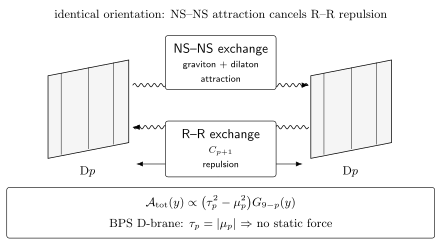
These are long-distance D3 interaction energies, with and positive normalization . Take and weak backreaction. In units of , the NSNS and equal-charge RR curves are and ; their sum is zero. Reversing one brane’s charge gives total . The curves are potentials, not forces or a short-distance tachyon potential.
The D0/D6 monopole and an invisible patch choice
Section titled “The D0/D6 monopole and an invisible patch choice”The simplest Dirac argument uses an ordinary one-form. Place a positive D6 along , and use spherical coordinates in its oriented transverse space . Its outward flux is the signed quantity . Away from the source,
A single smooth potential cannot cover the whole sphere. Choose two regular potentials:
The first is regular at the north pole, the second at the south pole. On their overlap,
A D0 wavefunction has patch transition . Since and denote the same point, this transition must be single-valued:
For the fixed orientations used here, one elementary positive D0 and positive D6 give . Reversing a linking or source orientation reverses that integer. The meaningful minimality statement is .
This condition does not say that every physical Wilson loop has phase one. At latitude , for example, the north-patch phase is
It is generally nontrivial. What must be invisible is the choice of gauge patch or spanning surface used to calculate that phase. The two choices differ by the flux through the complete sphere.
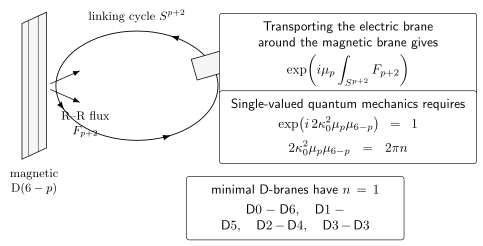
The outward-oriented sphere links a positive D6, so its signed flux is in the stated WZ basis. Two spanning surfaces for the same oriented boundary differ by the complete sphere. Patch independence requires , with for elementary positive D0/D6 sources. It does not remove the physical holonomy of a general loop. The sphere and caps are geometric schematics, with no physical radius specified.
Higher-form Dirac quantization
Section titled “Higher-form Dirac quantization”For an electric D-brane, a closed history contributes the phase . If the history bounds an extension in a region where the potential is defined in patches, Stokes’ theorem expresses that phase through .
Two extensions with the same oriented boundary differ by a closed -cycle. If that cycle links one magnetic D-brane, their ratio is . Independence of the extension gives
This is the higher-form version of the monopole patch calculation. The electric history has dimension ; the extension and the linking cycle have dimension . They must not be confused with one another.
For elementary charges, the magnitude of this condition is
Indeed, the powers of the string length cancel because , and the remaining powers of give one factor of . The charge inferred from the normalized annulus is therefore the minimal mutually allowed charge. Quantization alone fixes the product: it would also allow an inverse rescaling of the electric and magnetic charge units until the kinetic/source normalization is supplied.
Polchinski, section 4.1, equations (95)–(96), gives this check and explains the self-dual D3 exception. A useful configuration has D3-branes along and , both localized in . T-dualize direction : they become a D2 along and a D4 along . The dependence of the relative wavefunction on the common transverse coordinates is unchanged. Thus the D2/D4 phase condition establishes the D3/D3 result without incorrectly treating a self-dual five-form as an unconstrained ordinary form.
Local cancellation and global charge constraints
Section titled “Local cancellation and global charge constraints”A stack of parallel elementary branes has WZ charge and BPS tension . Its overall U(1) scalar multiplet describes center-of-mass motion; relative scalar expectation values and off-diagonal strings belong to the adjoint dynamics developed on page 17.
If branes and antibranes are placed in an uncondensed configuration, the source charge is and the sum of their individual tensions is . Interactions and tachyon condensation can change the energy, but not the conserved net charge in the stated setting. Zero net charge permits annihilation; it does not specify the resulting energy distribution or rule out flux or defects. The tachyon discussion on page 18 explains those limits.
On a compact transverse space without boundary, integrating the source equation requires the total signed charge to vanish, unless additional terms or compensating sources contribute. A local cancellation of attractive and repulsive forces does not remove this global equation. The D9 ten-form imposes a related charge constraint through its nondynamical field equation, rather than through an ordinary propagating transverse flux.
Exercises
Section titled “Exercises”Exercise 1: the FI vortex, including its boundary term
Section titled “Exercise 1: the FI vortex, including its boundary term”Derive the square completion in the text. For the circular ansatz and , derive the radial first-order equations for . Specify regularity and finite-energy boundary data and check the energy and flux normalization. Work in the classical flat-space model; no gravitational backreaction is included.
Solution
Define the real gauge-invariant current . Direct differentiation, using , gives
Expanding the other square gives
Thus the exact integrated identity is the two-square expression plus and . The latter is a boundary circulation. It vanishes at infinity for finite-energy vortex fields and at the origin for a regular field. Keeping it until those conditions are imposed prevents a false local identity.
In polar coordinates , and the angular covariant derivative is . Therefore the positive-winding equations are
Regularity gives with and . Finite energy requires . Integrating gives . At saturation both squares vanish and .
For , complete with and the opposite magnetic sign. The energy becomes , not a negative tension. The same first-order equations and positive energy branch follow from the flat limit of Dvali, Kallosh and Van Proeyen’s equations (2.11)–(2.12) and (4.4)–(4.6).
Exercise 2: two charge matrices and different BPS bounds
Section titled “Exercise 2: two charge matrices and different BPS bounds”Let two independent Hermitian charge matrices and satisfy , and consider . Derive the bound and saturation kernel when and anticommute. Then treat commuting matrices whose four joint eigenspaces are all present with equal dimension. Explain why the two cases describe different threshold behavior.
Solution
If , then
For nonzero charges its two eigenvalues are with equal multiplicities. Positivity gives . At equality half the eigenvalues of vanish. On a thirty-two-component charge space this preserves sixteen generators. A concrete realization is , .
If , use simultaneous eigenvalues . The four eigenvalues of are . All must be nonnegative, so . For two nonzero charges, only the joint eigenspace with and has zero norm at saturation. Under the stated equal-multiplicity assumption, its dimension is eight. For example, take and .
When one charge vanishes, the kernel doubles to sixteen. When both vanish, only the zero-energy vacuum saturates, with the full kernel. For two nonzero charges, the anticommuting bound is below the sum of the individual absolute charges, whereas the commuting bound equals that sum. This algebraic distinction permits a binding energy in the former case and a threshold configuration in the latter; it does not itself prove that a state saturating either bound exists. Polchinski’s equations (107)–(110) give physical string/brane examples.
Exercise 3: a physical loop versus a patch transition
Section titled “Exercise 3: a physical loop versus a patch transition”Compute the D0 phase around a latitude on the D6 linking sphere, using each monopole patch. Show that their ratio is one for quantized charge, although each phase need not equal one. Track the sign for an elementary positive D0 and D6 in the orientation used in the text.
Solution
For a loop oriented by increasing at fixed ,
Their difference is , independent of the latitude. The corresponding ratio of phases is . It is one precisely when .
For positive elementary sources and , hence . At the equator the north phase is , and the south phase is . Their equality is the consistency requirement; their nontrivial value is the physical holonomy.
The north cap has the loop as its boundary. To use the south cap for the same loop, reverse the cap’s induced orientation. The difference of the two extensions is the outward complete sphere. This reproduces the gauge-patch calculation geometrically and explains why the quantization test concerns a difference of extensions.
Exercise 4: compact transverse space and its zero mode
Section titled “Exercise 4: compact transverse space and its zero mode”Suppose the transverse space is a flat torus of volume . Show that the Poisson equation for static sources requires total signed charge zero. Construct a Green function for a neutral pair and explain which additive ambiguity cannot affect the force. State why this is compatible with local BPS no-force cancellation.
Solution
The Laplacian integrates to zero on a compact space without boundary. Thus implies . With the RR source equation this is the vanishing of the total signed WZ charge. It cannot be repaired by adding a constant to .
Let run over the reciprocal torus lattice. Removing the zero Fourier mode defines
For point sources and at , the appropriate difference of Green functions has source proportional to ; the constant terms cancel. At coincident points the singular self-field needs its usual short-distance treatment. Adding a constant to leaves the pair field difference and every derivative unchanged, so it cannot change a force.
BPS no-force cancellation concerns the sum of gravitational/dilaton and RR interactions in a background that solves its field equations. It does not delete the RR Gauss constraint. A collection of only positive charges on the compact transverse torus requires compensating sources or other explicitly included contributions. A nonneutral source cannot be made consistent merely by omitting its Fourier zero mode: that would add an unmentioned uniform compensating density.
Exercise 5: attraction and the stretched tachyon threshold
Section titled “Exercise 5: attraction and the stretched tachyon threshold”Differentiate the long-distance brane–antibrane potential for to determine the signed radial force per spatial volume. Separately derive the critical separation at which the opposite-GSO open NS ground state becomes tachyonic. Explain the regimes of both results.
Solution
For , the Green function is . Its derivative at positive separation is , giving
Negative radial force decreases the separation. This calculation assumes a separation large compared with the string length and a weak sourced background.
For a string stretched between the brane and antibrane, the reversed relative GSO projection retains the NS ground state. Its mass is
The gradient energy raises the mass while the NS intercept lowers it. The ground state is massless at and tachyonic for . This is a perturbative open-string statement about the separated boundary conditions, not an extrapolation of the massless closed-exchange potential. At large separation the pair is already nonsupersymmetric but has no stretched-string tachyon. Below threshold, the quadratic instability does not determine the final state or the fate of conserved flux and defects.
Exercise 6: reducing the Dirac product to four dimensions
Section titled “Exercise 6: reducing the Dirac product to four dimensions”Compactify directions on a flat torus of proper string-frame volume , keeping its moduli and dilaton constant. A D0 is a four-dimensional electric particle and a wrapped D6 a magnetic particle for the same RR one-form. Derive their canonical gauge charges and masses. Check that their signed Dirac product is independent of and .
Solution
For fields independent of the compact coordinates, the one-form kinetic action reduces to
The canonical field is . The D0 electric charge is therefore
The magnetic charge is the flux of its canonical field strength through the outward two-sphere. Using the signed D6 flux gives
The inverse volume factors cancel. Both four-dimensional charges are dimensionless: , , and . In these unrescaled RR variables neither charge depends on .
Their masses, however, are and . Six circle T-dualities exchange the wrapped and unwrapped descriptions while transforming the volume and coupling; the tension identities of page 20 preserve their energies. This exercise fixes the gauge-field normalization and Dirac phase. A complete four-dimensional BPS force calculation must also retain the dilaton and compactification scalar fields; the Maxwell field alone does not establish no force.
References
Section titled “References”- Gia Dvali, Renata Kallosh and Antoine Van Proeyen, “D-term strings,” Journal of High Energy Physics 2004 (01), 035 (2004), arXiv:hep-th/0312005, doi:10.1088/1126-6708/2004/01/035. Sections 2 and 4 give the FI model, first-order equations and energy bound; the flat-space example here uses their decoupling limit.
- Joseph Polchinski, “TASI Lectures on D-Branes,” in Fields, Strings and Duality, edited by Costas Efthimiou and Brian Greene (World Scientific, Singapore, 1997), pp. 293–356, arXiv:hep-th/9611050. Section 3.5 fixes the annulus normalization; sections 4.1 and 4.3 explain RR Dirac quantization and the supersymmetry charge bound, including the self-dual D3 qualification.