
The Relativistic Point Particle
A relativistic particle gives a small but complete example of the ideas behind the string worldsheet: an arbitrary coordinate labels its history, an auxiliary metric imposes a constraint, and gauge fixing leaves a modulus that must still be integrated. We will derive the scalar propagator from this worldline description. The central distinction is between the particle’s spacetime proper time, which has units of length, and the Schwinger modulus, which has units of length squared.
The global conventions fix the spacetime signature and units. Familiarity with classical mechanics and Gaussian integrals is enough for the classical discussion and the free path integral below.
The worldline and its proper length
Section titled “The worldline and its proper length”A trajectory in flat spacetime is a map from an interval into spacetime. Initially take the parameter to be dimensionless, , and write . For a timelike curve, the positive proper-time element and total proper time are
The action of a free particle of mass is
The action measures worldline length, just as the Nambu–Goto action will measure worldsheet area. In a curved spacetime one replaces by ; here we keep the target spacetime flat so that the quantum calculation is exactly Gaussian.
Coordinate labels are gauge choices
Section titled “Coordinate labels are gauge choices”Consider a smooth, orientation-preserving change of parameter,
The embedding is a scalar under this change: . Thus
The action is unchanged. The freedom is local along the curve, so this is a gauge symmetry: different parameterized maps can represent the same geometric history.
For a future-directed timelike trajectory, increases monotonically. We can instead use the target time as the parameter, with its own endpoint interval. Writing , we obtain
The Hamiltonian for evolution in target time is
This is the positive-energy branch of relativistic mechanics. The choice is useful classically, but treating all spacetime coordinates symmetrically will be more convenient for the covariant propagator.
The einbein and the mass-shell constraint
Section titled “The einbein and the mass-shell constraint”The square root can be removed by introducing an independent positive function , called the einbein:
Reparametrization invariance requires
The factor is an invariant measure along the parameter interval. The kinetic term is invariant as well: its two velocity factors supply , canceled by the factors from and .
An einbein is the one-dimensional analogue of a vielbein. We may introduce an auxiliary Lorentzian metric and rewrite the action as
This metric is independent of the induced metric on the curve. Its normalization in this action gives for dimensionless ; consequently is not the spacetime proper-time element . This auxiliary-metric formulation and its massless extension are discussed in Tong, §1.1.2.
Vary before fixing the gauge
Section titled “Vary before fixing the gauge”With the endpoints of fixed, the two independent variations give
The first equation states that the momentum is constant. The second is a constraint, because has no derivative term. For on the positive-einbein branch,
Substituting this expression into the action gives
The two actions therefore describe the same classical massive particle. The same equation also gives the precise relation between their invariant measures:
These relations use the einbein equation of motion. They do not identify the auxiliary measure with the length of every off-shell path in a quantum path integral.
Canonical form and the meaning of zero Hamiltonian
Section titled “Canonical form and the meaning of zero Hamiltonian”The covariant canonical momentum is . The Legendre transform gives
In this first-order form is explicitly a Lagrange multiplier. Its variation imposes
Thus vanishes on constrained trajectories. This does not mean that the particle has zero energy: generates changes of the arbitrary label , whereas generates evolution in the physical target time after temporal gauge has been chosen.
Replacing by gives the wave equation
This is the Klein–Gordon equation. The constraint alone does not choose a Green function or its boundary condition; the propagator will require a prescription for the modulus integral.
The massless limit
Section titled “The massless limit”Setting directly in makes that action identically zero; it cannot supply the massless particle’s equations. By contrast,
still gives both and . The nontrivial classical trajectories are null straight lines in flat spacetime. One cannot solve for by dividing by , but the constraint and gauge symmetry remain meaningful. In particular, a null trajectory has zero spacetime proper time without forcing its positive einbein to vanish.
Gauge fixing leaves one modulus
Section titled “Gauge fixing leaves one modulus”Return to the fixed parameter interval . For any smooth , define
Then , , and . The transformed einbein is constant:
This explicit map shows exactly what gauge fixing removes. It removes the variation of along the interval, but preserves its invariant integral . No endpoint-preserving reparametrization can change that integral. Equivalently, the coordinate sets the einbein to one but changes the coordinate interval to ; the same modulus survives in its endpoint.
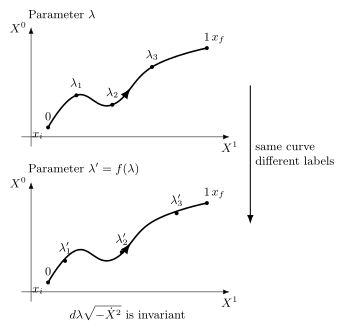
An endpoint-preserving change of parameter replaces by , with . The auxiliary measure and the geometric worldline are unchanged. The drawing is schematic; label spacing is a coordinate choice, not a physical velocity measurement.
The constant-einbein action is
The parameter is often called proper time in the Schwinger representation. Its dimension is , and it equals only when the massive timelike einbein constraint holds. We will call it the Schwinger modulus to keep it distinct from the spacetime proper time .
Classically one must retain the constraint derived before gauge fixing. Fixing and varying only would give a straight-line equation but lose the mass-shell condition. Quantum mechanically the positive modulus remains an integration variable after the local gauge redundancy has been removed.
A fixed modulus gives the heat kernel
Section titled “A fixed modulus gives the heat kernel”To calculate the free Gaussian integral, continue to Euclidean target coordinates and a positive Euclidean einbein. The oscillatory Lorentzian integral is defined by analytic continuation with its causal prescription; rotating a target coordinate alone is not a claim that a Lorentzian Gaussian becomes convergent for every real einbein. The resulting Euclidean action in constant gauge is
For endpoints , the fixed-modulus kernel is
Here the measure is normalized to give the identity kernel as . The particle is free, so this normalization and the Gaussian calculation determine completely.
Separate the classical path from fluctuations
Section titled “Separate the classical path from fluctuations”Write and
The cross term vanishes because . Hence
This already determines the endpoint dependence. To fix the fluctuation prefactor without a formal infinite product, use the momentum eigenstates of the Euclidean Hamiltonian :
Each momentum integral is elementary:
Multiplying the factors gives
The result has dimension , as a position-space kernel should. It is the massless diffusion kernel multiplied by .
The differential equation fixes the interpretation
Section titled “The differential equation fixes the interpretation”Differentiating the Fourier representation gives
The second equality is a distributional limit: integrating the narrow Gaussian against a smooth test function returns that function at . Its total integral is
Thus a massive kernel does not conserve the integral of the diffusion density. The kernels nevertheless obey the composition law
which follows either from multiplication of or from a Gaussian convolution.
Integrating the modulus gives the propagator
Section titled “Integrating the modulus gives the propagator”A fixed-modulus kernel is not yet a relativistic Green function. For , the Euclidean inverse of is
In momentum space the statement is simply
The factor is required by the in the Hamiltonian; omitting it doubles the Green function. If we instead use , the formula takes the familiar form with . Both and have units of length squared. This operator identity fixes the normalization of the gauge-fixed interval path integral. Worldline representations of propagators and effective actions are developed in Schubert, §§1 and 3.
The source equation is an especially useful check. Since ,
The short-modulus endpoint produces the delta-function source. The large-modulus boundary term vanishes for positive ; massless limits require an infrared check. At separated points the massless integral converges for , whereas in it needs an infrared prescription. Coincident-point ultraviolet singularities are understood distributionally rather than as finite values of .
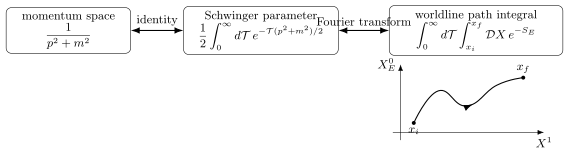
For the free scalar in Euclidean space, is the kernel of , where . The integral gives , and the boundary value supplies the Green-function source. Positive ensures decay at large modulus; the diagram represents operator relations, not a spacetime trajectory.
The Lorentzian causal prescription
Section titled “The Lorentzian causal prescription”Returning to Lorentzian momentum, the Feynman two-point function has the mostly-plus-signature form
The exponent includes , so the regulator damps large and fixes the pole prescription. Since , this is the usual .
A propagator is an inverse differential operator with specified boundary conditions, not simply a projection onto on-shell momenta. Integrating an oscillatory exponential over the entire real modulus axis would instead produce a delta function of . The positive half-line and its convergence prescription are therefore part of the physical definition of the propagator.
From a worldline to a worldsheet
Section titled “From a worldline to a worldsheet”The particle construction isolates the steps that will reappear for strings:
| Particle | String |
|---|---|
| Embedding of a line | Embedding of a surface |
| Action proportional to proper length | Nambu–Goto action proportional to area |
| Independent einbein | Independent worldsheet metric |
| Einbein variation imposes | Metric variation imposes worldsheet stress-tensor constraints |
| Interval gauge fixing leaves | Worldsheet gauge fixing can leave moduli depending on topology and insertions |
The string has an additional feature: in two dimensions its auxiliary-metric action has Weyl symmetry. The consequences of that symmetry and its quantum anomaly will occupy much of the course. The immediate next step is the Nambu–Goto string and its symmetries.
Exercises
Section titled “Exercises”1. Recover the nonrelativistic expansion
Section titled “1. Recover the nonrelativistic expansion”Expand the temporal-gauge Lagrangian through fourth order in . Compute its exact momentum and Hamiltonian, and explain why the constant term in the Lagrangian can be discarded for the classical trajectory while the rest energy still appears in .
Solution
Using ,
Direct differentiation of the unexpanded expression gives
Adding to changes the action by for fixed endpoints and does not change the Euler–Lagrange equation. It shifts the Hamiltonian by , choosing kinetic energy rather than total relativistic energy as the zero of energy. The covariant mass-shell relation still involves the total energy and reads .
2. Make a nonconstant einbein constant
Section titled “2. Make a nonconstant einbein constant”Let with and on . Find the modulus and the endpoint-preserving gauge map, verify the transformed einbein explicitly, and explain why one cannot impose on the same dimensionless interval for every .
Solution
Integration gives
The endpoint values are , and
The integral is invariant. After a length unit has been chosen, on would fix that integral to one and discard all other moduli; it is not an allowed gauge choice for arbitrary . Taking does produce unit einbein, but the new coordinate has units and interval .
3. A null particle with nonzero modulus
Section titled “3. A null particle with nonzero modulus”For and constant , solve the classical equations. Show that a nonzero target energy is compatible with a vanishing canonical Hamiltonian and vanishing spacetime proper time.
Solution
The momentum is constant, so
For example, with is a nonzero null momentum. Then and , while
The zero Hamiltonian generates gauge evolution in ; the nonzero generates target-time translations. Nullness places no requirement that vanish. For prescribed endpoints a classical solution of this kind exists only when their separation is null (or zero).
4. Check the composition law
Section titled “4. Check the composition law”Prove the heat-kernel composition law directly in momentum space, including all Fourier factors and the mass dependence.
Solution
Insert one Fourier representation for each kernel. The integral over the intermediate point is
It removes one momentum integral and one factor . The remaining expression is
which is precisely . The mass factors multiply to , as required. The law expresses the sum over every possible intermediate position; no integration over an additional modulus is involved in this fixed-modulus composition.
5. Derive two position-space Green functions
Section titled “5. Derive two position-space Green functions”At separation , evaluate for (a) a massless scalar in and (b) a scalar with in . For part (b) you may use
Check the massless limit of the three-dimensional result.
Solution
For ,
Set . Then , with reversed endpoints, and
For , apply the supplied identity with and :
Its massless limit is . The dimensions are in four dimensions and in three, agreeing with . Both expressions are singular at , where their Green equations hold as distributional identities.
6. Relate the Euclidean saddle to geometric length
Section titled “6. Relate the Euclidean saddle to geometric length”For a straight Euclidean path of length and , extremize the classical exponent
Find the stationary modulus and action. Explain what happens for , and why this exercise does not assert that the full modulus integrand is stationary at the same point.
Solution
The derivative vanishes when
The second derivative is positive, and substitution gives . Thus , the Euclidean counterpart of the massive length relation. The minimum is also immediate from the arithmetic–geometric mean inequality applied to the two positive terms.
For and , the exponent decreases toward zero as and has no finite stationary point. The full kernel contains the fluctuation factor , so the negative logarithm of its modulus integrand also contains , where a fixed reference modulus only changes an irrelevant additive constant. Its stationary point differs from that of the classical exponent. The geometric saddle controls a semiclassical approximation when is large, not an exact localization of the quantum integral.
References
Section titled “References”- Schubert, Christian. “Perturbative Quantum Field Theory in the String-Inspired Formalism.” Physics Reports 355 (2001), 73–234. arXiv:hep-th/0101036; doi:10.1016/S0370-1573(01)00013-8. Sections 1 and 3 explain worldline path integrals and Schwinger representations; the loop applications go beyond this page’s open interval.
- Tong, David. Lectures on String Theory. University of Cambridge Part III lecture notes, 2009. arXiv:0908.0333, §1.1, especially §§1.1.1–1.1.2 on quantization and the einbein.