
Weyl Anomaly, Liouville Theory, and BRST Quantization
Conformal gauge removes the local worldsheet metric from the classical string equations. Why is this still a valid operation after quantization? The answer requires two steps. First, the matter and ghost contributions to the Weyl anomaly must cancel. Second, the gauge-fixed theory must retain a symmetry that identifies physical states and removes gauge redundancy. This is BRST symmetry, named after Becchi, Rouet, Stora, and Tyutin.
This page connects the path integral to the state space. We derive the finite change of the partition function under a Weyl rescaling, explain when a Liouville field can compensate an anomaly, and construct the BRST charge with an explicit choice of ghost vacuum. A massless open-string vertex then shows how the spacetime gauge transformation of a vector emerges from a BRST-exact operator.
The prerequisites are the stress-tensor OPE, the Virasoro algebra, and the weight ghost system. The preceding discussions of ghost zero modes and the Polyakov path integral and moduli supply the geometric interpretation of the fixed vertex operators used below. Normalizations and signs follow the global conventions in the course overview.
The Weyl anomaly and total central charge
Section titled “The Weyl anomaly and total central charge”The matter and ghost anomalies add. For free coordinates, , while . More generally, may include an internal CFT, and denotes its entire matter central charge. The total stress tensor therefore has the OPE
Classically, a Weyl rescaling changes only the choice of ruler on the worldsheet. A regulator, however, introduces a short-distance scale. The quantum measure need not respect the classical rescaling symmetry. Its universal response is controlled by the same central charge that appears in this OPE.
Deriving the finite Weyl response
Section titled “Deriving the finite Weyl response”Under the local Weyl variation , the metric variation of the functional integral gives
For a CFT of central charge , the renormalized trace anomaly is
We subtract the regulator-dependent area divergence and handle zero modes consistently in . When an unsaturated ghost partition function vanishes, the statement applies to its regulated measure or to correlators with the required zero-mode insertions. The curvature coefficient is the universal part of the anomaly. Polchinski, §2.4 explains its relation to the stress-tensor central term.
Now consider a smooth closed worldsheet and
Rather than guessing a functional of , integrate the infinitesimal anomaly along . In two dimensions,
Consequently,
Integration by parts yields the finite Weyl response:
The effective action has the opposite variation. This accounts for many apparent sign differences between references. On a surface with boundary, curvature and integration-by-parts boundary terms must also be included; the displayed formula is not the complete disk formula.
For the gauge-fixed bosonic string, the coefficient is . Thus an ordinary critical background requires
For free coordinates alone this means ; with an internal CFT it instead means . The vanishing anomaly removes the obstruction to treating the conformal factor as gauge. It does not remove the finite-dimensional worldsheet moduli, and it does not by itself prove positivity of the physical Hilbert space. The no-ghost theorem is a separate statement with assumptions on the matter theory and state space.
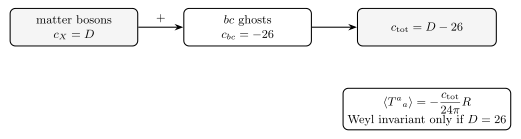
The matter and ghost anomalies add. Vanishing total central charge allows the conformal factor to remain gauge; a noncritical completion includes an additional conformal sector, such as Liouville theory. The diagram is schematic.
The Liouville field and its range of validity
Section titled “The Liouville field and its range of validity”If , simply dropping the conformal factor gives an anomalous theory. A different possibility is to integrate over that factor and construct a noncritical string. The Weyl response supplies a kinetic term, while an area term supplies an exponential interaction. After normalization and quantum renormalization, the standard spacelike Liouville action is
The positive kinetic term explains the word spacelike. The background charge couples the field to curvature, and weights the area. These are renormalized quantities: quantizing the conformal factor introduces its own measure and anomaly, so one must not identify the final coefficient with by a classical field rescaling alone. This approach originates in Polyakov’s construction of noncritical bosonic strings.
The holomorphic short-distance normalization and improved stress tensor are
Two short OPE computations determine the quantum parameters. First, the ordinary scalar contributes central charge , while
adds to the fourth-order pole. Hence
Second, for , contracting the quadratic part of twice gives , and contracting the improvement term gives . Therefore
The interaction must have weights so that its integral is marginal. Thus
These are the standard quantum Liouville relations; see Teschner, §2.1. Combining them with anomaly cancellation gives
The appearance of , rather than , is the central charge of the Liouville scalar itself. There is also a crucial restriction: for real , . Standard real spacelike Liouville theory therefore has and, in this string construction, . For , the anomaly equation gives a real but no real satisfying marginality. For , even is imaginary in this normalization. Such regimes require continuations or different constructions; the algebraic formula for does not establish an ordinary real spacelike Liouville theory there.
For the rest of this page, take the complete matter sector to have . It may be the usual flat critical string, or a suitable noncritical completion whose additional fields are included in .
Ghost vacua and normal ordering
Section titled “Ghost vacua and normal ordering”BRST symmetry acts on matter and ghosts together. To write its charge without an ambiguous intercept, we must distinguish two ghost states. Expand
with
The plane vacuum corresponds to the identity operator. Regularity at the origin implies
It has . By contrast, the useful oscillator vacuum and its zero-mode partner are
Their defining relations include
The added modes give and ghost numbers and . An overall shift in ghost-number convention changes these labels, not the cohomology.
The plane stress tensor gives
If normal ordering instead places annihilators of to the right, denote it by . Its oscillator energy is
This shift is the origin of the explicit intercept term in the oscillator BRST charge below. Replacing plane OPE normal ordering by oscillator normal ordering therefore changes the constant term as well as the notation.
Constructing the BRST charge
Section titled “Constructing the BRST charge”The holomorphic BRST current is
Products in the first line are normal ordered. The improvement term is needed for the conventional local current, although its contour integral around a local state vanishes. The ghost interaction is essential: the Virasoro constraints have a nonabelian algebra, and alone does not square to zero.
For an operator , define the graded transformation
where is for an even operator and for an odd one. The basic current OPEs give
In particular, the total stress tensor is BRST exact. Gauge changes of the worldsheet metric therefore become BRST variations in the gauge-fixed theory. Decoupling such variations from amplitudes also requires a consistent treatment of possible boundaries of moduli space.
The cubic sign and the intercept
Section titled “The cubic sign and the intercept”In oscillator normal ordering, introduce a possible intercept :
All sums run over integers, and matter Virasoro generators use the plane convention. The charge obtained from the displayed current has in this oscillator convention.
The minus sign before the cubic term follows directly from the current. In its contour residue, supplies the factor . Relabeling the two modes as gives the coefficient ; antisymmetrizing because they anticommute gives
A useful independent check is the anticommutator with an antighost. With
one finds
At , this is exactly in plane ordering, since . Reversing the cubic sign would instead reverse the ghost contribution. Conversely, inserting an extra into the already plane-normal-ordered contour charge would count the vacuum shift twice.
Why nilpotency fixes both parameters
Section titled “Why nilpotency fixes both parameters”The matter Virasoro central term and the ghost ordering constant leave the following obstruction:
One way to organize the calculation is to commute with itself using the Virasoro algebra. The noncentral terms from the matter constraints cancel against the cubic ghost term, while the fourth-order stress-tensor pole produces the term. The vacuum shift contributes the term linear in . Thus the remaining obstruction is entirely an anomaly.
The conditions are already determined by two modes:
Requiring as an operator therefore fixes
The same anomaly that spoiled Weyl invariance now prevents BRST nilpotency. At these values, write . For a closed string, there is an independent antiholomorphic charge , and the full differential is .
Physical states as cohomology
Section titled “Physical states as cohomology”Let be the matter-plus-ghost state space at ghost number . Since raises ghost number by one and squares to zero,
is a complex. Physical representatives obey , but two representatives describe the same state if
The resulting space is the BRST cohomology
The numerator imposes the quantum constraints; the denominator removes gauge equivalence. Nilpotency is what makes the denominator a subspace of the numerator. Standard open-string scattering states are represented at ghost number , and closed-string vertices at total ghost number , with our vacuum convention. This does not assert that cohomology at every other ghost number vanishes.
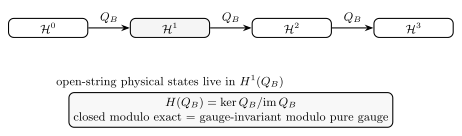
At fixed ghost number, physical representatives are -closed states modulo -exact states. Nilpotency puts every exact state inside the closed subspace; the quotient retains inequivalent physical states. This is a schematic of vector spaces, not their dimensions.
The identity explains why cohomology is on shell. If a closed state has nonzero total conformal weight , then
It is exact. Nontrivial classes can therefore occur only at . For a matter state tensored with , this becomes .
Often one uses the relative open-string complex, imposing and ; the anticommutator ensures that preserves it. Closed-string applications also require level matching and an appropriate antighost zero-mode condition, usually . These restrictions must be specified when turning the local cohomology statement into a spectrum or amplitude prescription. See Polchinski, §2.5 for the state-space construction.
Vertex operators, closure, and descent
Section titled “Vertex operators, closure, and descent”Consider an even matter primary of holomorphic weight . Its stress-tensor OPE is
Only the term in the current contracts with . Expanding about and taking the residue gives
The unintegrated open-string candidate is . Applying the graded product rule,
Thus a weight-one primary gives a closed operator. This calculation explains more than the observation that has total weight zero: a nonprimary can have higher-order poles in , and those produce additional BRST constraints. The vector example below exhibits precisely this issue.
For , the same OPE gives the descent equation
Consequently, the integrated boundary insertion is BRST invariant when the total derivative has no endpoint contribution. In state language, and give the same result. Fixed and integrated vertices are therefore related by BRST descent, not two unrelated prescriptions.
For a closed-string matter primary of weights , the fixed vertex is
and its two integrated directions give . Indeed,
so its integrated variation is a boundary term on the worldsheet. The ghost insertions at fixed punctures saturate conformal Killing zero modes; antighost insertions handle moduli. Contact terms and degeneration limits must be treated when using these local statements inside a full amplitude.
Worked example: the massless open-string vector
Section titled “Worked example: the massless open-string vector”Take Neumann boundary conditions on the upper half-plane. The doubling construction writes the boundary field as , so
The boundary exponential therefore has weight . This differs from the bulk holomorphic weight ; forgetting the doubling factor would give the wrong open-string mass shell.
Consider
Using gives
The third-order pole comes from contracting one derivative in with and the other with the exponential. It vanishes only for transverse polarization. Its BRST residue contains , so
For a generic nonzero momentum, closure imposes
These are the massless wave equation and transversality condition. There is still a redundancy. On the mass shell, has weight zero and
Therefore a polarization shift changes the fixed vertex by
The longitudinal vector is BRST exact. Here is a ghost-number-zero gauge parameter, not a physical scalar vertex. At nonzero null momentum, transversality leaves components and the longitudinal equivalence removes one more, giving physical vector polarizations. The cohomology has reproduced spacetime gauge invariance directly from the worldsheet theory.
Exercises with solutions
Section titled “Exercises with solutions”Exercise 1. A constant Weyl rescaling
Section titled “Exercise 1. A constant Weyl rescaling”Let be constant on a closed genus- surface. Find the change of and check that differentiating it reproduces the integrated trace anomaly. What happens on a torus?
Solution
The gradient term vanishes. Gauss–Bonnet gives , with , so
Differentiation gives . Independently,
For a torus, , so the universal response to a constant rescaling vanishes. This does not imply the local anomaly is absent: a nonconstant Weyl factor can still produce the gradient term. The calculation assumes the same zero-mode prescription and subtraction of the area divergence as in the derivation above.
Exercise 2. The spacelike Liouville restriction
Section titled “Exercise 2. The spacelike Liouville restriction”For matter central charges , determine and whether there is a real for which the Liouville interaction is marginal. Find both solutions for when they exist.
Solution
Combining central-charge cancellation with marginality gives
For , and
For , and the two roots coincide at . For , , so and neither root is real. The real background charge alone is therefore insufficient to establish a real spacelike Liouville interaction. When both roots exist, .
Exercise 3. The ghost energy and the intercept
Section titled “Exercise 3. The ghost energy and the intercept”Use to compute the plane conformal weights of and . For a matter primary state of weight , derive the mass-shell condition from on .
Solution
Since the identity vacuum has weight zero,
The mode commutes with , so both and have weight . Their ghost numbers differ, but their conformal energies do not.
The state in the question is annihilated by . If it is BRST closed, then
Thus . In oscillator ordering the same equation is ; the ghost oscillator vacuum has energy zero, and restores the plane answer. This is a necessary condition; the remaining positive-mode constraints are contained in full BRST closure.
Exercise 4. Two independent nilpotency obstructions
Section titled “Exercise 4. Two independent nilpotency obstructions”Could changing the intercept compensate a matter central charge different from ? Use the modes and of to decide. Then check the consistency of the obstruction with .
Solution
The coefficient is , so nilpotency requires . With this value, , which requires . A single ordering constant cannot remove a cubic polynomial in .
The ghost algebra gives
Since , summing yields
At , this agrees with the mode form of
because . The anomaly in the stress tensor and the failure of the charge to be nilpotent are the same obstruction.
Exercise 5. Open and closed tachyon mass shells
Section titled “Exercise 5. Open and closed tachyon mass shells”Use BRST closure to find the momentum condition for a boundary exponential and for the bulk exponential . Translate them into masses using . Explain why their numerical coefficients differ.
Solution
For an open string, is closed when the boundary weight equals one. Thus
For a closed string, requires both and . Each bulk weight is , so
The difference follows from the boundary doubling of , which multiplies the exponential’s chiral weight by four. In either case the corresponding integrated vertex follows from descent. These negative masses squared describe the bosonic-string tachyons; they are distinct from the weight-zero exponential used as the vector gauge parameter.
Exercise 6. Exactness and the massless vector
Section titled “Exercise 6. Exactness and the massless vector”First show that a BRST-closed state of nonzero eigenvalue represents the zero class. Then, for a nonzero null momentum, show that the shift preserves the vector’s closure conditions and identify its ghost-number-zero gauge parameter. Explain why closure alone would overcount polarizations.
Solution
If and with , then
Thus off-shell closed states are exact. For the on-shell vector,
so a longitudinal shift stays in the closed subspace. With , the weight-zero primary transformation gives
The shift is exact and must be quotiented out. Transversality alone leaves components at nonzero null momentum; the quotient removes the remaining longitudinal direction and leaves . At zero momentum this counting argument degenerates, so it should not be used to classify exceptional zero-momentum cohomology.
References
Section titled “References”- J. Polchinski, What Is String Theory?, 1994 Les Houches lectures, arXiv:hep-th/9411028 (1994), §§2.4–2.5: the Weyl anomaly, gauge fixing, and BRST quantization in a coherent worldsheet treatment.
- A. M. Polyakov, Quantum Geometry of Bosonic Strings, Physics Letters B 103 (1981), 207–210: the original treatment of the conformal factor in the noncritical string path integral.
- J. Teschner, Liouville Theory Revisited, Classical and Quantum Gravity 18 (2001), R153–R222, especially §2.1: the quantum Liouville parameters and conformal weights; later sections develop the interacting theory beyond the local OPE analysis used here.